
The written record
Read the transcript
Read along with the recording · About 24 min to read
First on the scene, crime photographer. Got it? Look for it in the Morning Express.
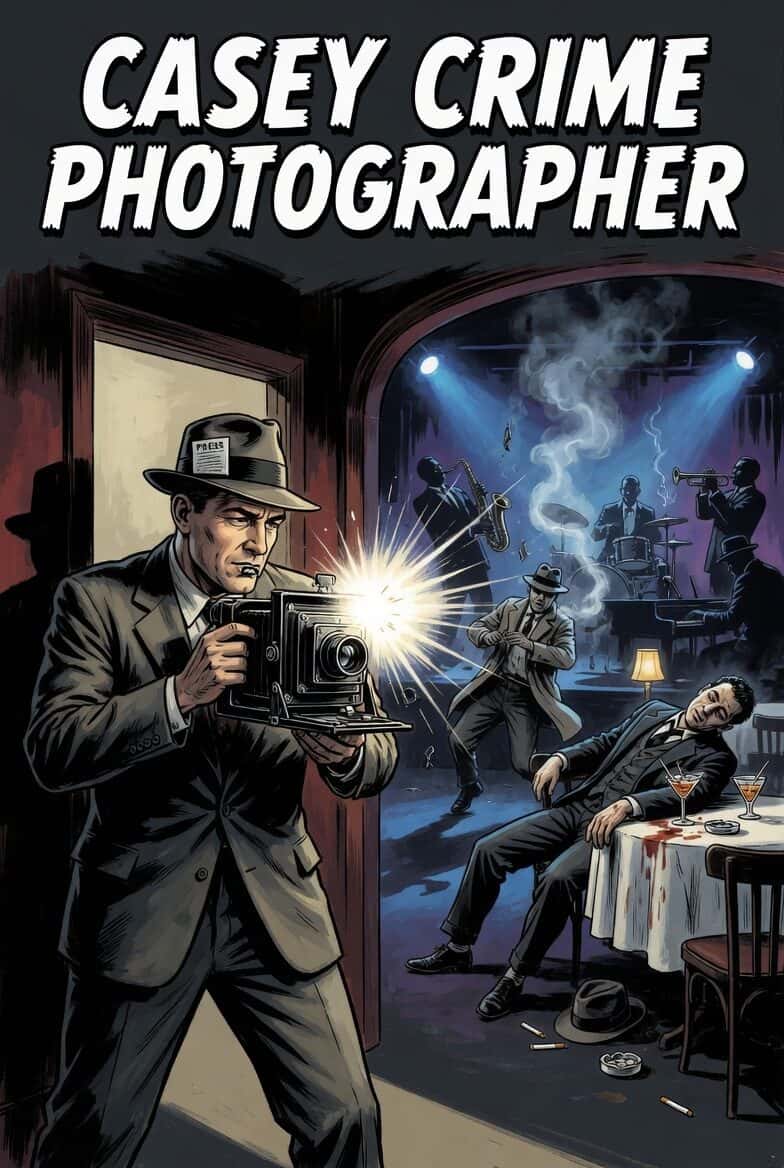
CBS Radio brings you Crime Photographer, another adventure of Casey, ace cameraman of the Morning Express, who covers the crime news of a great city. Written for radio by Alonzo Dean Cole and played by Staats Cotsworth. Tonight's adventure: Source of Information.
Early afternoon. The untidy photographer's room of the Morning Express. It empty now except for Casey, who stands at a window, frowning at the threatening wintry sky. And the door opens softly and an old man enters. His face is unshaven, his clothing unkempt.
"Hi, Casey."
"Huh? Oh, hello, Grove. Nasty day outside."
"Yeah. I'm glad you're alone here, boy. Look, Grove, I simply can't make any more loans. I've lost track of—"
"Wait. What's going on?"
The room of the Morning Express. It's empty now except for Casey, who stands at a—
"You got me for now, but it's at least a couple of hundred."
"You got me wrong, Casey. I'm not here in search of financial assistance this morning. This afternoon, no, no, no. This time, unfortunately, my problems can't be solved by money. Casey, I've been robbed. Robbed of my life's work, my magnum opus. The exposé that could rock this town to its foundations. The candid memoirs of my 40 years as a crime reporter."
"Oh, you've been talking to me for a long time."
"I've been talking to you for a long time about that big exposé."
"For a long time, Pop. You ever actually put any of it down on paper?"
"It was almost completely finished, Casey. Well, good half of it was. Honest, boy, I'd... I'd written a lot. It was in my typewriter. I went out last evening around 10 o'clock for, you know, a couple of beers, and I ran into friends and... oh, nuts. No use trying to kid you. I got blotto and passed out. Woke up lying in a doorway somewhere. And I was like... oh, my god, I'm not always somewhere. And finally made my room about an hour ago. It had been ransacked and my manuscript was gone. Then I borrowed car fare and came straight to you."
"Why to me?"
"Well, the cops wouldn't believe anything I told them. You know, they know I'm a rummy. And I don't... you know, I... I was once a great newspaper man. One of the greats, you know. I could write an exposé that had put a lot of this town's big shots behind glass."
"Sure. But because you were a great newspaper guy, you'd never write the kind of stuff you've been threatening. It'll be ratting on a whole lot of people who gave you their confidence. You'd be divulging your sources of information. And drunk or sober, no top banana in our racket ever does that."
"He might when he's piled up the grudges I have."
"I doubt it. You don't realize what it is to be in the gutter and see guys whom you know are stinking rats riding by in their Cadillacs. Sons even sold out their own fathers and mothers."
"I know. But you're a newspaper man, and you wouldn't betray your source of information."
"Casey, my manuscript was stolen because somebody thinks I would disclose a source of private information."
"You wouldn't even write it."
"You don't know how sore a guy who's down and out can get."
"Oh, you're right in one way. No, I... I wouldn't let the stuff be published. I... I wouldn't let anyone even look at it. But I did write it, Casey. I did write it. I had to, in order to get rid of some of the poison that's eating deep into my guts."
"Who do you think stole that stuff?"
"I told you. That I would be disclosed to the public. I would not be disclosed to the public. I would not be disclosed to a source of information. I prefer to retain your good opinion."
"Grove, are you leveling with me?"
"No, no, Casey, no. Nothing was stolen from me. Nothing that matters, that is. I was just building up for a touch. I figured if you thought I'd lost my memoirs, my life's work, which I haven't written and never will, you might be sympathetic enough for... for a five spot. Well, so long, boy."
"No, wait. Here's the five. I can't spare any more. Thanks. Now look here, I was talking to a guy last night who wants some ghost writing done. It's the kind of thing that you can bat out in your sleep. It'll pay good dough. You go see him."
"Casey, I... I can't write anymore."
"You can. No one who's ever been as good as you were was ever finished until they're dead. I'm writing the guy's name and address on one of my cards. And now you give it to him, okay?"
"Thanks again."
"Forget it. So long, boy."
"Yeah, uh... Grover, you were lying to me about those memoirs being stolen?"
"Yeah, yeah. Nothing's been stolen from me. Nothing of any value can ever be stolen from me. So long."
"So long, pal."
Wonder. Oh, nuts. You ain't got good sense, Casey.
"Well, I won't even let Grove Snyder come into this bar room."
"You can let a old bum like him put the bee on you again."
"Just beat it. I didn't let him put the bee on me, Ethelbert. I... I merely mentioned that he dropped in to see me about half an hour ago."
"How much did he take you for this time, Casey?"
"He didn't take me for anything. What if I... if I did pass him maybe four bits, so what? People like you and me, Annie, and you too, Ethelbert, you should be proud to know a guy like Grover Cleveland Snyder. You know, his byline was once the most famous in this country."
"Sure. And then he drank it up. For the past five years at least, he couldn't have held a job on the Bingeville Bugle."
"Okay, he's a bum and I'm a sap. I wonder if he's ever wrote any of them memoirs he's always talking about. They should be real hot stuff."
"Yeah, he certainly could tell all about some characters in this town. Yeah, reporting and investigating crimes for 40 years, as he's always saying. He must have got the low down on a lot of seamy people and dangerous people."
"Hey, let's... let's change the subject, huh? Casey, what are you worried about?"
"Nothing. I'm not worried."
"You act like you was."
"Well, okay then, I'm worried about... about the Dodgers. Listen, do you think they'll stand a chance next season, Casey?"
"That's a matter I've given a lot of thought to. Just a second. Oh, excuse me. Blue Note Cafe, Ethelbert the bartender speaking. Oh, hello. Huh? Yeah, sure. Just a minute. It's for you, Casey. City desk."
"No. Captain Logan. Logan? That's what he said, and he was kind of snappy."
"Give me. Well, Logan never calls here. Hello? Yes, Logan. Why, just... just a little while ago, around 12:30. Yes. What? Where? I'll join you right away."
"What is it, Casey?"
"Old Grove has mooched his last dime."
"What?"
"He's dead. Old Grove. Dead. Shot three times through the stomach and once between the eyes."
"But why?"
"Maybe because I didn't believe him at the right time and did believe him at the wrong time. He had a card of mine in his pocket. That's why Logan phoned me. Let's go."
"And Casey, you believe now that Grove was telling the truth when he said those memoirs were stolen from his room last night?"
"That seems to be the answer, Logan. Somebody who heard of Grove's threats to write an exposé of all the inside stuff he knew didn't want something to become public. And somebody didn't realize that the old guy wouldn't and couldn't make confidential stuff public anyhow."
"Aw, nuts. If I had a look—"
"Casey, quit blaming yourself."
"Well, I'd have reacted to Grove's story the same way you did. So would I, Miss Williams. So would anyone who knew the old moocher."
"We did, pal. I suppose so. Uh, from what you've told me, Logan, this looks like the job of a professional rodman. Somebody hired him."
"Yeah, killer worked fast and effectively and then got lost in the crowd. Casey, you know where the old guy's rooming house is?"
"Yeah, it's a crummy joint up on 90th Street. Now let's go. I want to look at his room."
"So go on and have a good time."
"I'm ready. I'll see you later."
"So do I."
"What crooked business has ever went on in this rooming house of mine?"
"Mrs. Brundage, one of your roomers has been murdered. While my men are going over his room in there, it'll be best if you answer some civil questions without any further argument."
"I've never gotten a civil question from a cop. 'Where's the fire,' you say, when I'm driving. 'Must you block the sidewalk,' you say, when I'm standing. 'Will you keep back,' you say, when I'm looking."
"Excuse me, Logan. Mrs. Brundage?"
"Yeah?"
"Well, that's an uncommon name, isn't it, Brundage?"
"My late husband was an Englishman, born and bred in London. Brundage is an English name."
"Really? It's a name you don't hear every day. Ain't like Smith or Jones or Cohen."
"My maiden name was Gallagher."
"What do you know? My name's Casey."
"Is it now?"
"Mm-hmm. My mother was a Shannon."
"Mine was a Flanagan."
"Well, well, well. Do you mind if I shoot a picture of you?"
"I certainly do. What's your game, Mr. Casey?"
"I'm a press photographer."
"I say you're a con man. Blarney boy."
"Huh?"
"And I'm not buying anything you've got to sell. I... ooh."
"But, Captain Logan, you and I speak the same honest language. What is it you want to know about poor Roe Snyder?"
"Well, Mrs. Brundage. Sit down, Blarney boy. And way back."
"Okay, Annie, will I ever hear the last of this? Now, first, Mrs. Brundage, have you any idea when Snyder left his room last night?"
"I heard his typewriter going until, oh, maybe 10 o'clock, Cap. If he went out, it was after that."
"And when did he return?"
"I didn't see him until around half past 11 this morning."
"Did he say anything to you, then?"
"Yep. Said he'd been robbed and wanted to borrow 50 cents from me, which I'll never see again, and went out."
"And you didn't touch anything in his room?"
"No. I just took a look at the mess inside and closed the door and locked it."
"Uh, you know anything about the book he was writing?"
"Sure. He talked to everyone about it. He was going to turn this town inside out and make him a million dollars, he said."
"Have you ever seen his manuscript, Mrs. Brundage?"
"His what?"
"The accumulated pages. Does he type for his book?"
"No. But sometimes he typed all day and most of the night, and then he'd go on a bender, and I wouldn't hear his machine for a couple of weeks or more. Often, it'd be in a pawn shop. That's all I can tell you about Grove Snyder, except he was a pest, a moocher, and a sorehead. But he was a real gentleman underneath, and I'm sorry he's gone."
"Hey, Captain Logan."
"Yeah, Sergeant?"
"We finished with the room."
"Good. Excuse me, Mrs. Brundage."
"Certainly, Captain."
"What'd you find, Sergeant?"
"A loose floorboard there. Under... underneath was this scrap of paper. A corner torn from a typewritten page."
"Mm-hmm. So the manuscript was hidden under the floorboard, hmm?"
"Well, that's my guess, Miss Williams."
"Well, what's written on that torn-off corner, Logan?"
"Nothing that makes sense, just the end of a sentence. 'Ulti case was broken.'"
"Ulti case? Ulti? U-L-T-Y?"
"It's merely part of a word that's been torn, Casey. The entire word could have been Tumulty or Faculty. There's a good four inches of blank paper under those three and a half words. So this was probably torn from the final or bottom page of the manuscript by whoever lifted it from that hole."
"Anything else, Sergeant?"
"Yes, sir. The boys and I picked up 22 cigarette butts off this floor. Now, all of a brand the landlady said Grove Snyder never smoked."
"Well, the thief must have been here an awful long time to smoke 22."
"The thief and killer, Annie. He came here to get that manuscript and to bump off Grove Snyder at the same time. The old man got too drunk to find his way home, and the killer had to get out before people in the house woke up this morning. So he picked up Grove later, tailed him, and shot him."
"Yeah, I think that's how it was."
"Here's a little thing we found that don't look as though it belonged to Snyder, sir."
"Dice? Only one?"
"Well, Grove never shot craps. He didn't gamble at all."
"Nobody'd be gambling with that dice, Casey."
"Crooked?"
"As a country road, Captain. Look, it always comes up five. Get a six with it, and you've thrown 11. Or a two gives you seven. And you can't throw snake eyes or double deuces or boxcars. You couldn't put a raw cheater like that in a game. Even school kids would get wise to it after a few passes. But a guy might carry it as a gag, a pocket piece, or a trademark."
"Sergeant, you're reminded of somebody?"
"High Alias Sam."
"High Alias Sam?"
"There's a wanted on him in four states, Casey. He's a killer who'll work for anyone who'll pay his fee. You know, some crooks always wear polka dot neckties and blue suits."
High Alias Sam is never without a pair of loaded dice in his pocket. Old-fashioned hick cheaters like this. They're his calling cards, his identification papers when he goes into new territory. And he may be minus half a pair right now.
Yeah, that's the picture I see. Sergeant, get out a special alarm on High Alias.
Homicide Bureau, Captain Logan speaking. You got High Alias Sam already? Oh, dear. Shot in the back, then tossed out of a car, huh? And half a pair of dice in his pocket that throws only twos. That's just dandy.
We'll return to Crime Photographer in just a moment. Tomorrow night, Marlene Dietrich as Diane LaVolta unmasks a fake diplomat on Time for Love. It's a drama of international intrigue involving our roving young adventurist, Miss LaVolta, in a skiing episode that turns out to be deadly. Tomorrow night, CBS Radio's Time for Love will be loaded with thrills, and it'll be yours over most of these same stations. And now, back to Casey, Crime Photographer.
Then the murder case of Grove Snyder is right back where it started, huh, Casey?
Back behind where it started, Ethelbert. We had some leads, but with this High Alias Sam bumped off, we got nothing.
Well, even if the cops had found him alive, we'd have had nothing, Casey. Hired killers of his type don't talk.
I know. You know, the way that gunman was bumped off as a lead, Annie?
Oh, yeah?
It was just as unprofessional as the murder of Grove Snyder was professional. Or old Grove had four shots pumped into him, all at vital spots. High Alias Sam was shot only once. And the ME figures that he was still alive when he was dumped haphazardly out of a car and slowly bled to death.
Well, where's the lead to this one?
I'm looking for it. You know, in my book, somebody hired High Alias Sam to steal Grove's manuscript and to bump the old guy off. But High Alias wasn't able to do both jobs at the same time. Circumstances compelled a long wait. A wait longer than it took. And it takes a guy to smoke 22 cigarettes. And to kill time, he probably read Grove's manuscript.
Oh, and learned a lot of dirt about the person who'd hired him.
Uh-huh. Say. So the employer couldn't take a chance. He killed High Alias?
I think so, Ethelbert.
Yeah, but who do you suppose the employer was?
Grove wrote about him. Gave the lowdown on him and that expose.
Yeah, but the manuscript's gone. And Grove can't tell us what was in it.
He can give us a big hint. And the stuff that was published under his byline... Casey, Grove Snyder was a crime reporter for 40 years.
He told me his memoirs were half completed, Annie. That'd cover the first 20 years, more or less. And he's been on the beach for around five years. We go through the files starting about 25 years back.
We go through the files?
Right now, in the Morning Express morgue, Annie. Come on.
Oh, Casey, you can't do this to me. Ain't you even gonna say so long?
Hmm. Reading back numbers of newspapers from 19... 1930 back. Ah, but them were the good old days. 1930, 1929. What am I saying? Them were Prohibition days.
Uh-huh. I found something. Look, come here and read this. September 15th, 1929. Today, former political power Big John Keston and his chief lieutenant Fred Ziggy Friedlander entered Wollstock Prison to begin serving the life sentences imposed on them for instigating the New Year's Eve massacre of the four McNulty brothers.
McNulty? That torn scrap of paper, Annie.
Ulti case is broken.
Yeah, yeah, I know. The McNulty massacre is one of the great crime classics.
That's right. As I remember, the four McNulty brothers were big-time bootleggers who controlled all the liquor business on the South Side. And on New Year's Eve of 28, I think it was, they threw a big party at one of their joints. And when everybody was plastered, half a dozen masked men crashed the gate and shot several guards. They lined the four McNultys up against a wall and cut loose on them with Tommy guns.
Oh, yeah, and a rival gang was first blamed for the killings.
That's right, that was a Carmine mob. But as usual during Prohibition days, the John Laws talked a lot and did nothing. And over a year went by, and then Grove Snyder got some information and broke the case wide open. It was one of his greatest scoops.
Yeah, and he got a journalism prize for the job he did.
That's right. I don't remember any of the details. Annie, get back to those files. Let's learn everything we can about the McNulty massacre.
What did you and Miss Williams get out of boning up on the McNulty ancient history, Casey?
That Grove Snyder, through a source of private information that he, of course, refused to identify, secured evidence that sent three guys to the chair and two others to Wollstock with life sentences. And Grove had to have bodyguards during the trial and for nearly a year afterwards. Big John Keston, the political boss who engineered the entire dirty mess, served his life sentence in six months. A heart attack finished him off. Ziggy Friedlander, his head stooge, got out on parole about a year ago.
You may have something, Casey. Ziggy was the kind who never forgot a grudge.
Well, I've been checking on Ziggy Friedlander, pal, and he doesn't fit our picture.
Huh?
He seems to have been a guy who played awful rough, but in accordance with the rules. I mean, he'd have knocked off Grove or his own brother to save himself and his boss from those life sentences. But after the book was thrown at him, he couldn't nurse a hate for a newspaperman. He was a newspaper guy who played according to his set of rules.
What's your idea?
Big John Keston had a son, an only child.
Yeah, I believe so. You don't know much about him?
Nothing, as a matter of fact.
Well, I made it a point of learning something about him, and I'm gonna learn more. Something old Grove said about sons who'd sell out their own fathers.
Huh?
I made a date with John Keston, Jr. tonight at his home. Afterwards, Logan, I'll let you know how it made out.
Hey, I don't get this.
I'm playing a hunch, pal. And if it's right, you'll have the solution to the murders of Grove Snyder and High Alias Sam.
Have a chair, Mr. Casey.
Thanks, Mr. Keston. Beautiful apartment you have here.
Oh, it's a little large for a bachelor, but I never like cramped quarters. You're a newspaper man, you said, when you phoned.
Yeah, Morning Express. We're alone here?
Yes. You, of course, want to interview me about the professional indoor tennis matches I'm sponsoring next month.
No. I'm here to talk to you about Grover Cleveland Snyder.
Who or what is Grover Cleveland Snyder?
You don't know.
I'm not sure that I do.
He's the man who sent your father to prison.
Oh, that Snyder. Mm-hmm. And less than a week ago, the papers reported his murder. I don't read crime news, Mr. Casey. Since you're familiar with my father's tragedy, you can imagine why I don't.
There's practically no limit to my imagination, Mr. Keston.
You'll call me Mr. Snyder.
You, of course, didn't know that Grove Snyder was writing...
No.
Or that the typewritten manuscript of that book was stolen from his room the night before he was killed.
My only knowledge of the man and his works dates back 25 years, when I was a boy. He sent my father to prison on false evidence, and my father died there. My mother died, too, as a result of our disgrace. I've tried to forget you, Mr. Snyder.
You weren't exactly a boy 25 years ago.
I've been looking up the record...
All right. I was 26 years old then. But what about it?
Nothing. Snyder talked a lot about the book he was writing, Mr. Keston, and you must have heard about it. The book was going to be an expose of the rottenness and rattiness Grove Snyder had encountered as a crime reporter.
Now, look here.
Yes, there was one thing that nobody knew about that half-finished book but Grove and me. That even the guy who had it stolen doesn't know now.
Well?
I'll tell you. The guy who stole the manuscript got only half of what his employer wanted. He found the original, but not the carbon copy.
Carbon copy?
Mm-hmm. Writers make carbon copies of what they write. I have the copy of Snyder's expose.
What do you want, Casey?
What am I offered?
Before we go into that, let's have some proof that you're telling the truth.
All right, how's this? You inherited a couple of million dollars when your old man died of a heart attack in prison. He was a big, strong-looking guy, but the docs told him to watch his step and avoid excitement because of his weakness. He had a big heart. And you knew of a way to provide lots of excitement. So you got acquainted with a famous newspaper man named Grover Cleveland Snyder.
You make me sound like a murderer.
Uh-huh. But your old man had a stronger ticker than you and his doctors thought. And it carried him through a long court trial and six months in jail, but it finally gave out. Didn't you find that story in your copy of the old Grove manuscript, Mr. Keston?
You, uh... You've come here to blackmail me.
Have I?
But you're not going to get away with it.
What?
Oh. Is that the gun you used on High Alias Sam?
Yes. And since you know about him, you know I use it well. He read that lying manuscript, too, and thought he could hold it over me. I want your copy, Mr. Casey. Where is it?
In my apartment. We're going there right now, and you're giving it to me.
Well, with that gun in your hand, what can I do?
Only what I tell you.
That's what you think.
What?
Drop your rod, you...
All right. I have. I have. Don't shoot, don't shoot.
Who are you?
Junior should know. Or has 25 years in stir changed me too much, Junior?
Ziggy. Ziggy Friedlander.
Uh-huh. And it's nice to meet up with you again after all this time.
You... You heard?
Yeah. I called while you was out to dinner, Junior, and as an old friend should, I let myself in. I wanted to look over your swell big flat in private. You see, I've been reading in the papers about the killings of... of Grove Snyder and that High Alias Sam. In prison, I'd done an awful lot of thinking. Everything added up, Junior, but I wanted to be sure. Even very suspicious guys like me find it hard to believe that a son would sell out his father.
What, uh... What are you going to do, Ziggy?
Do to a rat like you? No, no, don't, don't.
Hey, Ziggy, let the law have it.
When did I ever...
The law. It makes too many guys and too many mistakes for a guy like me. I don't make any.
Ziggy!
No!
Friedlander!
Keep back, mister. This rod's got three more slugs in it.
And they're for me?
No. I've done the job I came to do, and though you didn't mean to, you helped me. I've heard about you, Casey of the Morning Express. You're pretty well known up in Wollstock.
Yeah?
A lot of guys there hate your guts, but they say you play according to the rules. You weren't pulling a blackmail on Junior. You had cops waiting downstairs for him. Didn't you?
Yes.
Well, your cops are still waiting. And here's my rod to give them.
Ziggy.
Yeah, I'm old. I'm tired. I just paid a debt that's been eating me. And the only home I got is prison. If they put me in a death cell this time, well, that's according to the rules. Some guys learn how to really think in prison, Casey. I did. Come on. Let's go.
Character, that Ziggy Friedlander, Casey.
Hmm, yeah.
Yeah, well, don't get sentimental about him, Ethelbert. He's a vicious, wild animal that's only been partially tamed by old age and long imprisonment in a cage, and he shouldn't have been let out of that cage.
I guess that's right, Miss Williams.
Say, Casey, I'd like to read the hot stuff Grove Snyder must have wrote in his book. You think he might have really left a carbon copy of it?
Of course he didn't, Ethelbert. Old-time newspaper guys like Grove never made a copy of anything. They simply stuck a single sheet in a typewriter and banged away with a copy boy waiting beside him to grab each page and rush it to the desk.
I figured Keston wouldn't know about that.
And Grove Snyder speaking to you about rats who even sold out their own fathers and mothers gave you the idea?
Well, it helped. But Ziggy Friedlander figured Keston, too, and without that lead. But it took him 25 years to do it.
Well, your pal Casey's a very bright guy, Ethelbert.
Oh, sure, and you're a modest violet. You know what your bright pal Casey is called in certain quarters, Ethelbert?
What, Miss Williams?
Blarney Boy.
Blarney Boy?
Yeah, I'll tell you about it. I knew that was gonna be brought up sometime.
You've been listening to Crime Photographer, played by Staats Cotsworth and written for radio by Alonzo Dean Cole, based on the original character created by George Harmon Cox. With Jan Miner as Ann, John Gibson as Ethelbert, Bernard Lenrow as Captain Logan, Lou White's original music, and Teddy Wilson as the blue-note pianist, Crime Photographer is produced and directed by John Dietz.
This is Bob Hite inviting you to join us again next week at this same time for another fast-moving adventure of Casey, Crime Photographer.
Tomorrow night on CBS Radio's Junior Miss, Judy, she's our Junior Miss, as you may know, gets into a dither but death, as her girlfriend, Fuffy, and she disagree on how to study for final exams. Another teapot tempest with loads of laughs in the brewing thereof. Tomorrow night on most of these stations, Junior Miss, don't miss it.
Gangbusters go into action Saturday nights on the CBS Radio Network.