
The written record
Read the transcript
Read along with the recording · About 28 min to read
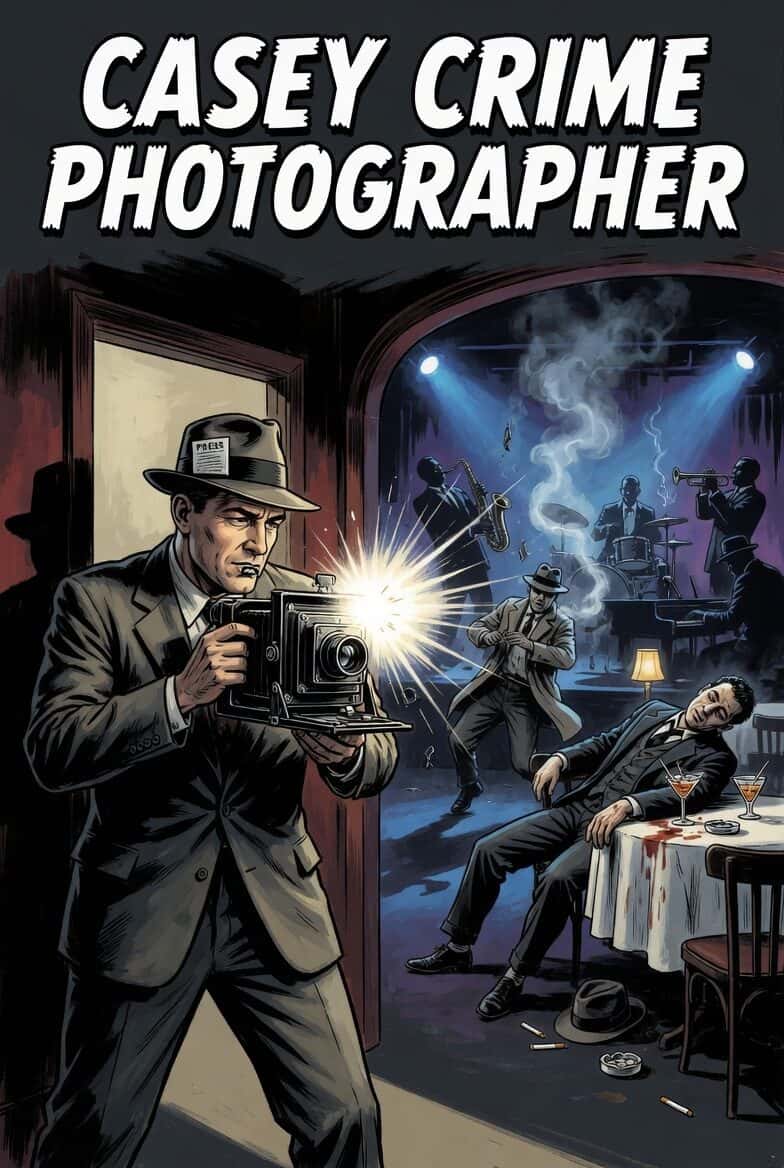
This program is called Whatever Became of Casey, Crime Photographer. My name is Richard Lamparsky, and we have John Gibson back with us today, who is Ethelbert. I mentioned that right off because he's, I think, the first person who's been on the series more than once. We've been on since March of 1965, and maybe that's a bad sign that I'm repeating guests already, but I enjoyed him so much when he was here a few months ago that I thought I'd ask him back.
And with us also is a man who you recognize immediately, even if I didn't tell you his name, because his voice is so distinctive. It's one of my favorites from days of the golden days of radio, Staats Cotsworth.
Well, Richard, my, my, my.
Don't people tell you that?
Oh, people who want to borrow money tell me that, but I don't always believe them, you know.
You mean when you walk into a store from time to time and...
Oh, I've heard that, yes, yes. I'm amazed that there's some people who are under 65, you know, stop me in the A&P, and they say, uh, uh, I heard you, um, asking how much this is, and I recognize your voice, and, uh, so I thought maybe you might have been Casey Crime Photographer. And I said, well, it just so happens that I was. And, um, um, then the same thing happens when I try to, um, fulfill my duty to the higher classics and the art of the theater by acting in Shakespeare. Um, I act my head off in Shakespeare, and then somebody comes around backstage and says, I remember you, you were Casey Crime Photographer, you can't fool me.
So, I said, oh, no, I played Ethelbert.
Oh, no, you didn't.
How long, were you the original Ethelbert?
Yes. Actually, Johnny, Johnny was on it technically longer than I was, because, uh, although I was on it 11 years, and that's pretty long, and, uh, most people think I was the original.
Yeah. Yeah. If I was the original, I wasn't. There were two other actors, uh, who failed miserably in a period of five weeks. And, uh, fortunately for me, um, uh, you know, the management found out that they just couldn't act. So, I won't tell you who they were.
Well, I know, but I'm not going to say. I'll tell you where I got that, how I know, and I want to plug this book. It's not my own, by the way, because, um, it's called Radio's Golden Age by Frank Buxton and Bill Owen. Do you, have you seen? Were they, were the fellows up at, uh, ABC?
Right. Yeah. Right. Yeah. Well, I remember coming around and culling information from us.
I don't know about this one.
You don't know the book?
No.
Well, I'll plug it some more. It's a very accurate book, because I've used it a number of times in this program, particularly when I'm doing, you know, people from, from radio. And it, uh, gives the complete, I guess, cast list of just every show.
Way, way back.
Yeah. Because I remember that coming around. Johnny, you did. Those, uh, ABC, um, recorded radio shows a few years ago. Don't you remember up there? Where did it go? Five, five, nine, five star final. That goes back too far. But, uh, five something theater, theater five. Wasn't that it? Something like that.
Yeah. Theater five. But anyway, um, these two gentlemen came around and they were on staff at ABC and they were quite serious. I thought they were kidding. They wanted, they wanted to talk about old days of radio, you know? And this was about, um, about 1957, 58, I should say. Uh, and no, they went around to each of us and Leon Janney was there and a couple of, you know, old timers. And, uh, so they asked them all questions. They asked me questions and wrote it all down. And I thought, you know, that's a book you'll never see. But now I'm delighted to hear that it's out.
Yeah, it is. It's doing very well. It's just been out recently then.
I think it's been out about, uh, about two months. I was on the program with them locally, you know, I was plugging my book and they were plugging theirs. And I told them that I'd used it and how accurate it was. Uh, the man was here who was on, um, uh, One Man's Family. And now that really had a cast in that because it was on so many years and they had many people replacement. And he went through it and he said, this is really amazing. There are people who did maybe one and two shows. I particularly remember one they had with Jill Oppenheimer. He said, I don't know how they ever remember that. She was a teenage girl. And she... She is Jill St. John today.
They said, to my knowledge, and he was on the show, One Man's Family from the beginning in 32, whatever it was until it went off the air. He said she was on one show and they had her name, right? And there she was.
Yeah. It's wonderful that people like radio or anything well enough to do that because you're, they're not going to get rich off it. I can assure them of that.
Well, there's another book, you know, Richard, that, uh, is, is, is coming out. It isn't as far along. It's finished, but it isn't, um, it hadn't been announced yet. It has been written by Mary Jane Higby, who was one of the finest, uh, uh, radio actresses we've had and, uh, who for many, no, she was When a Girl Marries, she was, what was the name of it? What was her name on it? I used to do the show once in a while.
I don't know When a Girl Marries, but she was the original lead on it for many, many years. And of course, through the portals of that studio past hundreds and hundreds and hundreds of radio actors. That's, uh, some of whom. Some have disappeared, some have died, some have gone into the theater, some of them have gone from bad to worse and from there to Kansas City.
But I mean, you can't, you don't know Mary Jane Higby.
Yes, I do. Now, our book is going to be called, I believe The Show Must Go On period. And then after that, it says, go on question mark. The Show Must Go On, go on. That's a tentative title only. I don't think that'll stick. But it's a very amusing book. It won't be anything like, um, the documentary one that you're talking about because it will contain stories of how people, um, barely missed shows and, uh, how they, um, drop their script just before the second act.
Well, it's an anecdote book.
It's an anecdote book. Yeah. I love those. I knew about the book for some time because she was supposed to be on a program I recorded. Oh, gee. Well, over a year and a half ago with Vivian. Vivian Smolin, who was Our Gal Sunday and Mary Jane Higby lives in the same apartment building. Yeah. And she said, if she'd be, if she's going to be home this afternoon, we'll have her drop in and, uh, have her do a guest shot. But she was out doing shopping.
Well, maybe next year by the time her book is out, maybe you'll have her on because she's very interesting talker. And I particularly postponed, you know, calling her because I thought, well, I will wait until the book comes out and then we can, uh, we can, uh, plug the, um, book.
There's another book on radio. I have it at home. Somebody gave it to me. I can't think of the title of it, but there's several, the one, the Ben Gross book, which is now out of print called I Looked and I Listened, you know, Ben Gross of the Daily News wrote that about, I guess about 10 years ago. Excellent book, which you can't buy anymore. Another one is called, um, it sounds impossible. And that was written by an executive with CBS. It's not one of those. And then there's another one and I have it called Confessions, I think of a Broadcaster. And that was written by the manager of WJR in Detroit, who is now an executive also with CBS, I think here in New York or NBC.
There's a great show that used to come out of Detroit for many, many, many years. A kid's show, a cowboy show. What was that?
The Lone Ranger.
No.
Well, the Lone Ranger came on the Green Hornet.
Oh, the Green Hornet. Right. Yeah. Who's going to, he's going to be on this program.
Is he running?
Yeah. He's already... Al Hodge. He was also Captain Video.
Oh, of course. Yes. Well, I knew out here. I did. I didn't know I was in Detroit.
Yes. I know Al well. Did you know he was the Green Hornet?
He was the Green Hornet. That's right. Now that you reminded me, I remember he was. I guess Detroit was right. I haven't seen him for so long.
There was one out of Chicago.
Oh, there were a lot out of Chicago, weren't there? Oh, American Boy. Who was the other one out of Chicago in the Bar B?
It was Billy Benson, Bobby Benson.
Bobby Benson. Right. Uh-huh. I think that was out of Chicago.
Did you begin in Chicago, Mr. Cotsworth?
No, I didn't exactly begin there. Actually, in 1939, though, I had a notable period of unemployment, but my wife was employed in playing Mary Todd Lincoln in Abe Lincoln in Illinois, which went on tour. And one of its first engagements, long engagements, was in Chicago around Christmas time in 39. So I went out to Chicago to spend Christmas with my wife and discovered that the people who were doing radio out there were refugees from Broadway. And I had known several of them. Jack Hurdle was one of them. And George Englund, was it?
George Engle, who originally directed Ma Perkins when it came from Chicago. And there was one called The Carters of Elm Street. Well, the first thing I knew, I was really doing an awful lot of daytime radio and nighttime, too, out there. So Muriel's show packed up and went off, and I stayed in Chicago and did radio. And that was, it wasn't the first radio I'd ever done. I'd done radio here before. John's Other Wife and whatnot. But I rather scorned it, you see, because I still considered myself to be what was then scornfully known as a stage actor. I mean, and I played Shakespeare, too. Well, I did go back and play Shakespeare with Maurice Evans and June Anderson in 1940 and 41, and like that. And then that theater bit lasted until 1944, and I gave up my whole life to radio from then on for 11 years, because I couldn't do anything else then, because I got a few daytime things and Casey, God bless him. And so, you know, I was scorned then by all the theater people.
You know, I was on a program, Night Before Last, in Boston, called Contact. It's done on the Westinghouse stations. They fly you in, and you do the radio program at night, and then you stay overnight, and the next morning you do the same program, it's called Contact, on morning TV. It goes on from 9 to 10 right after the Today Show. I've been on it in Washington and also in Philadelphia and also in Pittsburgh. But the one in Boston has a telephone thing that the people call in questions. They were asking me, you know, whatever became. Toby Wing, whatever became of this one. And someone called in. It must have been about the fifth call. It was so funny, and you'll think I'm putting you on when I say this. A guy called in. He was a doctor. He gave his name and his address and so forth, and he said, I want to know whatever happened to Ethelbert. Do you know who he is? And I said, yes, I do, and I can tell you where he is. I hope he's getting ready to come in on the station to do a program with me. But he didn't ask about Flashgun Casey.
No, it was the name Ethelbert, I think, that intrigued him. Oh, he thought I wouldn't know what program it was from.
Is that a real name? I've never known anyone named that.
Yeah, well, it was Ethelbert Nevin, the composer.
Right. Yeah. Somebody always has to be called Ethelbert, but he shouldn't look like an Ethelbert, you see. Funny thing was that when we had a studio audience, we'd all get introduced, you know, before the program went on the air, and we'd all get introduced as we came up, shaking and holding our scripts and so forth. And the minute Johnny came out, they didn't have to introduce him. They did right away. That was Ethelbert, and he started to laugh before he opened his mouth.
We didn't say, for the benefit of younger people, that Ethelbert was the bartender.
No.
What was the name of the bar? I don't remember that.
The Blue Note.
The Blue Note! That's right. Blue Note Cafe.
Blue Note Cafe, yeah. And now, pianist was Herman Chittison.
That's right. And then later...
He's dead now.
Is he?
Mm-hmm. He died not too long ago.
Oh, I didn't know that.
Neither one of you have mentioned this, and I want to put in a piece of trivia, because I know it. Someone wrote in... right after this program went on the air, it was a lady, as a matter of fact, and she said, please tell me, was it true that Casey, Crime Photographer, was originally called Flash Gun Casey?
Yes. That's right.
Right? That's right. Yeah.
Mm-hmm. Very good audience. I think we worked under that title at first.
We worked under that title for a while. That was George Harmon Coxe's original title of his book, called Flash Gun Casey, you see.
Mm-hmm. And the book, I think he wrote several books. George Harmon Coxe is one of the finest mystery writers in the country, you know, and he's written a stack of books that would reach the ceiling here. And he originated the title and the character. And then Alonzo Dean Cole became the adapter or the chief writer of the radio show, you see, which was based on George Harmon Coxe's original character in the Blue Note.
Yeah.
During this summer and the previous summer, I repeated programs because I thought, well, we don't have as large an audience, and also it was easier for me because I do most of my writing during the summer. I was doing a first book the year before, and I'm doing a second book now. And I asked the audience to write in and say which programs they would like repeated from the previous year, and I thought when I began the series that the movie stars would be the most popular, more than politicians, more than anybody else. And I found both years, much to my surprise, particularly this year, that it was radio people. Now that's funny because a lot of them were not known as personalities, they were known only as characters. And now Staats Cotsworth said before we began that he was afraid we would be using cliches repeating, but evidently you don't, because I do. I say one out of four of my programs are with radio people, and I don't know that we've ever repeated any stories at all.
I thought it was interesting what Mr. Cotsworth was saying before we went on the air about the... why the program continued. Would you tell that again? Why, when it was on so long, with the war plant?
Oh, well, yes. Because in 1944, as you know, war plants were working 24 hours a day in Canada and in the United States, and you know, with triple shifts and double shifts and so on. And the night shift, it was called the graveyard shift.
The graveyard shift. Yes.
That lasted, I believe that began you at 11 o'clock, and went through six, seven in the morning. They would take a vote on what radio program they would like to hear while they were working. In other words, they had big speakers, and in certain areas where the noise wasn't too great, the big speakers pervaded whatever was best on radio, whatever the people wanted, the workers wanted. So they took a vote, and in Canada, two very large plants wrote in that they had taken a vote, wrote to CBS and said, our favorite night program is Casey, Crime Photographer, so please keep it on the air, you know. So that was very helpful. And also we got a lot of beautiful fan letters because people who were late stayer-uppers that could listen from 11:30 to 12.
Remember, Johnny? Yes, 11:30 to 12 at night, sustaining, from 1944 to about... I don't think we were sold until about 1947.
I don't know where we... I think we were on the air sustaining for damn many years.
Mail poll meant a lot more though then than it does.
Oh yes, it doesn't seem to mean anything now.
Did they use ratings then?
Oh yeah, oh yeah, sure. I remember at the back of the, I think it would be the Saturday paper in Detroit, it would say what the most popular programs was, and it was by Crosley or Crosby.
Yeah, Crosby. Radio. People started that.
Right. I don't know how the ratings were done, but we went to first place one time, I remember. We were in competition with the famous... Sinatra.
No.
No, that's right. We took Sinatra's spot for a while on CBS. It was prime time.
Walter Winchell.
Walter Winchell had number one spot, particularly during the summer. And we finally beat him one time.
Did he send you vials of lye?
Who was your sponsor?
It was Juergens.
No, his was Juergens.
His was. I said, what was yours?
Ours was Toni.
Toni Home Permanent.
They're complete competitors, aren't they?
Sure. Yes, I mean, they are.
Well, that was only one of our sponsors. We had three all together. The first one was Anchor Hocking Glass, and the second was Toni, and the third was Kreml.
That's where we go for this.
Swanky, you don't remember us.
We had Ken Roberts as the announcer.
Here's the thing. Here's a... Archie Bleyer's orchestra?
Top Chief. We had him for quite a while.
What was your theme? Because I don't remember it. I looked through my recordings to see if I had it, but I didn't.
The first thing that happened was it came around at 60, and there was dead air for about two seconds. Then all of a sudden you heard a camera clink. One of those focal plane shutters. Like they used to have on the old Graflex cameras, you know. It made a nice noise, like clank, you know. "Look for it in the morning express." And then the theme began.
What was the theme? I can't remember. I think Archie wrote it. At that time, you see, you don't always remember the themes because each sponsor had a different theme.
Archie wasn't our first orchestra.
No.
We always, usually, opened in the Blue Note and ended in the Blue Note. And sometimes there was a little in between.
That's right. But they figured that, originally, they figured that for newspapermen, a bar was the central place.
Well, they were right.
Yeah, it was papermen I knew. Well, it very much, in a way, could be compared, perhaps, to the Artists and Writers here in New York, which is right next to what was the old Herald Tribune.
That's right. Building, and near enough the New York Times, so that the newspapermen from both the Times and the Trib would congregate there, and they still do, as a matter of fact. It's a rather big restaurant now.
The Blue Note, the idea that Cole and Dietz, who was the director, tried to produce it, tried to get over, as far as the Blue Note Cafe was concerned, was intimacy, and sort of, in a way, the only possible meeting place for Casey and Ann, his sidekick, who, for a long while, was played by Jan Miner, and Ethelbert. And Ethelbert was the bartender. There was only one bartender, as far as we could see, except he was always calling for lemons, which were apparently down in the cellar.
And who was the fellow that was your assistant? Was it Walter?
Walter, yes. "And Walter, bring up some lemons."
Right. Yeah. Ethelbert always talked like that. Probably. And Casey would come in all disgruntled, and Ethelbert, apparently Casey never drank anything at all, except he said, "Well, give me a stiff one." But stiff what? You know, a double orange juice or something, you know, probably. But Ethelbert was so funny, and such a marvelous character, because Johnny Dietz, who adored the character, would give Johnny Gibson here a free hand, and some very funny things developed. I mean, like, for instance, getting an olive pit caught in a telephone receiver. Do you remember that?
Do you remember that?
Yes.
Do you remember Grace?
Oh, Grace, who never existed at all. Grace was his girlfriend, but she never appeared, she never existed, but he was always talking about her. We'd be at the, Casey and Ethelbert would be at the bar talking, and he'd be confiding in Ethelbert, and all of a sudden, Ethelbert would say, "Excuse me, uh, goodbye, Grace." And from then on, Ethelbert was no good. He didn't listen to anything, and he'd be like... oh, Dietz loved non sequiturs, you know. Things that would happen that would be never explained.
Oh, I can think of one that was kind of funny. A lot of chasing going on, a lot of physical activity of running down the street and climbing over a fence and getting out of some place where we've been confined and gagged and everything in this building, and getting out just in the nick of time before the building blows up and so forth, and just as we're going over the fence, Johnny tells the sound man, "Um, you see that piece of, uh, window shade over there? Just at that moment, tear it." So the fellow would rip just exactly at the right moment, and Casey would stop what he was saying and say, "What was that?" And Ann would say, "Never mind." And then we'd go right on with the script. You know. Things that made no sense.
Do you remember the non sequiturs? Wonderful.
I have a very impressive list of actors that appear on the program. I was looking through again in the radio's Golden Age, and Art Carney, I see.
Oh, many times. And Bryna Raeburn, who's one of my... I've never met her. I've talked to her many times on the telephone. Long periods of time. You can't only be sure you're talking to Bryna. She's got so many voices. But she's very amusing. I must have her on this program sometimes.
You should. And Jackson Beck, I guess, was a police captain, right?
Yes. That's right. Good deal of the time.
Bernie Lenrow.
Bernie Lenrow was, too. John Dietz for years, because he was a real pixie character. When he was directing in the booth, that phase of the day, he would be in the booth, and he would put on the intercom, or the talkback, as we called it, every day for years that we did the show. And he'd say, "John Gibson," and I'd say, "Yes." And he'd say, "Your wife called. She said, don't forget the you-know-what." And I'd say, "Thank you." And he'd hang up. Then about 15 minutes later, he'd put it on again and say, "John Gibson," I'd say, "Yes." He said, "Your wife called back and said, never mind." I'd say, "Thank you." And that one, one actor one day threw down his script and he said, I'll be so-and-so-and-so-and-so. I haven't been on this show for four years and the last time I was on, they did the same routine.
Oh, those were happy days, I'll tell you.
One of the wonderful actors, Ed Begley, for instance, used to be on quite frequently and he'd come huffing and puffing, always with a conflict. That means he was always on another program. He could make a rehearsal more than any other actor on radio, really. I never do a program on radio that people don't bring up the fact that Ed Begley would play the show.
Well, I don't think I'm the only one, but I tell you, I have a canceled check. The amount of $4.90 paid to Edward Begley in 1944. To act as a stand-in for me. And when he was starred in Inherit the Wind and I was featured in it in 1955, much later on, I brought that check in one day and, you know, Begley was a crazy guy anyway. He threw a fit, you know, it was a fake fit, but I mean, it was a real fit. He said, I never did anything of the kind. That's not my name at all. He tried to convince Muni that he'd never done a stand-in.
He was a client of the office I worked. Or when I was a press agent. We all fought to get him. Whenever he was in town, we were in the New York office of a Hollywood-based firm. And whenever Ed Begley would get a memo saying Ed Begley was coming in from Tuesday to Friday or something with his wife, and at that time she was just about to present him with a baby. Remember when he got married?
He hasn't got over that yet. He's still doing it.
Well, I guess he was on in years.
Yeah. He's a funny man.
Yeah.
Did you ever hear about, I think everybody in the business has heard about this. One night, he used to take a Long Island train, and I took another train, and we had been to an after-meeting, but not together. And I had a long wait, and I saw him wandering through the station. He didn't see me, and I went over and I grabbed him by the lapels, and I said, "Just a minute, buddy. Purchase a ticket before boarding the train, see?" And he backed away from me, showed no recognition.
He backed away, and people began looking. And finally, he backed in back of the guard at the entrance to his train. And I kept calling him back, and then I looked around, there was a policeman watching me, and the guard watching me, and they were watching each other. And it got pretty embarrassing. I finally left.
Well, about six months later, I had worked with Begley, but I hadn't seen him in the station. And this time, I was waiting with about a hundred people for my gate to open, and I saw Begley wandering along. So I, I decided to ignore him completely. And I did, but he spotted me, and he came over, and he walked around me in a circle, and he said, what? With a tremendous voice. And I said, get away, I don't know you. So he said, and you could hear it all over the station, why should I give you money? And everybody looked at me and said...
Oh, that's wonderful. I remember that. He was telling you about that. And I was left high and dry. He was a great practical joker and a sense of humor that didn't give itself away. I mean, he didn't start laughing. He still joked right away. You couldn't tell when he was playing straight. He would stand in the front of an elevator with a crowd, and when they closed the door, he'd pretend they'd got his nose, you know.
Oh, he has told me he did that. He's done other awful things. On the eighth floor, that was at NBC on the eighth floor, and he went, oh! He kind of grabbed his nose, you see. He started walking down, and the poor elevator guy thought, oh, my God, what have I done? And he chased him all the way down. Oh, and then Ed turns around and looks at him. What's the matter with you?
Every time they had a glass crash in the studio, the sound effect, he pretended he'd gotten his eye. Every time.
You two gentlemen, nice to have to come here on such a rainy day. I think you should get to plug your program. Tell them where they can see you. I'll just listen to you.
TV program. Well, I am on Edge of Night, and my sixth year as Joe Pollock, the editor of a paper and the father of quite a family. And, incidentally, Go Marry Me.
Oh, yes. Well, I'm just doing one episode next week from Washington, D.C., while they're in the East.
You know, the transition from radio to television wasn't all as easy as it might have seemed to be. And there are very few, I think, who can boast as Johnny can, that they made an easy segue into television from radio. Because in the first place, there were a great many radio actors who had never acted on the stage or acted before a camera and who were totally unequipped to use their faces and their bodies in acting, you see. Their voices were perfect and beautiful, and they could do marvelous things with their voices. But a few of them were just plain left behind when this became a pictorial medium, don't you think, Johnny?
Yes, I'm afraid so. I was lucky in a way because I had started in the theater originally a long time ago with Eva Le Gallienne down at the City Repertory, which nobody remembers now, I suppose, unless they look at books. But that was in the 30s, in the early 30s. And then the radio thing came along, and I loved it and loved it. And the more I got of it, the better I loved it. And then the television thing came along, and it was all right for me, although I don't do any, I haven't any regular parts on daytime shows anymore. I've done a lot of them, but mostly it's been the theater and pictures and individuals. You know, things like Hallmark or something. They don't come too often, but when they do, they're very pleasant. And I've been going back and forth to the coast except in this last year to do things like Hitchcock and Dr. Kildare and then The Defenders here. I did, well, you did that too. I did the judge quite a few times on it. I played the nasty judge, the corrupt judge. Whenever they needed a corrupt judge, they got me.
Well, if I can prevail on you to say a few more minutes, maybe we'll take a few pictures because there's going to be, you won't be in these, but there's going to be a picture layout in this October issue of TV Radio Mirror on this program. The only one I can think of, there are about six pictures in it. I haven't seen it yet, but they told me they were going to use where one is of Helen Trent.
Oh, yeah. Julie Stevens.
That's right. And some other radio people. They would take the interest in it.
Oh, I think Just Plain Bill, too. We'll be on it, too. Let's see, that was Arthur Hughes. So that'll be out. I think it's on the stands now. This program is heard in September. It's on the stands now. I don't know where we'll use your pictures. Well, we'll stick around until we see them. And if they don't turn up, well, then we'll just come and take them.
Okay. My thanks, then, to John Gibson, Ethel Everett, and a second-time guest on Whatever Became Of. And I'm very flattered to be the first second-time guest.
It's been a pleasure. And our first second time, I might say.
And Staats Cotsworth. We were doing Whatever Became Of Casey, Crime Photographer. Now they know. Next week, at the same time, 7:30 on Tuesday evenings, or 10:30 Wednesday morning, we'll have with us Mae Questel, who was the voice of Betty Boop and Olive Oyl. And with her, in lieu of Max Fleischer, who wasn't feeling well and is unable to appear, his daughter. She'll be talking with us about Max Fleischer, who created Popeye, Betty Boop, Follow the Bouncing Ball, and Out of the Inkwell. So, next week, same time, Richard Lamparski. Thanks for listening. Good night.