
The written record
Read the transcript
Read along with the recording · About 29 min to read
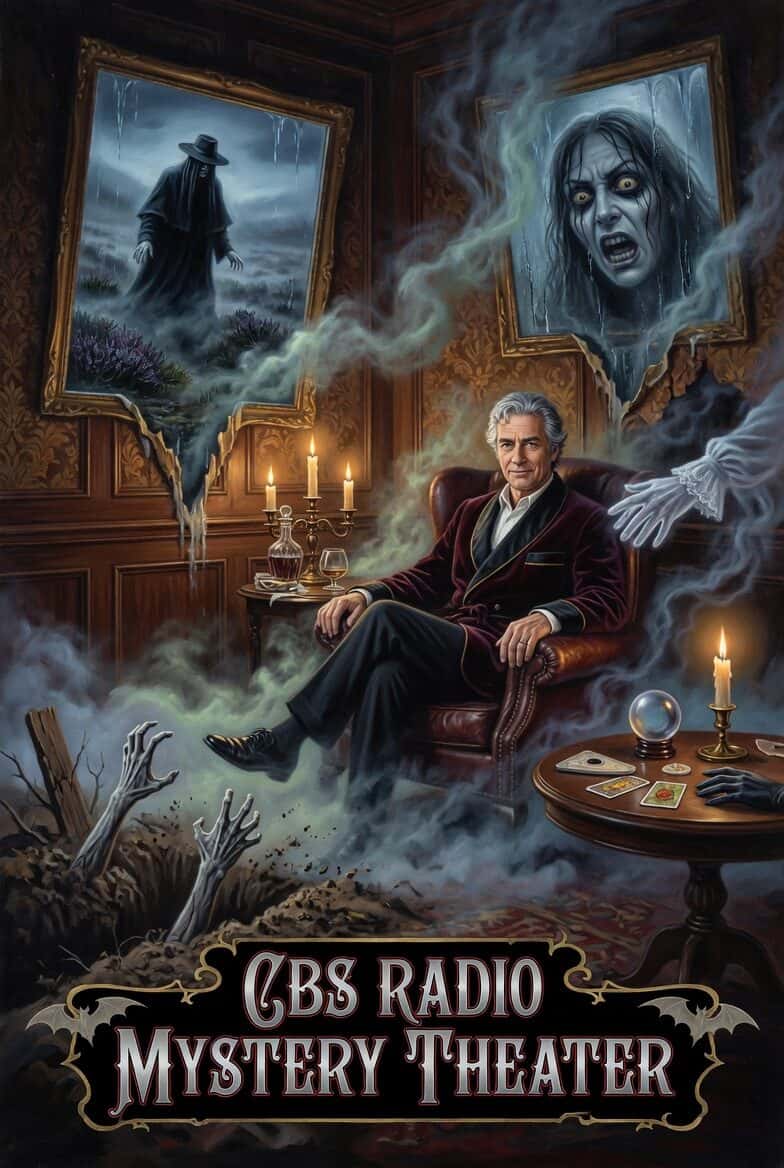
The CBS Radio Mystery Theater presents... Welcome, I'm E.G. Marshall. To put us in the frame of mind to accept the deviousness of man, we reach into that philosophical legacy bequeathed us by the immortal bard, Shakespeare. Men, he says, should be what they seem, or those that be not, would they might seem none. The lie or the truth? Who is false? Who is not? And we have 60 minutes to find out.
We find it peculiar, Professor Versagie, that the man who robbed your safe left cigarette stubs of a brand you say are made only for you.
Let me see. They are mine. I cannot deny it.
Isn't "cannot deny" a peculiar way of putting it?
I don't understand you, police. I report a robbery and you treat me as if I have stolen from myself. As if I were the criminal.
That, sir, is entirely possible.
A mystery drama, The Versagie Case, adapted from the classic German story by Karl Roessner, is dramatized especially for the Mystery Theater by Gerald Keane and stars Arnold Moss. It is sponsored in part by A.R.M., allergy relief medicine. I'll be back shortly with Act One.
We are in Budapest, in the era of wine, women, songs and swindlers. In many ways, life in the 1800s is as exciting as life in our century. There are just as many good men and certainly just as many bad. Where then to begin? Why, at that address at which you'll find both good and bad. The Central Police Office.
Plaut? Uh, Plaut, come in here.
Good morning, Commissioner. What's the problem?
Shut the door behind you, will you, Plaut? Secret. No more than the usual. No more than the usual in this place. Now, I thought it better for the morale of the other detectives and police if I extended my compliments to you in private.
Compliments? Commissioner, are you not feeling well?
Plaut, the department greatly appreciates your rounding up all those Romanian swindlers.
Thank you. But I must see him. I must see the Commissioner of Police without him.
Who is that out there?
Someone who must see you, I would say.
No, no, no. I do not wish to see the lieutenant. Neither the lieutenant nor do I wish to see the captain. Either or not. Terrible robbery, and I am the victim. That is my wife and I. You must tell the Commissioner I am here. Professor Sandor Versagie. Professor Versagie, if you would be good enough to wait, I shall tell him the moment he is free.
No, I cannot wait. I will not wait. Which door is this? Ah, yes, there I see it.
No, no, no. You cannot go in there.
Can't I go? Uh, Commissioner Franz? Yes? Yes, Professor Versagie. Come in. Come in.
How do you know my name?
I would say there isn't anyone in this entire building who is not aware of your presence.
I am sorry, Commissioner. The gentleman insisted.
No, no. Plaut. Stay here. Wait. Oh, nerve. I took such nerve for me to come here to the police station. I am on the edge all the time. All the time. You see, I am... Wait. Let me explain. As you have probably gathered... Yes? Yes. As you have probably gathered, I am... At least the doctors say I am extremely nervous. I am in a highly nervous state. Very excitable.
Professor, sit down. Go ahead. The chair won't bite you.
Well, what I wish to explain is that... Detective Plaut, would you pour the Professor some water from the pitcher by the window, please?
Some water? Two glasses there, Plaut. Fill them both and give one to the Professor.
Oh, that's very kind of you, sir. But I am...
Here is your glass, Professor.
Well, why not? Professor, would you be kind enough to drink the entire glass of water?
Glad to. I am thirsty after all.
Splendid. It is a scientific fact that water is an effective tranquilizer. Now, quietly and as reasonably as possible, will you tell us why you are here?
Well, I am attached to the Budapest University from which I had to retire last year because of nervous disorder. Last night, my wife and I returned from Vienna where I had gone for treatment and I was very tired from the journey. I went to bed immediately. This morning... To think of it... To think of it... Ah, Plaut. The other glass of water. Quickly.
No, no, no, no, no. No, no. I am all right. I am perfectly all right. This morning, you discovered you had been robbed.
Commissioner Franz, how extraordinary. You should know that I was told you had a sixth sense.
It is Detective Richard Plaut here who is blessed with a sixth sense. I have only the other five. Now, to continue, Professor. You were robbed...
In my sleep. In my study. In my study, I have a safe. The safe was open. I looked inside. One hundred and fifty thousand gulden worth of securities and almost all my wife's best jewelry are gone.
And is there anyone in your household who might have a duplicate key?
No, no, no one. We live in an apartment. It is very nice. Third floor on the Königstrasse. When we are there... We live in an apartment. It is very nice. When we are there, a cleaning woman comes in every day. Downstairs is the janitor, but no one has any keys.
Do you suspect anyone you know who might rob you?
Someone I know. Exactly what I said, Professor. Someone... Oh, no, no, no. Decidedly no, no.
You are married, Professor?
Yes. My wife accompanied me to the sanatorium near Vienna. She was with me the whole time. We closed up the apartment.
Your wife was actually in the sanatorium while you were there?
Oh, yes, yes. They have accommodations for relatives. It was not very pleasant for her, but she is a devoted wife, and she wants me to be well again and get rid of this hateful nervous disorder. Fortunately, I have only been plagued with it this past year. Oh, she has been wonderful. One could not ask for more. I am a lucky man, and I know it. Why, I am fifty years old, and Helena is half my age.
Indeed. Twenty-five, eh? That would interest you, Detective Plaut, wouldn't it?
And extremely beautiful, I am proud to say.
Detective Plaut, I would like you to take on this case, knowing your interest in this case.
Oh, yes, yes, yes. I will. I will.
Ackermann, what does that mean to you?
And... I, that's all we have. I am sorry.
Doctor... it, Professor? You haven't changed anything in the room?
No, no, exactly as I found it this morning. I did examine the inside of the safe when I found the door open, but I touched nothing, nothing. My wife said I should not until it has been examined by the police.
Oh, oh, Helena, there you are. Ah, good day, gentlemen. Oh, my dear. This is my wife, Helena, gentlemen. These gentlemen are from the police. You haven't been overdoing it, have you?
Oh, the professor did not exaggerate. She is stunning.
Mrs. Versagie, this is Commissioner Franz. My name is Richard Plaut. My pleasure.
Do you know whether any other pieces of furniture were damaged or whether anything else was stolen besides, I understand, the securities and your jewels?
I would say no to both questions, Mr. Plaut. The jewels and the securities were in a small box. It is still there. You can see it, but empty. That thief got himself quite a lot for his trouble.
Plaut, over here. Matches, pieces of burnt candles. What's this?
I would say pieces of iron broken off. And there on the floor, that piece looks like it was broken from a file. I'll slip these into our envelopes.
Nothing else?
I've already taken the cigarette ashes and the stubs. Be careless, robber, leaving the ends of cigarettes.
You are both very careful about your work.
We try. Whatever is found at the scene of a crime is, like handwriting, a personal message, in this case, from the thief.
And you can trace the criminal with cigarettes, perhaps, and so on?
We hope to.
Commissioner, I would like your opinion over here, please.
What is it, Plaut?
Will you examine the door of the safe? It's been hacked about. The hinges and the lock have been broken. The door is filed in a haphazard way. And if you look more closely, those marks have nothing to do with opening the safe.
You're right, Plaut. The door was opened with a key.
You agree then?
Oh, absolutely. The marks were made on the safe door after it was opened. An amateur trying to make it look as if it had been forced open.
What are you two looking at now?
These marks.
Well, it was certainly made a mess trying to open it.
A mess? Exactly, Professor. Have you an axe in the house?
An axe? You had better ask Helena. She runs the household.
Do we have an axe, dear? Or a hatchet?
I'll go see. I'll be back in a minute.
I don't understand.
Professor, this safe has not been subjected to what we might call professional treatment.
You mean you can tell what kind of a person did this?
No, there isn't a burglar tool used by a professional. Fever does not leave its mark. We know them all. Here, however.
This is our hatchet. We keep it in the kitchen. Will it do?
Very nicely. Commissioner, would you like to do the matching?
Thank you. Here, too. Yes, yes. Ah, yes. What? This hatchet and these deep scratches and cuts? Match.
Is that, uh, unusual?
I don't think the professor understands what you are getting at, Commissioner.
Unusual? Yes. I find it remarkable, sir, that the thieves should have maltreated your safe with your own hatchet.
That is, obviously, to those who follow the workings of detection, Commissioner Franz of the Budapest Police has already made up his mind. But then, if renowned assassins... If the man named Sandor Versagie has falsified a robbery, there must be a reason. That may be the most interesting path to follow. Not the how, but the why. We shall pick up the trail exactly where we left off when I return shortly with Act Two.
Dissemblance. That is the theme of this performance at Mystery Theatre. Who is performing? When people are so adept at disguising their true selves, they begin to believe they are what they pretend. Detective Richard Plaut and the Commissioner resume the investigation.
Now, as to these papers lying about here on the floor, is this exactly the way you found them?
I think so.
I hold up this insurance policy. Is it yours?
Well, is it mine? Does it have my name on it?
What does it say, Plaut?
Sandor Versagie insures himself against robbery with certain itemized pieces of jewelry and a sum of 150,000 gulden.
Then you're insured against robbery, Professor. You didn't think to inform us of that.
Didn't you tell the gentlemen that we were insured?
Oh, Sandor, how can a thing like that slip your mind?
That's the reason, sir, that we can meet this loss with a certain amount of calm.
Calm? I would say that Professor Versagie has been quite excited about this robbery. It was his nervousness which first attracted our attention when he came to report the incident at the police station. And now we find he is insured, so as to completely cover his loss. I cannot see any reason for his great excitement.
My husband is ill. Surely you have noticed that. We have just returned from the sanatorium where he was being treated. And now, to you gentlemen of the police, robbery may be an everyday occurrence, but robbery is not an everyday occurrence to us. Even though we were insured, the invasion of our home by strangers, it is...
Mrs. Versagie, forgive us. We don't wish to add to your unhappiness. Commissioner, why don't we permit Mr. and Mrs. Versagie to pass the rest of the day alone?
I'm happy to discover the Versagies had been insured all along. No matter how I rationalized it, it was the old insurance game. I could see the professor was in a very nervous state. Nervous state, and so perhaps not accountable for his actions. But Helena, his beautiful young wife, how could she know nothing of her husband's deception? How could she be innocent? The following morning, I was at their door.
Ah, I was expecting you earlier, Mr. Plaut.
I came as soon as I could. I see you have not had time to unpack.
How is your husband?
Ah, this robbery has undone a great deal of the good of his visit to the sanatorium.
He's in his bedroom, reading. If you like, I should be happy to bring in your suitcases from the hall.
Oh, no, I wouldn't dream of it. That, uh, that's a beautiful coat lying there. What is that for?
Seal. But it's as you can call him, a husband so fond of. He takes it everywhere. It was much too hot for Vienna, so he left it with his stepbrother, who lives there.
When did you leave Budapest?
The 27th of March. We first went to see Lajos.
Lajos?
My husband's stepbrother. He's written us, insisting we spend a few days with him before going on to the sanatorium.
And, uh, where is that?
In a suburb of Vienna, in Kaltenleutgeben. We stayed at the sanatorium until the 3rd of May, and my husband was really improving. And then two days with Lajos, and then back here the day before yesterday.
Ah, there you are, Helena. Oh, oh. You have it. A visitor. Uh, mister, uh, I've forgotten your name.
Plaut. Richard Plaut, Mr. Versagie. I, uh, was going to ask if I might continue examining your study.
I have no objection. Follow me.
Mr. Plaut, may I offer you a glass of wine?
Oh, don't tempt me. Police regulations forbid that while a man is on duty.
A great pity. Seal, I am not a policeman, so I shall have a glass.
Ah, stand or don't. You know what the doctor said. It's a stimulant, and for the present, no stimulants.
Is a cigarette all right?
Oh, don't be silly. Of course it is. Especially since you brought back your special favorites from Vienna.
Uh, may I have one, Professor?
Please. Glad to. You will enjoy them. Made especially for me in Vienna. You can't get them here. Nobody smokes them in Budapest.
Oh, really?
Really.
And you are quite certain this room was thoroughly cleaned before you went away?
Housekeeping is my pride and joy, Mr. Plaut.
And the cigarette you're smoking, Professor, have you smoked in here since you returned?
No, I have not. Why all this questioning about cigarettes?
Let me show you something. In this envelope are two cigarette stubs we picked up in this room yesterday. Now, isn't it rather remarkable that whoever plundered your cigarettes, they've smoked the same cigarettes as you do. A brand, you say, which is unattainable in Budapest. See for yourself. Open the envelope.
Oh, it's right, Sandor. These stubs are the same, but how is it possible?
Let me see. It is right. Those stubs are mine. I cannot deny it.
You said, I cannot deny. Isn't that a peculiar word to use under the circumstances?
Well, it's... Nothing. Just words. I did not mean anything by it. I do not understand you, police. I report... I report a crime to you and you treat me as if I were the criminal.
Sandor, Sandor, please. Mr. Plaut, if your investigation results in a kind of third degree, I must ask you to leave. My husband tires easily. Sandor, will you go lie down? I shall be with you in a moment. I'll see Mr. Plaut to the door.
All right, then. But don't be long.
Mr. Plaut, you were asking about household tools yesterday. Well, I was getting out the checkbook and I found this broken piece of metal in my husband's desk. I thought I'd better give it to you. Now, what do you suppose it is?
It's what they call a file. The end is broken off.
Is it helpful for you to have it?
I regret to say, Mrs. Versagie, this broken file in your husband's desk is extremely helpful. To say I was shocked is putting it mildly. I could draw only two conclusions. In attacking his safe to simulate a robbery, the professor had broken the file himself or Mrs. Versagie was trying to implicate her husband. I went downstairs and asked if the janitor would see me.
This is a respectable house. Why are the police asking me questions?
When a robbery has been reported, we ask everybody.
A robbery? Who? Where?
Professor Versagie, upstairs on the third.
Oh, he's quite mad. He complains about my children making noise. I don't think he's quite right in the head. If I wasn't sorry for his wife, I could make a few complaints myself.
Indeed. Oh, he thinks he can make all the noises he wants and that's all right. But if my children happen to run up and down stairs, it's not.
What noises? I thought they were away for a month.
Don't you think I know what's going on here? What kind of a janitor do you think I am? The professor came back one afternoon and evening about a week after they left. And the noise he made in his apartment. Oh, you thought he was chopping up the furniture.
You're quite certain it was Professor Versagie?
I don't say anything unless I'm sure of it. It was the third or fourth of April, early in the evening. My door was open. I looked up. There he was in his brown fur coat with the African collar. He didn't even say hello. I thought, that's pretty silly. Such a hot day, his face buried in the collar. He went right upstairs. And after making all that noise, he comes down again, doesn't say a word, all bundled up he is. Now he reports a robbery. If you ask me, he takes all kinds in this world.
Anything else, officer?
I think not.
How is the case going, Plaut?
It's not going very well.
I'm sorry. I've got some information that might cheer you. That list of Versagie's stolen securities we sent out. Here's a wire from a bank in Vienna. As per your inquiry, on April 6th, Hungarian bonds valued 40,000 gulden presented at Anglo Bank, Vienna. Money paid out.
What do you say to that, Plaut? Our man is supposed to be in a sanatorium, and he cashes in some of his own bonds.
I'd better take the overnight train to Vienna. If you're going to the Anglo Bank to get a description of who cashed in the securities, you might also visit the Austrian Bank. I have their telegram, and they bought 60,000 gulden worth of Versagie's securities.
May I have both telegrams, please?
Certainly. Have a good trip, Plaut, and try to keep away from the ladies.
Yes, Commissioner Franz. I'm calling you from Vienna. I have been to both banks. The man who cashed in the securities in each could not have been Versagie, nor are the signatures for the money his signatures.
Oh, yes, yes, that's possible. But why would an accomplice be that stupid, A, to sign Versagie's name, and B, to wear a conspicuous overcoat in both banks?
Uh-huh, the same one. Just to be completely clear, I am going to the sanatorium in Kaltenleutgeben to make sure Mr. and Mrs. Versagie remain there the entire month. Then I am going to have a chat with Versagie's stepbrother, this, uh, Lajos. See what he can tell me. So, be back in Budapest?
I don't expect so, but you can always reach me at the central Vienna police station. I may go pay... Uh, no, I would not do that.
No?
I think by tomorrow I may have evidence that clears him, and he is such an excitable man I wouldn't like anything to push him over the edge. Promise me you won't go see him before I get back.
You promised.
I would like to be the first to see the professor.
I never got to see Sandor Versagie. The next morning I was handed a telegram at the Vienna police station from Commissioner Franz. Stop further investigation in Versagie case. Guilt proven by me beyond doubt. Unfortunately, immediately after arrest, criminal committed suicide. Come back.
Detective Richard Plaut was stunned that Sandor Versagie should take his own life at the very moment his innocence might be proven. Why had he killed himself? Police records are full of cases of those who are unable to withstand pressure. Who prefer death to dishonor. No, suicide is not always an admission of guilt.
When I return shortly with act three. Trained investigator leaves not one stone, whether it be a slight case of theft or a serious case of murder. It is the very nature of the man to seek after the truth, however cleverly it may be hidden. Such a man is our detective Richard Plaut. He takes up the story.
Versagie Lajos, Schwind Street 3 was the address in the directory. I know that the Versagies had stayed with his stepbrother before and after the professor's month in the sanatorium. Lajos Versagie was a heavily built, clean-shaven man with thick black hair. He sat me in his drawing room, his back to the window, keeping his face in the shadow. An old trick.
So you are from the police, are you? Is something the matter?
You have a stepbrother in Budapest?
Yes, indeed. Sandor, very fine professor at the university.
I have just received a message from Budapest, Mr. Versagie, which tells me your stepbrother was completely crushed by the suspicion. More than that, that he is dead by his own hand.
Oh, no. Oh, merciful heavens. Poor man. How unfair, how wicked. Look, I am sorry. You must think me absurdly emotional. He was my stepbrother, and only a few days ago he was in this very room. He and his wife, they stayed in my guest room at the end of the hall, and we are terrible, this office. Brother's death just at this time places Mrs. Versagie in a very painful position. His suicide will appear it was all true. People will say he died to escape punishment and dishonor. So unless we succeed in discovering the real thief, his name will be destroyed.
The real thief? Then you don't believe Sandor has any connection with the theft?
Oh, no. No, the real thief is quite another person.
That's why I came to see you. But how can I help you?
We have discovered traces here in Vienna of the man who apparently is the robber. Obviously, this man knew the professor's habits and must have met him while he was here. Do you know of any such person he might have seen?
No, I really don't. When Sandor and Helena came here, I saw very little of them. I know that Sandor is dead. Sandor visited several old Viennese friends, but who they were, I don't know. My sister-in-law should be able to tell you.
I expect you are right. I shall leave now. I am sorry to have been the bearer of such bad news.
It's incredible. Awful. Please, if there is any further way I can be of help, don't hesitate to call on me.
I certainly shall.
Commissioner, how did this happen? I expected it. The man was always guilty and he knew it.
Just tell me what happened.
Well, we had his house watched, naturally. A man on the roof over his apartment. One morning, the janitor was seen moving a small trunk from the basement. When questioned, he said the professor was taking a trip. Now, if you were in my shoes, Plaut, what would you have done?
But I did. I went to see him directly.
Well, Commissioner, what are you doing here? Where are you going, pushing your way in here?
You appear to be packing to go on a trip. That's rather odd.
Yes, yes, I am. But what I do, where I am going, is no business of yours.
It is my business. You are going to Vienna.
Well, since you know it, why do you bother me with questions? Now, please, I am in a hurry. I am sent for a cab to take me to the station.
Spare yourself the trouble, Professor. The cab will not be here. We have had this house under surveillance, and no one comes or goes without our permission.
How dare you? But what do you want of me? How dare the police put a watch upon me?
I want to know what takes you to Vienna.
I owe you no accounting.
As you like. But then I shall be obliged to forbid your departure.
Professor Versagie, I must do my duty, hard it may be. And my duty, after all the evidence we have against you, is to arrest you.
Professor, come back here.
What happened then?
He ran down the stairs. But I had a policeman on duty there. So he turned around and raced up the stairs, crying all the time. I am innocent. I am innocent. He went up another flight, calling out to his wife, who hadn't come home yet. Oh, how ghastly, the poor, demented man. Another one of our men came downstairs from the roof. Versagie kept running back and forth, calling, Helena, Helena. Helena! Helena! Then I think he lost his head completely. I tried to reach him, but he eluded me on the stairs, ran out into the street blindly, right into a big van, which could not stop. He was dead when I got to his side.
It's good of you to see me, Mrs. Versagie.
It's so hard. Anyone connected with the police, I... I know you have every reason to despise us.
They drove him to his death with their suspicions. Sandor was the kindest, gentlest man who ever lived.
Mrs. Versagy, I am certain your husband had nothing to do with the crime.
You believe in him?
Yes, yes, I do.
How well did your husband get along with his stepbrother?
Well, for a year, they've been very good friends.
And before that?
Mrs. Versagy, it's important for me to know that.
They avoided each other for many years.
And why was that?
It was because of me. My husband married very late in life. I was a student of his at the university. We'd only been married for five years.
Believe me, I would do anything to spare you this ordeal.
No, no, no, it's all right. Sandor and I were engaged. Lajos, his stepbrother, came to visit. I didn't know him. I was friendly in a natural, normal way. I mean, rather, to my fiancé. But he misunderstood it. One night, I happened to be alone with him. And he put his arms around me. I hate to think of it. Fortunately, Sandor came in. There were words. Sandor literally threw him out. And until a year ago, they never spoke.
How did they become friends again?
It was Sandor. I told you what a kind man he was. He heard that Lajos had business difficulties. And he sent him money. Later, Lajos paid it back and apologized. And that was that. So when he heard we were going to Vienna to the sanatorium, he wrote and he insisted that we stay with him first.
You did not ask to stay with him. He asked you.
That's right.
Why?
One last question. Have you any idea why the professor wanted to go to Vienna?
He was very quiet about it. I think he was going to see Lajos. Why, I don't know. He did say I wasn't to go with him.
Mr. Plaut, is it possible? Is there any chance of finding the real criminal soon?
Soon? By tomorrow. The funeral is tomorrow.
I know what you are going to say. I can promise you that your husband will be laid to rest with his honor and reputation clear. It's almost too good to be true.
That's the least we can do for you. Thank you.
Mr. Plaut, I did not expect you back in Vienna so soon. Please forgive this confusion, but I am here in the midst of work. I am extremely busy, so it is going to be impossible for me to go to Budapest for the funeral.
You have probably seen in the newspapers that officially, the police believe your stepbrother guilty. And they are going to arrest him. Yes. And they have stopped any further action in the case.
Yes, I read that. Poor Sandor. If he had not been in such a state, he would never have arranged a pretended robbery to collect the insurance.
Then you now believe him guilty.
There is so much that points to him. I don't know what to think.
But that is why I came here today with the good news that your stepbrother is innocent.
What? Oh, I thought you would be pleased.
Yes, proof positive.
You have proof?
Do you remember my asking you who your stepbrother might have met while in Vienna? Let's say it was some man he hadn't seen in a long time. A relative, perhaps. Let us assume this man to be in financial straits. He learns the professor has a large fortune in securities, jewels, and so forth, left in a closed, unsecured place. And that is why I am here today. And I am here today because I want to ask you a question.
What is it?
Why aren't you speaking?
I don't remember saying anything of the kind.
Oh, then I must be mistaken. But it doesn't matter. We're only talking about possibilities. Let us assume Professor Bach is a morphine addict. Obviously he is not. Persigy told this interesting fact to, say, to you, for instance. Yes, yes, to you. Or to anyone else, let's say, to the robber who took the money eventually. We know for a fact the robbery took place April 4th, two days after the professor entered the sanatorium. The janitor saw the robber pass in and out and thought he was the professor. Because he wore the professor's fur overcoat. The police took for granted the robbery was faked since keys had been used to enter the apartment and to open the safe and a certain kind of cigarette had been smoked, marks made on the safe by a kitchen hatchet, etc., etc., etc.
And did they find all these things?
Oh, they did. But in my opinion, these things prove the professor's... the professor's innocence. I really cannot understand. It looks to me as if the real robber wanted to throw suspicion on your stepbrother. Don't you think so?
I don't know.
There is one missing link in our chain of evidence. How did the robber come into possession of Professor Versagy's overcoat and his keys? Any ideas?
I am up to my neck in work. I am not... I am no detective and I would very much prefer that you follow up your investigations alone until you really need my help.
I need it now. You see, Mr. Versagy, my theory for the solution is very simple. I believe your brother left his overcoat and his keys with the robber here in Vienna in some place where he thought them safe. A great deal warmer in Vienna than Budapest. It would be natural to leave it here with you. Let us say in the room you had given him?
Will you excuse me if I ring for your maid?
What right do you have to come barging in here and to—
You rang, sir.
Would you please show me the room occupied recently by Professor and Mrs. Versagy?
Certainly, sir. This way.
Madame, do you remember the professor's visit early this month? Did he leave anything here when he went to the sanatorium?
Oh, yes, sir. This was their room. He left his... his overcoat and some other things. They were locked in that cupboard.
Uh-huh. Who had the keys to this cupboard?
Mr. Versagy gave the key to the professor. He took it with him.
Oh, dear me. Someone must have mislaid the key. The door has been forced from its hinges. Look. Look carefully.
What are you doing? Mr. Versagy, the police are the ones who asked the questions.
Notice, sir. Sir, someone has... the door has been opened with the hinges of this cupboard door.
What do you mean?
I have found the missing link in the chain of evidence. Lajos Versagy, I arrest you in the name of the law.
Detective Richard Plaut kept his word. On the following day, Sandor Versagy was buried with honor and dignity, befitting an honest man. Perhaps in death, the professor has a lesson for all of us. How sacredly reputation must be guarded. How fragile a thing it is. And should it be lost, it is rarely regained.
More on this when I return shortly.
We began today's story with a word from Shakespeare, a favorite pastime of ours. For the tragedy of Sandor Versagy was also the tragedy of Othello, who said, "Who steals my purse steals trash. 'Tis something, nothing. 'Twas mine, 'tis his, and has been slave to thousands. But he that filches from me my good name robs me of that which not enriches him and makes me poor indeed."
Our cast included Arnold Moss, William Griffis, Carol Teitel, and Robert Dryden. Entire production was under the direction of Hyman Brown. This is E.G. Marshall inviting you to return to our mystery theater for another adventure in the macabre. Until next time, pleasant dreams.