
The written record
Read the transcript
Read along with the recording · About 26 min to read
<!-- kimi_cleaned -->
A merchant displays his samples. We can stand right here on this roof and walk around here, and we can see almost $200 million of our investments from this roof. Here's the Chrysler Building and the Graybar Building. I'd say those two are worth $90 million. This one here is worth $15 million, $18 million. And 270 Park Avenue around the corner here, that's the whole block to the north of us here, that's worth another, I should think, $20 million. That's 1407 Broadway. Now, that building has got a million feet in it. We built that.
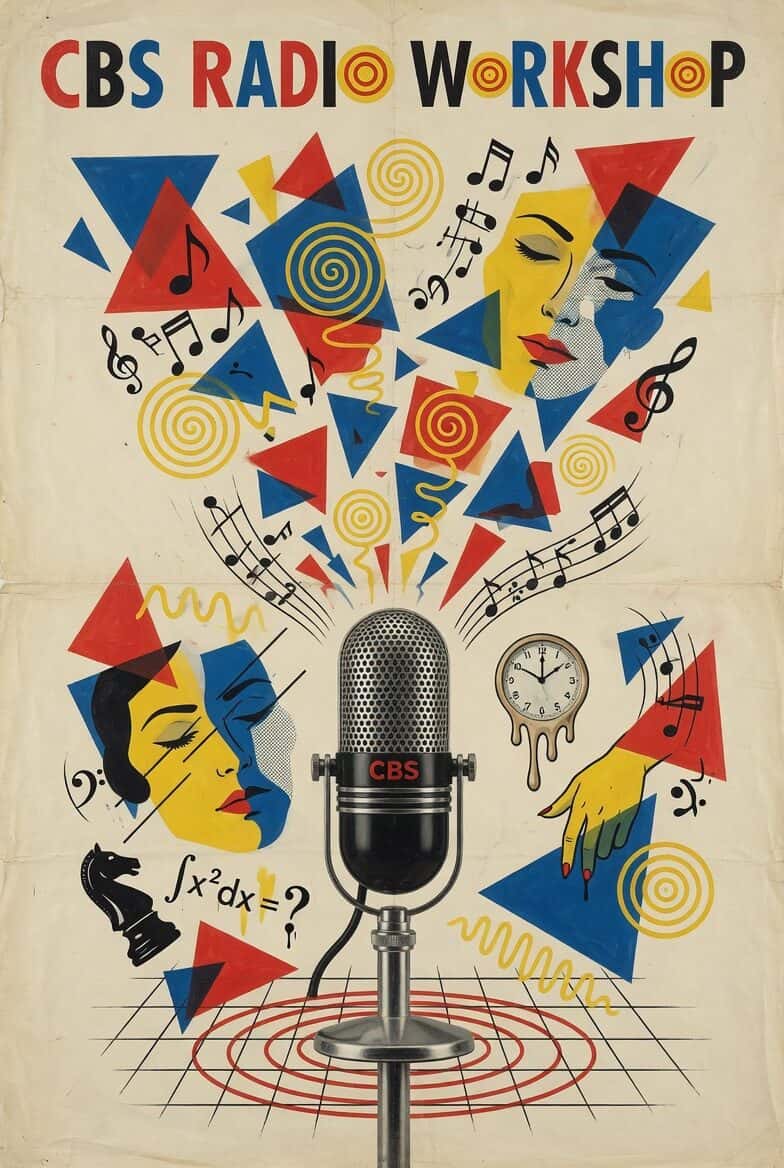
CBS Radio, a division of the Columbia Broadcasting System and its 217 affiliated stations, present the CBS Radio Workshop, dedicated to man's imagination, the theater of the mind.
My name is Martin Weldon. I'm a radio reporter. The man you heard earlier pointing out some of his properties is without question the most spectacular real estate operator of his time. He has been praised as a financial wizard, a man of responsibility and vision who creates cities out of deserts. He has also been called a mere money juggler who buys from Peter to sell to Paul, pocketing a difference in price. A man whose elaborate schemes to build and create and develop are nothing but pipe dreams. A man who buys and sells but does not build. But whatever he is, he is a tycoon, a businessman of undeniable wealth and power.
Tonight, the CBS Radio Workshop examines the personality, the living and working habits of a tycoon. Our tools are a notebook and a tape recorder, combining to create a living portrait of a man in action, the portrait of William Zeckendorf.
Among those who have seen him in action is Billy Rose. He has all the instincts of a Mississippi riverboat gambler. He'll take any kind of a wild chance if his knowledge tells him there's a good possibility of an enormous payoff. He seems completely disinterested in playing penny-ante poker.
And Roger L. Stevens, rated Zeckendorf's only real rival at the top of the real estate world. He is all the superlatives with which he's been described in the press. The burden that he carries on his shoulders is unbelievable. Most of the time, he's carrying in his head the deals that possibly the next 30 busiest real estate men might be busy at.
Edward J. Crawford, a man who has been a tycoon for a long time, senior vice president of Charles F. Noyes, and 55 years in the business. He's the greatest financial genius that we've ever had in the real estate business during my term.
Palmer Hoyt, publisher of the Denver Post. Everybody in Denver is pro-Zeckendorf or against him. Now I think there are more pros than against. Zeckendorf was always unpalatable to the local fat cats, but very popular with the newcomers and the have-nots. A lot of people don't know him. A lot of people said that he would never build Mile High Center, this 22-story building we have. I always thought he would. He did.
Robert Moses on Zeckendorf's proposed half-billion-dollar rehabilitation of Manhattan's West Side. There's no element of public condemnation for what we conceive to be essentially a private purpose, a good purpose, but a private purpose. And we've told Bill repeatedly that we don't think that in himself he constitutes a public purpose. Bill has a tendency to believe that.
The portrait begins to fill in. It takes on detail as you observe the man in action. One recent morning, Zeckendorf gave one of his eight o'clock business breakfasts in his private penthouse dining room in the offices of Webb and Knapp, the firm he heads, on the 14th floor at 383-385 Madison Avenue. His guests were two financiers from San Francisco, Harry McClelland and Edward Ryan.
We'll expect you to put up the money.
Well, we learned a long while ago. We fell for that line for years. We'll put in the know-how, and you'll put up the money. We don't do that anymore.
Bill Courtney said, know-how, the other fellow puts up the money.
Well, we don't care. We'll buy the other fellow.
I'm not kidding about this, because if you're not going to put up most of the money, we don't need you.
No, that's fine.
Well, we'll talk about that. We don't want any free ride, because we've got a little money of our own to put up.
No, I understand that. But we haven't got enough money to do all the business we're doing. I'll tell you, we haven't got it. Hello? And we're all through straining ourselves for money, because opportunities are too great for us to get money from people who want to be with us. And we've been wonderful moneymakers for everybody we ever touched. Now, we'll cover that a little later. Here are the properties I want you to show these fellows. You're going to be over on what day? I want to show them 270 Park Avenue. I'll give you this list. The reason I want them to see what a conversion job looks like from a hotel and an apartment house to an office building. I think they ought to see the United Nations area. Show them what we did over there. Flushing. Roosevelt Field. 42nd Street Post Office. The Airlines Terminal Building. You know the Chatham Building over here? 42nd? We bought that land.
Yeah, that isn't all, is it?
No, there's more. We've got more in New York.
That's enough.
That's enough? That's enough. Before a second off, we're going to show you a little bit of what we've got.
When he could start showing his guests around, an important phone call came in. Asking an aide to use the time to show McClelland and Ryan around the Webb and Knapp offices, he picked up the phone. It was Harry Helmsley, a broker, representing a syndicate headed by Lawrence Wien, negotiating for the purchase from Zeckendorf of 120 Broadway.
The mortgage is extended. The mortgage runs with the lease. Except at the end of the 50th year, we have the right to buy you out.
That's right.
Hold the wire a minute. Wait a minute. Jim O'Loughlin wants to say something. And for such period as we do not buy you out, it continues just at 6% and the rent that we pay you is $179 a month.
Is that $1.3 million a year?
That's the $1.3 million and the $8.50 on the ground.
Right. It continues at 6%.
Yeah. Because that's what it is.
Yeah, sure. Yeah. There's no question about that, Harry, is there?
Well.
What is it?
I think it's not.
Well, we're only paying ourselves our own interest, so what are you talking about?
So you were including the 510.
Right. Just as it had been. The same rent that had been paid right along.
Yeah. The 6%.
Right. The 6% interest without amortization, which has been going on during the previous 30 years.
That's right.
Okay.
Okay. Very good.
He hung up as one of the doors to his round, windowless, teakwood-paneled office opened. Nicholas Salgo, Webb and Knapp Executive Vice President, walked in. He looked worried.
Listen, this is a tremendously important thing.
Yes, Bill?
I know you're aware of that. I am in favor of knowing where we're going at once. Now, this letter that you got from them, that's fine. I want to know what lawyers are doing what on the deal.
Bill, do you want to handle it?
No.
Then let me handle it, have a seat.
I only want... I'm asking you a question. What lawyers are doing... What are they doing? Besides, I told you what lawyers are handling and what difference it makes.
Ask.
Yeah, yeah. Ask you if it is, uh, if the fellow's, uh, what the fellow's names are. I'm not going to tell you every detail on it. That's wasting your time on it. I don't want to have my time wasted. I want to know, Nick.
Are we drawing papers?
Nick.
Yeah.
This thing is perhaps the most important deal in this office right now.
I guess so.
Right, and I want to know what's going on. Did you cover the question?
No assets we are selling, Bill.
A long-distance call demanded Zeckendorf's attention, leaving this problem... I'm sorry... in the air. This time, it was Angus Wynne Jr., his associate in a proposed $200 million development between Dallas and Fort Worth.
I hate that. Uh, in a bad market, you might say that, but this is a good market, and it's good enough to get the securities off. Now, I don't want to make a profit. I want to make it in the deal.
Yeah.
Not off the public. Even if the market was better, I wouldn't want to mark the property up and have it known that we took a big kill out of it before the public got in. So, I can't see that argument. I think what we've got to do, I think I ought to pay you a visit down there or let them come up. I think maybe it'd be better to bring Dallas Rupp up here and let them see what we can do, what we've done. You see, what I want to do is draw a picture of a stock like Roosevelt Field, which was in exactly the condition this thing is in. They cost us $2 and is now split three for one four years later and selling for $13. They'll understand that, won't they?
By this time, McClelland and Ryan were back from their tour around the offices. It was time to get down to cases.
Now, what do you got in mind on San Francisco?
I really don't know. All I say is, let's get together. Let's do it together.
San Francisco may not be anything for us to do together. Now, you're not limiting this to San Francisco.
No.
There may be other projects that we need an organization like yours to put over. See, we have the team. We have the manpower. We have the business. Our overhead is almost like the Bank of America. We've got a payroll here of $3 million a year.
Is that so?
That's the best investment we got. That's better than buildings. If you have the right kind of manpower, you get the buildings until you get these things. Now, I don't... Sure.
I want to make my position very clear as far as San Francisco is concerned because we want to know more about it and...
You've got no commitment to us.
I know. We're not asking you for any commitment.
No, I understand. But I wanted to find out what you had in mind.
We could... Have nothing in mind. Nothing in mind. We'd like to have a powerful friend out there.
Yes.
This can take a lot of dough.
Yeah.
It may be that we're walking too much the same side of the street and we have no interest in each other.
No, we need... We haven't got the organization to handle a lot of deals that we simply can't touch because we haven't got the organization.
They all put on their hats and coats and started for lunch. At the restaurant, the conversation veered away from the business at hand.
I just came. I just came back from testifying in defense of a lawsuit against us for $300 million. Did you hear about that?
No.
That's the greatest compliment that was ever paid to you.
I sued it for $300 million. The judge asked me if I had any comment to make and I said, yes, your honor. I said, I'd like to match the gentleman double or nothing.
That's how the morning went. A typical business morning in the life of a tycoon. A man of undeniable wealth and increasing power. What is the power that he's reaching for?
I think the most important city to study is Florence where you had a marriage of the de' Medici's, the Borgia's and the other great merchant families and banking families with the da Vinci's and the Michelangelo's and the Bernini's and the other great men of art, engineering and architecture. I feel that our country is rapidly approaching that point. I wish to work out some means by which the parallel interest of businessmen, builders like ourselves could somehow be merged with the interest of the artist and create something that is both beautiful and functional and economically sound.
That's the life plan. The design behind the furious physical drive of this 50-year-old, 6-foot, 230-pound, round, solid, fast-moving man who looks made to order for a Santa Claus costume. Without question a big man physically. One of his friends, former district attorney, now judge, Miles McDonald, found him too big on one occasion.
He's a lousy duck, you know. He's too big to get in the blind in the first place and too big for anybody else to handle their gun when he's in there. Then he leads the bridge. He's always ahead of everybody else. He leads them too far.
His associate in the West Side Project, Billy Rose.
He has the same quest, same hunger for self-identification that made Churchill tick or that made Truman tick or that makes Baruch tick. Bill is a kind of a city version of the old western pioneer who would move into a small town and 25 or 30 years later the town was dotted with monuments to the man's achievement.
And again, real estate dean, Edward J. Crawford.
He always likes to sell something where there's a profit in for the other fellow. He doesn't hold out for the last dollar. While his wife, like other wives, sees a man who comes home tired. He had come home and was so very, very tired. He said, oh, I'm so glad you've come home. I'm so glad you got to bed. And he was just about to turn out the light and the phone rang and a man wanted to see him about the deal. This was about 10, 10:15. Some people would have said, oh, I'll see you tomorrow. But he got up. He got up and wearily put on his clothes and went out. And that took a lot of willpower to get up when he was tired and exhausted and go out and meet a man and talk to him about a deal. I've admired him greatly for that.
A man, whether clerk or tycoon, is revealed by what others say about him. He's also revealed by his own words.
There was a time Zeckendorf became a father-in-law.
Would you like to hear a little story about my son? He's an exception. He ran off and got married, as you know. He called us from Washington. They called us from Washington where they come from wherever the town was in Virginia having been married. And he said, now, Dad, we'd like to have no publicity on this. He said, on the other hand, if we could get a little ad, maybe an inch ad announcing it. I said, well, I'll tell you, Bill, you handle this one yourself. I said, I'm not sure what's going to happen, but I don't want you to blame it on me. So he got ahold of John Bell, who was vice president here in charge of public relations, and he asked him to give it the hush-hush treatment, which he did very successfully because all Bill did was just a leak. It only hit page one of the News, the Mirror, the Herald Tribune, and three columns in the social section of the Times. See that? I'd have to shoot three men to get that.
The time he did business with Branch Rickey, then part-time owner of the Brooklyn Dodgers, and willing to sell his interest in the club one quarter for a million dollars.
We started drawing the papers, and the papers were all ready for signature. He said, now, by the way, I forgot to tell you that you'll have to wait 90 days before you know that you've got the deal. I said, why? He said, well, because I've got an agreement with two of my other three partners that they or I always will have a right to match any outside bid. Well, I said, Branch, what you are saying to me is that I haven't got a contract. What you have asked me to do is to give you a put, that if they don't want it, I have to take it. Well, he said, I guess that's right. Well, I said, I'm not in the business of giving puts. But I said, if you want to buy one, I'll sell you a put. He said, what do you mean by that? Well, I said, this is a million-dollar deal. I've got to stand here ready to pay you a million dollars for 90 days or whatever the time is, and I may not get it, in which case it's too bad, or I may be in big panic in the meantime, in which case I'll surely get it. I can't turn around. I said, I'll tell you what we'll do. If I get it, it'll cost you nothing. But if your partners match the bid, I want 50,000 for my trouble. He said, that'll be all right. So 90 days later, he sent me $50,000. 50,000 in a couple of weeks. A side deal with a friend. Well, maybe it isn't the amount involved that gives a man his real satisfaction. Maybe it's getting the best of a bargain. Is it that, or is it something else?
I, uh... Vocation and avocation are very much alike. I like being constructive. I enjoy the excitement of going off into the atmosphere of the unknown. I never like to do a deal where you can see the end of the road. The speculative possibilities inherent in the unforeseeable are the things that attract me most. It's like a game. Furthermore, I have a fundamental desire to be constructive and to create things. But it's also the fun of manipulating. Money, bricks, people.
How does a modern tycoon maneuver his way through a deal?
For example, if a man's coming in to sell you something, you should turn on lights with a blue tint. If you want to sell something to somebody else, you put on a rosy tint. And if things are looking dull, put on a bright light. If a man's a real sourpuss, he doesn't seem to warm up by trying to get him to take a drink.
The technique of a salesman. And Zeckendorf is, among other things, a salesman. What he sells is himself and his visions. And in trying to arouse in others the same enthusiasm that he feels, he cites his record.
In 1946, he bought up 17 acres of slaughterhouses and slums on Manhattan's Middle East side. He announced an ambitious plan to spruce up the neighborhood. Then various committees began to kick around a hopeful idea of a new world. A hopeful idea of a new world. A hopeful idea of a new world. A hopeful idea of a new world. A hopeful idea of a new world. A hopeful idea of a new world. A hopeful, vagrant idea known as the United Nations.
It looked as though the U.N. would wind up in Philadelphia. I told Mayor O'Dwyer, and I asked him if he'd like to keep them in New York, and he said he'd give anything in the world to do it. I said, put your secretary on the phone for a memorandum. And I said, here it is. I hereby offer you 17 acres of land for the United Nations at any price they wish to pay. And eight days later, it was all over.
One day, Byron Foy, owner of the Chrysler Building, called to ask Zeckendorf if he might rent him a particular apartment with a ceiling high enough to display Mrs. Foy's rare tapestries.
I said, Byron, while you're here, let's talk about another real estate deal. He said, what's that? I said, why don't you sell me the Chrysler Building? You see, Mrs. Foy was a Miss Chrysler. And he said, well, he said, get a hold of Walter and talk to him about it. About two months later, we drew up a contract and signed it to buy the Chrysler Building and the Chrysler East. While we were doing that, there was a property, across the street, called the Graybar Building. And we threw that in and got the whole thing under one piece of blanket financing. It ran about $52 million, and the Equitable Life Assurance Society loaned, made their biggest mortgage, the biggest one they ever made on a piece of real estate in the United States. And I think that probably is the largest real estate deal in this city, ever.
And one day, Zeckendorf was stopped by a traffic light.
I remember riding through 66th Street one day after being offered the famous Golden Riding Academy, which is on that block. And I turned it down because it was presumed primarily valuable for land to be used to build a new apartment house. There were two red lights in a row. I couldn't even get through. But I did see a parking space on the side. And I said, well, here I am standing in front of it. I'll look it over. I walked in and saw these horses riding around a ring. And I saw this wonderful high ceiling and clear span and all the different rooms they had for rehearsals, for shows, and so on. And I said, this isn't a riding academy. This is to make a wonderful television studio. So we bought it. And I offered the television studio to all the companies. And I received return mail letters very politely turning it down. That put us into the horse business. We bought 150 horses, started buying hay and selling manure. And we had a regular loss of about $4,000 or $5,000 a month. Until one day, I got a telephone call from a gentleman who said his name was E.J. Noble. Radio man, he said. I thought he was trying to repair my radio. Well, he told me that he happened to be chairman of the board of the American Broadcasting Company. Well, to make a long story short, I was ready to drop that property and lose the money we put into it. But Mr. Noble was so kind. He gave me $600,000 profit. It's now ABC's main central station.
Yes, certain deals are squarely on the record. Some attracted much attention, like the erection of Denver's Mile High building, the purchase of the Lincoln Hotel, the shopping center at Roosevelt Field, and the construction of the New York Times. But there was a lot of trouble. We had to go to the Roosevelt Field, now well on its way. Other activities, though less spectacular, have been equally adventurous.
It was a jail in Boise, Idaho that they offered to us, and I looked at it for its real estate potentials, and I saw that it really had retail value. And the city said, well, do you mind if we keep it for a while? We've still got a few people. We've got some time to run. So for quite a while, we held that with customers and tenants, as I say. We later turned it into a commercial property, and we decided to keep it for a while. And then we went on to sell it.
The man who bought a jail for a quick turnover was recently awarded an honorary degree of Doctor of Laws by Long Island University, of which he is chairman of the Board of Trustees.
All this is on the record. Does it show a financial genius, a long-range planner, or does it show a bold, lucky operator who has enjoyed a long, free ride on a rising economy? Obviously only time will tell. But Zeckendorf isn't waiting for any final verdicts. Time is too short. He goes whizzing around the country, unwrapping one colossal plan after another. In his favorite role of a modern de' Medici, he reveals his dazzling visions of handsome factories, spacious homes, comfortable office buildings, and shining cities springing out of wasteland.
Between Dallas and Fort Worth, a project for industry and housing worth $200 million on land now used to graze cattle.
We hope to have a great industrial development. And the source of revenue and employment, which will draw upon and add to both communities, industrial plants and the attendant housing that would go with it. We're just getting started on this thing. We'll get underway by the fall of this year, and it should be completed within the next five years, maybe ten. It depends on economic conditions nationally.
A plan for the even more distant future.
We are the largest property owners in Los Angeles. There we bought property way ahead of its time. We own an area in Los Angeles of almost 12,000 acres, which is more land than there is in Manhattan Island. But it's wild land. It's in the northwest area, where it runs from the sea back to the San Fernando Valley, mostly through mountain country. But while its future is considerably off at some unknown date, it is rapidly coming because that's the only direction in which the city can grow.
In New York City, another dream with a price tag of half a billion. To rebuild the shabby West Side, between 30th and 38th Streets, with a permanent World's Fair and a television city.
These are the dreams. Can dreams on so vast a scale come true? In Wall Street, where dreams sometimes run into dollars and cents reality, they ask the question another way. It goes, could Zeckendorf survive a falling market, a sudden sharp drop in the economy? It's a highly pertinent question. Zeckendorf did make his name and his money in, and to some extent because of, a continuously rising market. Real estate is worth more today than it was yesterday. Would it be worth even more tomorrow? Zeckendorf guesses that it will. And to back up that guess, are plans calling for investments of more than a billion dollars.
Among those who've been watching is Wall Street expert Gerald M. Loeb, partner in E.F. Hutton & Company, author of the best-selling *The Battle for Investment Survival*.
Certainly. If the country ran into trouble, I think Webb and Knapp would have its problems. But remember this, we would not have much of a country if men like Zeckendorf and those that go with him did not possess optimism and vision and a willingness to bet on the growth of the nation. It is men like that who pioneered in all of our now great industry.
Anyway, there's no question about one thing. Zeckendorf loves the spotlight, the drama of the press conference, the power to make news. Just the other day, he revealed that his plan to develop the southwest section of Washington, D.C., the most ambitious slum clearance project of all time, had been given official approval.
And tonight, it is our plan to implement the new Wall Street renaissance with a balance of housing, pursuant to a plan conceived by Mr. Robert Moses and Mr. David Rockefeller. This housing will be available to walk-to-work residents of the financial district of the extraordinary in character type and style, in that they will all be round buildings, 30 stories high, four, five, or six of them, sitting in the midst of a garden with 360-degree marine view, visible from the ships at sea, either going to or from the harbor. We have actually started our planning for it, and we have volunteered to act as sponsors of this Title I urban redevelopment project.
That's the story of a tycoon in action. Just yesterday, he was making another deal. Moses Richter, a textile man who was thinking of buying up an Atlantic cotton company, which makes bags, asked Zeckendorf to come in with him. Billy Rose brought them together.
Well, if you're interested in having us join you, I think it's something we should certainly give serious consideration to. May I tell you some of the ground rules we like to employ in joining people in ventures? We like to supply the personality, the know-how, the organization, and we love to have the other fellow put up all the money. Does that appeal to you?
Well, it, uh... I, uh... I thought that we possessed the personality, but...
You mean we have a clash of personalities?
Yeah.
Well, I can see we're both walking the same side of the street.
It's a question... Well, I wish to assure you that you do not possess the money.
You don't possess the money?
No.
Well, then we both like the same thing.
We'll have this... Yeah, yeah.
I think we need a third partner.
I don't think you have any trouble.
You don't, huh? Well, maybe Billy Rose, he's back there. He'll put up the money. He always likes to put money up for other people. Bill, uh, come on over here. You've been getting angels to back you for so many years. Why don't you back two guys in the rag business?
I have it right here in my shoe.
If we're looking for the secret of one man's ability to do things, maybe this is it. He enjoys what he does.
Tonight, the CBS Radio Workshop has presented A Living Portrait, the story of a tycoon in action. Living Portrait was conceived, taped, and narrated by Martin Weldon. This is Bob Hite inviting you to join us next week when we present The Record Collectors, an unusual symposium of early American popular music. Among our special guests will be the noted singer Margaret Whiting and composer-conductor Lynne Murray. The CBS Radio Workshop is produced in New York by Paul Roberts. America listens most to the CBS Radio Network.