
The written record
Read the transcript
Read along with the recording · About 20 min to read
<!-- kimi_cleaned -->
Who played the rhythmic bones on Nora Bayes' 1919 recording of The Village Vamp? Aristotle Figg. Any boob would know that.
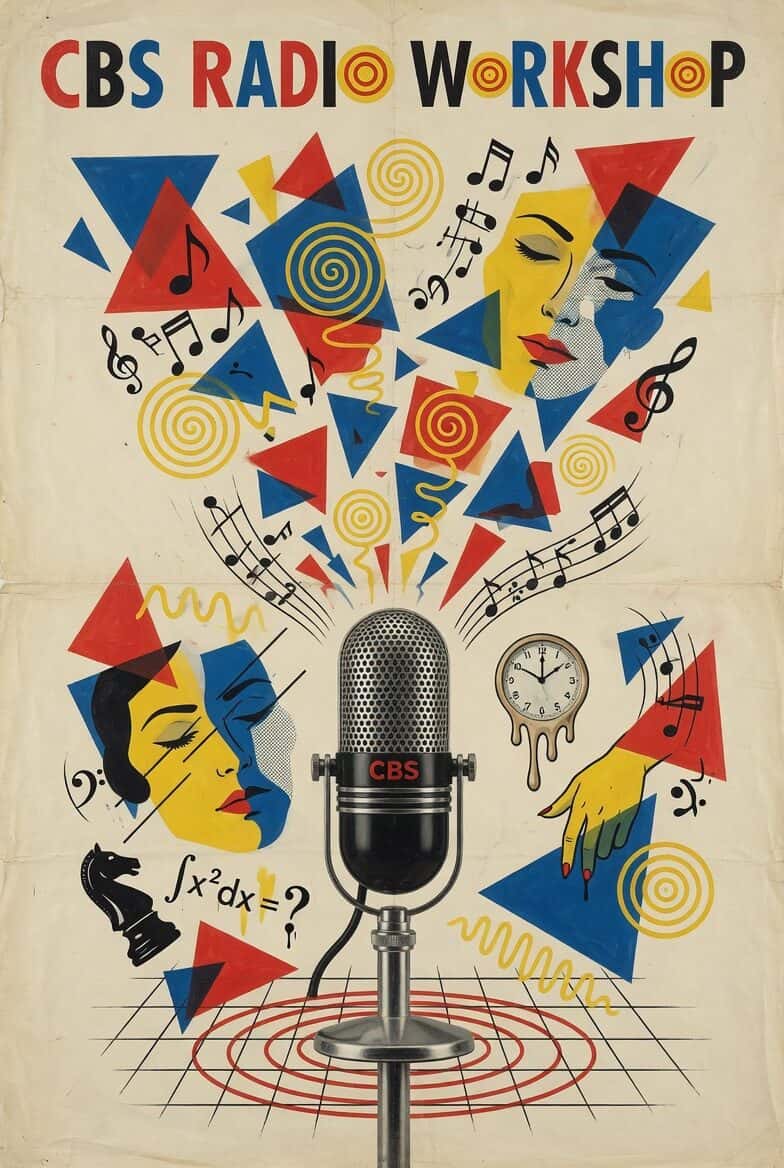
CBS Radio, a division of the Columbia Broadcasting System, and its 217 affiliated stations, present the CBS Radio Workshop, dedicated to man's imagination, the theater of the mind. Tonight we spin the hands of the clock backward into the fascinating past to bring you an unusual symposium of early American popular music explored by the eminent Dr. Vincent Arbogast and Mr. Titus McFatridge, the record collectors. Our special guests will be the noted singer, Miss Margaret Whiting, composer-conductor, Mr. Lynn Murray, and a great voice from the past, Miss Margaret Young. And now here is our moderator, Mr. John Dehner.
Good evening. Some people collect stamps, seashells, or old coins. Others collect paintings, butterflies, or matchsticks. With us tonight are two gentlemen who collect old records. They are Dr. Vincent Arbogast and Mr. Titus McFatridge. To take them in alphabetical order, let's hear first from Dr. Arbogast.
Good evening, sir.
Good evening, Mr. Dehner, and friends out there in Radio Land. And Mrs. Tessie Dorblin in La Jolla.
Before we get to our records, I'd like to talk about what you two gentlemen do. I mean in the field of commerce as opposed to your hobby. Dr. Arbogast. Dr. Arbogast, you are a breeder of giant frogs, right?
Yes, Mother and I have a frog farm at Costa Mesa.
Dr. Arbogast, are you a real doctor?
Well, let me answer your question with a question, Mr. Dehner. Are frogs entitled to medical services?
If they're sick.
You would deny them medical service if they were well?
No, no, I didn't say that, doctor. All I asked you was, are you a medical doctor?
No.
I see. Well, one day... One day, several years ago, a mutinous assistant at the farm challenged one of my frog-feeding formulae. I told him, that formula, or pack your duds.
An ultimatum.
Pack your duds. He simpered, you're the doctor. The weasel.
That's how you became Dr. Vincent Arbogast.
Yes.
Now, Mr. McFatridge, you, I believe, are engaged in the field of teratology, right?
Roger. Roger. Roger. Titus heard an aeronautist use... Titus used that as a form of agreement.
Oh. Well, what is teratology, Mr. McFatridge?
The science of creating monsters.
Monsters?
I made a dilly for a Christmas parade in Muncie, Indiana, for a department store.
What kind of monster was it, specifically, I mean?
Well, sir, I took the body of a crocodile, the head of the bearded yak, and the wings of the condor. Beautiful. I felt I had something here that would frighten any child.
At a Christmas parade? Is that what you wanted?
Yes, yes, yes.
Did it work?
No. There were no children to frighten. They had all fled in terror from the first exhibit in the parade, a monster five floats ahead.
What was that?
Well, sir, it was a man-like thing stuffed into a flaming red suit with a raging white beard. As it lashed its reindeer, it waved ferociously in all directions, shouting threats at the crowd. The children left.
Now, as I understand it, you two gentlemen plan to present tonight your views on American popular music. So, may we have your first recording, please?
It is the hit tune of 1923, Toot, Toot, Tootsie. It is sung by that very popular duo of vaudeville and records, Billy Murray and Ed Smalle. And note the realistic train whistle interpolated into the rendition.
Yesterday I heard a lover sigh. Seven times he got aboard his train. Aboard his train. And seven times he hurried back to kiss his love again. And then tell her, Toot, Toot, Tootsie, goodbye. Please don't cry, little Tootsie. The choo-choo train that takes me far away from you. No word can tell how sad it makes me. Kiss me, Tootsie, and then do it over again. Kiss me again, sweet mama. Watch for the mail. I promise I'll never fail. You know if you don't get a letter, then you'll know I'm in jail. Toot, Toot, Tootsie. Toot, Toot, Toot, Toot, Toot, Toot, Tootsie. Don't cry. Toot, Toot, Toot, Toot, Toot, Toot, Tootsie. Toot, Toot, Tootsie.
The 1923 hit sung by Billy Murray and Ed Smalle. They don't make records like that these days, Mr. Dehner.
Dr. Arbogast, how long have you been collecting records?
Uh, 30 years, 4 months, approximately.
And how many do you have, approximately?
Really, I wouldn't venture to say. I measure my collection by values far removed from consideration of mere numbers. Oh, let the banker count his money, let the farmer weigh his crops. But upon what adding machine, upon what scales can a collector measure the value of his treasure?
Well, Dr. Arbogast, how do you measure the value of the records in your collection?
I realized that everybody was collecting the records of artists who were so good that the public didn't appreciate them. But nobody was saving the records of the singers and musicians who were popular in their day. I determined to remedy that deplorable situation.
How?
I set out to acquire records that once sold by the millions, the records the general public paid its money for.
Well, now, do I understand you to say that there are no really great artists in your collection?
Not at all. It occasionally happens that a truly fine artist is acclaimed by the public as well as by the critics. In such a case, I would not let an artist's superior talent bar him from a place in my collection.
I see. Now, let's hear from our other collector, Mr. Titus McFatridge.
The records in my collection, if laid side by side, would cover two-thirds of the space of a basketball court.
That's very interesting. How many records does that make?
I really haven't the slightest idea. I share Dr. Arbogast's views on the stupidity of counting the items in one's collection.
But how did you arrive at the figure of how much of a basketball court your records would cover if you don't know how many you have?
Empirically and incidentally. Ah, uh-huh. At one time, I resided at the YMCA at Muncie, Indiana. I needed to catalog and sort out my records. Since my room was small, the secretary of the YMCA, Stanley Proctor by name, kindly gave me permission to spread out my records in the gym while the fellows on the team were in the showers. I noted that my records took up two-thirds of the basketball court. Now, those wishing to know exactly the number of records might write to the Muncie, Indiana YMCA for the dimensions of the court. And by the aid of simple arithmetic, compute the number of records I had at that time. Stanley Proctor, however, is no longer there. He was, I believe, transferred to Terre Haute in 1932.
Well, it doesn't matter, Mr. Proctor.
Fort Wayne, not Terre Haute, pardon me.
Now, gentlemen, we move on to our first guest. Mr. Lynn Murray is a distinguished conductor in the field of popular music. His background might best be summed up by referring to his work on the Hit Parade with the excellent... Lynn Murray Choristers. For many years, Mr. Murray has brought Americans live, vibrant interpretations of their most popular ballads. Mr. Murray, it's a pleasure and privilege to have you here and to introduce you to my two colleagues, Dr. Arbogast and Mr. McFatridge. Sir, how old are you?
Well, now, Dr. Arbogast, it's not necessary to...
A man's age is very necessary.
But I have no objections to giving my age.
Well, see, by the way, did you say Billy, Murray?
Uh, Lynn, L-Y-N-N. I was born in 1909.
Oh. Well, that makes you, uh, 46.
Gentlemen, gentlemen, please. I've just invited Mr. Murray to play his latest disc.
Disc, Mr. Dehner? I didn't realize Mr. Murray was a member of the Olympic team.
No, disc, gentlemen, platter, wax, recording. No wonder these modern musicologists can't produce decent renditions. They don't even agree what to call them.
Gentlemen, please. Courtesy, at least. Mr. Murray, would you give us the title of your latest record?
It's called He's Got Time, and the members of the cast are Jane Russell, Connie Haines, and Beryl Davis.
You've never heard of them?
Of course not. Let's listen to Mr. Murray's record.
He's got time He's got time You may not walk his way Because his rainbow didn't get that bright Overnight His roses didn't get that bright Get to flower In an hour His heaven didn't get that blue In a minute or two So he's got time And he can't wait for you He can't wait You may not seek his love Today But he can't wait Takes a week To teach his ivy high And teach his sinners high Keeps him busy all day But he's got time And a way For you He's got time To make a shot He's got time You may not walk his way Because his rainbow didn't get that bright His roses didn't get that flower His heaven didn't get that or two So he's got time And he can't wait for you
Well, gentlemen, Mr. Lynn Murray's latest recording. It's a pity to put those unsullied young ladies at such a disadvantage, recording under this electronic hodgepodge. Where is the surface noise? Where are you? Where are those lived-with sounds?
Well, gentlemen, perhaps now the public can hear the music. Isn't that the general idea, Mr. Murray?
Yes, it is. We're constantly striving for better forms of reproduction, you know. Today, thanks to high fidelity...
High fidelity? Music for dogs. I read just the other day of a basset hound who, upon hearing a rendition of the funeral march on his master's high-fidelity set, went out and cut his throat. A crime against society. These people should be reported to the Society for the Prevention of Cruelty to Animals. That equipment... Electrical equipment? Blaring out noises all over the land. Soon we shall have a nation of deafened canines. Man's best friend.
But, gentlemen, what did you think of Mr. Murray's record?
Sir, this is an electric recording, is it not?
Yes, Vincent. It isn't Mr. Murray's fault that the power is in the control room, you know.
Well, Dr. Arbogast, are you referring to what I understand was the acoustical or mechanical method?
The time-honored... Where the artist played or sang into the horn and his true vibrations were directly stenciled onto the wax mother.
But that's one of the most primitive...
Primitive? Has anyone improved on the wheel?
Thank you, Mr. Murray, for being with us and for bringing along your latest E.P. recording. He's got time.
E.P., Mr. Dehner? E.P.?
That means extended play, gentlemen. Surely you realize records come in various sizes and speeds.
Aha, oh, yes, now we're at the heart of the matter. There is only one size. Is Mr. Dehner one speed?
Yes, 78 revolutions per minute, 10 inches in diameter. Although I have heard there is a small group of malcontents who are considering using 12-inch records. Nothing will ever come of it, nothing.
Thank you, Mr. Murray, for being our guest.
It was a pleasure, Mr. Dehner. Good night, gentlemen.
Good night, Mr. Murray.
Good night, Mr. Murphy.
Dr. Arbogast, you have a record, I believe.
This record dates back 33... 30 years, to 19 and 19. It features one of the most popular feminine singers of that blessed era, the incomparable Miss Nora Bayes. Nora Bayes. Very great artist.
She introduced Shine On, Harvest Moon, didn't she?
Yes, but this record at the time was a very topical number, dealing with the influence of the flickers upon everyday life, the flicker motion pictures.
Yes, yes, sir. Well, many movies in that early day had a wicked woman of the world who had designs upon the noble hero. Now, these women were called vamps. Among them were, well, let me see, Theda Bara... Nita Naldi, Jetta Goudal...
Never belabor a poet, Mr. McFatridge. This record is entitled The Village Vamp and shows the effect of this type of movie upon a simple country girl. The Village Vamp, as sung by Miss Nora Bayes.
Who heard about Miss Sally Green? Sally Green, Sally Green Back home she was called... The Village Queen Sally Green was queen She took one trip to the city Came back home, oh, what a pity Now the folks call her The Village Vamp She's a vamp She wears high-heeled shoes and fancy hose She's a vamp, she's a vamp Paint her face and powders up her nose She's a vamp, she's a vamp Folks all around the world She's a vamp, she's a vamp She goes all day down in the valley Look what Broadway did to Sally Everywhere she goes, the roads all day Hey, there goes the vamp
Oh, oh, my, it's wonderful, wonderful, beautiful.
Now, Mr. McFadrey, do you have any special information about this record we just played?
Well, sir, Aristotle Figg was to have played the rhythmic bones on that record date.
Was to have?
They wrote him out at the last minute.
Oh, it's too bad.
Well, Figg never wanted to play the bones anyway. He was a bass drummer at heart. Played in the village band back in the Midwest. The bandmaster hated his superior talent and was always trying to find a way to get rid of him.
Did he find a way?
Please. Aristotle Figg's son, Bonafide, dabbled in amateur chemistry. A wretched child, he also chewed bubble gum incessantly. At the Sunday school picnic, he turned up chewing and carrying some of his chemicals in a vacuum flask. He was drinking this mixture in between blowing gum bubbles, and listening to the band.
The band was there, sir.
Young Figg didn't know it, but the chemicals he had mixed and was sampling were in just the correct proportions to form helium gas. He blew one monstrous bubble.
What happened?
He took off. There he was, hovering aloft.
Did he just float around aimlessly up there?
No. They shot him down over the bandstand. The minister, fortunately, had his slingshot with him.
Was the boy hurt?
No. He landed on his father's bass drum.
He was pretty lucky, huh?
On the contrary, Mr. Daynor. The elder Figg was counting out an 18-bar rest, three bars before F in the Poet and Peasant, when boom-de-boom landed his son. For that interruption, the bandmaster fired Aristotle Figg, who then developed his talent for the rhythmic bones and entered the popular music field.
Now, gentlemen, it's time to listen to the listener. And the letterbox is open. I have one here from the south, Tampa, Florida, to be exact. Mrs. J.R.W. She wants to know if it's true that a canary was once a featured soloist on an acoustical recording.
Yes, of course. Vocalion B-O-T-1-4-7. Starring the feathered songster Miss Lady Bird, formerly with the Ishpeming Mining Company. Rescued from the mines by an alert Welsh bird lover. The success of this record awakened the public to the plight of the unfortunate canary used against its will to test the air for poisonous gas. Thus was founded in Sundown, Indiana, the S-F-T-P-O-U-C-I-M-S, the Society for the Prevention of the Use of Canaries in Mine Shafts.
I see.
Meetings were held. Never let them take another canary down a mine shaft to test the purity of the air was the battle cry. They had, as a symbol of their crusade, a canary in a cage on a table on stage. After all, if it had been intended for birds to be under the damp ground, birds would have been born there. But birds are not born under the ground. But then miners were not...
Spread their wings, said Russell John, and give the canary the air. His audience loved his hatred of humans. They just sat and puffed orgiastically on their pipes and cigars in high ecstasy. They'd be there today, I think, if that young ruffian hadn't been there. Emma Shakespeare's son. He had an elastic band and a paper clip and a deadly aim. He shot the paper clip at the little canary on stage.
Oh, so that was quite amazing. What a mean act.
The bird was already unconscious as a result of all the cigar smoke in place. The paper clip lodged in the bird's bill, startling him so that he bent the little bars of his cage and exit. Still half asleep, the bird didn't know where he was. He flew around the room, shaking his bill to get rid of the paper clip. When he finally did shake it loose, it fell into one of the chandelier's empty sockets.
What happened?
A short circuit. The place burned to the ground. And the people there were incensed. What they felt was an ungrateful canary. A wave. A wave. A wave of anti-canary feelings swept the town, destroying the society forever.
Well, we can file Mrs. J.R.W.'s letter as answered. Now, gentlemen, I understand your next record is a rare one.
Indeed it is, Mr. Dinner. It was recorded in 1922, and it features that beautiful and talented vaudeville headliner, Miss Margaret Young.
Right. Careful title, sir.
Its title is Way Down Yonder in New Orleans.
Way Down Yonder in New Orleans, featuring Miss Margaret Young.
Now, gentlemen, I have a surprise for you. We have as our special guest this evening none other than Miss Margaret Young.
Oh! Bravo! Bravo!
Thank you, boys. Maggie, we've been admirers of yours for many, many years. They just don't make records like that anymore.
They still do.
They certainly don't. Youngsters today have no appreciation for basic values. Maggie, how many copies of that recording were sold?
Oh, over a million.
Oh, there you see. But listen, I didn't come here to play my record. I came to introduce you to my niece. She's the singing star of our family now, and I thought you'd like to meet her and hear one of her records.
Well, if you insist. Boys, just meet my talented niece, whose name is also Maggie.
How do you do?
How do you do? What's your last name, young lady?
My full name is Margaret Whiting.
Whiting? A whiting is a fish. Will you walk a little faster, said the whiting to the snail?
Lewis Carroll, Allison.
The Reverend William Dodgson, nom de plume, Lewis Carroll.
Oh, thank you, Taddis. Gentlemen, I should think that you would be quite honored to have as your guest tonight one of America's most popular singers. Margaret Whiting is known from coast to coast. Her records have sold by the millions.
Name one.
Well, there's...
That one alone sold over a million copies. And would you rank such a song in the same class with Out of a City of 10,000 People, Why Did You Pick on Me?
Oh, that was lovely.
Yes, it was, but I remember it well. That song sold over a million copies, Mr. Daner.
Well, gentlemen, that was a little before my time. After all, I'm...
She's right, Taddis. She couldn't be expected to remember the classics. She's still young. And we must keep in mind, after all, she is Maggie Young's niece.
Yes, that's a good point.
Yes, of course. Young lady, we've decided to listen to your record, regardless of our personal feelings in the matter.
Well, thank you, gentlemen. The name of my record is I've Told Every Little Star.
I've told every little star Just how sweet I think you are Why haven't I told you? I've told ripples in a brook Made my heart an open book Why haven't I told you? Friends ask me, am I in love? I always answer yes Might as well confess If I don't, they give Maybe you may know it too Maybe you may know it too Maybe you may know it too Maybe you may know it too Maybe you may know it too Maybe you may know it too Oh, my darling, if you do And you told me Friends ask me, am I in love? Always answer yes Might as well confess If I don't, they give Maybe you may know it too Oh, my darling, if you do Why haven't I told you? Why haven't you told me? I've told every little star
By our guest, Miss Margaret Whiting.
Well, gentlemen, what did you think? Gentlemen?
Well, perhaps you could tell us something about the record, Miss Whiting.
Well, I'd be delighted. See, it's from a recent LP album I recorded for Cal.
LP? First it's EP, now it's LP. One must need a code book just to talk to you people.
LP means long playing. Approximately 20 minutes on each side of the record.
Perhaps for people with long ears, huh, Vincent?
Oh, that's very good. Oh, that's very good.
Gentlemen, of course, Margaret Whiting...
Whiting can't hold a candle to a sardine.
Indeed not. I recall one dinner back in 1907, Vincent, in Kansas City.
Miss Whiting, we appreciate your dropping by.
Well, the pleasure was all mine. Good night, Dr. Arbogast. Mr. McFadden...
The oysters were perfectly dreadful, but the sardines... The sardines, mm. I recall a young man I met that evening.
Gentlemen, gentlemen, we are discussing recordings.
Oh, yes, of course. Well, the last recording was Way Down Yonder in New Orleans.
Well, no, we just played her niece's, Margaret.
Way Down Yonder in New Orleans. Most unusual. Most unusual. Will you have some information on that record?
Yes. Paysag Gaskell, I think, played clarinet on that one.
Do you mind, Paysag, Vincent?
Oh, yes, I mind, Paysag Gaskell.
Well, well, good clarinetist. He was a channel swimmer, too.
A channel swimmer?
Mm-hmm, the best. There was a champion. Paysag never used grease. He used to flex his little muscles and say proudly, what's good enough for the blue whale is good enough for me.
Ah. Well, gentlemen, our time is up. Paysag Gaskell was an excellent channel swimmer, and at the drop of a towel he would plunge into any water that even resembled a channel. He was once compared favorably with the lemming.
Well, that's it, gentlemen. Our time is up.
Yeah. Now, say good night to Arlie.
Listeners.
Good night, friends out there in Radio Land. And Mrs. Carrie Moomaw in the Needles Public Library. By the magic of electronic recording, we have brought you the views of two men, Dr. Vincent Arbogast and Mr. Titus McFatridge, the record collectors. Their guests were Mr. Lyn Murray, noted composer and conductor, the popular singing star, Miss Margaret Whiting, and Miss Maggie Young. This is John Daner saying good night.
The CBS Radio Workshop is produced and directed in Hollywood by William Froog. The Record Collectors was written by William Woodson, Lou Houston, and Larry Thor. Howard McNear was Dr. Arbogast, and Lou Houston was Mr. McFatridge. The moderator was John Daner. Next week, a new and unusual musical presentation, an original one-act opera for radio composed and conducted by David Brookman, based on the first war between the states, the story of the battle between Michigan and Ohio over the city of Toledo, told in music, and presented on the CBS Radio Workshop.
I see a rose from you among my souvenirs A few more tokens are left within my treasure chest And though they do their best to give a consolation I count them all apart And as the teardrops start I find a broken heart among my souvenirs