
The written record
Read the transcript
Read along with the recording · About 20 min to read
<!-- kimi_cleaned -->
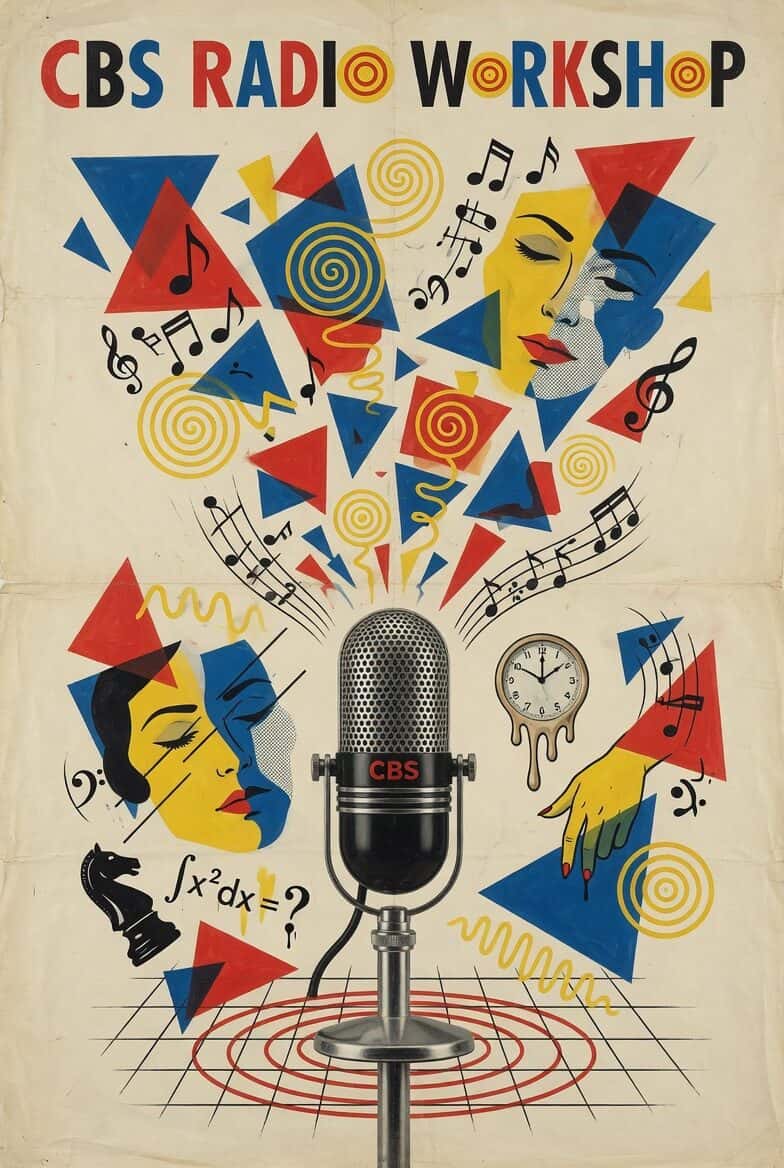
CBS Radio presents the CBS Radio Workshop, dedicated to man's imagination, the theater of the mind. Tonight, the enormous radio, based on John Cheever's extraordinary short story, which originally appeared in the pages of the New Yorker magazine.
Don't you want to hear the workshop? It's a pretty good show.
Oh, I feel like music, don't you?
It's the Schubert Phantasy, isn't it?
Yeah. All right, leave it on. A little louder, though, will you?
Jim and Irene Westcott were the kind of people who seemed to strike that satisfactory average of income, endeavor, and respectability that is reached by the statistical reports in college alumni bulletins. They differed from their friends, their classmates, and their neighbors, only in an interest they shared. They shared in serious music. They went to a great many concerts, although they seldom mentioned this to anyone, and they spent a good deal of time listening to music on the radio.
Now, their radio was an old instrument, sensitive, unpredictable, and beyond repair. And when it faltered, Jim would strike at the side of the cabinet with his hand, while this sometimes helped. But one Sunday afternoon...
Darling, the radio. Oh, no, this time it's finished.
Bang it again.
Oh, it's finished. It's just burned out.
It might not be. How do you know? Try reversing the plug or something.
But it won't do any good. It's a miracle it lasted this long. Let me try.
That's not going to do any good. A woman's touch. Why don't you sit down? It'll... See, there it goes. It's so aggravating. And of course, it had to happen while they were playing the Schubert.
Take it easy. It makes me mad. We knew this was going to happen. We should have done something. I told you what the repairman said, honey. It'd cost almost as much to fix it as to buy a new one.
Darling, couldn't we get a new one?
I don't know. We agreed to get along with this until we could get a good high-fi with some FM.
Please. It's not going to be much fun without music.
All right. All right, dear. I'll look around tomorrow. See what I can find.
The next day, on Monday, when he came home from work, he told her that he'd got one. He refused to describe it and said that it would be a surprise for her when it came.
The radio was delivered the following afternoon. And with the assistance of her maid and the handyman, Irene uncrated.
Here, you hold this, Emma. And brought it into the living room. We'll take this stuff in the kitchen later. Oh, this sure is a heavy one.
It's not a very pretty cabinet.
Oh, ma'am, look at all the dials on it. I never could get the hang of that.
It shouldn't be too difficult, I suppose. Volume, treble boost, bass boost, tuning, shortwave, band. One, two, three, four. Oh, well, this must be the switch to turn it on. Yes. Plug it in now, will you, Emma?
Oh, yes, ma'am. All right. It probably takes a minute to warm up.
Well, isn't it, ma'am? Much louder than the old one.
Yes. It'll take a little getting used to, tuning it in. My, you certainly do know how to find good music, I'll say.
It is nice. Well, you'd better see about getting supper now.
Yes, ma'am.
It's time to listen, feeling once again complete. The music came through clearly. The new instrument had a much purer tone, she thought, than the old one. But she decided that tone was most important, and she could conceal the ugly gumwood cabinet behind the sofa.
But as soon as she'd made her peace with the radio, the interference began.
Oh, dear. And they call this high-fi.
Nothing she did with the switches and dials dimmed the interference. As she sat down again, disappointed and bewildered, and tried to trace the flight of the melody. The elevator shaft in her building ran beside the living room wall, and it was the noise of the elevator that gave her a clue to the character of the static. The rattling of the elevator cables were reproduced in her loudspeaker. And realizing that the radio was sensitive to electrical currents of all sorts, she began to discern through the Mozart, the various other sounds. By listening more carefully, she was able to distinguish doorbells, elevator bells, electric razors, and Waring mixers, picked up from the apartments that surrounded her. The powerful and ugly instrument, with its mistaken sensitivity to discord, was more than she could hope to master, so she turned the thing off.
Hello?
Hello, Irene. Did it get there?
Oh, the radio. Yes, dear. How do you like it?
Well, it's fine, but...
But what?
Well, there's all kinds of sounds, noises coming through.
What do you mean? Static?
Well, yes, but more like real noises. I think it's picking up all the electric things in the building. Bells, vacuums, telephones...
You better not fool with it until I get home. It probably needs a ground or something.
All right. I think it's wonderful, dear. Much nicer than the old one, when it's clear. The music sounds beautiful.
Oh, good. Well, I'll see you later. Bye.
Bye.
When Jim Westcott came home that night, he went to the radio, confidently. Worked the controls.
Low pressure area, which developed over the southwest yesterday, is moving rapidly toward the north and east. With lower temperatures...
What the devil?
That's what I was telling you.
He fiddled with the knobs. Couldn't get rid of the noise. And he turned the radio off.
What the heck with it, huh? I'll call the fellow who sold it to me in the morning. He's going to hear something from me.
The following day, Irene had a luncheon date and did some shopping during the afternoon. It was late when she returned home and she didn't have a chance to turn on the radio, although the maid informed her that a man had come and fixed it. She busied herself with the children, seeing to their baths and bedtime. When Jim came home that night, he was tired and took a shower and changed his clothes, and then he joined Irene in the living room. He had just turned on the radio when the maid announced dinner, so he left it on and he and Irene went to the table.
I saw the sweetest dress this afternoon. Of course, I didn't buy it, but...
Well, that's just as well. I mean, we'd better go slow for a bit.
Hard day, dear?
Yeah. Music does sound nice, doesn't it?
Mm, very nice.
For heaven's sake, Kathy, do you always have to play the piano when I get home?
Well, it's the only chance I have. I'm at the office all day.
So am I. I wish you'd...
Did you hear that?
Yeah, but it's probably a play.
I think it is a play. What's the matter? Where are you going?
I want to see what that was.
Well, try another station.
Hey, have you seen my garters? Button me up.
I said, have you seen my garters? Just button me up and I'll find your garters.
All right, all right. Is that a radio show?
I don't know. Here, let me see them. I wish you wouldn't leave apple cores in the ashtray. I hate the smell.
What the devil is this?
Thanks. Mr. Coromandel, well, where the early pumpkins blow, in the middle of the woods lived the Yonghy-Bonghy-Bo. Two old chairs and half a candle, one old jug without a handle.
That's the Sweeney's nurse. What?
Turn that thing off. Maybe they can hear us.
That was Miss Armstrong, the Sweeney's nurse. She must be reading to the little girl. They live in 17B. I've talked to her in the park. I know her voice.
We must be getting other people's apartments. That's impossible.
That was Sweeney's nurse. I know her voice. I know it very well.
All right, now, wait a minute. Wait a minute.
A lady jingly, sitting where the pumpkins blow. Maybe they can hear us.
You can't be my wife. I'll get him. I'm tired of living singly on this house.
Hello?
So wild and singly.
Hello?
I'm a weary of my life. If you'd come and be my wife...
I guess she can't hear us.
...quite serene would my life be.
Try something else.
Great. Oh, sure, I'd love some. Those must be the Hutchinsons in 15B. I knew they were giving a party this afternoon. I saw her in the liquor store.
Isn't this divine?
Try something else.
All right, wait a minute. See if you can get those people in 18C.
The Westcotts overheard that evening a monologue on salmon fishing in Canada, a bridge game, running comments on home movies, and a bitter family quarrel about an overdraft at the bank. They turned off the radio at midnight, went to bed, weak with laughter.
Sometime in the night, their son began to call for a glass of water, and Irene got one, got into his room. It was very early. From his window, all the lights in the neighborhood were extinguished. She went into the living room and turned on the radio.
All right, darling. All right, I guess. But you know, Charlie, I don't feel like myself anymore. Sometimes there are only, oh, about 15 or 20 minutes in the week when I feel like myself. I don't like to go to another doctor. The doctor bills are so awful already, but I just don't feel like myself. I don't feel like myself, Charlie. I just never feel like myself.
Oh, dear. How sad. How terribly sad.
The following morning, after her children and husband had been carried away in the elevator, she went into the living room and tried the radio again.
Are going to school this morning, my girl, and that's all there is to it. Look, we paid $800 to get you into that school, and you'll go if it kills you.
I think he's so hot, why don't you just...
Oh, sure. Oh, sure. I can just see you. You'd like that, wouldn't you? That's what you're waiting for. You'd like me to do something like that. The kind of thing you've been doing. Huh? You think I don't know? You think I don't smell that perfume on you when you get home from work? Work? You think I haven't seen the lipstick on your handkerchief?
That's the Johnson's.
If you look in my pockets again, I'll break your arm. Thanks for a lousy breakfast and indigestion. I may see you tonight and I may not.
Go on. Get out. Go on. Stay out all night.
Maybe I will.
Irene shifted the control, and invaded the privacy of several breakfast tables. She overheard demonstrations of indigestion, love, abysmal vanity, faith, and despair. Her life was nearly as simple and sheltered as it appeared to be, and the forthright and sometimes brutal language that came from this loudspeaker the morning there astonished and troubled her. She continued to listen until her maid came in, and then she turned the radio off quickly. Since this insight, she realized, was a furtive one.
She had a luncheon date with a friend that day and didn't get home until after 2:30. For some reason, she felt strangely disturbed.
Hello, dear. I expected Miss Cummings.
No, she's out getting me some coffee. My, what an efficient secretary.
Something wrong?
No. You won't forget we're going out for dinner tonight.
No, I won't forget. Look, dear, I'm rather busy.
Oh, I'm sorry, dear.
That's all right. Oh, the funniest thing. What? I went out for lunch. There were some people in the apartment elevator. It was the funniest thing. I kept wondering...
Honey, will you tell me about it later? I haven't got time now. I'll see you about seven.
The best scotch to anyone who hasn't white hair. And see if you can get rid of that liver paste before you pass those hot things.
As the afternoon waned, the conversations increased in intensity. On her radio, she could hear the arrival of cocktail guests, the return of children, and businessmen from their schools and offices. The voices swirled around her.
I found a good-sized diamond on the bathroom floor this morning. It must have fallen out of that bracelet Mrs. Dunstan was wearing last night.
Let me see it. Here it is. We'll sell it. We'll take it down to the jeweler on Madison Avenue and sell it. Mrs. Dunstan won't know the difference, and we could use a couple of hundred bucks out of it.
No. How horrible.
Oranges and lemons, Say the bells of St. Clement's. Hey, pence and farthing, Say the bells of St. Martin's. When will you pay me? Say the bells at Old Bailey.
It's not a hat. It's not a hat. It's a love affair. He said it's not a hat, it's a love affair.
Talk to somebody, honey. Talk to somebody. If she catches you standing here not talking to anyone, she'll take us off her invitation list. And I love these parties.
I hate these things. I think they stink.
I love them.
The Westcotts were going out for dinner, and when Jim came home, Irene was dressing. She seemed sad and vague, and he brought her a drink. They were dining with friends in the neighborhood, and they walked to where they were going. It was one of those splendid spring evenings that excite memory and desire, and the air that touched their hands and faces felt very soft. A Salvation Army band was on the corner playing.
"They're really such nice people, aren't they? They have such nice faces. Actually, they're so much nicer than a lot of people we know."
She took a bill out of her purse and walked over and dropped it into the tambourine. There was in her face when she returned to her husband a look of radiant melancholy that he was not familiar with. And her conduct at the dinner party seemed strange to him too. She interrupted her hostess.
"I don't agree with you. I think you're absolutely wrong. Completely wrong."
Stared at people across the table from her with an intensity for which she would have punished her children.
She waited that night until Jim had fallen asleep, and then went into the living room and turned on the radio.
The next day she had a slight headache and didn't keep an appointment she had. At two o'clock Jim called her from the office.
"Everything all right?"
"Yes, I suppose so."
"Aren't you feeling well?"
"I've got a bit of a headache."
"Oh. What'd you find out about the car?"
"No, I didn't."
"Well, I asked you to be sure to, honey. We won't get it until tomorrow now. Now, will you please call them right away and tell them I've got to have it by tomorrow?"
"Yes."
"Irene, did you hear me?"
"I said yes."
"What's the matter with you?"
"I've got a headache."
"You've been listening to that radio all morning, haven't you? Now, look, fun's fun, but you're running it into the ground, honey. It's not good for you. Now, please, keep the thing off, will you?"
"All right."
"You promise?"
"All right."
Jim came home at about six that night. Emma, the maid, let him in. And he had taken off his hat and was taking off his coat when Irene ran into the hall.
"Go up to 16C, Jim."
"What?"
"Don't take off your coat. Go up to 16C. Mr. Osborne's beating his wife. They've been quarreling since four o'clock and now he's hitting her. Go up there and stop it."
"No, cut it off, stop it. You don't have to listen to this sort of thing, you know. It's indecent. It's like looking in windows. You know you don't have to listen to this sort of thing. You can just turn it off."
"It's horrible. It's so dreadful. I've been listening all day."
"Honey, why do you listen to it? Why? I bought the filthy thing to give you some pleasure. I paid a lot for it. I thought it might make you happy. I wanted to make you happy."
"No, no, no. Don't quarrel with me, please. Please. All the others have been quarreling all day. Everybody's quarreling. They're all worried about money. Mrs. Hutchinson's mother is dying in Florida. And they don't have enough money to send her to the Mayo Clinic. And Mrs. Melville has... heart trouble. And some woman is playing around with the superintendent. It's disgusting. And Mr. Hendricks is going to lose his job. And that girl who plays the Missouri Waltz all the time. Mr. Osborn hitting Mrs. Osborn."
"Irene, Irene, listen to me. Why do you have to turn it on? Why do you have to listen to that stuff? It makes you so miserable."
"No, not too terrible. It's too sordid and too awful. We've never been like that, have we, darling? Have we? I mean... we've always been good and decent and loving, haven't we? And we have two children. Beautiful children. Our lives aren't sordid, are they, darling? Are they? We're happy, aren't we? We are happy."
"Of course we're happy, darling, of course. Now, look, I'll have the fool radio fixed or taken away tomorrow. Come on, it's all right, honey. It's all right. You love me, don't you? And we're not... we're not hypercritical or worried about money or dishonest, are we?"
"No."
A man came in the morning and fixed the radio. And Irene was happy to hear a recording of the Beethoven Ninth, including Schiller's Ode to Joy. She kept the radio on all day. And nothing untoward came from the speaker. Debussy's La Mer was being played when Jim came home, and they went into dinner.
His face was pale, she thought.
"I, uh, I paid the bill for the radio today. It cost four hundred dollars. I just hope you get some enjoyment out of it."
"I'm sure I will, darling."
"Four hundred dollars is a good deal more than I can afford. But I wanted to get something you'd enjoy. It's the last extravagance we'll be able to indulge ourselves in this year."
"All right, dear, of course I understand."
"Irene, by the way, I... I noticed you hadn't paid your clothing bills yet. I saw them on your dressing table."
"Oh, I, uh, suppose I must have forgot?"
"Well, why did you tell me you'd paid them? Why did you lie to me?"
"Well, I just didn't want to worry you, Jim. I'll be able to pay my bills out of this month's allowance. There were slipcovers last month from that party we had together."
"Well, you just got to learn to handle the money I give you a little more intelligently, Irene."
"Yes, darling, I will. I really will."
"You've just got to understand that we won't have as much money this year as we had last, eh? I had a very sobering talk with Mitchell today. No one's buying anything. We're spending all our time promoting new issues. And you know how long that takes. I'm not getting any younger, you know. I'm thirty-seven, and I haven't done as well as I hoped I'd do. I... I don't suppose things will get any better."
"Yes, Jim."
"We've just got to start cutting down. Start thinking of the children. To be perfectly frank with you, I worry about money a great deal. I'm not at all sure of the future. No one is. I've worked very hard to give you and the children a comfortable life. And I don't like to see all that energy wasted in fur coats, radios, and slipcovers."
"Please, Jim, please, they'll hear us."
"Who'll hear us? Emma can't hear us."
"The radio! The radio!"
"I'm sick of it! I'm sick to death of you..."
"That radio can't hear us! Nobody can hear us! And what if they can hear us? Who cares? Why are you so holier than thou all of a sudden? What's turned you overnight into a nice girl? You stole your mother's jewelry before they probated her will. You never gave your sister a cent of that money that was intended for her. Not even when she needed it."
Irene stood for a minute before the... hideous radio, disgraced and sickened. But she held her hand on the switch before she extinguished the music, hoping that the instrument might speak to her kindly, that she might hear the Sweeney's nurse. And as she turned the dial, the voice on the radio was suave and noncommittal.
Buffalo. A fire in a hospital near Buffalo for the care of blind children was put out early this morning. There were several injuries but no fatalities. And that's the news. The temperature downtown is sixty-four. Humidity, ninety. And now an interlude of music.
The CBS Radio Workshop has presented The Enormous Radio by John Cheever. Produced and directed by Antony Ellis. The script was adapted for radio by Mr. Ellis. The cast included William Conrad, Virginia Gregg, Stacy Harris, Eve McVeagh, Hans Conried, Charlotte Lawrence, Joseph Kearns, Paula Winslowe, Herb Butterfield, Helen Kleeb, George Walsh, and Irene Tedrow. Special effects were by Robert Chadwick, Bill James, and Clark Casey.
This is Hugh Douglas inviting you to join us again next week when from New York we present a special production by the Helen Hayes Drama Group, Lovers, Villains, and Fools, with the famous actress as narrator. The title of the piece is derived from the three principal categories of character portrayals which are basic equipment for which members of this theater group strive. The narration is written by Albert G. Miller. Special music has been composed and will be conducted by Alex Steinert. That's next week on the CBS Radio Workshop.
How many people are there in a crowd of ten million? Do you have any picture in your mind, or is that figure too overwhelming? Well, ten million is more people than there are in Chicago, Philadelphia, and Los Angeles combined. And that's how many men, women, and children in our country are suffering from some form of mental illness. Yes, ten million. Among that ten million maybe there's someone you know, a neighbor, friend, or a relative. So you see, mental illness is a problem that concerns us all. And that's why we are all being asked to give to our local mental health campaign to fight mental illness. The best weapon is research. Research to find out how to prevent mental illness. Your doctors can be helped by your dollars. They can learn enough to really lick this number one problem, mental illness. The victims of mental illness need your help desperately. Give to your local mental health campaign.
Stay tuned for five minutes of CBS News, to be followed on most of these same stations by My Son Jeep. America listens most to the CBS Radio Network.