
The written record
Read the transcript
Read along with the recording · About 20 min to read
<!-- kimi_cleaned -->
This is Helen Hayes, and this is a simple story about actors. I guess I know pretty much about actors because I've been one for 50 years.
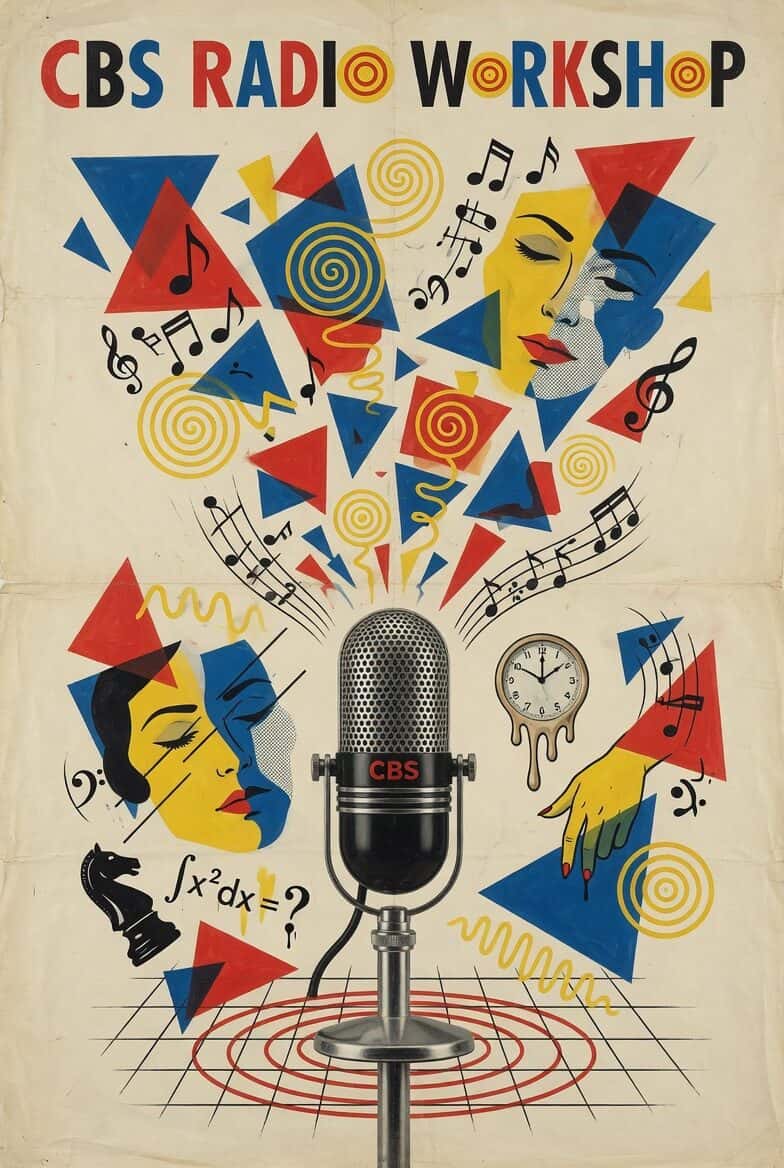
The CBS Radio Workshop, dedicated to man's imagination, the theater of the mind. Tonight, the Helen Hayes Drama Group and Helen Hayes present Lovers, Villains, and Fools.
Helen Hayes has been known for years as one of the leading actresses of the American stage, and lately as a New York theater. And now on tape, Miss Hayes.
Thank you. I still haven't become accustomed to being a theater. But after all these years inside of theaters, I'm quite at home when talking about actors and acting. As I said a moment ago, this is a story about actors. Throughout history, strange opinions have been held about actors by people outside the profession. People sometimes say, sometimes known to theater folk as civilians, actors have been accused of being childlike, vain, feather-brained, irresponsible, and, well, sometimes not even quite respectable. But whatever else they are, actors are artists. They work hard to learn their trade. It isn't easy to be called on to be a lover for one instant and a villain the next, and then turn from being a villain into a fool.
And so an actor reaches for Shakespeare, whose plays provide him with all the examples of character he will ever need, no matter what, ever, or wherever he plays. Tonight, Jack Manning, my young actor friend, has brought our group to the studio with a Shakespearean repertoire of lovers, villains, and fools. And it might be wise to begin foolishly with a fool. The actor will be Dick York, reading a speech of Launce, a foolish fellow in Two Gentlemen of Verona. Launce is the clownish servant of Proteus, one of the two gentlemen. He is especially appreciated for his soliloquies to his dog, Crab, the sourest natured dog that lives. The stage direction, enter Launce, leading a dog.
When a man's servant shall play the cur with him, look you, it goes hard. One that I brought up of a puppy. One that I saved from drowning. When three or four of his blind brothers and sisters went to it. I have taught him, as you might say, precisely. Thus I would teach a dog. I was sent to deliver him as a present to Mistress Sylvia from my master. And I came no sooner into the dining chamber, but he steps me to her trencher and steals her capon's leg. Oh, 'tis a foul thing when a cur cannot keep himself in all companies. If I had not had more wit, to take a fault upon me, that he did, I think verily he'd have been hanged for it. Sure as I live, he'd have suffered for it. You shall judge. He thrust me himself into the company of three or four gentlemanlike dogs under the Duke's table. He'd not been there, bless the mark, but all the chamber smelt him. Out with the dog, says one. What cur is that, says another. Whip him out, says a third. Hang him up, says the Duke. Well, I, having been acquainted with this smell before, knew it was Crab. And goes me to the fellow that whips the dogs. Friend, quoth I, do you mean to whip the dog? Aye, marry I do, quoth he. You do him the more wrong, quoth I. 'Twas I did the thing you wot of. He makes me no more ado, but whips me out of the chamber. How many masters would do this for their servant? Oh, thou thinkest not on this now. Nay, I remember the trick thou served me when I took my leave of Madam Sylvia. Did I not bid thee still mark me and do as I do? When didst thou ever see me heave up my leg against a gentlewoman's farthingale? Didst thou ever see me do such a trick?
Certain people may think it's easy for an actor to play a fool because they fondly believe that he is a man. They fondly believe that an actor is a fool to begin with. Well, is he really? Certainly an actor does his work earnestly and honestly. Mr. J.B. Priestley, the author, has this to say. I prefer acting that I see in the theatre, says Mr. Priestley, to acting that I see in the Harley Street consulting room, in the law courts, or the houses of Parliament. The man who openly plays a character part for two hours a night is more likely to remain in a healthy state of mind than the man who plays a character part day and night, using every room he enters as his stage.
So much for who is the fool. Now, in Twelfth Night, Shakespeare tells the story of lovers and demonstrates his fondness for disguising his heroine as a boy, thus fooling a lovesick swain. Joseph Warren plays the Duke, and Terry Clark plays Viola.
Give me some music. Come, the song we had last night. Mark it, Cesario. It is old and plain. The spinsters and the knitters in the sun and the free maids that weave their thread with bones do use to chant it. It is silly sooth, and dallies with the innocence of love, like the old age.
Come hither, boy. How dost thou like this tune?
It gives a very echo to the seat where love is thrown.
Thou dost speak masterly. My life upon it, young though thou art, thine eye hath stayed upon some favour that it loves. Hath it not, boy?
A little by your favour.
What kind of woman is't?
Of your complexion.
She is not worthy, then. What years, i'faith?
About your years, my lord.
Too old by heaven. Let thy love be younger than thyself, for thy affection cannot hold the bent. For women are as roses, whose fair flower, being once displayed, doth fall at very hour.
And so they are. Alas, that they are so, to die even when they to perfection grow.
Once more, Cesario, get thee to yon same sovereign cruelty.
But if she cannot love you, sir.
I cannot be so answered.
O sooth, but you must. Say that some lady, as perhaps there is, hath for your love as great a pang of heart as you have for Olivia. You cannot love her, you tell us, so must she not then be answered.
There is no woman's sides can bide the beating of so strong a passion as love doth give my heart.
Ay, but I know.
What dost thou know?
Too well what love women to men may owe. In faith they are as true of heart as we. My father had a daughter, loved a man. As might be, perhaps, were I a woman, I should your lordship.
And what's her history?
A blank, my lord. For she never told her love. But let concealment, like a worm i' the bud, feed on her damask cheek. She pined in thought, and with a green and yellow melancholy she sat like patience on a monument, smiling at grief. Was not this love indeed? O, we men may say more, swear more, but indeed our shows are more than will, for still we prove much in our vows, but little in our love.
But died thy sister of her love, my boy?
I am all the daughters of my father's house, and all the brothers, too, and yet I know not.
So shall I to this lady?
Aye, that's the theme. To her in haste. Give her this jewel. Say, my love can give no place, bide no denay.
The players who are illustrating this story about actors are all young, they're all artists, and they all make their living by acting on stage, screen, radio, or television. They formed their group because they felt a desperate need to learn their craft well by working. And they chose to study and perform Shakespeare because Shakespeare is the one dramatist who challenges every mood, every skill, and every emotion. Being human beings as well as actors, there are lovers among these young people, I'm certain of that, and there may be a fool or two. But I'm sure that there are no out-and-out villains. Actors leave pure villainy to the drama critics. But they can quickly assume the villain's sneer when the part calls for it. Villainous roles such as Gloucester in King Henry VI, Part III. Here's Jack Manning as Gloucester, the man who can smile and murder while he smiles.
Aye, Edward will use women honorably. Would he were wasted, marrow, bones, and all, that from his loins no hopeful branch may spring to cross me from the golden time I look for. And yet, between my soul's desire and me, the lustful Edward's title buried, is Clarence, Henry, and his son young Edward, and all the unlooked-for issue of their bodies to take their rooms ere I can place myself. A cold premeditation for my purpose. Why, then, I do but dream on sovereignty. Eh, say there is no kingdom then for Richard. What other pleasure? What can the world afford? I'll make my heaven in a lady's lap and deck my body in gay ornaments and witch sweet ladies with my words and looks. Miserable thought. And more unlikely than to accomplish twenty golden crowns. My love forswore me in my mother's womb. She did corrupt frail nature with some bribe to shrink mine arm up like a withered shrub, to make an envious mountain on my back where sits deformity to mock my body, to shape my legs of an unequal size, to disproportion me in every part like to a chaos or an unlicked bear-whelp that carries no impression like the dam. And am I, then, a man to be beloved? O, monstrous fault to harbor such a thought. Then, since this earth affords no joy to me but to command, to check, to o'erbear such as are of better person than myself, I'll make my heaven to dream upon the crown. And whiles I live, to account this world but hell until my misshaped trunk that bears this head be round impaled with a glorious crown. And yet I know not how to get the crown. For many lives stand between me and home. And I, like one lost in a thorny wood that rends the thorns and is rent with the thorns, seeking a way and straying from the way, not knowing how to find the open air but toiling desperately to find it out, torment myself to catch the English crown. And from that torment I will free myself or hew my way out with a bloody axe. Why, I can smile and murder whiles I smile, and cry content to that which grieves my heart, and wet my cheek with artificial tears, and frame my face to all occasions. I can add colors to the chameleon, change shapes with Proteus for advantages, and set the murderous Machiavel to school. Can I do this and cannot get a crown? Tut, were it further off, I'll pluck it down.
This is Jack Manning. In Shakespeare, as in life, we find lovers who are villains. And by being villains are fools indeed. Here are Macbeth and his lady passionately plotting the death of Duncan. Barbara Joyce as Lady Macbeth and Douglas Gordon as Macbeth.
What news?
He has almost supped. Why have you left the chamber?
Hath he asked for me?
Know you not he has?
We will proceed no further in this business. He hath honored me of late, and I have bought golden opinions from all sorts of people which would be worn now in their newest gloss, not cast aside so soon.
Was the hope drunk wherein you dressed yourself? Hath it slept since, and wakes it now to look so green and pale at what it did so freely? From this time such I account thy love. Art thou afeard to be the same in thine own act and valor as thou art in desire? Wouldst thou have that which thou esteemest the ornament of life and live a coward in thine own esteem?
Prithee, peace. I dare do all that may become a man. Who dares do more is none.
What beast was it then that made you break this enterprise to me? When you durst do it, then you were a man. And to be more than what you were, you would be so much more the man. If we should fail.
We fail! But screw your courage to the sticking place and we'll not fail. When Duncan is asleep, whereto his day's hard journey soundly invite him, his two chamberlains will I with wine and wassail so convince that memory, the warder of the brain, shall be a fume, and the receipt of reason a limbeck only. When in swinish sleep their drenched natures lie as in a death, what cannot you and I perform upon the unguarded Duncan? Bring forth men-children only, for thy undaunted mettle should compose nothing but males. Will it not be received when we have marked with blood those sleepy two of his own chamber and used their very daggers that they have done't?
Who dares receive it other? As we shall make our griefs and clamor roar upon his death.
I'm settled. And bend up each corporal agent to this terrible feat. Away.
Mark the time with fairest show. False face must hide what the false heart doth know.
The greatest ambition of all actors is to play Hamlet. And our acting group is no less ambitious than others. So the climax of our story about actors will be a scene from this greatest play of all. A drama that's a treasure house of lovers, villains, and fools. Appropriately for this working group, the scene opens with Shakespeare's instructions to actors young and old in all lands, in all ages. We know it as Hamlet's advice to the players.
The speech, I pray you, as I pronounced it to you, trippingly on the tongue. But if you mouth it, as many of your players do, I had as lief the town crier spoke my lines. Oh, it offends me to the soul to hear a robustious, periwig-pated fellow tear a passion to tatters, to very rags, to split the ears of the groundlings, who, for the most part, are capable of nothing but inexplicable dumb shows and noise. Pray you, avoid it.
I warrant, Your Honor.
Be not too tame, neither, but let your own discretion be your tutor. Suit the action to the word, the word to the action. With this special observance, that the purpose of playing, both at the first, and now, was and is, to hold, as t'were, the mirror up to nature, to show virtue her own feature, scorn her own image, and the very age and body of the time his form and pressure. Oh, there be players that I have seen play, and heard others praise, and that highly, have so strutted and bellowed, that I have thought some of nature's journeymen had made men, and not made them well, they imitated humanity so abominably.
I hope we have reformed that endeavor, differently with us, sir.
Oh, reform it altogether. And let those that play your clowns speak no more than is set down for them. For there be of them that will themselves laugh, to set on some quantity of barren spectators to laugh too. Though, in the meantime, some necessary question of the play be then to be considered. That's villainous, and shows a most pitiful ambition in the fool that uses it. Go, make you ready.
Otto, Horatio.
Here, sweet lord, at your service.
Horatio, there is a play tonight before the king. One scene of it comes near the circumstance which I have told thee of my father's death. I prithee, when thou seest that act afoot, even with the very comment of thy soul, observe my uncle. Give him heedful note. For I, mine eyes, will rivet to his face, and after, we will both our judgments join in censure of his seeming.
Well, my lord, if he steal aught the whilst this play is playing and scape detecting, I will pay the theft.
They are coming to the play. I must be idle. I'll get you a place.
How fares our cousin Hamlet?
Excellent i' faith. I eat the air, promise-crammed. You cannot feed capons so.
I have nothing with this answer, Hamlet. These words are not mine.
No, nor mine now.
Be the players ready?
Aye, my lord, they stay upon your patience.
Come hither, my dear Hamlet. Sit by me.
No, good mother, here's metal more attractive.
You are merry, my lord.
Who, I?
I, my lord.
Oh, God, your only jig-maker. What should a man do but be merry? For look you, how cheerfully my mother looks and my father died within's two hours.
Nay, it is twice two months, my lord.
So long? Oh, heavens, died two months ago and not forgotten yet. Well, then there's hope a great man's memory may outlive his life half a year. Come, the play.
Enter the king and queen very lovingly, the queen embracing him and he her. She kneels and makes show of protestation unto him. He takes her up and declines his head upon her neck, lays him down upon a bank of flowers. She, seeing him asleep, leaves him.
Madam, how like you this play?
The lady doth protest too much, methinks.
Ah, but she'll keep her word.
Have you heard the argument? Is there no offense in it?
No, no, they do but jest. Poison in jest. No offense i' the world.
What do you call the play?
The Mousetrap. This play is the image of a murder done in Vienna. You shall see anon. 'Tis a knavish piece of work. But what of that? Your majesty and we that have free souls, it touches us not. Come the play.
Anon comes in a fellow, takes off the king's crown, kisses it, and pours poison in the king's ears and exits. The queen returns, finds the king dead and makes passionate action. The poisoner woos the queen with gifts. She seems loath and unwilling awhile, but in the end accepts his love.
The king rises.
What? Frightened with false fire?
Affairs for lord. Give o'er the play. Give me some light. Light, light.
Good Horatio.
My lord.
I'll take the ghost's word for a thousand pounds. Didst perceive?
Very well, my lord. Upon the talk of the poisoner.
I did very well note him.
Leave me, Horatio. 'Tis now the very witching time of night when churchyards yawn and hell itself breathes out contagion to this world. Now could I drink hot blood and do such bitter business as the day would quake to look on. Soft, now to my mother. O heart, lose not thy nature. Let not ever the soul of Nero enter this firm bosom. Let me be cruel, not unnatural. I will speak daggers to her, but use none.
Hamlet, thou hast thy father much offended.
Mother?
You have my father much offended.
Come, come, you answer with an idle tongue.
Go, go, you question with a wicked tongue.
Why, how now, Hamlet? What's the matter now?
Have you forgot me?
No, by the rood, not so. You are the queen, your husband's brother's wife. And, would it were not so, you are my mother.
Nay, then, I'll set those to you who can speak.
Come, sit you down. You shall not budge. You go not till I set you up a glass where you may see the inmost part of you.
What wilt thou do? Thou wilt not murder me.
Leave wringing your hands. Peace, sit you down. And let me wring your heart. For so I shall if it be made of penetrable stuff. If damned custom have not brazed it so that it is proof and bulwark against sense.
What have I done that thou darest wag thy tongue in noise so rude against me?
Look here, upon this picture and on this, the counterfeit presentment of two brothers. See what a grace was seated on this brow. A combination and a form indeed where every god did seem to set his seal to give the world assurance of a man. This was your husband. Look you now what follows. Here is your husband, like a mildewed ear blasting his wholesome brother. Have you eyes? Where is thy blush?
No, Hamlet, speak no more. These words like daggers enter in mine ears. No more, oh sweet Hamlet.
A murderer and a villain, a slave that is not twentieth part the tithe of your precedent lord.
No more.
A king of shreds and patches.
I am thy father's ghost. Save me and hover over me with your wings, you heavenly gods.
What would your gracious figure?
Alas, he's mad.
Do you not come your tardy son to chide, that lapsed in time and passion lets go by the important acting of your dread command? Oh, say.
Do not forget. This visitation is but to whet thine almost blunted purpose. But look, amazement on thy mother sits. Oh, step between her and her fighting soul. Conceit in weakest bodies strongest works. Speak to her, Hamlet.
How is't with you, lady?
Alas, how is't with you that you do bend your eye on vacancy and with the incorporal air do hold discourse? Whereon do you look?
On him, on him. Look you how pale he glares.
To whom do you speak this?
Do you see nothing there?
Nothing at all. Yet all that is I see.
Nor did you nothing hear?
No, nothing but ourselves.
Why, look you there. Look how it steals away. My father in his habit as he lived. Look where he goes even now out at the portal.
This is the very coinage of your brain. This bodiless creation ecstasy is very cunning in.
Ecstasy?
Ecstasy.
Ecstasy.
Mother, for love of grace, lay not that flattering unction to your soul that not your trespass but my madness speaks. Confess yourself to heaven. Repent what's past. Avoid what is to come and do not spread the compost on the weeds to make them ranker.
Oh, Hamlet, thou hast cleft my heart in twain.
Throw away the worser part and live the purer with the other half. But go not to my uncle's bed. Refrain tonight and that shall lend a kind of easiness to the next abstinence, the next more easy. Once more, good night. And when you are desirous to be blessed, I'll blessing beg of you. Good night.
Good night, Hamlet.
This has been a story about actors and actors at work. Our revels now are ended. We are such stuff as dreams are made on. And our little life is rounded with a sleep. Good night, everyone.
The CBS Radio Workshop has presented the Helen Hayes Drama Group with Helen Hayes on tape in Lovers, Villains, and Fools. Produced and directed by Paul Roberts. Narration was written by Albert Miller. Music composed and conducted by Alexander Steinert. Heard with Miss Hayes were Jack Manning, Dick Vaya, Barbara Joyce, Joe Warren, Terry Clark, Douglas Gordon, Betty Ellen, and Arthur Anderson.
This is Bob Hite inviting you to join us again next week when from Hollywood we present a delightful and thrilling fairy tale. A fairy tale by Antoine de Saint-Exupéry called The Little Prince.
This is the CBS Radio Network.