
The written record
Read the transcript
Read along with the recording · About 22 min to read
<!-- kimi_cleaned -->
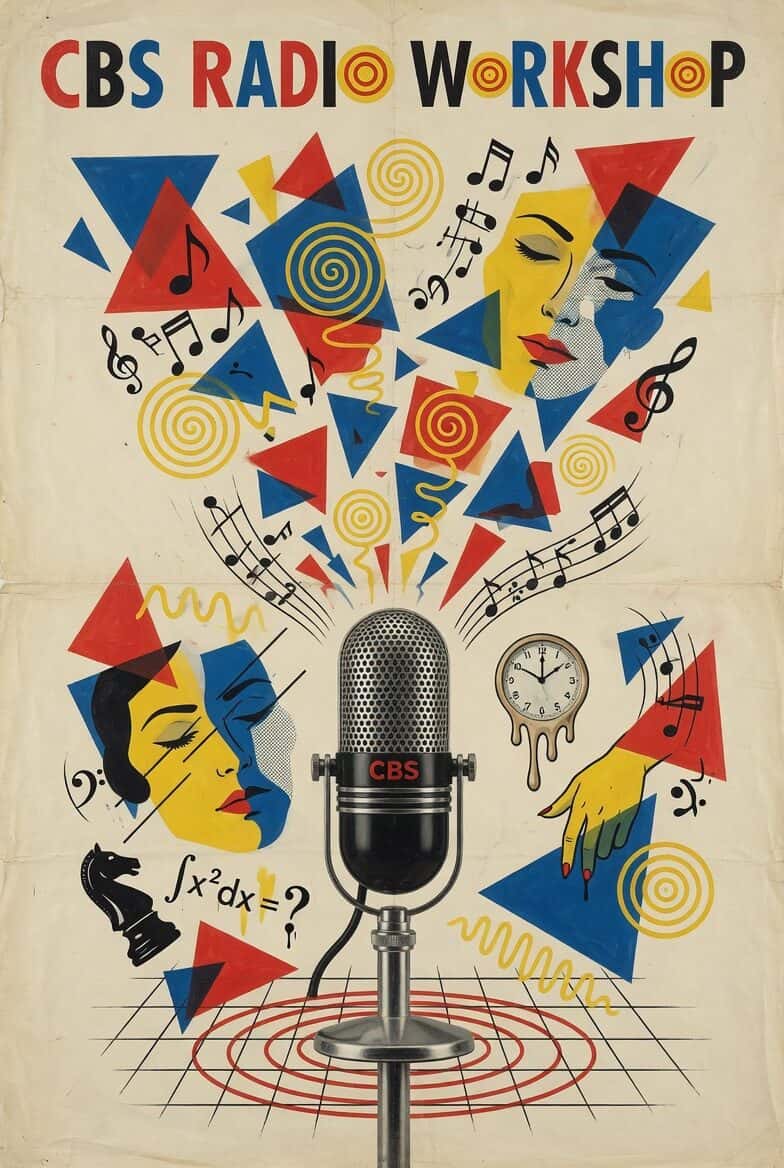
From Hollywood, CBS Radio presents the CBS Radio Workshop, dedicated to man's imagination, the theater of the mind. Tonight, Colloquy II, a dissertation on love.
From time to time, the Workshop presents discussions or colloquies on matters of general interest. A few months ago, Workshop listeners heard Colloquy I, in which Dr. Frank C. Baxter interviewed William Shakespeare in an effort to determine whether Shakespeare had indeed written the works of Shakespeare. Tonight, we turn our attention to a more universal subject, one that has intrigued both scientists and scholars throughout the ages, love. And to moderate our discussion, we have an eminent scholar indeed, Dr. Frank C. Baxter, professor of English at the University of Southern California, who will in turn present Colloquy II, a dissertation on love, or boy meets girl.
Dr. Baxter.
Good evening. Thoughtful men and women the world over agree that the peaceful future of mankind depends on mutual understanding and the free and unrestricted exchange of information on every subject, from nuclear fission to the care and feeding of infants. It's in this spirit that our colloquy is being held tonight. For if it is indeed true that love makes the world go round, then it's of the most vital importance that the world understand just what love is. To this end, we have invited here distinguished authorities in the Ars Amatoria to join with us in this dissertation on love. From London, Sir Eustace Ponsonby, scientist, scholar, and student of human behavior.
Good evening. I must say that I'm looking forward to this evening's exercises. We had a similar do on our wireless, on the Third Program, of course, about 12 months ago. It was very stimulating, but, yes, exceedingly so. Good show.
Thank you, Sir Eustace. We'll do our best to emulate the BBC, if not to surpass them. And from Paris.
Yes, Monsieur Lucien Duran, noted author and critic.
Bonsoir, mes amis Américains. Though considerably later than my compatriot Lafayette, I am no less happy to be here. And I am particularly happy to discuss the subject of love. For, as you know, love is to Paris what automobiles are to Detroit.
And from another city where love is a commodity, from Hollywood, and from the American point of view, one of our brighter young leading men, motion picture star, Tuck Flint.
Well, love, it's a great subject. That's what my next picture is about. With an angle, of course. Very offbeat. To plagiarize Mark Twain, love is like the weather, everybody talks about it. But unlike the weather, everybody does something about it. And what they do about it is the subject of this meeting tonight.
In order to begin our discussion, we should have a definition of love. What we might well ask is love. Mr. Flint?
Love, that's what makes money at the box office. It's what the best-selling books are all about and the hit tunes on the jukeboxes. Without love, we'd be out of business.
Then love's nothing more than a commercial product?
Well, I wouldn't go... well, I wouldn't go that far.
Well, I see. Monsieur Duran, would you care to hazard a definition of love?
Ah, l'amour. L'amour, c'est la raison d'être. C'est le bon vin de la vie.
Yes, of course. I'm sure it's all of these things. Sir Eustace?
Well, let me see. Well, we must realize that a man has many loves. His horse, his dog, his regimental comrades. Yes, sometimes even his wife.
Oh, sir, it would appear, Sir Eustace, that the British, in finding so many objects for love, are inclined to spread their love too thin.
By God, sir, I'll have you know there's nothing thin about the way an Englishman makes love.
No, very subtle. A race which boils its mutton could scarcely be expected to kiss the hands of its ladies, eh?
Absolute rot.
Well, kissing hands never won an empire, sir.
Ah, but he whose kingdom is a woman's heart craves no wider realm.
Gentlemen, gentlemen, if I may. It would appear from your attempts to define love that it's perhaps an emotion unsusceptible of definition.
Right. If it makes money, why knock it?
Well, gentlemen, in lieu, then, of some satisfactory definition of love, suppose we approach the subject by example.
Oh? How do you propose to do that, Doctor?
Well, by observing how love works. Now, let us see what happens in the first phase of boy meets girl.
Doctor, everybody knows that. Boy meets girl, boy loses girl, boy gets girl. It's my next picture, but like I said, with a new angle.
Oh, boy gets girl. With your typical American efficiency, you have reduced love to a formula.
Excuse me, I believe that Dr. Baxter is ready with the demonstration.
Oh, thank you, Sir Eustace, thank you. Now, I present for your consideration an American girl. Her name is Mary, Mary Smith. She's an average American girl. She's typical, she's lovely, but she's not engaged. She sets her hair with Marvell, brushes her teeth with Star Lure, creams her face with Glamour, keeps healthy with Vitaglow, but still she's not engaged.
She needs a head shrinker.
Doctor, how old is this girl, by the way?
Almost 22.
Probably something to do with her psyche. I know a guy in Beverly Hills, he's pretty expensive, but I'm sure he could be a...
Wait, wait, Mary Smith won't be an old maid, for at this very moment, she is about to embark upon love's supreme adventure. She is about to meet the man in her life. But as she works at her switchboard in the offices of the legal firm of Green, Brown, White, Black, and Etc., little does she suspect that bliss awaits her beyond the opening of a door.
Oh yes, this is the legal firm of Green, Brown, White, Black, and Etc.
Oh, I'll connect you with Mr. O'Brien, our attorney.
Enter the boy. His name is Bill. Bill Jones. An ordinary guy, clean-cut in a manly sort of way. His clothes are Ivy League. He shaves the modern way, the electric way. He enjoys beer in manly moderation. And he smokes filter tips, cigarette and all. He likes children, dogs, owes everything he is to his mother, and everything he has to the finance company. Like almost all thinking Americans in this puzzle generation, he spends much of his waking time wondering where the yellow went.
He seems like a nice sort of a guy.
Oh, he is. But Bill Jones is completely unprepared for what is about to happen to him.
Good morning.
Oh, good morning. Can I help you?
Yes, I have an appointment with... with...
Yes?
Uh... how about taking in a show with me tonight?
Oh, thank you, but I'm afraid I'm busy tonight.
Well, how about tomorrow night then?
Oh, I'm awfully sorry.
The next night? Could I pick you up after work and we could have dinner first?
Oh, well, uh, maybe. I'm not sure. I'd have to break a date.
Oh, break it then, will you?
I'll try. I'll pick you up at 5:30, okay?
I guess so. See you then.
Oh, gee, I nearly forgot something.
What?
You are precipitous, Mark.
It would seem so, but that's what we call love at first sight.
Well, you'll be interested in what a rather noted Britisher, Mr. Rudyard Kipling, had to say on this subject. Mr. Kipling said, and I quote, "It takes a great deal of Christianity to wipe out uncivilized Eastern instincts such as falling in love at first sight." Rather clever, huh?
Yes, and a certain Christopher Marlowe also said, "Whoever loved that loved not at first sight."
Well, how about you, Dr. Baxter? Do you believe in love at first sight?
Good sir, I am but the moderator of this forum. However, if I may offer just one more quotation, the late Josh Billings had this to say, "Love is like the measles. We cannot have it but once, and the later in life we have it, the tougher it hits us."
Now, gentlemen, gentlemen to the question at hand. The boy and girl have obviously fallen in love.
Yes, Doctor, but if it were really the grand passion, if they felt all of those things which you so charmingly hinted at, the bells in their heads, the fur dartifice before their eyes, the throbbing of their titillated hearts, why, why did the girl not agree to a rendezvous immediately?
Because she's a nice, well-brought-up American girl, and she has to play hard to get.
Hey, you know, that's a pretty good scene. Maybe I could get the studio to buy it with a few fixes, we could...
Mr. Flint, please, please. The accepted technique is to make the boy believe that the girl is very, very popular.
Dr. Baxter, you have already pointed out that despite her allegiance to all the accepted brand names, she has remained unhappily unengaged.
Ah, you know that, Monsieur Duran. I know that. But the young man doesn't know it.
Oh, well, I can only point out, mes amis, that in France, if a young woman plays too hard to get, she sometimes does not get got.
Well, that's always a calculated risk, I imagine. But suppose you tell us, Monsieur Duran, how does boy meet girl in Paris?
Oh, very well. Well, now, the girl is a midinette, a seamstress for a modiste in the Rue Saint-Honoré. One evening, as she walks down the Rue Royale to the Métro, that is, the Paris subway, she passes the boy. He sees her, but she does not see him. He follows her into the Métro station, buys a ticket, and follows her onto the platform, his heart beating madly. When the Direction Vincennes train clatters in, he boards the same car that she does.
I know that picture. Allied Artists made it last year in Italy. Now, what was that girl's name?
This is a different story, Monsieur Tuck.
Oh, I'm sorry.
Eh bien, alors. Well, the boy does the same thing night after night for a week, ten days, perhaps two weeks. Gradually, the girl becomes aware of him sitting in the Métro across from her, standing on the platform near her, waiting on the corner for her, or down the street. So, they have fallen in love before they even speak to each other. And then, finally, one night, the boy is rewarded as his heart tells him he must be. As the train rumbles into the Vincennes station at the end of the line, the girl smiles at him. He is beside himself with joy and beside her in a moment.
Bonsoir, mademoiselle.
Bonsoir, Monsieur. Would you permit me to accompany you across?
Oh, it would be a pleasure, Monsieur.
Oh, c'est mon plaisir, mademoiselle. You live near the Porte de Vincennes?
Oh, no, no, no, mademoiselle. I live on the Avenue de la Porte de Villiers on the other side of Paris.
Oh, then why have you been riding in the direction of Vincennes these many nights?
It is more pleasant ride than Direction Neuilly since it is the route you take.
Monsieur est gentil.
Mademoiselle est belle. I wish you lived so far away.
I must not permit you to accompany me without doubt you are late for some rendezvous.
Oh, pas de tout, pas de tout. My only rendezvous is with you.
But I must not detain you. Undoubtedly you are expected.
Oh, no, no, no, no. Only for dinner. Besides, I told Mama I had a feeling I might be detained tonight.
Very interesting, Monsieur Duran. But still rather irregular. Just, well, not cricket.
Oh, Sir Eustace, do you English make love by the rule book?
Well, no, that's to say... well, we'll dash it all, my dear fellow. There are some things that just aren't done in England.
Apparently in England the most interesting things are not done.
Dr. Baxter, must I endure the captious comments of this amoral apologist for a decadent and immoral nation?
Sir Eustace, France is much more than a nation. France is a state of mind, a way of life, a civilization.
No, sir, not civilization.
Gentlemen, gentlemen, please. Suppose we pursue our investigations into phase two, boy gets girl.
By that, Doctor, I take it that you mean the courtship.
Yes, I believe we may call it that. And, Sir Eustace, since we've heard both the American and the French points of view in the first phase of love, perhaps you could show us this second phase, the courtship, from the British point of view.
Oh, I should be charmed.
Well, shall we begin?
At your service, sir.
And so they have met, this charming young couple. Properly introduced, being of the same social standing and background, and with the same sensible viewpoint on life.
A year has passed, possibly two, and a mutual attraction has developed. One might say that they care for one another. And, as we find them seated in the study of her mother's home, the boy speaks.
Happy. Aesthetically. Tea? Thanks. Sugar? Two. Cream? Thanks, no. A stout fellow. I know. That's why I'm skipping cream.
Daphne? Yes, Gerald? I've been thinking. Really? Quite. We're engaged, you know. Yes, I know. Thrilling, isn't it? Wizard.
Daphne? Yes, Gerald? Daphne, you've never permitted me to kiss you. It isn't being done, Gerald. But now that we're engaged... I'm sorry, Gerald, if you find me rather old-fashioned. But, Demi, Daphne, I'm a man, you know, with red blood in me veins. Yes. I suppose you are. I only claim what is rightfully mine. I suppose so. May I? If you really insist. I do, you know. Very well.
Are you feeling better?
No wonder those British movies lay a bomb at the box office over here.
Apparently then, Sir Eustace, your countrymen believe in a more quiet, even a more sedate kind of romance than we've found in either France or America.
Yes, exactly, sir. Let me put it this way. Nature has never produced a more beautiful nor a more perfect form than the egg. Yet nothing to be more quickly ruined by too rapid cooking.
You let one of those eggs sit around too long and what have you got?
Very good, Monsieur Flint, very good.
Gentlemen, gentlemen, gentlemen, I must ask you to stick to the subject at hand. We have so far been quite unable to define love. Our examples have revealed a wide difference of opinion as to what constitutes even the most normal behavior patterns of boy and girl in love. I've always understood that love is the universal language, yet we seem to be getting to no agreement here. So now, gentlemen, I ask you to think of some things of love about which you can agree. Those mannerisms that seem to know no national boundaries, that are oblivious to geography, in short, the love that is universal.
Well, Sir Eustace?
Well, Shakespeare said, Friendship is constant in all other things save in the office and affairs of love. Therefore all hearts in love use their own tongues. Let every eye negotiate for itself and trust no agent. Much ado about nothing.
Well, gentlemen?
That's a pretty fair writer. Did you see Brando and Julius Caesar? It was a success with the eggheads, but did it make money at the box office?
Well, that's a very interesting viewpoint, Mr. Flint, but how does that translate into terms of love?
Well, it's just that we Americans have our feet on the ground, that's all. None of this nonsense about living in a garret on bread and wine. We think big. That's why we are big.
Even in love?
Suppose you explain exactly what you mean.
Okay with you, Dr. Baxter?
The floor is yours, sir.
Okay. Let's have a little romantic American music.
Darling, I could go on dancing to this music forever. Yeah, they're playing our song. Oh, just think, as long as I live, whenever I hear them play Rock Around the Clock, I'll remember they were playing it when you asked me to marry you. Yeah. You scared? A little. After all, it isn't every day that a girl changes her name from Smith to Jones. Yeah. Gee, it's cool. Real cool. Let's go somewhere where we can be alone and talk. Oh, that sounds wonderful, darling. We could drive up to Lake Waxahachie, the view from the hill. Oh, everybody drives up there. Well, we could drive down to Elm Meadows. Oh, everybody says that's filled with mosquitoes this year. Yeah. Well, what do we do? I don't know. Hey, there's a moon outside. Maybe we could take a walk. Walk? Gee, I never thought of that. Come on. Get a load of that moon.
Ah, quelle délice. Quelle délice.
I beg your pardon, Monsieur Durand?
Forgive me for interrupting the proceedings, Dr. Baxter, but the boy's discovery of the moon is universal, n'est-ce pas?
That's a very good point, Monsieur Durand. You're suggesting there are, after all, perhaps certain similarities in love?
Right. Moons belong. They're part of the picture. Blue moon, moon over Miami, Allegheny moon, hit songs all because they use moon in the title.
What's your opinion, Sir Eustace?
Well, moons do function as certain peculiar stimuli. You know, I once tried to separate in the laboratory particles from the air from which the moon had evidently...
Pardon me, Sir Eustace. The boy is talking. Oh, I beg your pardon. Yes, yes, of course.
There. How's that for a view? Oh, it's dreamy. The moonlight on the river and the little ripples gleaming in the light. Bill. What? It's like we're going to live. Like what? Like where we're going to live. What's the problem? You know, there's a dreamy little cottage out in Summit Hills we could buy with an option to... I thought we'd start out in a little apartment. Buying a house would cost a lot of dough. Just furnishing a house would cost a fortune. Oh, no, it wouldn't, darling. We wouldn't need much to start with. A TV set, of course, a freezer, a washing machine, oh, and of course, a dryer. One of those electric rotisseries and... With a warm weather and air conditioner... How are we going to pay for all this stuff? With the installment plan. Gee, it sounds like paradise. Hmm.
I take it, then, that marital bliss in America depends upon household appliances bought on credit for a house one cannot afford.
Well, I hardly think the young man is well enough along in business to assume all these obligations.
Well, that's just my point. They think big. Those kids will make out okay. Those kids are in love.
I don't seem to recall them mentioning the fact.
They're buying a house, aren't they?
Gentlemen, a moment ago, there was hope that we could arrive at some point of mutual agreement. The mention of the word moon seemed to spark a response from each of you. Now, if the moon is indeed a universal symbol of love, surely there must be other symbols to which you can all agree. What about romantic music?
Oh, you call that, uh, how do you say, rock and roll romantic?
Well, what of the girl's looks, of her beauty, of her beauty, of her beauty? Cervantes said, there are but two things that chiefly excite us to the love of a woman, attractive beauty and unspotted fame.
Oh, oh, oh, unspotted fame excites us to love? Oh, oh, oh, really, my good doctor?
He's from France, you know.
Well, Monsieur Durand, won't you tell us, how is it with our boy and girl now in France?
Well, gentlemen, a Parisian boy and girl who met on the metro... This subway, they got along fine. Now, let us pay a visit to one and a half rooms on the sixth floor of a 400-year-old building in the Rue de Faubourg, Montmartre. The building is very historic, which is to say, there is no elevator. It is also, in some respects, quite modern. There is running water. Cold water, naturally.
Bonsoir, chérie. Ah, bonsoir, mon amour. Ça va? Oui, ça va. It is good to see you, chérie. Oh, and it is good to see you, mon amour. All day long, as I have awaited this moment, I've seen your face before me, smiling, welcoming, beckoning. Oh, with me, it has been the same, mon amour. How sweet you are. Oh, kiss me, mon cher. And now, I will get you a glass of wine. Pardon, chérie. Allo? Allo? Oui? Oh, oui, chère amie. Yes, yes. It's for you, mon amour. Oh? Who is it? It is your wife.
Oh, French seem to be a very understanding race.
Ah, precisely. But it is a practical arrangement, and it preserves a certain way of life.
Well, I say preserve us from such a way of life.
By the way, what of your English boy and girl, Sir Eustace? Are you prepared to say that they are living happily ever after?
Certainly. Eldest boy's in public school, nipper's still with his nanny, Daphne's grown into quite a lovely woman, busy from morning to night, good works, committees, all that sort of thing.
As for Gerald himself?
Oh, he's coming along smashingly. Got a good situation in the city, joined one of the better clubs, and spends a great deal of time there nowadays, too.
Why does he, with such a seemingly happy home?
Yeah, I thought an Englishman's home is his castle.
Well, it is indeed. But then, of all the womenfolk at home, the cook, the maid, the nanny, they say nothing of the wife, well, what would a man do without his club?
He might find a beautiful woman.
Oh, nonsense, nonsense, Monsieur. Gerald forgot about beautiful women when he married Daphne. Besides, he finds his club much more interesting.
I suppose so. England is a land conceived by men for the comfort of men.
And France?
Aha, a land where the comfort of men is the first concern of the women.
Well, it would seem then, gentlemen, if I may attempt a summary, that love, money, the very splendid thing that it is, takes on different forms in different lands and climes. We've been unable, clearly, to find our universal language. To our Gallic cousins, it is not always co-existent with a nuptial state. To the English, it's one of the more placid emotions. While to the American, love is so easy to come by that, well, it may have possibly lost much of its pristine value.
Very well put, Doctor. Very fair statement, I say, Doctor.
Well, Mr. Flint, what have you got to say to that?
Uh, Mr. Flint? Hm? Oh, oh, excuse me, excuse... Say, Doctor Baxter, that actress who played the girl in the demonstration, what's her name?
Why, that's Sammy Hill.
Hmm, I thought she did a real fine job. Sammy's a cute name. Yes, indeed, both she and the boy. Oh, who is he, by the way?
That's Shep Menken.
Uh, Shep, Sammy, I want to thank you for helping us with our dissertation on love tonight.
Well, not at all, Doctor Baxter, it was a pleasure.
Oh, I had a lot of fun, too.
You did? Yes. Uh, oh, Sammy, may I present Mr. Tack Flint?
The Tack Flint?
Yeah, pleased to meet you.
Oh, Mr. Flint, uh, Tack, the pleasure's all mine.
Are you sure?
Vive l'amour.
Well, at least they were properly introduced.
Oh, perhaps Shakespeare said it best, No sooner met but they looked, No sooner looked but they loved, No sooner loved but they sighed, No sooner sighed but they asked one another the reason, No sooner knew the reason but they sought the remedy. Or did the same Will Shakespeare sum up this knotty question of love still better than all dissertations, discussions, and conversation when he said, My love's more richer than my tongue?
From Hollywood, you have just heard the CBS Radio Workshop production of Dissertation on Love, starring Dr. Frank C. Baxter as moderator. The CBS Radio Workshop is produced in Hollywood by William N. Robson and was directed tonight by Sam Pierce, written by Mr. Robson and Jess Goldstein. With Dr. Baxter tonight were Ben Wright, Shepard Menken, Ramsey Hill, Peter Leeds, and Sammy Hill. This is Hugh Douglas.
Next week, from New York, the CBS Radio Workshop will present Figure Fallop's Billion-Dollar Failure, the story of a pollster who accepts an assignment for a job from a minion of the nether regions, and comes a cropper.
As national interest runs high in the conventions and their results, CBS Radio, which is broadcasting these important events, urges you to follow through to make sure you're registered to vote next November. No matter which candidate you prefer, you are lost in making a choice unless you're registered to vote in a national election. Are you sure you're registered? Are you sure the rest of the voters in your family are? Make sure today. Registration laws vary from state to state. Make sure you're in the book.
Stay tuned for five minutes of CBS News to be followed over most of these same stations by My Son Jeep.
Tonight, attend the Democratic Convention with the CBS Radio Network.