
The written record
Read the transcript
Read along with the recording · About 21 min to read
<!-- kimi_cleaned -->
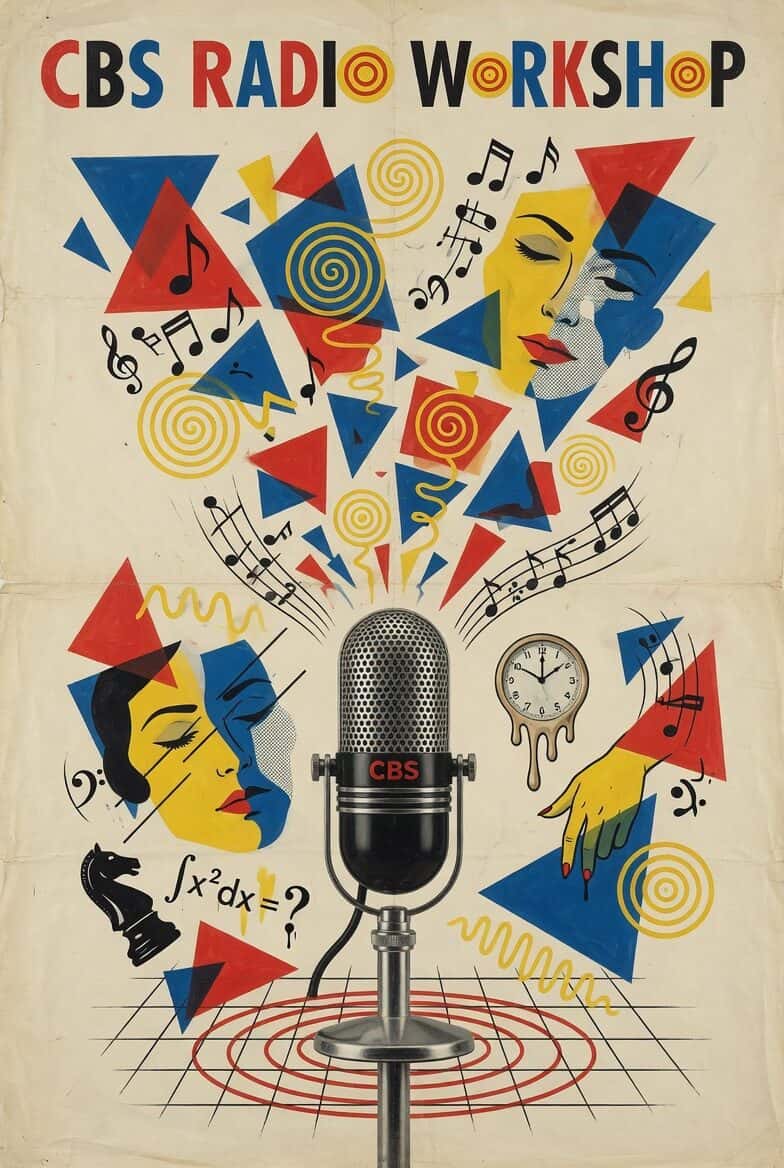
The unexplored life is not worth living. That was the Greek philosopher Socrates, now dead these 23 centuries. The CBS Radio Workshop, dedicated to man's imagination, the theater of the mind.
Our theme tonight is a timeless one. The tragic fate of men and women who violate mankind's most awesome taboos and must suffer the penalty, both in the torments of their own souls and in the fearful punishment meted out to them by gods and men, even if they were actually innocent of guilty intent. The specific situation involved in our study is so ancient that we refer to it by a term derived from the name of a Greek prince who lived more than 3,000 years ago. Our title, The Oedipus Story.
Oedipus, we are told, was the son of King Laios and Queen Jocasta of the Greek Empire. Oedipus was born in the Greek city-state of Thebes, not far from Athens, and belonged to the generation just preceding that of the Trojan War, that is, to the 11th century before Christ.
Oedipus' parents were childless and had in despair sent a messenger to the famous temple of Phoebus Apollo at Delphi to ask the god through his prophetic priestess to grant them a son and heir.
Holy Pythia, I am sent by my lord and lady, the king and queen of Thebes, to pray a boon of mighty Phoebus. I bring gifts.
Name the boon.
The king and queen lack one thing only to make their happiness complete. A son.
Hmm, let me see those offerings. A tripod. Gold? No. Good workmanship, though. Spices, incense. No meat?
The sheep are tied outside.
How many?
Three.
Hmm, well, stay where you are, whatever your name is, while I consult the god. Mighty son, heavenly holy archer, seer of the gods. There's one before me who seeks a favor. He's from Thebes, he says. His king and queen long for a child. A son. They send gifts, mighty Phoebus. I have put some of their incense into the fire. I hear you, master. I hear you, lord. No. Yes, master. I will tell him.
The message, sacred one, for my king.
Queen Jocasta will bear a son. But it would have been better not to have invoked the gods. The son will slay his father and take his mother to wife.
But, holy one.
The gods have spoken. Go.
But—
There is a curse upon the family. I know not when nor why.
It is from Homer, the most ancient of the Greek poets whose works survived, that we first hear of the consequences of that terrible curse. In his Odyssey, the hero, Odysseus, makes a brief visit to the underworld and meets the shades of some of the renowned men and women of the past.
The mother, too, of Oedipus I saw. Beautiful Jocasta, who in life had done unwittingly a heinous deed, had married her own son, who, having slain his father first, espoused her. In misery he lived, for so decreed the offended gods. But she went down to Hades. Hades' gates that are forever barred to her, since in her grief she'd slung a rope from the bridal chamber's rafter and ended her own life, leaving Oedipus to bear woes without measure.
The Greeks seem to have been the first Europeans who gave dramatic expression to the Oedipus theme, the dilemma of a man who becomes abnormally attached to his mother and, as a result, becomes his father's unconscious rival. The situation which the Oedipus story symbolizes, however, is much older than the classical Greek version and has appeared in nearly every part of the world, often in religious clothing.
In ancient Egypt, for example.
With us, it was part of the Isis, Osiris, and Horus cult.
In Babylonia, we had Ishtar and Tammuz.
In Assyria, too, and the Sumerians had something like that before us.
Many people, especially in India, still tell our story of Agni, Yama, and Mitra.
It was a major theme in the old Persian and Median religion.
With us, in Japan. It is the story of—
They had different names in Scandinavia, Africa, Polynesia, and the Americas, but the story was much the same. It obviously describes a situation which, psychologically, was so common as to seem universal. Our modern term, Oedipus complex, derives from it.
The mother, usually, is the first person whom an infant learns to love, since the mother is usually the first to supply food and warmth, comforts, and affection. It is natural, therefore, that children should at first be jealous of anyone else who makes demands on their mother's attentions, whether other children or father.
Hush now, Nicky, I'm feeding the baby.
I don't care.
All right, Nicky, I'm sorry, but I have to feed the baby now.
I don't care. I hate her anyway.
Now, Nicky, you shouldn't say that.
But it's true. You're always busy with her.
Now, Nicky, she's just a baby.
I don't care. Johnny hit me.
All right, come here. Mama will kiss it and make it better.
Well, oh, darn it. Oh, Nicky, please run and open the door. Mama's still feeding the baby.
You're going to kiss it. It's right on my head here.
All right, bend over. Now, please go and see who's at the door. I'll kiss it again later.
Okay.
Well, I thought I'd never get in.
Oh, thank you, son.
Where's Mama?
Honey?
In here.
I'm sorry, honey. I left my keys at home.
Oh, you're with the baby.
I'm just done. Wait a minute. I'll be right with you.
But, Mama! Mama, you said you'd kiss it again.
Now, don't be a crybaby, Nick. Let me see. Gosh, that doesn't look like so much.
Yeah, but now Mama's going to talk to you all the time. And she said when she was through with the baby—
Well, as they grow up, most children adjust themselves to the fact that they are not the only ones who count in the world, even to their parents. And they gradually form the outside attachments which go with so-called normal living. It is only when the emotional dependence of growing children upon one parent or the other becomes too intense or lasts into adulthood that we psychiatrists reach for special terms such as Oedipus Complex. Or sometimes, in the case of a girl's overly strong attachment to her father, Electra Complex. The two terms, of course, merely describe opposite sides of the same coin, an Oedipus situation. A common symptom of both is dislike or even hatred for the other parent, who appears as an ever-present rival for exclusive affection.
The Oedipus motif, in one form or another, appears in the literature of all ages and regions so often that the emotional situation which it symbolizes must also have been a common experience. Greece of the 4th century B.C. alone left us at least eight dramatic works about Oedipus himself, plus a number of others with related themes. In the Middle Ages, the Oedipus theme was sometimes connected with figures prominent in Christian tradition, such as Judas Iscariot, Gregorius, and St. Gregory. And in modern times, a great array of poets and dramatists have dealt with the subject, including Shakespeare, Corneille, Voltaire, Dryden, and not least of all, America's own great Eugene O'Neill in his trilogy, Mourning Becomes Electra.
O'Neill does not depict just one aspect of the Oedipus situation, but several, including the Electra form, from which he takes his title. His story is laid in New England at the end of the Civil War and deals with the tangled relationships between a well-to-do ship owner, General Ezra Mannon, his wife, Christine, his daughter, Lavinia, and his only son, Orin. The general and his son have been away to war, the son unwillingly, having signed up only in response to his father's and sister's pressure.
Lavinia, the daughter, is sitting in the garden with a young ship captain, Adam Brant, who was employed by her father's firm. Captain Brant has been secretly making love to Christine, the mother, while pretending to be interested in Lavinia.
What do you think of the news of Lee surrendering, Captain Brant? We expect my father home very soon now.
Yes, you must be very happy at the prospect of seeing your father again. Your mother has told me how close you have always been to him.
Did she? I love Father better than anyone in the world. There's nothing I wouldn't do to protect him from hurt.
You care for him more than for your mother?
Yes.
Well, I suppose that's the usual way of it. A daughter feels closer to her father and a son to his mother.
A short time later, Lavinia, in her father's study, accuses her mother of having become involved with Captain Brant.
Stop lying, I tell you. I went upstairs. I heard you telling him I love you, Adam, and kissing him. You're shameless and evil. Even if you are my mother, I say it.
I knew you hated me, Vinnie, but not as bitterly as that.
Very well. I love Adam Brant.
How will you say that without any shame? You don't give one thought to Father who's so good, who trusts you. How could you do this to Father?
I won't listen.
You will listen. I'm talking to you as a woman now, not as mother to daughter. I loved your father once before I married him, but marriage soon turned romance into disgust.
So I was born of your disgust. I've always guessed that, Mother, ever since I was little when I used to come to you with love. You'd always push me away. Oh, I hate you.
I tried to love you, but I could never make myself feel you were born of anybody but your father.
How can you? You've loved my brother, Orin. Why didn't you hate him, too?
I was resigned by then. I hope you realize I never would have fallen in love with Adam if I'd had Orin with me. When he'd gone to war, there was nothing left but hate and a desire to be revenged and a longing for love.
Suppose you'll hardly let your father get in the door before you tell him.
No, not unless you force me to. Father hasn't been well lately, and I'm not going to have him hurt. It's my first duty to pretend. I'm going to protect him from you.
I know you, Vinnie. I've watched you ever since you were little, trying to do exactly what you're doing now. You've tried to become the wife of your father and the mother of Orin.
Lavinia, of course, had bitten off a great deal more than would perhaps seem proper in a daughter. And when her father, General Mannon, arrives home...
I thought I taught you never to cry.
Oh, Father, but I'm so happy.
Tears are queer tokens of happiness. But I appreciate your... your feeling.
Oh, I'm so happy you're here. You're the only man I'll ever love. I'm going to stay with you.
I hope so. I want you to remain my... my little girl for a while longer, at least. Must be your bedtime, Vinnie. March now.
Yes, Father.
O'Neill, in these scenes, has outlined the conflicting relationships between Lavinia and her father and her mother. In the following, he gives us a similar insight into Orin's position in the all-embracing Oedipus situation which dominates life in the Mannon household. Orin cynically describes to Lavinia an incident during the war which won him military honors and his father's respect. Orin belittles both.
And I think how proud he was when he came home, Orin. He boasted that you had done one of the bravest things he'd seen in the war.
One... one of the bravest things he'd seen. I'll tell you the joke about that heroic deed. I sneaked through their lines. There was a thick mist. It was so still that you could hear the fog seeping into the ground. I met a rebel crawling toward our lines. His face drifted out of the mist toward mine. I shortened my sword and let him have the point under the ear. He... he stared at me with an idiotic look and his eyes dimmed and went out.
Don't think of that now.
Before I'd gotten back, I had to kill another in the same way. It was like murdering the same man twice. I had a queer feeling that war meant murdering the same man over and over again. Their faces kept coming back in dreams and they changed to Father's face. What does it mean, Vinnie?
I don't know.
The next morning, in the trenches, my head was queer and I thought, what a joke it would be on the stupid generals like Father if everyone on both sides suddenly saw the joke that war was on them and laughed and shook hands. So I began to laugh and walk toward their lines with my hand out. Of course, the joke was on me. I got this wound in my head. Then I went mad and ran on yelling.
Then a lot of our fools went crazy too and followed me, and we captured part of the line we hadn't dared tackle before.
You wonder that I laugh? General Mannon is dead by this time, poisoned by Christine. A final revenge, perhaps, for his having robbed her of her son. Lavinia knows that her mother has killed her father, but is unable to convince Orin.
My God, how can you think such things? Am I... I've never lied to you, have I?
Yes, but...
And even if she's got you so under her thumb again that you doubt my word, you can't doubt the absolute proof.
Never mind what you call proofs.
Now, you listen here. If you think that you're going to tell me a lot of crazy stuff about Mother, I warn you, I won't listen. Mother means a thousand times more to me than Father ever did.
Lavinia and Orin, driven by Lavinia, do avenge their father's death by killing Captain Brant and driving their mother to suicide. But they too must pay the penalty. Orin misses his mother's death. He misses his mother so much that he also kills himself. And Lavinia is left alone, a woman past despair, with only her pride and her bitter memories to keep her company.
The immortal version of the Oedipus story, of course, is that of Sophocles, who wrote his trilogy sometime in the 5th century before Christ. His drama begins with Oedipus at the height of his glory as king of Thebes and contented husband and father. The curse which overhung Oedipus' birth had frightened King Laius and Queen Jocasta so much that they had given their newborn infant to a trusted shepherd with orders that the child should be exposed on the barren slopes of Mount Cithaeron and that a spike should be driven through his feet so that he could not even crawl for shelter. It was from this that the boy had later derived his name, Oedipus, which in Greek means swollen foot. The faithful shepherd had pierced the infant's feet but then, in pity, had turned him over to another herdsman from Corinth, and the Corinthian had delivered the child to his own royal couple, who were themselves childless. Oedipus had grown up never doubting that he was the son and heir of Polybus and Merope, the king and queen of Corinth. But when he had reached manhood, this is how he himself describes the incident to Jocasta in John Dryden's play Oedipus.
It was at a bridal feast. One warm with wine told me I was a foundling, not the king's son. I, stung with this reproach, struck him. My father heard of it. The man was made to ask me to ask pardon and the business hushed. To somewhat odd. And strangely, it perplexed me. I stole away to Delphos and implored the god to tell my certain parentage. He bade me seek no further. It was my fate to kill my father and pollute his bed by marrying her who bore me.
What had happened before Oedipus had met and married Jocasta we have to reconstruct from various accounts. Oedipus, on his way to Delphos, a boy in his chariot, had had to pass through a narrow gap in the mountains. Partway through, he had met a party of five men also with a chariot carrying his unknown true father, Laius.
Get away yourself. I'm deeper in the pass than you are.
Can you not recognize the Lord?
So am I, O Lord, and of current. There is gold on my chariot, not brass as on his.
Well, listen to pretty boy. We'll take care of you.
Stop. Stop, I say.
Never mind, Lord Laius. We can handle him.
At him!
Well, then, come on. As for you, bowed mouth. And now, you, my lord, whoever you may be. Look at the last of your warriors run. I am ready, robber.
Robber? No, my lord. I shall leave your chariot for your driver over there to take back to your home and your armor as well. Sorry, my lord. But it was not I who begged the fight. Charioteer, you may come now and pick up your master and your comrades. I'm on my way.
After Oedipus had received his horrifying oracle from the temple at Delphi, he had decided never again to return to Corinth to avoid any chance of the prophecies coming true. Never realizing, of course, that he had already fulfilled the first part of it by killing his real father, King Laius, in the fight in the mountain pass. And then, in his aimless wanderings, he reached his native Thebes and found the city in terror. A sphinx had settled on a cliff overlooking the city, and insisted that all passers-by solve a riddle on pain of death. Many Thebans had already perished when Oedipus, passing through the city, volunteered to face the monster.
Thou hast a riddle, winged one?
Indeed I have. And many Theban stranger have died for lack of wit to answer it. Cares thou so little for thy worthless life that thou wouldst come forth to challenge me?
Tis little indeed I care. Speak up!
Hear then, and die, fool, as have all the others. Name me the creature that walks on four legs in the morning, on two at noon, and three in the evening.
Tis simple.
Indeed it is.
Tis man, who in his infancy on all fours crawls, in the strength of his middle years walks on two, but needs a staff when creeping age once more deprives him of his powers.
In the abyss, in your depths...
The Thebans, grateful for their deliverance from the monster, had offered Oedipus the kingship and the hand of their widowed queen, Jocasta. For nearly twenty years, Thebes had prospered again. Oedipus had proved himself a wise and popular ruler. His life with Jocasta was happy, and he had four children by her, two boys and two girls. But then a terrible plague struck the kingdom.
A thousand deaths advance. All is so sudden. Scarce one man falls but that another, looking on in wonder, falls himself. And a third, stooping to raise his dying friend, topples beside him. Deaths groan riotous. Her streets are covered with the dead and dying. Betwixt the bride and bridegroom does a nuptial torch do come in office for marriage and for death. Nor are the people alone afflicted. Our cattle die, and the very earth has turned as barren as the wombs of our wives. The gods are angry. Some evil stalks the city.
To find out for what sinful deed Thebes was being punished, the queen's brother, Creon, is sent to Delphi once again to consult the oracle of Phoebus Apollo. He reports that the gods are wrathful because King Laius's murderer has not been punished, although he lives in Thebes itself. Puzzled, Oedipus sends for the old blind seer, Tiresias.
To thee, Tiresias, sightless but all-seeing, the purport of the answer the god returned to us, the messengers have doubtless told.
Let me go home. Prevent me not. To a best that thou shouldst bear, are thy burden and I mine.
For shame. Withhold not, I adjure thee, the word of prophecy. We are thy suppliants all. Wouldst thou betray us and destroy the state?
I will not vex myself nor thee. Why ask? All that will come will come, though I be mute.
Thou mak'st me wroth. I will not stint my words. I think that thou art he who planned the crime, and, were't not blind, I'd truly think that thou didst do the bloody deed.
Is that thy thought? Then let me go. Let me charge thee. Upon thine self thy curse and punishment inflict. For thou... Yes, thou, Lord Oedipus, thou art the murderer thou seek'st. Tis thou and thou alone who draweth misfortune upon Thebes.
Vile slanderer.
Thou goad'st me to speak against my will. Thou shalt rue so gross a calumny.
Must I say more to aggravate thy rage? I say thou livest with thy nearest kin. In infamy. In infamy. Unwitting of thy shame. Thy weird is not to be invoked by me. I leave to Phoebus what concerns the god. This day shall be thy birthday and thy grave.
And so it proved. Oedipus almost immediately found evidence that it must have been he who had killed King Laius. Yet he still did not accept the fact that Laius had been his true father and Jocasta therefore his mother. But then, a messenger arrived.
Who is this man? And what is news for me?
He comes from Corinth and his message this. Thy father Polybus has passed away. And the Ismian commons have resolved to make thee king.
Nay. I will never go to Corinth more. Not while my mother lives. If that old curse perchance is causing thee alarm, know that thy fears are groundless. Polybus no more thy sire was than I. He took thee from my hands. He was a living gift. While I in turn had got thee feet sore wounded from a servant of thine own household who said he had found thee in Sithereen's wooded glen.
Oh, nay. Speak no more. Enough of these ancient lays.
Not so, my queen. At last, I find the truth after so long a search. Perhaps, my lord, thou soon wilt wish that thou hadst never found it. I must go.
So Oedipus alone continues to question the Corinthian messenger, his horror and despair mounting as bit by bit the truth is revealed. He sends for the aged shepherd to whom his death had originally been entrusted, and the old man unwillingly admits that it was Jocasta herself who...
Our sovereign lady, Queen Jocasta, dead, dead by her own hand, and all the horror of it none who have not seen can comprehend. And Oedipus, our king, he with a frenzied cry against the bedroom's door launched his full weight and splintered it to find Jocasta hanging there, a running noose entwined about her neck. And when he saw her, with a maddened roar, he loosed the cord, and when her wretched corpse lay stretched upon the earth, it was dread what followed. He tore the golden brooches that upheld her queenly robes, upraised them high and smote the pins into his eyeballs, uttering words like these. Swing wide the gates! All thieves let see their king, messiah, slayer, and his mothers. Look ye! The gates are opening! No more shall ye behold such sights of woe. Deeds I have suffered and myself have wrought. I vow to flee, self-banished from the land to save my people from the curse which yet adheres to me.
The end? Oh, where? An end? Too dread to tell. Too dark to see.
You've been listening to the CBS Radio Workshop and the Oedipus Story as written by Henry E. Fritch with excerpts from Sophocles to Eugene O'Neill. Music was composed and arranged by Alexander Steinert with additional scoring by Ralph Sandor and Henry Silvern and directed by Henry Silvern. The CBS Radio Workshop is produced and directed in New York by Paul Roberts. Alexander Scourby was the narrator, Elspeth Eric was heard as Lavinia, Peggy Allenby as Christine, Jack Manning as Orin and Oedipus, and Roger De Koven as General Mannon and Laius. Also included in the cast were Ivor Francis, Robert McQueeney, Guy Repp, Nell Harrison, Mark Leonard, Bob Dryden, Bobby Alford, Joanne Palmer, Joseph Julian, Ruth Tobin, and Joseph Warren. America listens most to the CBS Radio Network.