
The written record
Read the transcript
Read along with the recording · About 18 min to read
<!-- kimi_cleaned -->
From Hollywood, the CBS Radio Workshop. This is Radio Rhodesia broadcasting on the mega, micro, and strato beams. We take you now to the Ethnical Museum of Antiquity at Kenya, and our correspondent, Dinar Geb. Come in, Dinar Geb. Stand by, please. We are trying to get through. Radio Rhodesia to Dinar Geb in Kenya. Come in, Dinar Geb.
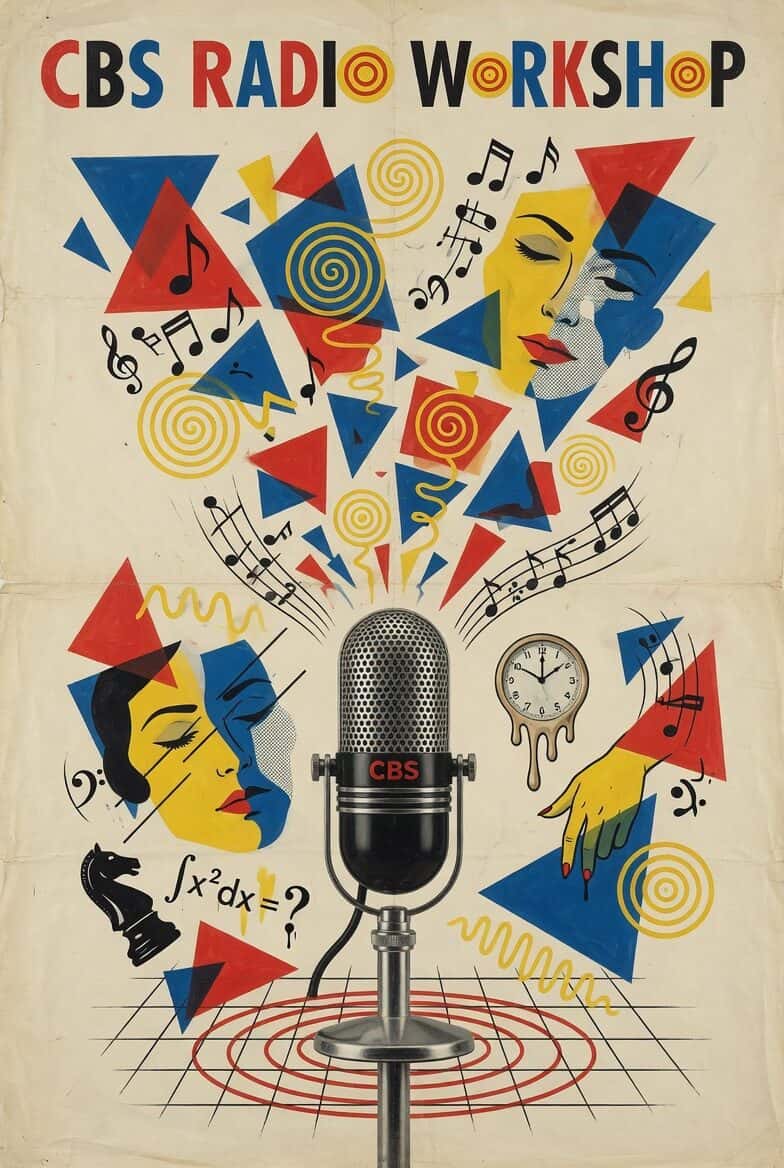
CBS Radio presents the CBS Radio Workshop, dedicated to man's imagination. The theater of the mind.
Some weeks ago, the workshop presented A Pride of Carrots, in which the novelist Robert Nathan described the planet Venus as it might appear to modern man. In the broadcast you are about to hear, Mr. Nathan describes our culture as it might appear to the men of 6,000 years from now. Based upon the story in the current issue of Harper's Magazine, here is Mr. Nathan's report on the Weans.
This is Dinar Geb, speaking from the Great Antiquity, at the City Hall of the Ethnical Museum of Antiquity at Kenya. If my voice sounds a little strange to you, it's because I've become infected with the excitement of the scholars gathered here to receive the reports from the field expeditions on the Great West Continent. As you know, as part of the worldwide celebration of this astrophysical year of 7956 A.D., teams of archaeologists have been working for months in the tumuli, or city mounds, of the unenhanced world. Our staff correspondents are with them now at the tumulus of Enyok, at Sha'ago, at Loose Angles, and at Pound Laundry.
In just a moment you'll hear them in person, but first, standing beside me at this microphone is Srabahan Bolek, Chancellor of Education and Curator of the Museum. Srabahan Bolek, would you care to give our listeners some hint as to what discoveries may be announced today?
No, Srabahan Geb, that would be cheating.
Yes, I suppose it would. But I will say this. I believe we all agree that we have come a great distance in understanding the Weans since the first artifacts were dug up in the city mound of Boxton, or, as some prefer to pronounce it, Boston, nearly 200 years ago.
They're the ones in this case, are they not?
That's right. An ivory cross attached to some beads and a rusted iron wheel, apparently designed to run along some kind of track. But, alas, scarcely enough upon which to posture yourself, to manipulate a culture or project a civilization.
And so, for more than a century, the great West Continent has kept its secret. But during that time, other discoveries were made, were they not?
Oh, yes. From time to time, hunters, prospectors, and other adventurers returned from that deserted and forbidding land with fragments of scrolls. But they were completely meaningless hieroglyphs until the discovery, some years ago, of the Talking Disc of Olene.
Olene. That's the city mound at the extreme south of the great West Continent, isn't it?
Exactly. At the mouth of the immensely wide, dry river, the Misses. It was there, in the winter of 7940, that an expedition under my esteemed colleague, Han Shui, discovered the disc in an astonishing state of preservation. Since the Disc of Olene gave us our first indication of the identity of the people of we, I thought, perhaps, it would not be inappropriate to hear it now.
An excellent idea. Is that the original you have there?
Oh, my, no. This is a copy, a transcription of it. The original is never removed from the vaults of the museum, but it is a faithful copy. Listen.
And Thayans knows Thayans' hearts. Weans ain't gonna let Thayans tell us how to run things down here. Manage us in zone affairs. No damn Yankee from the north is gonna tell us nothing.
Well, that's mighty interesting, Sra Bolek. Mighty interesting. But what does it mean?
Well, its actual meaning is obscure. But don't you realize that this human voice speaking to us from 6,000 years ago has uttered the sound of every letter symbol in all the glyphs and scrolls we have discovered. We know now, thanks to the great deductive scholarship of Sra Hanshwee, that these people who so often inscribed their scrolls with the letters U, S, A, referred to themselves as Weans. We did not know how to pronounce U, S, A prior to the discovery of the Disc of Orleans. Now we know that U, S, A, is incorrect and the symbols U, S, A are properly pronounced Weans.
Well, thank you, Sra Bolek. I believe Sra Hanshwee is at the city mound of Sha'ago right now with our Radio Rhodesia reporter, Hulay Beneker. Take it away, Hulay.
This is Hulay Beneker. We are here at the Sha'ago excavation and here is the distinguished professor and dean of the Advanced School of Primitive Languages of Kenya University, Sra Hanshwee.
Greetings to my colleagues in the field as well as back home. This is indeed a great and proud day for me. I have found another disc. Just as the Talking Disc of Orleans gave us the secret of the Weans language, I believe this Singing Disc of Sha'ago may indicate what the music of the Weans was.
Yes. It's an inscription on the disc, Sra Hanshwee. What does it say?
It is somewhat unclear. The nearest I can make out, it says Blue Sway Shoe by Avis Paisley. Sold a million copies.
What does it mean?
I haven't the slightest idea, but let's listen to the music.
That's music? Primitive, isn't it? Most rudimentary.
Yes, but I'd hardly call it music.
Hello, Hanshwee.
Yes, who is it?
Von Bullock at Kenya. Congratulations on your find.
Oh, thank you, my old friend. But I'm afraid you're mistaken.
I'm mistaken?
Yes, that's not music. That's a religious ceremony.
What?
Yes, you have misread the inscription. It is not Avis Paisley. It is Ephus Fressley. Ephus Fressley. Ephus Fressley. Ephus Fressley.
Yes. Don't you remember my translation of the Enyoc Scroll regarding a great religious festival? I quote, And Fressley and did cause them by to give out cries and corridors in syncope. Quote.
You are right as always, Rob Bullock. I had thought it was music. I doubt if the Weans had any music, but your find is more important. They had a religion.
And now, after that unscheduled but exceedingly interesting interview, exchange between two long-time friends and associates, we continue our report on the Weans from the far edge of the continent. Our next pick-up is from Loose Angles, or, as some translators prefer, Loose Ankles, at the edge of the great Western Ocean. We take you there now. The next voice you will hear will be of our staff correspondent, Yosh Ertebi.
...in Chicago.
This is Yosh Ertebi speaking to you from the excavations near the bleak brown hills of Loose Angles. And here beside me, is the head of this particular expedition, and the only woman scientist participating, Ceres Besnef, the brilliant dean of advanced femininity at the University of Zagora.
Hello there. I was most interested in the comments Sra Bahan Bullock just made upon the religious significance of the find at the Chagodig. Because out here, we too have come upon objects which have, for the first time, led us to believe that the Weans did indeed have a primitive religion.
You are referring to the Golden Idols?
Precisely. Repeatedly, in the kitchen middens of smaller communities surrounding Loose Angles, we have dug up these small gilded statues cast away among the pottery sherds and other refuse. The presence of so many of the golden fetishes indicates beyond a shadow of a doubt the existence of a considerable cult of Oscar, as our translation of certain scrolls proved the god's name to be. So, for several months, we've been searching for the temple of this god. Particularly, in this area of Holy Wood, which, by its very name, indicates that it was once a place of veneration and worship. I believe I can safely report to you today that we have unearthed the temple of Oscar.
It is not large as temples go, but it is distinguished from all the others in archaeological history in one important respect. You see, one expects to read the record of vanished races on the walls or frescoed ceilings of ancient temples. Here, the record has been placed on the floor. The court is laid out in squares, and in each square are the imprints of feet and hands and words.
What do they signify?
My specialty is archaeology, not hieroglyphs. But my guess is that they were incantations to the god Oscar. The footprints were perhaps those of his priests, or perhaps sacrificial victims.
Can you translate any of them?
Well, I can try. Here's one that says, Glor iar swan song. Utter gibberish. Look at this one. There's the imprint of what looks like spectacles.
Yes, that one says, Har old yoid.
And there's one which looks like a large human nose.
Jim me dur ant ee.
Wouldn't that appear to indicate that these were sacrifices rather than priests?
Oh, quite possibly. Certainly, some of them at least appear to have been put through a humiliating ordeal to prove their devotion to this ancient god Oscar.
Thank you, Seres Besnev. And now, this is Yush Ertebe returning you to Din Ageb in Kenya.
Back once more at the Great Hall of Kenya Museum. Sra Bolek has been joined by his colleague Sra Hab Bukong of the Libya Academy of Geophysical Sciences. Well, Sras, what do you think of the field reports so far?
Splendid, splendid. They substantiate my theory that the Weeans had at least a semblance of culture.
Sra Bolek, to me, your theory is as unconvincing as your translation of the name of the Weean capital. Pound Laundry, indeed.
Well, how else would you translate it? The glyph for washing means laundry, and the Weean glyph ton stands for a unit of weight, hence pound, pound laundry. You couldn't say washing ton. It wouldn't make any sense, though I must confess we have never learned what was washed at pound laundry.
Yes, well, Sras, this is most interesting. But I'm informed that the expedition at the Enyoc site is ready to make its report. So we take you now to the city mound of Enyoc and our Radio Rhodesia correspondent, Cowley Dee.
Speaking from the Enyoc dig 100 feet below the surface, and believe me, Sras and Sresses, in just a moment, you may be witnessing a great historic occasion. But here's the head of the Enyoc expedition, Sra Obergirst Levy, to tell you about it himself.
Thank you, Cowley Dee. We have been digging downward along this gallery for nearly a week, and at last we have arrived at a sealed door which may well be the entrance to a tomb. Above it is a glyph which translates phonetically as Maseys Bargan Bay. This, men, seems to be meaningless. Nevertheless, we shall break through this door now and attempt to describe to you what, if anything, we find beyond. You may begin, men.
Easy there, easy!
What? What's that?
I don't know, Sra Levy. As soon as the glass door was broken...
A warning, perhaps. It's frightening.
Oh, nonsense. I remember reading about what happened to the men who violated the tombs of the Egyptian pharaohs. Do you really think these weans can reach out across six thousand years and harm us?
No, Sra, not really, but still, one wonders. Proceed with the opening.
Yes, Sra. Sra Levy, what do you think you may find here?
I have no idea. Throw a light down there!
Well?
What is it, Sra Levy?
We shall see. Come.
Yes.
Yes, it is indeed a tomb.
A tomb?
Yes. Look. Will you look? On these racks here. Garments. Strange ancient garments. Coats of fur. Kabbalistic symbols. One, nine, eight, reduced from two to five. Yes, and over there, tiny effigies. Tiny wagons. And here, bowls and cooking pots in perfect condition. There appear to be more chambers beyond.
Is there any indication of sarcophagus? Or mummies?
None so far, Sra.
Mummies? Oh, yes, yes. You will recall that it was the custom of many ancient peoples to bury their kings along with their retinue and their household goods to assure them comfort and companionship in the next world. The Egyptians were most advanced in these matters. Up until now.
I'm afraid I don't follow you completely, Sr. Levy, and I'm sure our listeners would like a further explanation.
Oh, dear me, dear me. We are on the air, aren't we? I'd quite forgotten. Excuse me, Srs. and Sr. Levy. Excuse me, Srs. and Srses. I've been carried away by the amazing significance of this find. We have obviously penetrated the tomb of a great king, pharaoh, president, whichever translation you prefer, of the Weyans, a ruler named Macy.
Excuse me, Sr. Obelghest Levy. You have found the mummy of Macy?
No, but in this next chamber, something most strange. Great eyes. Come.
Great eyes? This is indeed a strange and wonderful sight, Srs. and Srses. We are moving now from the main chamber of the tomb into a side chamber. And now our light beams are reflected by rows and rows of gigantic glass eyes, each in its own polished box. What are they, Sr. Obelghest Levy?
I don't know. Each of them has a dial with numbers on it. Now, let me see. The dial is numbered from 1 to 13, of mystic significance, no doubt. Ah, it turns.
Yes, but nothing happens.
True, but we are not Weyans. These strange cyclopean boxes must have held great significance for them. See, Srs. Levy, here on the wall is a glyph.
Oh, yes, yes. 1956. Model. CBS. Tell. E. Viz. On. Utterly meaningless. But see the pictograph. A Weyan and his Shiweyan sit before the box. And in the box is the face of another Weyan.
Yes. Indeed, then they were eyes of some sort. But did the Weyans watch the eye, or did the eye watch the Weyans? These are questions that only exhaustive research can answer. But, Srs. Levy, can you hazard a guess why so many of these eyes have been put in the tomb of the potentate Macy?
A guess, yes. But only a guess. He must have been a man so vain that even after death he wished to watch through these eyes what his people were doing. Or he wished through these eyes that his people could watch him. Who knows?
Who, indeed. And now, Srs. Obelgars Levy, would you say that the discovery of this tomb of Macy overshadows in importance your unearthing of the great lintel and your translation of its message, which has indicated how the Weyans met their end?
Indeed, I would. We had hoped to broadcast from the site of the temple, but of course we can't be two places at once.
No, no, no, no, we can't. But Sr. Bahan Bolek, back home at the museum, already has my report on the temple's inscription. I'm sure he will be glad to give it. Frankly, I am unwilling to tear myself away from all these ancient splendors.
I quite understand, Srs. Levy. So this is Cowley Dee at the tomb of Macy in Enyoc, returning you to the Kiny Museum and Dinah Geb.
Thank you, Cowley Dee and Srs. Obelgars Levy, for an exciting remote. And now, Sr. Bahan Bolek, I wonder if you'd be good enough to follow Srs. Levy's suggestion.
Suggestion?
Yes, the report on the temple inscription at Enyoc.
Yes, of course. I must confess, I was so carried away with the magnitude of this newest find, I'd quite forgotten. Well, now for the other great discovery of Srs. Obelgars Levy. We now have definite proof of how the Weyans perished. For weeks, Srs. Obelgar Levy has been excavating a great temple not far from where he has now discovered the tomb of Macy. Last week, he gave me, in all confidence, the intelligence he has now asked me to divulge. On the lintel of this temple, he has found this fragmentary glyph, which he translates as follows. Nor rain nor gloom of night. There are pointed rounds.
That is pretty obscure.
Well, Sr. Bukong, it is incomplete. Some of the hieroglyphs are missing.
There are pointed rounds. What does that mean?
Well, first, you must realize, Sr. Bukong, that the R and the W are readily interchangeable in both the Hittite and the Hivite languages. You will then admit this may be so in the ancient Weyan language.
For the sake of argument.
Very well, then. Instead of "there are pointed rounds," the phrase may well mean "their pointed wounds," may it not?
It might, but what about the rest of it?
Well, the word "nor" can be considered "north," and the word "gloom" could be translated "doom," and "night," "fright." Then what have you got? The tragic story of the end of the Weyans. The north snow, the north rain, the north doom of fright, their pointed wounds. In other words, invaders from the north have annihilated the inhabitants.
That sounds pretty glib to me.
Not when you remember the talking disc of Orleans. Let me recall those historic and prophetic words to you. The Weyans know what awesome damn you, taking from the north is going to tell us nothing. Notice the obvious reference to the enemy, damn Yankee from the north.
Oh, no, there's no question about it. North snow, north rain, doom of fright. Yes, the Weyans perished by the wounds of the north.
But tell me this, then, Sr. Bolek. How did they have time to inscribe this account of their annihilation on a great marble temple before they were annihilated?
But that's the obvious part of it. We know that Enyoc was the most populous city in the great west continent. And why? Because at the end, it was bursting with refugees. One by one, the great cities fell to the doom of fright from the north. Shargo, Los Angles or Ankles. Orleans, Pound Laundry. Enyoc, an island bastion, was the last to fall. Knowing the fate of the others, the Weyans built their own. The Weyans built their own. The Weyans built their own. The Weyans built their own. The Weyans built their own. They built this temple and inscribed upon its great lintel their fate so that we, who came later, might understand what happened to them.
Yes, yes, sounds reasonable. But there is one more question.
What is that?
We have read much in their scrolls of a city more important than any of those we have excavated. Milltown.
Yes, Milltown. What about Milltown?
Our expeditions have searched and searched, but they have found no trace of a city called Milltown.
Strange. Exceeding strange. Yes. I dare say we will never know anything more about the Weyans, but we now know enough to evaluate them as a minor culture with a rudimentary religion devoted to a god named Oscar who was worshipped by rocking and rolling. They enjoyed their brief moment in history, established their hegemony in the land of We by killing off the aborigines. They evidently built their empire such as it was by the sword, and when the sword rusted, they died by another's, even as Egypt and Babylon and Greece and Rome, leaving behind them curious city mounds, a splendid tomb, and no music. Sic transit gloria Weyan.
Thank you, Sr. Bahan Bolek, and thanks also to our scientists, archaeologists, commentators, and announcers who have made possible this Report on the Weyans, the greatest single event of this astrophysical year of 7956 A.D. This is Dinah Geb, speaking to you from the Great Hall of the Ethnical Museum of Antiquity at Kenya, returning you to the main studios of Radio-National Radio. Thank you. Thank you. Thank you. Thank you. Thank you.
Radio Rhodesia. The CBS Radio Workshop is produced and directed in Hollywood by William N. Robson. Report on the Weyans by Robert Nathan appears in the current issue of Harper's Magazine. The radio version was written by Mr. Robson and Fran Van Hartesveldt. The scientists and commentators of 6,000 years from now included June Foray, Byron Kane, Daws Butler, Edgar Barrier, Jay Novello, Joe Kearns, Joe DeSantis, and Hans Conried. Next week from New York, the CBS Radio Workshop will present The Growth of Our Nation, the story of the development of America told in sound effects. Be with us then, won't you? Every Sunday evening, current events come into sharper focus as prominent Washington personalities are interviewed by a battery of top flight reporters on the CBS public affairs feature Face the Nation. Hear Face the Nation over most of these same stations tonight. Stay tuned for Suspense, which follows immediately over most of these same stations.