
The written record
Read the transcript
Read along with the recording · About 20 min to read
<!-- kimi_cleaned -->
From Hollywood, the CBS Radio Workshop. A funny thing happened to me on the way to the studio. I met a woman who sleeps with cats. A woman who sleeps with cats? Yeah, Mrs. Katz.
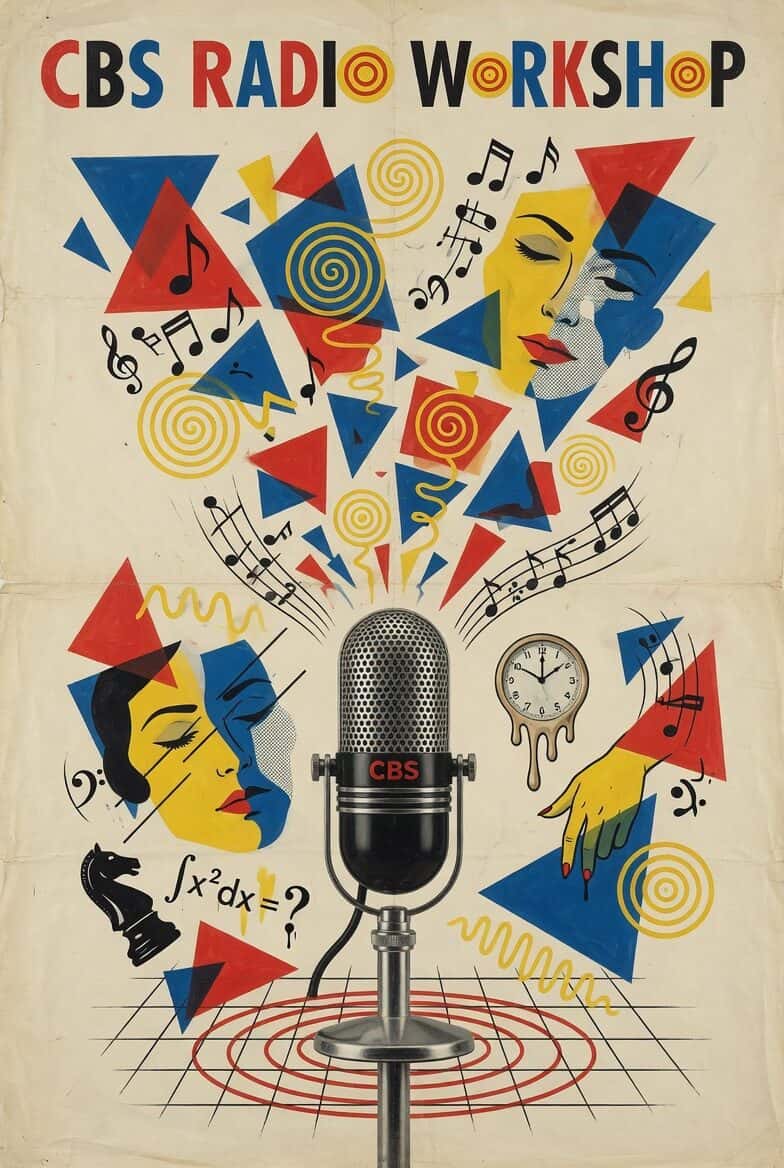
CBS Radio presents the CBS Radio Workshop, dedicated to man's imagination, the theater of the mind. This afternoon, the workshop examines another little understood aspect of man's behavior, humor, in Colloquy 4, the Joe Miller Joke Book, produced in Hollywood by William N. Robson and conducted by Dr. Frank C. Baxter, professor of English literature at the University of Southern California.
Dr. Baxter.
If you fear that your radio is receiving two programs simultaneously here, one of very old jokes and the other a talk on literature, then don't touch the dial. Believe me, this is all one program. Now, my own interest in the ancient... is a scholarly one, stemming from the fact that jokes have always had a very real part in literature, at least as long as we have the spoken word. Moreover, there's always been a heartening feeling of immediacy about jokes, not only because so many are topical, but because, in one way or another, we all use jokes with gratifying regularity. Some of us tell a joke to fortify a point we wish to make, to entertain, to enhance ourselves, thus, in the opinion of others, or, perhaps, we tell them for the laudatory purpose of relieving the tedium of some dull occasion. Now, I can best show you what I mean by bringing you a few examples, perhaps, of a classic joke, a classic teller, and a typical occasion. Let's start with a man who's almost a semi-pro in the field, the after-dinner speaker.
Uh, friends, uh, put away your watches. I'm not going to talk for an hour. In fact, the brevity of my remarks reminds me of what Abe Lincoln once said when his tailor suggested maybe Lincoln's... his legs were too long. No, Sam, the president said. I reckon they're just long enough. They reach the ground, don't they?
And all of us have met this next fellow, the self-appointed life of the party.
Hey, you heard the latest story about the farmer's daughter? Well, the farmer did, and now she can never darken his door again.
Even learned men with professional degrees use jokes tellingly. As, for example, now, the glib and successful trader, a trial lawyer.
Ladies and gentlemen of the jury, I assure you I'm implying no criticism of my worthy opponent who found it necessary to address you for two hours and a half. But he did put me in mind of an old farmer they say Andrew Jackson came across one day. It seems the farmer was feeding his mule one piece of straw at a time. Neighbor, old Hickory finally said, feeding your mule that way, isn't that going to take a long time? Well, General, the rustic said slowly, reckon it will, but what's time to a stupid old jackass?
Yes, and let's not overlook the determinedly cheerful wife who feels she has to greet her husband gaily when he returns from a grueling day at the office.
Now, Henry, just lie back there and relax while I tell you the funniest story of your day. Okay. Do you know what one merry-go-round horse said to the other merry-go-round horse, Henry? Yeah. Let's get off this merry-go-round and get married. I'm sick and tired of going around with you. Oh.
And finally, finally, the man whose living depends on telling jokes, the comedian.
Hey, buddy, do you know why cream costs more than milk? No, tell me, my boy. Why does cream cost more than milk? Because, stupid, it's harder for the cows to sit on those tiny little bottles.
And there, happily, there ends our illustrations. Now, admittedly, these were old, old jokes, but if you make the common error of classifying them as Joe Millers, you're wrong. They're much older. Every one of those jokes, in one form or another, was already old before Joe Miller was born.
Professor, Professor, are you trying to tell us that there actually was a Joe Miller?
Yes. Though the records are unclear as to the year of his birth, we do know that he died in London in 1738.
I get it. Joe Miller lived. It's his jokes that died.
Oh, on the contrary. Joe Miller died. His jokes live on forever.
But I'd always heard, Joe Miller died. Joe Miller was, uh, you know, sort of a myth, an excuse for a bum joke.
No, Miller was an actual person. But oddly enough, not only did Joe Miller never utter a joke himself, the book bearing his name was published more than a year after he died.
Oh, come on. You know, I think Joe Miller's still alive, and he's on my payroll as a writer under an assumed name. He's my brother-in-law.
Dr. Baxter, you've made some pretty fantastic allegations. Are you able to... to prove any part of them?
Well, yes, Counselor. It happens that I have with me several monographs written by Joe Miller's own contemporaries.
In a court of law, Doctor, that would be inadmissible as evidence. It's hearsay. Out and out hearsay. However, since you claim he's dead, acceptable proof would be the corpus itself. Now, that's pretty ridiculous, isn't it? Even for a lawyer?
It isn't quite as impossible as you might at first seem.
Oh, now, what sort of mumbo-jumbo is that? Either you can produce Joe Miller, or you cannot.
You know, I don't see why I shouldn't try to produce him in this Bridey Murphy age of supersonic animation, automation, mechanical brains, technology more baffling than Merlin. Even though I do not pretend myself to be a pure scientist, merely a sometime student, this cause is a worthy one, and the end, if I succeed in materializing Joe Miller, merits the means. And the means are never very far away these days. Now, here beside me, I just happen to have a mammoth mechanical brain. I insert this punch card in it. I depress button A, so... I throw the switch marked go, go, go. And behold, we get... Joe Miller here.
Yes, Joe, we read you five by five. This is Dr. Frank Baxter of the University of Southern California.
Ah, yes, doctor. Is there some service I am able to perform for you? Some forgotten speech of Will Shakespeare's or Ben Jonson's, by chance?
No, Joe, not today. But right now, I'd like you to drop down here. It is down, isn't it, Joe?
There it is. Good. Well, then, would you drop down for a few moments? Provide the answers to the questions I have for you?
Well, so be it, good doctor. Can you direct me to your meeting place?
Well, now, let's see. Let me focus. Yes. Now, go past that first thunderhead on the left. Turn sharp at that fluffy gathering of cumulus. And then slide down the slightly tarnished rainbow. Straight ahead.
Ah, yes, friend Baxter. Wilco, and out.
Wonderful. Good friends. And which of you chances to be the usher in literature, Dr. Baxter?
I'm the dominie, Joe. I want you to know how much I appreciate this cooperation of yours.
The least I can do for a fellow student and player. Now, how may I serve you?
Would you just tell my friends here who you are, what you were, what connections, if any, you had with that famous book entitled Joe Miller's Jests?
Oh, Joe Miller's Jests. Ah! A pox on it. And the fulsome knaves who foisted it upon a half-witted world. I bite my thumb at them, sir.
We'll stipulate the pox, Miller, but let's get to the testimony. The professor here alleges you never wrote a joke.
Aye, sir, nor never spoke one. You see, good friends, I was a leading tragedian in London theatres, and a splendid one, if I say so myself, which I gladly do. I was a leading tragedian and not a comic clown. At the time in London, we had a self-styled critic of the drama, a suet head, one John Mottley. Mottley was an habitué of a tavern I frequented, which was the gathering place for all the mountebanks and roisterers from the theatres royal of Covent Garden and Drury Lane. John Gay, he who wrote The Beggar's Opera, among other things. Mr. Professor Lacy, all of them, the actors, the writers of merriment. This was that famous public house on Portsmouth Street?
Aye, friend Dominie.
Well, to get on, this knave, this Mottley, had a good thing going for him, which probably...
Profited him much, although it was equally abrim with chicanery.
You mean he had a racket?
He invented the rackets, this varlet. Would an actor buy Mottley all the ale and sack he could hold, Mottley, in turn, would publish glowing notices on the players' performances. A trap into which I would not fall.
Good for you, Mr. Miller.
Ah, me thanks, madam. And here, perhaps it is best I explain that my chiefest misfortune was the maid I had wed, me wife. Hm, comely, but a complete shrew. So, perhaps you can understand that after an evening's performance, I would repair to the tavern, spurning Mottley and his noisome companions, and sit alone at the table, the boniface reserved for me exclusively, dreading the hour when I must return to my home and Dame Miller.
So, all right already. Then what happened?
Well, after my constant rebuffs to buy his good opinion, Mottley became so enraged, he determined he would shame me. And ruin me, repute, to the leading tragedian. So, one day, when he came upon an ancient jest, so creaky of the joint it was repulsive, he determined his chance to destroy me had come. He waited until every tavern...
Friends, imbibers, and countrymen, lend me your ears. I have a jest to tell you. A rib-tickler just told me about that ever-popular tragedian, none other than Joe Miller.
Joe Miller? Joe Miller? Joe Miller? Joe Miller? Joe Miller? Joe Miller? Joe Miller? Joe Miller? Joe Miller? Joe Miller? Joe Miller? Joe Miller? Joe Miller? Joe Miller? Joe Miller? Joe Miller?
The jabbers Miller told it to me. A man asked his neighbor, but late married to a widow, how he agreed with his wife. Marvelous well, the neighbor replied. When I am merry, she is merry. When I am sad, she is sad. But when I go out, she is glad to see me go. And when I return, she is sad to see me. Thus, instead of being greeted with groans and catcalls, Mottley was filled with amaze to find he had evoked gales of leg-slapping laughter. Bitter and baffled, he managed to get aside, John Gay, and beseeched him to explain this unexpected outburst of mirth. Holding his sides, Gay managed his explanation.
Oh, friend Mottley, don't you see? It isn't a hoary jest. What makes it comical is that a vinegar visage like that ham-faced Miller should tell it. I, Mottley, that's what makes it funny. Joe Miller telling any joke.
And there I was, hoist by Mottley's own petard.
They didn't blame you.
Oh, for the bad joke, Mr. Miller?
Nay, madam, to the contrary. They found that to ascribe a jest to me was better insurance than had it been written by Lloyd's Coffeehouse. So from that night on, all ancient jests told in the city were laid at my door. But Mottley, at first deflated, finally wreaked his revenge on me.
How did he do that, Joe?
So identified did I become with jests and jibes that my very presence in a play would set an audience to convulsions. And since I was a tragedian, soon no theatrical manager in London would give me employ. I died not too long after. A broken man.
Well, granting all that, you still haven't explained that book bearing your name.
Aye, I come now to that, sirrah. Upon my demise, one Thaddeus Reed, a shrewd publisher of folios, sought out Mottley and proposed he collect the deadliest of the jokes being told and publish them as Joe Miller's. Mottley refused.
He refused to have anything to do with the publication which might perpetuate my name until Reed tempted him with visions of heady profits.
Mottley, lend ear to me. There is a fortune in the book of jests.
I will not be associated with Joe Miller. That ne'er-do-well, unfriendly, untalented...
Not for, say, a hundred pounds.
Not for a thousand pounds, you mean.
How much from a book of jokes?
I know not, except the rewards are limitless. Recall you Miles Coverdale's Bible, published in 1535.
Oh, yes. Coverdale obtained the funds to publish the Bible by issuing a collection of jests nine years earlier. The one eclipsed A Hundred Merry Tales. And a century ago, in 1630, the court jester Archie Armstrong published his book, and both volumes still are in good demand at the stalls.
Well, John, will you join me in this enterprise?
Aye, but on one condition. All London knows of my distaste for Joe Miller, and I do not wish to be made a laughingstock. I shall set down these jokes, but not under... my own name. We shall create a pseudonym for the acknowledged editor.
Excellent, John. And there you have the entire sordid story of Joe Miller's Jests, or The Wits of Ariconium, edited by Elijah Jenkins, Esquire, and published by T. Read, Anno Domini 1739.
Now, Joe, that was a story well told indeed.
Thank you, Dr. Baxter, one and all. And now my duty has been discharged, and I must be going.
How far south are you going, Joe?
A plague on you, sir. A pox and a plague on all hollow heads who practice what never did I preach. My lady, esteemed gentlemen, it is past the time when I must return.
Ah, parting is such sweet sorrow. Joe, wait. I feel I should repay you somehow for all the trouble to which we put you.
Goodbye!
Hey, he's gone, just vanished.
Can you blame even him after that gosh-awful pun of yours? How far south are you going?
True, the pun is the lowest form of wit.
Well, perhaps. Certainly Shakespeare used many puns. The great John Milton even had Satan make them. Puns are the basis of a lot of good humor, like the joke I opened up with. You all laughed at it, the one about Mrs. Katz.
Well, that wasn't a bad joke.
Yet there's another, perhaps more acceptable version if you'd care to hear it.
Yeah, I'd like it.
Very well, then. May I ask our joke demonstrators for version 13B of the Mrs. Katz joke?
I never thought I'd get here. I was just attacked by a man-eating rabbit.
A man-eating rabbit?
Yeah, I was in a restaurant and a man-eating rabbit threw a punch at me.
That was pretty good, Doctor. But, uh, was it original?
Heaven forbid. This, like most jokes, is what is technically known as a switcheroo. Now, let me show you how this is done historically. Uh, Joe Miller's joke number 99, please.
A lady questioned about her age affirmed she was 40, and called upon a gentleman for his opinion. I do not doubt it, madam, replied he, because have I not heard you say so the last 10 years?
Now, let's see where Mr. Motley got it to include in the Joe Miller jests. Uh, let's have the parallel joke from Armstrong's book published 1630, please.
A court lady had dinner and, speaking of her age, said she was 40. One gallant in hearing this whispered to his companion, I have not the faith to disbelieve her, for I've heard her say so any time these 10 years.
That's no switch, Doctor. That's out-and-out stealing. Even the numbers 40 and 10.
Yes, but the theft was Armstrong's, because that joke, the joke he took his joke from, was current back in Latin times and Roman times and Cicero's day, and it went like this. Oh, noble Cicero, Fabia Dolabella saith she is but 30 summers. Would this be true? It must be true, for I have heard it these last 20 years.
20 years? Oh!
Are there other examples, Doctor?
Yes, come on, Professor. I've got my pencil and notebook already, but they've got to be better than that.
Oh, there are dozens of examples, hundreds. Some I can't even quote because of the robustness of Elizabethan humor, and others which today are interesting, not for their shimmering wit, but only to scholars who seek sources. There's several jokes appearing in The Hundred Merry Tales, printed in 1500. That's a book that Shakespeare knew and referred to, by the way. The Hundred Merry Tales of 1500, there are jokes there, as well as in Archie Armstrong and Joe Miller, all similar, if not the same, and few of them are funny today.
Well, if they were funny once, Doctor, why aren't they funny today?
Let me give you one final example. Now, here's another joke, just as it appears in Armstrong's 17th-century book. Two Dutchmen, one very tall, the other of exceeding low stature, were walking together. A pleasant gentleman, seeing them, said to his friend, yonder go High Germany and the Low Country.
You call that a joke, Doctor?
Yes, at one time it was a joke, and a good joke, and it enjoyed great vogue. But now, using it as a springboard, let's take a much more recent version, which dates back only a few years, when the American theater man, Marcus Loew, and the producer, Lee Shubert, were familiar figures on Broadway. Now, Marcus Loew and Lee Shubert happened to pass one day, and this was their greeting. Hi, Lee. Hi, Loew.
So, you see, that Will Shakespeare was right when he wrote in Love's Labour's Lost, a jest's prosperity lies in the ear of him who hears it, never in the tongue of him who makes it.
Yes, Doctor, but you're quoting Shakespeare, of course. Haven't you a theory of your own about what's funny and why?
Well, as a matter of fact, I have a lot of theories. This is a dangerous business. Now, if one of you will be good enough to move that chopping block a little closer, I'll loosen my collar and lay my neck on the block.
Okay, Professor. Let's not keep a frantic world in suspenders waiting for us. Let's have it.
Have you given your theory a name, Doctor?
Well, I suppose so. It seems to me, by the way, that when we laugh, most of the time we laugh at someone who is doing something we'd like to do. We're all so inhibited and ruled and regulated by laws that whenever we see any person getting off second base safely, doing something that we'd like to do and can't, we acknowledge with a warm satisfaction of laughter the existence of one of our fellows who for a moment gets free. We say often to ourselves, I wish I'd said that. I wish I had done that. Or I wish I'd seen that. You might call this the I-wish-I theory.
I wish I?
Well, Doctor, that's pretty much a generality, isn't it?
Yes, of course. No one theory explains all jokes. But to be specific, why doesn't one of you tell his favorite joke to the others and see if they think it's funny?
Oh, we're not professionals. Why not let the comedian tell one of his?
Good, good idea.
Okay, okay, let's take this one. The scene is an asylum. An inmate is looking over the wall, watching the gardener work. Finally, he says, psst, hey, buddy, what are you doing? The gardener says, why, I'm putting fertilizer on the strawberries. The other guy screams, how do you like that? I put cream on mine, and they call me crazy.
Mine, Dr. Baxter's I-wish-I theory.
I wish I hadn't heard it.
You don't know what's funny and what isn't.
Well, let's see if we do or not. I'll tell one I know knocks them in the aisles. It seems a farmer and his daughter were in the farmer's car driving back home with the money they'd just gotten in town selling their eggs. Well, suddenly the farmer finds two armed bandits approaching, so he whispered to his daughter, very quick, stick that money in your mouth and hide it. Well, the girl did as she was told, and the holdup men couldn't find the money, which made them so sore, they kicked them out and took the car. Well, once he was sure they were safe, the farmer said, I guess we was lucky, all right, but if your ma had been along, we could have saved the car, too.
Well, I'll be damned.
Gentlemen, can't we have some order here? Gentlemen, please. Some decorum, if you will. Gentlemen, gentlemen, gentlemen, please.
Dr. Baxter. Could I speak with you a moment, good professor?
Why, Joe Miller. Back again. What brings you back, Joe?
I heard this idiotic argument and I came to assure you it was none of my doing, sir.
Of course it isn't. But, my, I'm glad you're back. You left before I could ask you to dine with me.
Well, I, uh, I really shouldn't, you know. Traveling after dark, but, well, I shall make an exception, good doctor, being so reduced. Long since I've had any solid food.
And what shall the menu be?
Well, now, how would a steak, a steak this thick, strike you?
Ah, perfection itself.
Then perhaps a salad of tossed California greens?
Oh, the very words fairly titillate my gastric juices.
And what shall we have with the coffee?
Why, why, anything you choose, Joe.
Would you have strawberries, Doctor?
You have all the strawberries your heart desires.
Oh, not for me, good friend, though. Strawberries for you.
Why, Joe? Why strawberries for me?
Because I want to see what you put on your strawberries.
Well, that's it, good friends. Joe Miller's jests are the wits of him who make them. Oh, may Joe and his jests both leave us and rest in peace.
You've been listening to the CBS Radio Workshop's production of Colloquy 4, The Joe Miller Joke Book, with Dr. Frank C. Baxter, professor of English literature at the University of Southern California. Colloquy 4 was written, directed in Hollywood by Paul Franklin. Included in the cast were Virginia Gregg, Joe Kearns, Peter Leeds, Ben Wright, Daws Butler, Howard McNear, Jane Avello, and Joe Forte. Sound effects by Gus Bayz.