
The written record
Read the transcript
Read along with the recording · About 15 min to read
<!-- kimi_cleaned -->
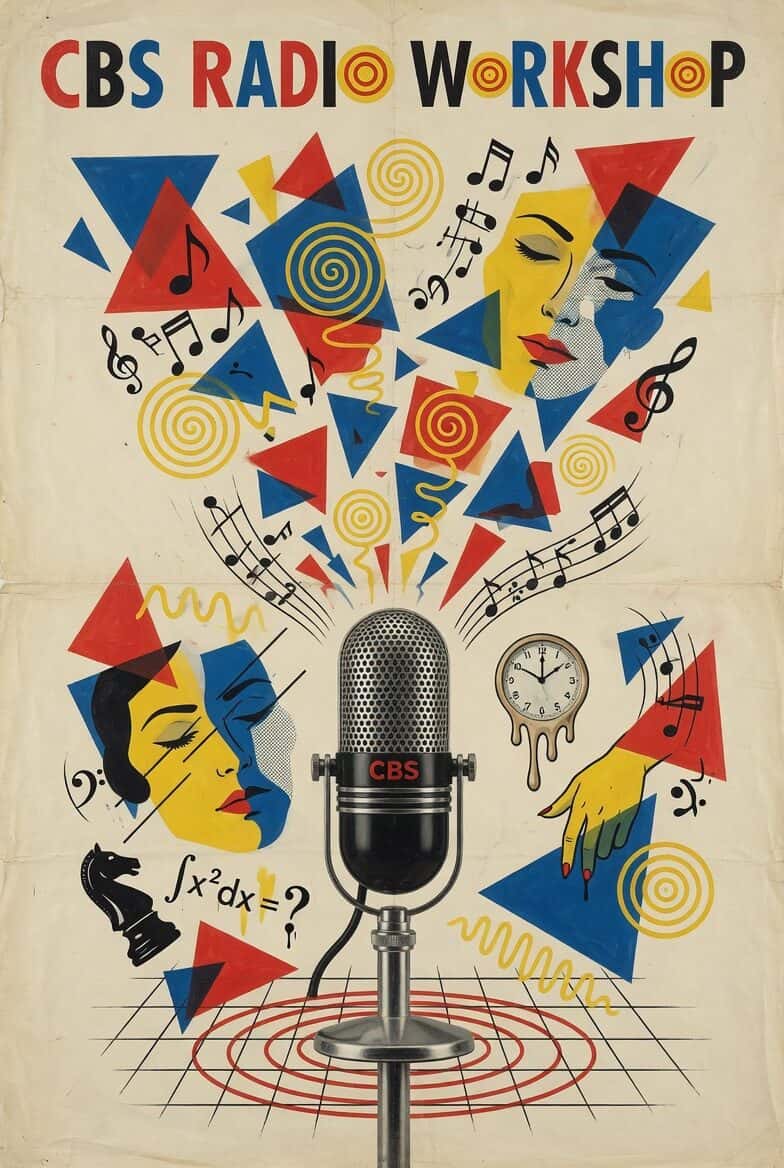
From Hollywood, the CBS Radio Workshop.
We puffed and he patted this old iron horse. Black and smoking cinders, a mark on his course. Down in the valley and up on the grade. Driving on steam, helping history be made.
CBS Radio presents the CBS Radio Workshop. Dedicated to man's imagination. The theater of the mind. From Hollywood, the workshop brings you William N. Robson's production of an original folktale. The Ballad of the Iron Horse.
He was a locomotive, a 4-4-0. Eight wheels and a diamond stack and a whistle to blow. When he was young, there was no mightier thing. West of the Mississippi, he was the rail king. He wasn't streamlined, didn't have much looks. But he wrote his page in the history books. His father was Iron Horse. His father was steel. Forged in a smelter from his stack to his wheel. Rocked the rails in 1862. Time of the strife, our grandpappy knew. The North General Grant, the South General Lee. Depended on the engines to win each victory. Armies and equipment, the war's heavy loads. Were all being carried on the new railroad.
Puffed and he patted this old iron horse. Smokin' cinders are markin' his course. Down in the valley and up on the grade. Drivin' on steam, helpin' history be made.
Long for the woodpile, Mr. Yancey?
That's right, boys, you'll be up ahead.
Well, it better be. This here engine eats up wood like it's striped candy.
Well, chunk in what's left. We can't let the steam drop while we're takin' on a new load.
Yeah, I know.
You know a lot for somebody young as you. How long you been achin' to be a fireman?
Never did ache to be.
Oh?
No, sir. I aim to be an engineer.
Engineer? Hey, hey.
Oh, you think that's funny?
You're sayin' he's on his first run anywhere and already he wants to be the boss.
Boy, I'm not laughin' at you.
Not much. But when the fightin's over, they're gonna be makin' lots of new engines. Somebody's gonna have to run them.
When the fightin's over? Well, that can't be too far off. Sherman's outside Atlanta. And with all the troops this road's been carryin' down from Nashville to helpin', the Rebs can't hold out much longer.
You think they can, Mr. Yancey?
Mr. Yancey?
Take a look up ahead there, boy. Tell me what you see.
Ah, looks like... Yeah, it's a fire. A big fire right near the track.
I'm thinkin' that's our wood.
Our firewood? We got any other kind?
But who'd do such a thing?
Now, who do you suppose?
The Rebs.
But for what?
Boy, you... To keep us from reachin' Atlanta. To keep the troops we're haulin' from goin' into battle.
Great day. Well, that sure leaves us in a pretty fix, don't you think?
Yes, don't it?
Might.
Well, what'll we do?
Sit.
Sit?
And wait. That's all we can do. Unless the colonel orders his men out to cut us some wood.
When Yancey told the colonel, the colonel did scream. Raved about an engine that burnt wood to make steam.
Coal, Mr. Yancey. You've heard me say, convert to coal without delay.
And I've said yes, I've certainly agreed. Coal burns slow. Give you more speed.
But what'll we do now? We're fresh out of wood.
Get the boys out. Exercise will do them good.
Truth began to holler. The troops did right. Havin' to chop wood far into the night. And who was it felt sorrow? And who felt shame? Our little old engine a-workin' to make his name.
Yes, sir, emotion is sometimes to be found in steel. Railroad men will tell you that engines can feel. And our little engine, his feelings and pride, both were hurt by this turn of the tide. And he was sent back north to haul coal from a mine. And never once got near the Atlanta battle line.
Oh, he chugged and he puffed this old iron horse. Black and smoking cinders, a-marking his course. Down in the valley and up on the grade. Driving on steam, helping history be made.
From the Shenandoah Valley to Chesapeake Bay. From Trenton, New Jersey to Reading, PA. Across the Appalachian, still pulling his load. Doing his best on the early railroad.
The end of the war saw folks moving west. And our little engine rolled on with the rest. Across the Missouri and out on the plains. Through pasture and fields planted with grains. Farmers lost land by his right-of-way. And engines swore vengeance to their dying day.
He puffed and he snorted in this iron horse. Black and smoking cinders, a-marking his course. Down in the valley and up on the grade. Driving on steam, helping history be made.
Started in to work on the old UP. Started laying track to the western sea. Across the mountains. From California, the Central Pacific was on its way. The workers that helped him were a motley crew. Wielding sledges and hammers and steam drivers too. Gandy dancers they called these. Irish and Chinese. Who sweated in the desert. And ignored winter's freeze. They gathered at the railhead. With a week's work done. Places like Omaha. Where they'd have their fun. They drank two-fisted gin and red-eye. And fought with each other for a woman named Vi. They paid through the nose to dance with this dolly. And as always, the Irish grew most melancholy.
Oh, he sings the right nice song, don't he, Yancey?
Yep, the desert hit. Kind of a sad song, though.
Uh-huh. You want to dance with her, Charlie?
Oh, I don't know. I thought that's what we came in here for.
You've been talking all week about how you wanted to come to Fat Hogger and dance with that woman.
She's looking right at you.
Oh, doggone.
Can't you answer? Boy, she must like your looks. Dancing's what you came in here for, ain't it?
Tallaput? Well, now, how'd you know I was a fireman?
Saw you tossing wood in the firebox the day I came in from St. Joe.
About three months ago?
That's right. You still on that run?
No, ma'am. No, we're hauling track to the end of steel now.
Well, then, you're in the real money. How much you gonna pay for that dance?
Henry Grady over there gave me five dollars.
Ma'am, I'll give you eight.
Silver?
Sure.
Sir, put some pepper in your play, and I got a gentleman. Come on, honey. Come on. Come on. Come on. Come on. Come on. Come on. Come on. Come on. Come on. Come on. Come on. Come on. Come on.
All right, just a minute, little lady. What do you think you're doing?
I'm dancing with this gentleman, Mr. Grady.
Not when I already said I'd pay you more than anybody else here.
Curly just gave me eight dollars.
Now, get out of my way. Come on, tallaput.
Don't you pay him no mind.
Tallaput, eh? I'm a fireman, mister. That's what the railroaders call us.
Well, I'm a steel-driving man myself. Now, you let loose a little bit.
I thought I'd bust your face open.
Henry Grady, you get away now. Pardon me, ma'am.
A fight was pretty common in the rail towns. It was an every-hour thing to see a man go down. Drink and the devil done their best, but the rails kept it going, snaking on west.
Oh, he puffed and he panted, this old iron horse. Black and smoking cinders are marking his course. Down in the valley and up on the grade. And driving on steam, helping history be made.
And fighting wasn't only done in saloons. There was a Sioux Indian chief by the name of Two Moons. It was him who swore vengeance to his dying day. They stopped the rails and they're right away.
How you feel, Charlie?
All right, I reckon.
How's your eye?
How's it look? Can you see out of it?
Good as I can the other one.
Come over here.
Yeah, take a look out across them bluffs.
No, over to the left more.
There, that's it. You see that?
Yeah.
What do you think it is?
Something moving for sure.
Buffalo, maybe.
Maybe not. How far to end of track?
Too far, about 18 miles.
Now look at him.
Yeah, Buffalo'll be running from us.
They're running toward us.
Build up the steam, Charlie.
Steam ain't gonna do no good. We can't run any faster on this road.
Bet it ain't settled.
We don't run faster, we'll never run no more.
Now, come on, move!
They let out the throttle with the engine moving fast. Looked out the cab and saw Indians riding past. Built up the pressure to 150 pounds. The safety valves blew, but they didn't let down. They grabbed up their rifles and they took careful aim. Our engine was straining, never to be the same. His boiler plate weakened already by rust. Didn't seem like they'd lose, that Indian dust.
Got me one!
Throw in more wood, Charlie!
You wanna bust the boilers, Mr. Yancey?
I aim down from these engine ponies. You look at the pressure gauge. You see what it says?
Can't help it. We don't get more speed, they'll be trying to board us.
But if the boiler goes...
So far, get with me. You do like I said. And keep it going while you're doing it.
Our little engine shuddered. His drivers did strain. But finally outran the fastest horse of the plain. His boiler plate warped. His oilers most sprung. He proved himself. Not a hero, but a hero unsung.
He puffed and he panted, this little iron horse. Driving on speed to change history's course. To the end of steel, this was his last run. To the roundhouse he went. Now repairs were begun.
Boiler plate, oilers, valves, steam pipes, pistons, drive crank, firebox. These all need work, Mr. Yancey.
All of that. And more. It's a wonder you got here under your own steam. Now, you just go up to the General Dodge Hotel and relax. When it's all done, I send you word.
I guess that's all I can do.
Of course it is.
Mr. Yancey! Mr. Yancey! You heard the news?
The bad news, I did.
But this is good. What news?
They're about to meet.
What? Who is?
The two roads. The tracks are about to meet. Word just came in over the telegraph.
Where they at?
Well, they're going to hold a ceremony. They say it'll be at Promontory Point.
Where's that?
Mr. Hamill? I'd like to be there.
Well, so would all of us. You think you'll be long getting my engine fixed?
Yancey, I told you. It's going to take time. But I do my best.
I figure maybe this little engine, he's likely done his share. Maybe he'd like to be there, too.
He sure would, Mr. Hamill. You can call me crazy, but I've been riding in his cab a long time. I know he would.
On the 10th of May, 1869, the meeting of the Central and UP line was marked by speeches and whiskey and glory and the gold spike driven at Promontory. And left sitting in the roundhouse far from this place. His boiler still out, not sound from the race, was the little engine who wanted to be honored and praised for his march toward the sea. But like many others, there was no mention was made of our little engine and the part he had played. So with this day over and another begun, his boiler returned. He chugged west toward the sun.
He puffed and he panted, this old iron horse. Black and smoking cinders were marking his course. Down in the valley and up on the grade. Driving on steam, helping history be made.
From Council Bluffs, Iowa to Old Cheyenne, he made the trip over and over again. He hauled lugs a while on the western line, then down into Utah. And on mountain time, he brought ranchers' goods and gave some a ride. Some of them paid with a buffalo hide. Climbed down from their steed, they called a cayuse, and they tilted their hats and climbed on the caboose.
Oh, he puffed and he panted, this old iron horse. Black and smoking cinders are marking his course. Down in the valley. And up on the grade. Driving on steam, helping history be made.
He pulled cars and lumber and sometimes coal. Then got orders, the Pacific was his goal. Puffed on to the Sierras through the lofty pines. Heading for California's rich gold mines. Up Donner Pass he struggled. Fought toward the top. But he couldn't quite make it. At last. Had to stop.
The work he'd done. The years he'd lived. Had taken its toll. He had no more to give. He fought with a last gasp. He struggled and cried. But he couldn't make the grade. No matter how he tried.
Well, what do we do now, Mr. Yancey?
Eh, there's a siding halfway down. A grade. I'll try backing onto it.
This engine's finished, ain't it?
I don't know. I don't want to think about it.
They left him on the siding. Said he was through. Got another engine. One with power that was new. They hauled his cars away. And left him on low. That siding was to be his last. He could hear other engines go charging on by. Making the grade without having to try. But they weren't the same breed. Not even a relation. All diesel and steel and aluminumization. Trains that had glamour. Like the Challenger and Super Chief. Flashing by the siding. Adding to his grief.
It gets cold up on Donner. Snow gets so deep. In the fall he was packed in. For a long winter's sleep. He stood there. Right in sight of the main line. But no one noticed him. For the longest time. His parts had most rusted. His pistons froze fast. He was an old has-been. A relic from the past.
On him? No, no. It's all right, Henry. I'll be able to tell.
Well, by God. By George Henry? I didn't think of that. I didn't think of that. I didn't think of that. I didn't think of that. I didn't think of that. I didn't think of that. It was possible. And it is what you've been looking for, Mr. Tash?
Exactly. Just exactly. An old eight-wheel American standard.
What's he doing here?
I don't know, sir. I asked around. But if anybody ever did know, they've forgotten.
Well, he'll need a complete overhaul.
Yes, sir. Of course, first thing is to get him down to the city.
I'll take care of it, sir.
Fine, Henry. You do that.
A few days later, a diesel-drawn train stopped at the siding with the help of a crane. Stopped at the siding with the help of a crane. Lifted our engine onto a flat car. Crossed over Donner toward the evening star. To the roundhouse in the city our friend was taken. And all the while knowing that he wasn't forsaken. And when the work was completed he stood there gleaming. He couldn't be sure that he hadn't been dreaming. And then off to a park with its grass so green. He was once more traveling under his very own steam.
Yeah, kiddies, yeah, boys and girls. Board the one, the only authentic diamond stack locomotive on the Pacific coast. For a scenic trip around the park. Travel like your grandpas did. Ride the train that carried the troops to the Civil War. And fought off the Indians. And won the West. Right this way, kiddies.
But... You don't believe us? We'll go to the park. But get there early. Not after dark. It costs a quarter for only a ride. But it's worth it to see that engine puffin' with pride.
Off Danny Pandit. This old iron horse. Black and smokin' cinders. A mark in his course. Down in the valley and up on the grade. A drive in our steam. Help and history be made.
The CBS Radio Workshop has presented The Ballad of the Iron Horse by Charles B. Smith, based upon an original story by Ken McManus, with music composed by Fred Steiner and conducted by Lyn Murray. The Ballad of the Iron Horse was sung by the Mellow Men, narrated by William Conrad, and produced and directed in Hollywood by William N. Robson. Included in the cast were Joan Banks, Dick Crenna, Joe DeSantis, John Dehner, Jack Moyles, and Daws Butler. Sound patterns by Bill James and Tom Hanley. The sounds of the Iron Horse were recorded on the Oahu Railway in Travel Town Griffith Park, Los Angeles, through the cooperation of William Fredrickson, Director of Recreation and Parks of the City of Los Angeles.
Next week from Hollywood, the CBS Radio Workshop will bring you The Prevarications of Mr. Peeps, a somewhat lesser known approach to the famed London Diarist.