
The written record
Read the transcript
Read along with the recording · About 16 min to read
<!-- kimi_cleaned -->
From Hollywood, the CBS Radio Workshop. Air Raid, by Archibald MacLeish.
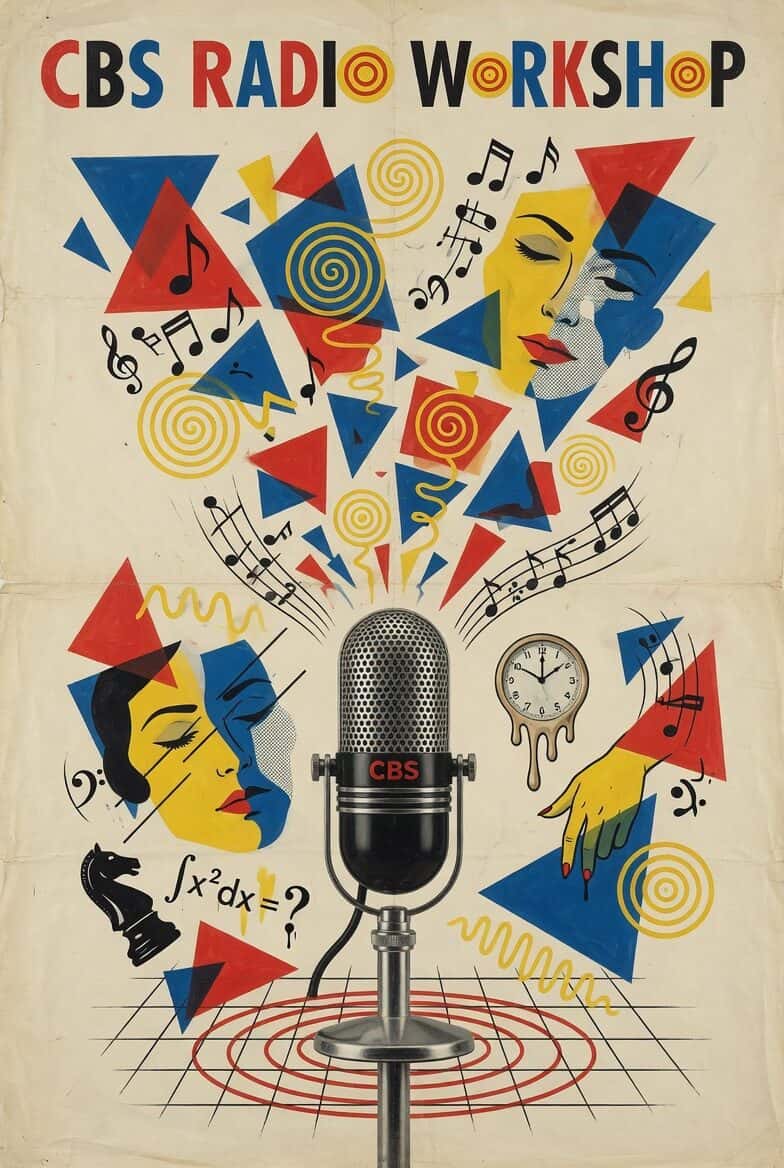
CBS Radio presents the CBS Radio Workshop, dedicated to man's imagination, the theater of the mind. Nineteen years ago, the workshop was honored to produce Air Raid, a new verse play written especially for it by the distinguished American poet Archibald MacLeish. In this work, Mr. MacLeish foresaw the nature of World War II and prophesied that it would be waged against defenseless civilians. Today, when the concern of every man of goodwill is for the safety and defense of his fellows, Mr. MacLeish's play seems even more stirringly true than it did nearly two decades ago. The workshop is once more proud to present William N. Robson's production of Air Raid, a verse play for radio, by Archibald MacLeish.
When you hear the gong sound, the time will be ten seconds past 2 a.m. precisely. WCBS, New York.
Ladies and gentlemen, you have only one thought tonight, all of you. You who fish the fathoms of the night with poles on rooftops and long loops of wire. Those of you who, driving from some visit, finger the button on the dashboard dial until the metal trembles like a medium in a trance, and tells you what is happening in France, or China, or in Spain, or some such country. You have one thought tonight, and only one. Will there be war? Has war come? Is Europe burning from the Tiber to the Somme? You think you hear the sudden, double thudding of the drum. You don't, though. Not now. But what your ears will hear within the hour, no one living in this world would try to tell you. So, we take you there to wait it for yourselves. Stand by, we'll try to take you through. One moment now, we'll try to take you.
The ultimatum, you remember, was for sunrise by their clock. Midnight by ours. Now ours is long past midnight. The sun is up on the whole curve of that continent. The weather is fair with wind southwest going southerly. A few clouds at 10,000, cumulus. Mist among the passes of the upper Julian Alps. Some fog on the east bank. Baltic, but lifting. Otherwise, sun. The Tyrrhenian Sea, all sunshine. The Adriatic creased with curling light. The Atlantic tumbles forward into morning on those beaches. The whole continent lolls in summer sunlight. Spain is drifting eastward with the shapes of clouds. France is smooth with morning as a turf. Germany is checkered with the squares of green and grain. The visibility is perfect. You think you hear the lonely, droning danger of the planes. You don't, though. Not yet. One moment now, we'll take you through.
We take you to a town behind the border. One of those old-time hill towns where the papers come tomorrow morning and the wars come years ago or in some other country. Our men are on a roof above the houses of the town. Strange and curious times, these times we live in. You watch from kitchens for the bloody signs. You watch for breaking war above the washing on the lines. In the old days, they watched along the borders. They called their warfare in the old days wars and fought with men. And men who fought were killed. We call it peace and kill the women and the children. Our women die in peace beneath the lintels of their doors. We have learned much. Civilization has gentled us. We have learned to take the dying and the wounds without the wars.
Stand by, please. We take you through now. We take you now across the traveler's sea. Across the trawler's coast. The parson's orchard. Across the merchant's villa with the vine above the porch. Across the laborer's city with the flames above the forges. Across the drover's plain. The planter's valley. The poplar trees and alleys are the roads. The linden trees in couples are the doors. The willows are the wandering water flowing. The pines in double lines are where the north wind burns the orchards. Those are the mountains where no meadow is squared. Nor a stream straight. Nor a road. Nor water quiet. The town is in those mountains. You are there. Rise to this roof.
Hoofs of stabled horses. Leaves. Even the speaking of sleepers rises. Many sleep in the one house here. They work in the fields, sleep in the village. The men go out at dawn, return to evening burning from the chimneys. The women keep the town between. They keep it now. The tenement's full of them. A four-story building of women. They're filling the court with their quick talk. They call back and forth from the windows. They laugh behind the kitchen doors. They rinse the shirts in the first real shine of the morning. They talk, their arms to elbows in the tub.
Look at it. Look at the cuff of his shirt. What's he been into? Black grease? What would you think he'd be into? A man like yours with an eye like his for wandering.
And you to talk. You with that red-headed lollipop. Hardly a day at dark with his head on the window. He's wearing his elbows out on the stone sill, looking us over from one floor to the next.
Well. If it's only the eye with him that wanders, I wonder.
It's war again. Have you heard of war? No. Have you heard them talking? How can we help but hear them blabbing about, cocking their feet on the kitchen table and talking? It's always war when they talk, and it's always talk. It's always talk when they get to the beer and tobacco. The beer comes out of the bottles. So does the talk, too. Yes, and the wars. Wasting their time on wars with the dishes to do and the children to chase. The wars. As though to make the wars were something wonderful.
Mary! Oh, the petticoat. Look at the petticoat.
We have seen nothing and heard nothing. If they left at dawn, we should have heard them. It's two hours now since dawn. They could make it in two. They could make it in under one and a half from their field to the border. Ten minutes more.
The town is very quiet and orderly. They are flushing the cobblestones with water. The sidewalks are slippery with sun. It smells of a summer morning anywhere. It smells of seven o'clock in the morning in any town they water dust in. Towns are all the same in summer. A man can remember the name of his own in any city after the water carts. The last shutters are opening. The rooms where no one hopes. The rooms where all the hope's been had. And sleep covers it. Folding it.
Where must I wait? Have they told you? Wait for what, Mother? Wait to be well? Wait to be... Yes. I remember. Someone saying it will come. Don't fear it. Were you never afraid, Mother? Never. Of anything. As nothing comes by day or night to fear. Not even war? They came when I was young once. I remember them. We smelled the smoke one morning in the alders. They had their tents by the stream in the water meadow. I'd never eat the sausages. I was the dainty one. I used to rinse my things in seven waters. Well water? Brook water? Rain? I dried them on the gravel by the river. Even at night, late, they would smell of the sun on them. I ate the watercress to make my mouth sweet. They had blue capes on their coats with scarlet linings. They spoke together in another tongue. They were slow and soft in their speech. With laughter. And looking. Evenings coming home across the evening. Seeing the constellations of the stars. They gave us milk to drink from jars of metal. You sit in the dark and drink. You don't say anything. They seem to want you not to speak or move. They seem to want you quiet like the heifers. You sit in the dark and rest. You don't say anything. You don't say thank you even. Not good night. You sit in the dark and rest. You don't say anything.
Listen. Motor throbbing. Probably one of their own. No one watching it anyway.
There he is. We've got him. One of the home ships. He's combing the hills in circles. Working heavily. Laboring. Leveling now. And he's gone. He's gone. He's gone. He's gone. He's gone. He's gone. He's gone. He's gone. He's gone. He's gone. He's gone. He's gone. He's gone. Leveling now. He's high enough. Spark in the sky when he hangs. And the sun angles the fuselage. Gone when the sunlight looses him. Sound coming down out of nowhere. Eddying, floating down. No one noticing anyway. No one looking or listening. Only that.
Late sleepers waken. Are you still there? I dreamed you had gone. I dreamed you had gone. Never go. Say we're happy. Tell me that we're happy. Say we're happy. Tell me we're happy. Say we're happy. Always. Say we're happy. Say we're happy. Happy. Stay as you are. Do not ever move. Stay there. Stay with this sunlight on your shoulders. Tell me we're happy. No, but say we are. How can I know we are unless you tell me? How can a woman know the world is good? Which is the world and which is her? And which is things she's known for sure that never happened? She can't tell. She can't. And be a woman. Can a cup full of well water tell you the taste of the well water? Stay with this sunlight on your shoulders. Stay with this sunlight in your hair.
We've lost him this time. No, wait. Wait. We've got him. He's doubled. He's doubling back into the sun. They've found something or feared it. They've found it. Feared and found. There's the siren, the signal. They've picked them up at the border. Ten minutes to wait. Ten, we'd guess, if we had to.
Strike at a king you must kill. Strike in sleep at a king. When you strike by trick at a people, the treacherous wars must be quick or the victims live for the victory.
Town quiet. Waiting. Women's skirts in the court. Women's arms in the windows. Women's talk on the stairs. They lean there, careless and talking. Their shawls are bright in the doors. The morning airs in their aprons. They shape their hair with their hands. They stand there softly and simply. The women lean from the stairs.
Can't they run the country decent and quiet till eight in the morning even? The rest of the day they can rule as loud as they like and as long as they mind to. They can do what they want with a country from eight on. Only till eight if they don't want to. They can't wait for the difficult sleepers. Those that count their heartbeats every hour. A woman's got no time to watch the wars. Scrubbing the kitchens Tuesdays, marrying Mondays, burying and burying. Men to be born and to bury. People dying never died before.
A police sergeant. He's shouting. He's marching down through the street. He's beating the shutters and shouting. He's calling them out. The cellars. Listen. Take to the cellars. Take to the church cellars.
They only laugh. They lean from the open windows and laugh at him. You take and take them, sergeant. Let the town police take the cellars. Maybe they'll catch them. The alarm has been given. Five minutes have passed. In five minutes more they must be here. They're coming in numbers. I do not know how many. The instructions are to occupy the vaults. These are the orders. These are the orders of persons of proper authority. You will march to the church by twos and at suitable intervals.
Will we? And who'll be watching the park while we're squatting there, counting the mother spiders? The police? There are frogs in the vault. There are also people's relations. Not the kind to gossip, either. And who will iron the underwear now that it's sprinkled? Oh, the police will. Listen to me, policemen. Perhaps it's true they're coming in their planes. Perhaps it isn't true. But if it is, it's not for housewives in this town they're coming. They're after the generals. They're after the cabinet ministers. They're coming to capture the square in the capital city. They always have. They always capture the city. Now, fine sight we'd be, a parcel of housewives spinning with the spiders in a hole, while soldiers that don't know the hole is there, or we are there, or anything is there, go running through the wonderful great sky.
Six minutes gone, four more as we figure it. If they pick them up to the right, we'll sight them over the river, rising or seeming to rise as geese do coming inland, blur of light on the fins. They're always marching past to capture something. It's all one if they march or they fly, they won't hurt us.
It's all one to us if they wing or they walk. They've never troubled us yet. They've never harmed us. They never will.
You are a new policeman. Less than ten years you've been in this district. I do not mention this to shame you. Only you do not know the history of this neighborhood. We have seen such people in this place before. They come in uniforms, carrying elegant banners. They march up and down. They ruin roads. They interfere with the cathedral. They rob the fruit trees. They frighten cattle. They trample clover. No one would say they were likeable people for visitors. Making history over the corn and the cabbage. Writing glorious pages in the beans. Disturbing serious men in haying season. Nevertheless, it is true that few have suffered. Maybe a girl would be rumpled a little. Not me. I do not say the order was expedient. I say it was issued. I do not account for orders. It is not my duty to account for orders. Nevertheless, it was issued by men of experience, persons of sound sense.
It may have been thought the wars have changed with the world, and not for the better. It may have been thought this enemy kills women. It may have been thought this enemy kills women, meaning to kill them. I say it may be thought he makes his wars on women. It may be thought this enemy is not the usual enemy. That this one is no general in the great coat conquering countries for the pride and the praise. That this one conquers other things than countries. It may be thought that this one conquers life. That life that won't be conquered can be killed. That women are most lifelike. That he kills them. It may be, as I say, it may be thought he makes his wars on women. It is possible.
Listen. Anti-aircraft. We can't see it. We hear it. Wait. There's a burst. There's another. They follow each other like footsteps. The steel stamps on the sky. The heel hits. They hang like quills dripping. They hang like quills dripping. They hang like quills dripping. They hang like quills dripping.
You can hear for yourselves. You will now follow the orders to occupy the vaults of village churches. In any event, to descend from upper floors and scatter in streets avoiding visible gatherings.
They're coming. I hear them. They're nearer. They're nearer. They're nearer.
Oh, they'll go over. There's nothing to fear. They'll go over. They always do. They go over. Don't you fear. Don't you fret. Don't you peer in the air. They'll go. They will. You'll forget they were ever by Saturday. Dukes, kings, emperors, now there's this kind.
We hear them, we can't see them. We hear the shearing metal, we hear the tearing air. All we see is sun, sun, the hawk's ambush. Their flight is from the sun. They might be low, they might be well down, 3,000, they might be less. They are many, hard to guess how many. We've got them now, we see them. They're out of the dazzle, they're flying, fighting formation in column. Squadron following squadron, 10, 15 squadrons, big ones. Not so low as we figured them, almost over. They're changing formation, they're banking, the whole flight is banking. Front wheeling to flank, flank anchored and climbing, climbing back into line, the line's swung like a lariat. They're wheeling round for the town, they're rounding in by the river, they're giving a throttle, they're climbing, the timing is perfect. They're flying with purpose. Perfect precision of timing, perfect mechanical certainty. Showing our ship to the street, all of us. They turn like stones on a string. They swing like steel in a groove. They move like tools, not men. You'd say there were no men. You'd say they had no will but the will of motor on metal. Showing our skirts in the street. It won't hurt us. They're showing our weakness. Showing our womanhood. They swing, the wing dips. There's the signal, the dip. They'll dive, they're ready to dive. They're steady, they're heading down. They're dead on. They're on the town. They're nosing, they're easing over, they're over. There they go, there they...
Stay as you are. Do not move. Do not ever move.
The CBS Radio Workshop has brought you Air Raid, a verse play for radio by Archibald MacLeish. Frank Goss was heard as the studio announcer and Ben Wright as the remote announcer. Others in the cast included Lurene Tuttle, Virginia Gregg, Shirley Mitchell, Ellen Morgan, Norma Jean Nilsen, Ann Whitfield, Betty Noyes, John Dehner, Richard Beals, and Shepard Menken.
Mr. MacLeish's prophecy of 19 years ago is grim reality today. Headlines tell of guided missiles whistling in from enemy submarines hundreds of miles at sea. They tell of Nike installations ringing our target cities in the hope that at least most of the missiles would be stopped before they loose their deadly nuclear destruction. Some will get through, some planes, some missiles. Learn what you can do to increase your chances of survival. Contact your civil defense office.
Next week, the workshop will present The Road to Nowhere by Henry E. Fritch, a story of a road that led to peace and prosperity until it linked to the outside world.