
The written record
Read the transcript
Read along with the recording · About 21 min to read
<!-- kimi_cleaned -->
From Hollywood, the CBS Radio Workshop.
He loved airplanes. He lived and breathed airplanes. His heaven was in the sky. It was just airplanes. He was building a model the morning he died.
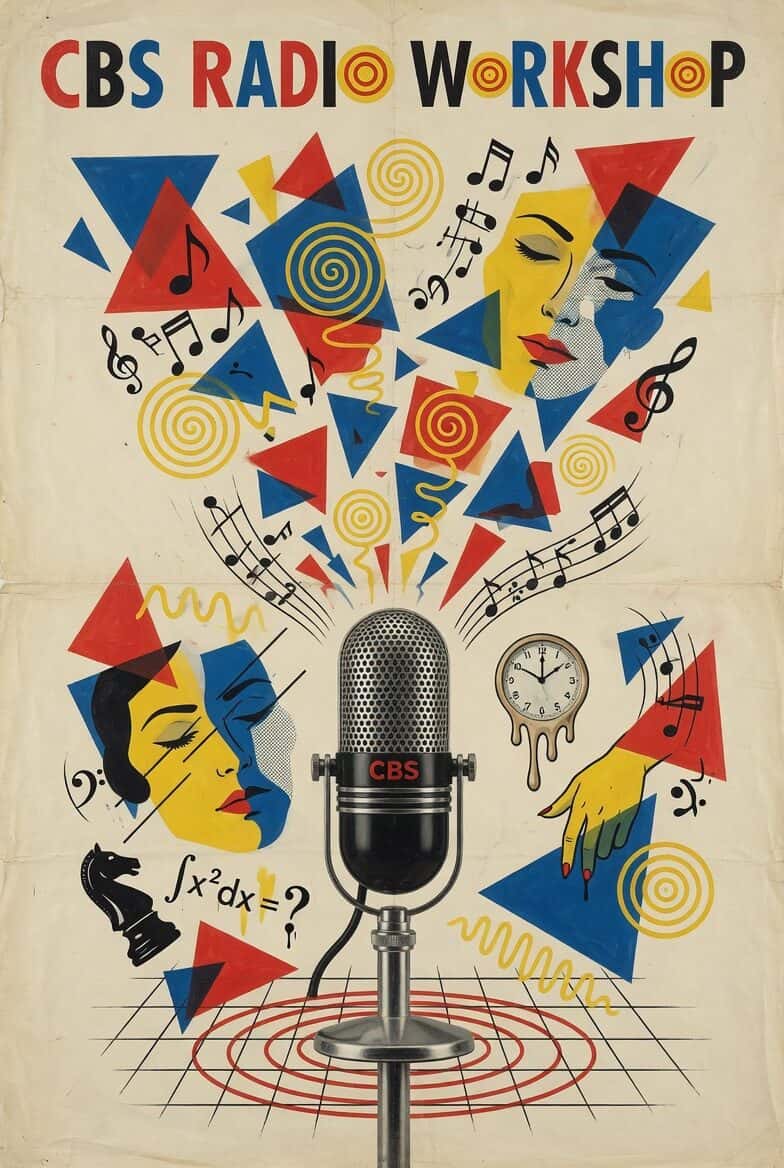
CBS Radio presents the CBS Radio Workshop, dedicated to man's imagination, the theater of the mind.
The Empyrean is no longer empty. Where Apollo once drove his fiery chariot across the firmament, the afterburners of supersonic jets blast the stratosphere. As the airplane has shrunk the earth, so has the air in which it flies been shrunk. A 500-mile-an-hour plane needs space in which to fly, more space than exists above our crowded land. And with tragic frequency, modern Icarus is learning that what goes up sometimes comes down in flames. Not quite four months ago, death fell without warning on a little California community, fell into a crowded schoolyard from a peaceful sky. You are about to hear what happened that day in the words of those to whom it happened, those who live beneath our shrinking air.
The CBS Radio Workshop presents a human document, Heaven is in the Sky, produced and directed by William N. Robson.
At 10:15 a.m., January 31st, flight engineer Waldo Adams grasped the flap, put four throttle knobs in his right hand, and slowly pushed them forward. Pilot William Carr, responding to the mighty pull of the engines, eased the wheels slowly back, keeping his feet steady on the rudder pedals, and the latest DC-7B took off from Santa Monica Airport on its first functional flight after manufacture.
At 10:30 a.m., radio operator Roy Nakazawa reported to Santa Monica Tower that the DC-7B was over Catalina Island at 9,000 feet and climbing. Ten minutes later and 50 miles north, the classes changed at the Pacoima Junior High School, and the boys of the 7th grade streamed into the schoolyard for 45 minutes of fun and games.
At 10:50, the Joshua trees of the Mojave Desert quivered as test pilot Roland E. Owen roared down Runway 25 on the Palmdale Airport, the tailpipe of his F-89J Scorpion streaking flame. A routine flight, a radar-check flight. His target plane, another jet, was already aloft and nearly out of sight in the clear blue sky.
It takes a piston job, even a new four-motored piston job, a little longer to make altitude. At 11:06, the DC-7B checked into Santa Monica Tower at 25,000 feet over Ontario, California. Some 50 miles northeast, the Scorpion was already at 25,000, making a radar fix on its target plane 8,000 feet higher. Somewhere between them, somewhere 5,000, the boys of the 7th grade Pacoima Junior High were discharging their energy, teenage energy. And the mother of one of them, the mother of Ronnie Brand, felt...
Here he couldn't have been in a safer place with an 8-foot fence around him. Even if there was a wreck on the street, a car couldn't come through that fence unless it was doing 90 miles an hour. So the only thing that could have got him was something out of the sky.
Draw a line northwest from Ontario. Draw another southwest from Palmdale. They will intersect above the San Fernando Valley, one of the fastest-growing areas in the world. Put a 300-mile-an-hour DC-7B on the northwest line and a 500-mile-an-hour Scorpion jet on the southwest line at exactly the same altitude, time it just right, and they will collide over the San Fernando Valley.
At 11:18 a.m., January 31st, they did.
The San Fernando Valley is 20 miles long and more than 10 miles wide, and dotted with pleasant little houses. But there are still places where a wrecked airplane might fall harmlessly to Earth. Walnut groves, alfalfa fields, dry riverbeds, the rugged mountains to the north. Toward these, the Scorpion hurtled, now a ball of fire. By the dying DC-7B, its left wing sheared away, continuing, faltering, falling toward the densely populated valley, pilot Carr vainly fighting the useless controls, while co-pilot Archie Twitchell reported to Santa Monica Tower...
We're a mid-air collision. We're a mid-air collision. We're going in. Uncontrollable. Uncontrollable. We're... Poor jet, too. I told you we should take chutes. Say goodbye to everybody.
It takes longer than you might think to fall five miles. Six minutes later, the play period of the seventh grade of Pacoima Junior High School was coming to an end, and the boys were beginning to straggle into the gym. In the auditorium, Linda Luttrell, valedictorian of the ninth grade, was rehearsing her graduation speech.
When it's over... We have only one life to live, and when it's over, will the world be a better place for our having lived in it?
Intent on her words, Linda didn't hear the sound of falling death, but the boys of the seventh grade did.
We was out on the gym field playing, and then we heard this high whistle, and everybody looked up. I saw the whole plane just coming down. It was going around and around. It was on fire, and pieces were flying. I ran from it, and groups of metal were coming down together. We all started running. Mike says, well, I'm with you, and we started running. And I seen Ronnie with me, and then I passed him, and then he passed me. I ran to try to get up a pole. I ran to get away. I ran from it.
I just jumped to the ground and covered up my head.
Donald Kellner, driver of the school bus parked by the playing field, heard it too.
While I was in my bus, I was making out a routine report, and I heard this scream, a screaming noise, just like a plane out of control. And I stepped out of my bus and looked up, and here was this DC-7. Then it exploded. And that thing exploded. It was just right over their heads. And, of course, when they were running away from it, and these parts were rolling with them, you know, and just knocking them down as they were running away from the thing. They were trying so hard to get away from it, you know, they were just running.
I was running, and if I hadn't stopped real fast, I'd have probably got it, because there was a, a great big piece about five feet long come sliding across in front of me. And a few other times, some pieces might have hit me. My main thought was to get out of the way of all the pieces that was sliding and flying.
Well, I didn't notice anything until the plane got right on top of me, and then it blew up, and then a bunch of stuff started flying over. I turned to take a step, and it said, something blew me down. It blew me about six times over.
I was 60 feet away from the plane when it hit the ground, and all the gas tanks behind the motors blew up and gave out tremendous heat, and it felt like a pressure tank, and it felt like a furnace. I was just thinking just to keep down and don't move until I think it was all right to get up. The only time I looked around is when my boyfriend, Rita Colasso, that came up to me and asked that he would, he asked me how to, you know, how to get up. I said, how do I look? He looked. I mean, and I just took one look at him. I didn't look at him too much because he was all burnt from his waist up. He was crying, and he says, he says, I'm ruined.
Well, I just jumped to the ground and covered up my head, so I figured if something hit, it wouldn't, so I wouldn't get my eyes cut open or something like that. About the time I hit the ground, the plane hit, part of the piece hit me in the foot. I got real mad, and I thought it did, I didn't feel the cut at first, so I started walking in, and then, I looked down, and I saw the cut, and it started hurting then.
Turned out, some of the kids were crying and yelling and screaming, and I saw kids laying all over the ground, white T-shirts. I couldn't see nothing until I got out of the D because there was so much smoke, and my shoulder was hurting the most, and when I got out, I seen these kids all laying out, and I seen one guy, it was Malcolm. He was, he's a Mexican kid, and I know him very good, and I drug, I drug him away from an engine light, and flame, and man, dripping out of it, and I was, and when it dripped, it started to fly, flames, bigger and bigger. I was dragging him away, and I couldn't drag him anymore because my shoulder had knocked me out, and a piece of metal knocked me out on it and wrecked me.
I ran towards the crash because, after all, it's my job, I'm responsible for the boys. John Vardanian speaking, physical education instructor at Pacoima Junior High School, the first grown-up to reach the hurt and frightened boys. I didn't think, I just acted. I ran immediately to the center of the impact, the crash impact, in order to pull out any boys that might have been burning, or clothes might have caught on fire, in which, in some cases, that happened. They called, coach, I'm hurt, and I had to put down several boys and told them to stay where they were. I judged how seriously they were hurt, and then I went over to the more serious. I couldn't do everything, there were just too many of them. There was no place that was really safe, no matter where they had been.
The mothers who lived near the school knew that death was close.
I was ironing Skippy shirts when I heard this awful whining sound, and I just threw my iron up, and all the steam went against the wall. And I saw the black smoke just curling up, and I said, Oh my God, Shirley, that's the schoolhouse. And she said, Yes, so we started running.
Others further away did not realize at first that their children were in danger.
The first thing I knew it was a school was when I got a phone call from some friends of mine in Montebello. And then they said over radio that it was the 7th and 8th grade boys that was out. And I just waited, there wasn't much I could do. I didn't go to school because I knew that if there was anything wrong that they would call me. I called some neighbors over, and we just waited. Every time the phone would ring, I was pretty afraid to pick the phone up, thinking that maybe it was from the hospital. I had my neighbors over, and we talked, and just kind of walked around between ourselves and tried to keep busy is about all we could do.
I had a feeling that he was involved, and there wasn't anything I could do. And then they said over radio not to jam up the traffic. I thought that you get down. And all the confusion, if you couldn't find your boy, then what would you do? I mean, I just wouldn't know what to do then. I'd probably go back home and just wait. And then when he didn't come home, well, I was positive of it. Either he was killed or seriously hurt. But I knew that there was no use going because they said they would call as soon as they could. I finally got my call about 2:30 in the afternoon, they called me. And told me that he was in the hospital.
But most of the mothers of Pacoima were not as philosophical as Mrs. Rotello.
Oh, they were. Hundreds of people on the field. And the parents, some of the mothers were screaming. And they were just in hysterics. They were hysterical, you know. And just running from one person to another asking, did you see my boy or this, and where is he? Where is he? That's all they'd say, you know. And someone would just stand and scream.
The first little boy that was laying there that was closest to me had a jacket on just like Skippy's. And, of course, I ran to him. And we just looked. I looked into the face, and it wasn't mine, so I looked into their little faces. Long enough to glance to make sure it wasn't mine. Because I even heard one mother say to a child, I can't help you, honey, I haven't found my own. I know my son, he yelled for somebody to help him, and they run right by him. Well, see, that's a normal reaction of parents, because we were looking for our own first. I started going around from boy to boy, the ones that were fallen and hurt, looking for my boy. I didn't, I looked at everyone. And I was helping my neighbor find her boy. The parents, those that thought or knew their boys were out there, were a little panicky, I don't blame them. Certainly no parent would.
But things looked differently to a 12-year-old. More realistic, perhaps.
The parents, they were down there, buzzing around and everything, causing a lot of confusion and scaring some of the kids that were B-7s. They were scaring them pretty bad. A lot of them went to the hospital just by from shock. They'd come in there screaming and everything. Say, scream out loud, where's my boy, where's my boy, and all like that. If they'd have calmed down, they'd have probably, they'd have probably found out where their boy was a lot sooner.
Mrs. Lorraine Laffanier, who had been ironing just a moment before, finally found her boy.
He was laying on his stomach, of course they had something over his head, his head was bleeding terrible. He says, don't cry, mama. And I said, oh, I'm not gonna cry now. I found you. And he says, let me see your face. And I bent down on, and he says, mama, would you say the Hail Mary and the Act of Contrition with me.
And Mrs. Margaret Barrios found hers.
And I saw my son walking toward me. He was hurt. He was bleeding. All his face was bloody. I saw that he was burnt. I didn't know the extent of his injuries, but he looked pretty bad to me.
But Mrs. Virginia Brand could not find her son, Ronnie, not at the schoolyard.
For an ambulance... The ambulance had already taken him to the hospital. Well, the nurse said, we'll just have to look at every boy, because we don't know who's who. And so myself and the nurse all ran around looking at each boy, and some of them were burnt to bed. I had to get right down at their face and look to see that it wasn't mine. And we ran, looked at all the boys, and then I came back to the desk and spelled out my name, in case they had a wrong name there. And because he was on the list of the injured. And then the doctor must have heard me or something. The doctor said, come here, I want to talk to you. And I said, well, what do you want to talk to me for? I guess I was stalling time. I knew what he was going to say. I just just had that feeling. The minute I drove in the hospital, I realized that the whole thing...
These are the words of Ronnie Brand's father.
A number of cars parked, and I don't know, I just was kind of numb, I guess, and her friend came out to meet me, and I just asked her, where my wife was, and I could tell by the look on her face, just what I was going to expect to hear.
Ronnie Brand, age 13, whose heaven was in the sky, was dead. A tiny sliver of metal from the sky had pierced his temple. A tiny fragment of Duralumin. A tiny piece of an airplane.
He loved airplanes. He just lived and breathed airplanes. I never saw him without an airplane in his hand. His heaven was in the sky. It was just airplanes. He was building a model the morning he died. I was getting ready for work and keeping after him, and he was just sitting there building this model. He had asked for a DC-7 model for his birthday, which I got because I generally buy what he wanted, with him reason. And that just happened to be that type of plane that killed him. All this money he's been making, this $2 a week, he went for model airplanes, and he just mentioned that he had $47 worth of models. And he has them sitting all over his room. I haven't been able to go out to his room. I bought this house because of that room, outside, like he wanted off the garage, so he could have privacy with his boyfriends, and they thoroughly enjoyed that room. It is very hard to come home at night, because Ronnie was always there. He'd come in about 6 o'clock or so, and then he'd watch the television, and I'd get home shortly after 6, and there'd always be a light. That's the hardest thing. I'd try and sleep in until after 8 o'clock, because he usually left for school at 10 minutes of 8. He always washed the dishes for me. I'd give him $2 a week for picking up the house and doing the dishes. And so he left his cereal dish on the table. I said, Ronnie, it's going to be easier to wash if you put it down in the sink when you get home. Put some water in it. So he did. And so that's when he noticed the time, and now he flew out the door. That was the last I saw him. And when I came home that night, well, my girlfriend was with me, and I saw that dish of cereal with the cereal still in the bowl, and I told her, I says, will you please wash up that? I can't stand to look at that, because I never did come home and find a dish on the sink. He wasn't too good about emptying the trash, but because it was out of sight, out of mind. But there was never a dish on that sink. Not even one cup. It didn't used to bother me a bit.
My mother-in-law, instead of buying him toys throughout all these years, has put money in the bank, which everybody thought was a wonderful idea. He had a bank account. For when he was 16, he was to have his car. He had it doped out, and he had it raised and lowered and everything in his mind, what he was going to do to it. You know. And so this money, I think it amounts to about $150, and it's in bonds right now. Last Mother's Day, he bought me a dime store diamond ring, and he said that when he got working, he was going to buy me a real diamond ring like that. And so he said it a number of times. He told my mother. He told my mother-in-law. It was something he was going to do. So I'm going to use that money, and buy myself a diamond ring that he was going to buy me.
A week after Ronnie Brand died, he would have been 14. On his birthday, his mother sat talking to his closest buddies, Larry Larimore and Carl Fox.
How did you feel when you heard Ronnie was gone?
I felt pretty bad because he was a close friend of mine. We always went around together and had a lot of fun. But when I heard he was gone, I felt pretty bad because I lost one of my friends. One of my best friends. Yeah. And it wouldn't be the same without him.
You're pretty close then at school.
I'm sorry I didn't know you before this, you know. I'm sorry I didn't know you before this, but we had a lot of fun together. Yeah, you seem the same type of boy that Ronnie was. Just a regular boy. You're not a sissy. You're not a toughy. You're just a boy.
And how do you feel, Carl, since he's gone out of the neighborhood?
No, I didn't even I didn't eat dinner that night. I didn't hardly sleep any that night, neither. I was thinking about that. And now, after it's all over, but every day I get out of the deal, we meet, Ronnie and me usually meet at this one place at brunch, and it's at these tables. Now, I always go back to them tables, and I look over there, and I don't see Ronnie, but then I go someplace else.
Uh-huh. I know just what you mean. I always get out at the same probably by the same period, and I always go over by the tables and look over, and I remember he's gone, and I walk over and find some other guy.
I never see you kids out playing anymore in the neighborhood. I used to always see you out there flying the airplanes. Last Sunday was the first time I'd seen you, since this all happened.
I never saw one that I didn't see. The four of you are usually always together.
I know we can't find each other anymore.
You should really miss Ronnie then in the neighborhood and at school and everything.
I never did lose a chum like that one throughout my life. I never knew anybody that got killed like that one, even casually. I didn't know him, but I imagine it's pretty hard. When I went to school, Ralph and everybody, they hardly ever meet because they don't know where to go. Ronnie used to always say, well, let's meet here and let's meet there, but now nobody says that, so we don't know where to meet.
I sure appreciate all you boys being pallbearers because I know that's what Ronnie would have done. I know that's what Ronnie would have done. I know that's what Ronnie would have done. And that's why I didn't want you to dress up because I figured it was the birthday party that Ronnie should have had tonight. That's why your father wanted to get you all suits. And I said, no, just whatever you clean up in. Because Ronnie wouldn't know your kids all in suits. And so I figured it was just kind of the kids that would have been there at the party.
His heaven was in the sky. May he and his two dead schoolmates, Bobby Zellin and Evan Elsner, and the four crewmen of the DC-7B, and the pilot of the F-89J, find their heaven less crowded than the skies above our peaceful land, where death lurks in the ever-shrinking, overcrowded air.
The CBS Radio Workshop has presented Heaven is in the Sky with Frank Goss as narrator. Recording and research by Jules Maitland. Next week from New York, the workshop presents I Have Three Heads, a study of the techniques, possibilities, and improbabilities of tape recording. A visit backstage in broadcasting where things happen that are stranger, more exciting, and more fun than anything Alice ever discovered behind the looking glass. Next week at this same time, I Have Three Heads. Now stay tuned for Suspense, which follows immediately over most of these same stations.