
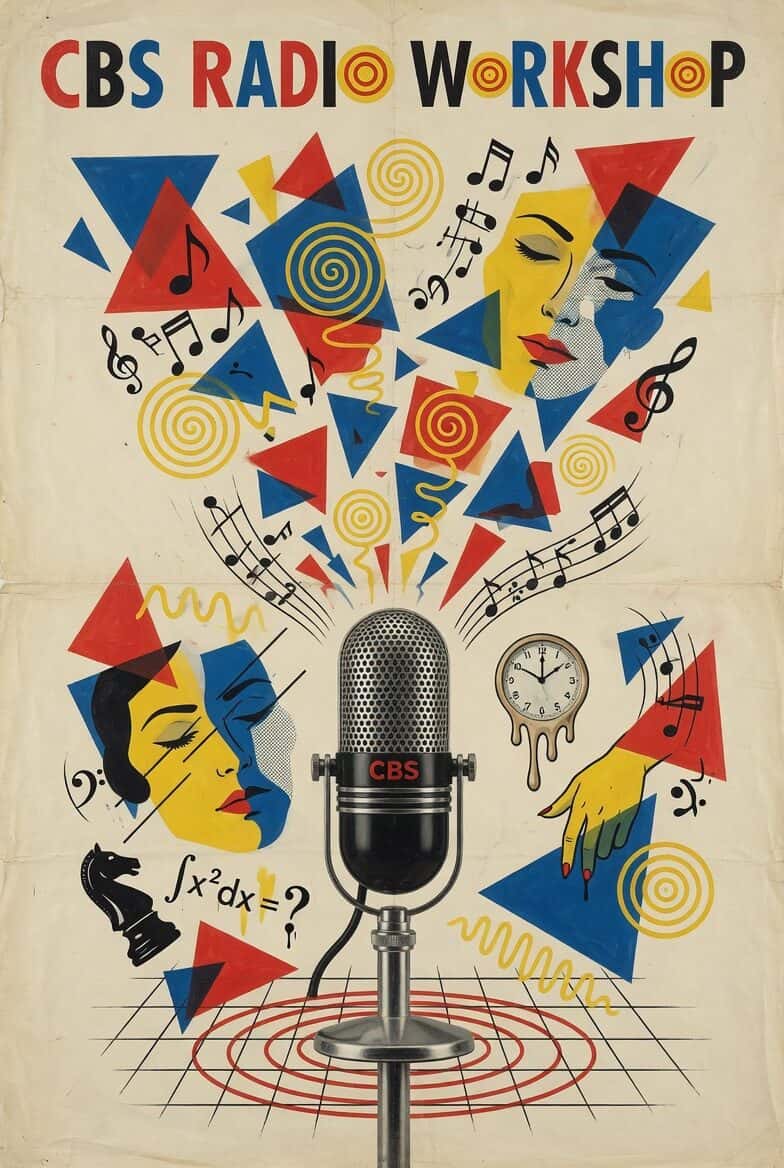
The written record
Read the transcript
Read along with the recording · About 13 min to read
<!-- kimi_cleaned -->
Passing tape over three heads, one for erasing, one for recording, the third for playback, and... The CBS Radio Workshop, dedicated to man's imagination, the theater of the mind, presents I Have Three Heads, a study of the techniques, the possibilities, and the improbabilities of tape recording. Today's workshop was conceived and created by CBS radio engineer Mort Goldberg. In today's workshop, Mr. Goldberg has been aided and abetted by... Hey, hold on! Slow down, wait a minute! Too fast! Too... That was Stu Metz. Nice guy, but loves to talk, like all announcers. Aided and abetted by... Aided and abetted by a writer, a director, a... Who needs him? All you need for a good bang-up tape job is a good engineer like Morty, and a trustworthy, loyal, helpful, friendly tape machine, like me. That's all you need. Morty and I, we put our heads together. His one head, and my three, and we can do anything. Yes, sir, anything.
Uh-oh, who's this coming in? Don't they know this tape room's closed until tomorrow morning?
Okay, Bill, tape room 18's clear. Ready to take her inside there?
Maintenance men. Prod you, poke you, take your insides out. Regular little Dr. Kildare's.
Please! These new machines get heavier all the time.
You said it. Lift a couple of these every day, and you could bend steel bars in a circus.
Right. New machine. What gives? Am I on the way out?
Okay, let's put her down for a minute and rest. I'm tired, boy. Get a cable. We'll have to stretch it to the new box. Over in the corner.
I got it.
Well, what are you waiting for?
What about tools? You got them?
I got them. All except the wrench that fell out of my pocket. In the elevator. I'll go get it.
Easy. Let's take the old machine out or we won't have room to work. These tape rooms aren't any bigger than a cell.
Right. Which one of these old machines goes?
Don't you know?
I don't know.
Won't you? Joe didn't tell you himself?
I thought Joe told you.
Okay, skip it, skip it. He's out. We'll have to wait till he comes back from supper.
Well, that's maintenance men for you. They can tell you transistor 205 connects to pole 83 on the BX sub-transformer. But when it comes to replacing one of the three experienced machines in this tape room, they should go back to plumbing. Sure hope it won't be me. Say, maybe this new machine knows who he's replacing.
Hi. New here, aren't you? That's obvious at first. At first glance, I should say. Well, we were all bright and new once. I'm Howard Ampex, model 200. And you?
Gerald Ampex, model 350.
We must be cousins.
Distant, I'm sure. Wait till this time tomorrow. Wait till you've worked 12, 14 hours steadily. Fast forward, rewind, stop, edit. Fast forward, stop, edit. Fast forward, rewind, stop, edit. Fast forward, dub, loop, rewind. I hope I'll see you after a week. I doubt whether you will.
What do you mean by that?
I saw how you trembled when I was ushered in a few minutes ago. You're quite sure I'm here to replace you, aren't you?
Oh, am I?
I heard those maintenance men talking. I remember every syllable of every word like a good tape machine should. I'm quite aware of what they said.
Are you? Let me play them back to you. Remember, the tape room door opened and then Frank and Bill started talking?
Okay, Bill. Tape room 18's clear.
Right. The new machine inside there?
Right.
Well, what are you waiting for? Let's steal her.
What about Joe?
Joe comes back from supper. Get a wrench and stretch him out in a box.
Right.
Okay, let's skip. The elevator man's in my pocket. Let's lift, take her out, and sell her.
Well, now, Gerald, which of us machines is going out tonight?
Howard Ampex, that's the most dishonest thing I ever heard.
What's dishonest? I didn't change a word.
You changed the order of the words. You changed the whole implication of their conversation. Cousin, you sure have a lot to learn about tape editing.
You mean that's what we do here? You... You...
Certainly not. We don't change meanings, that is. You're right. It is dishonest. That's why tape recordings are thrown out in the courts of most states. That's why editing for broadcast takes an entirely different turn.
Mom, to, uh, met, then, that, that, there was a...
What's that? A voice on the tape room floor. Just part of a day's work. An hour later... An hour later... An hour later... An hour's work, more or less.
It took a whole hour to get that?
Let me explain. This morning, Morty came in with a fellow named George Vekas. Produces a show called Update. Vekas and Morty had a German student on a piece of tape.
I got to know a few students. My own impression from America students was that there was a lot of tape. There was a...
Now, Gerald, is that clear?
There's more... Well, it's rather hard to get the drift than...
Of course it was. With radio, people are listening on small sets. People are listening in cars. Things have got to be very clear. You play something like that all over the country, people think something's wrong with their radio. So how did you save the country?
What? Oh, Morty and I go to work. Morty wants to start at the beginning of the studio. In front of Gordon's words, so he punches me into rewind. Here we are, back at the beginning. Morty punches my start button and the tape starts unreeling from the feed reel to the take-up reel. It passes by my three heads. One for erasing, the second for recording the sounds and words that are fed into it, and the third for playing back what's already on the tape. The playback head we're using now as we catch the student's first words.
I got to know a few students.
Morty punches my stop button. Back we go to find that ah.
What's that very odd noise?
Manual operation. Morty's working the machine by hand.
Well, really, by hand?
You'll have many a hand laid on you before you go back to maintenance for your first checkup. And many a razor blade, too.
Razor blade?
We're coming to that. Morty's found the uh-uh. Now he opens the gate, exposing the heads. He marks the spot for the cut. You'll hear him dropping the pencil.
Where's the razor blade?
My boy, never let it be said. We tape machines give any... Any external evidence of the anxiety, the pain, the shock of having a sharp razor blade passed across us a dozen times an hour. The next sound you hear will be the snick of the splicing tape. The tape machine's band-aids. Then the tape is put back in the gate. The gate is closed and we're off again. And... My own.
Hello, Ann. What happened to the words you were editing?
This is a... Troll job, son. Morty goes on to tighten the space between the words my and own. There you have it. Now you'll hear what Morty's edited so far. Taking out the uh, tightening the space between the my and own.
A few students. My own, uh, impression.
Uh-oh. Another uh to come out. And an im. From that im impression. So Morty makes a mark after my own. Pulls the tapes by hand this time. And marks the tape ready to cut after the first im.
My own, uh, im.
Well, Ann. That was me rewinding. Now, here we go forward.
My own impression from America. Uh, students.
Another uh to come out. Let's see how fast Morty can make this.
America. Students was that there was a... That there's more.
Stop. What's the matter, Gerald? Are you shaking your heads?
Howard, it can go like this all day?
It's a tough grind. But let me show you how it will sound after an hour or so. That's when you're proud of yourself and your engineer.
I got to know a few students. My own impression from America. Students was that there's more in the people of this country than that kind of materialism which the tourists expose.
Well, that's very interesting. That's... Howard? Are you crying?
Excuse me. Gerald, I, I, it's just so clear, so, so beautiful, the work I do. Too bad I haven't some soft music for your emotional jag.
Music? Now, that's where you can have some fun. Have you seen My Fair Lady?
My Fair Lady? What's that?
A musical show I wrote.
Oh, you? You? Well, I...
Helped, in a way. Morty and I taped some of Julie Andrews' Cockney pronunciations. And Mr. Harrison making with phonetics. And we taped a funny babble-babble of women's voices you hear on the My Fair Lady record, too.
They promised me two seat, but I never got them.
Yes. Did I, uh... Did I mention that I play classical music extremely well?
You did? As a matter of fact. You'll probably... You'll be very good at cleaning tapes.
Cleaning tapes?
Bringing foreign tapes up to American broadcast quality. Jim Fassett. He's our music commentator who has a program here on Sunday afternoons. World Music Festivals. He goes to Europe and brings back orchestras and singers in concerts American audiences might never hear. But listen.
That's not good broadcast quality, is it? Sounds like the Oskaloosa Little Symphony.
On us American machines, yes. But remember, Gerald, these tapes are made in Europe. Different machines. Jim and Morty and I work on these European tapes to restore the original quality. Take this piece of tape. You and I switch back and forth. You play the Fassett, Morty, Howard, American version. I'll play the original tape. Here I go.
Ooh. Late, so good night, folks.
What? Where in the world was that?
A piece of Jack Benny tape that Morty and I lost this afternoon. Wondered where it was.
Does this happen often?
Not often enough to my way of thinking. Boy, could we have fun. Boy, oh boy, oh boy. However, let me give you a case of where Morty and I did mix some tapes deliberately. You like band music? Military? College, circus, jazz, or street corner?
Military.
Not one, but four of them. This same fella, Vekas, that I told you about, he and Morty and I put together an audition for a show that hasn't been broadcast yet. A show called Sounds of the World. That music is the band up at West Point playing. We also got tapes of a band at Buckingham Palace. Another band from France. And still another. A band playing in Red Square in Moscow. We also got tapes of four sergeants. One from each country. And let them give the command to march. For international cooperation, how do you like this?
Company! This is your limbo!
Sounds of the World. Four military bands. From West Point, England, France, and Russia. Maybe they ought to trade the U.N. for a good tape machine, eh, Gerald?
I like that.
Howard? Sort of liked it myself, if I do say it, as shouldn't. Say, Howard, what's that tune?
That tune? Oh, it's a little number I wrote myself.
Before or after you wrote My Fair Lady?
Well, to edit this statement correctly, I, little old Howard Ampex of tape room 18, am probably the only tape machine that had a song especially arranged for him. For years, Morty has played tape backwards and forwards and upside down. But he has never had the chance, until just the other day, to find out what happened when an orchestra taped a song backwards. And then I played it forward again. Says Morty to himself, what happens to the instruments? So that's where Hank Silvern entered. And this is how Hank arranged Tea for Two straight. Now, I taped that. And here's how it would sound if played backwards.
You see? Almost everybody's done that, including the two million people who own home tape recorders. But now came the job of orchestrating Tea for Two backwards, so that the musicians began with the last note and played it through to the first note. Here's how that sounded.
We had seven top musicians. Hank at the piano, then guitar, bass, drums, vibes, sax, and trumpet. Four musicians, who could play Tea for Two straight in their sleep. This backward arrangement almost drove them to the point of turning in their union cards. But you should have seen their faces a few minutes later. Here's what we've been working for. A popular song, Tea for Two, orchestrated and played backwards. Now, reversed and played forward, so that the tune is recognizable.
Did you ever hear music like this?
Smoke, Howard! That's out of this world!
Well, let's say just barely in it. First time anybody but Morty and me and Hank and a few others have heard that music.
Gosh, Howard. I feel so... low.
About what?
I... I didn't recognize you as a... a pioneer.
Don't be corny and call me the tape machine's tape machine. It's all in the day's work. Come on. Cheer up, Gerald.
Uh-oh. Someone's coming.
Well, Bill. All set to get this new machine rolling?
Right. What number machine are we taking out?
Number 20. Got your wrench?
What wrench?
The one you left in the elevator earlier. I got it.
Well, hold it a minute. I forgot mine.
I guess it's goodbye, Number 20.
Cheer up, Gerald. Old tape machines never die. They just go back and get new heads. If they come around with those two tickets they promised you for My Fair Lady, shall Morty and I tell them where you are?
Don't bother. Morty made his own special version out of three recordings. Charlie Applewhite, Sylvia Sims, and Dinah Shore's.
Want to hear it? Just for kicks.
Fast forward. Stop. Start. And just for kicks.
I could have danced all night. I could have danced...
Today's Workshop, I Have Three Heads, was conceived and created by CBS Radio engineer Mortimer Goldberg. Mr. Goldberg has been aided and abetted by the following: Charles S. Monroe, writer. Ira Ashley, director in New York. Jackson Beck as Howard. Ian Martin as Gerald. And Ralph Bell and Bill Quinn as the maintenance men. Hank Sylvern, arranger and conductor. Stuart Metz, your announcer. The Workshop wishes to thank James Fassett, Irving Gitlin, George Beekus, and others who contributed portions of program material used today. Next week, from Hollywood, a satiric fantasy written by and starring Stan Freberg about the entertainment competition in a desert spa roughly paralleling Las Vegas. America listens most to the CBS Radio Network.