
The written record
Read the transcript
Read along with the recording · About 14 min to read
<!-- kimi_cleaned -->
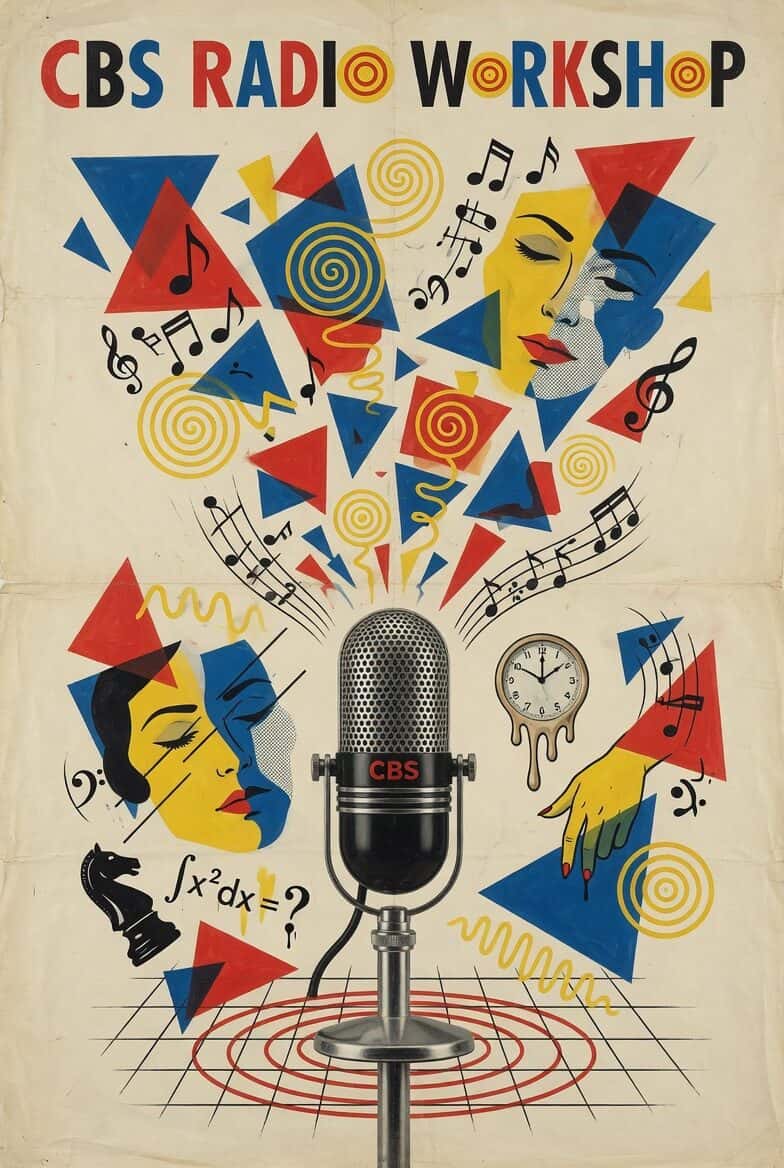
From Hollywood, the CBS Radio Workshop.
Where are the weak of will, the strong of arm, the clown, the boozer, the fighter? All, all are sleeping on the hill. Where are the tender heart, the simple soul, the loud, the proud, the happy one? All, all are sleeping on the hill.
The CBS Radio Workshop, dedicated to man's imagination, the theater of the mind, presents Epitaphs with the words from Edgar Lee Masters' Spoon River Anthology, the music of Wolfgang Frankl, and your narrator, William Conrad.
Mr. Conrad.
Thank you. More than 40 years ago, Edgar Lee Masters' Spoon River Anthology was first published. Although this group of subjective epitaphs from an Illinois graveyard is scarcely remembered today, it profoundly affected a generation of American writers, opening their minds to the vast dimensions of the character of our land and its people. In the years that followed the publication of Spoon River, while we were becoming acquainted with giant after giant, Sinclair Lewis, Ernest Hemingway, Sherwood Anderson, Carl Sandburg, the poetry of the quiet, bespectacled law partner of Clarence Darrow has all but been forgotten. How we feel that this should not be. And so to a new generation, we beg leave to offer a few of the townspeople of Spoon River, as Edgar Lee Masters saw them. They speak from the burial ground on the hill above the village. What they say is often at variance with the words graven upon their tombstones, and at variance, too, with their fellow townsmen's opinions of them. For even in the stillness of death, they are... disturbingly human. None so good nor so bad as he may have seemed while yet alive.
There was Robert Fulton Tanner, who ran the village hardware store.
Looking back, he thought he had developed at last a concept of life. If a man could bite the giant hand that catches and destroys him, as I was bitten by a rat while demonstrating my patent trap in my hardware store that day. But a man can never avenge himself on the monstrous ogre life, if you enter the room that's being born. And then you must live, work out your soul. Aha, the bait that you crave is in view. A woman with money you want to marry, prestige, place, or power in the world. Ah, but there's work to do and things to conquer. Oh, yes, the wires that screen the bait. At last you get in, but you hear a step. The ogre life comes into the room. He was waiting and heard the clang of the spring. To watch you nibble the wondrous cheese and stare with his burning eyes at you, and scowl and laugh and mock and curse you, rubbing up and down in the trap until your misery bores him.
What God hath joined together let no man put asunder. How often had the Reverend Lemuel Wiley enjoined these words, and those others the corollary, till death do you part. Well, Mrs. Charles Bliss heard them once and lived and died regretting having heard.
Reverend Wiley advised me not to divorce him for the sake of the children, and Judge Somers advised him the same. So we stuck it out to the end of the path. But two of the children thought he was right, and two of the children thought I was right, and the two who sided with him blamed me, and the two who sided with me blamed him. And they grieved for the one they sided with, and all were torn with the guilt of judging and tortured in soul because they could not admire equally him and me. Now every gardener knows that plants grown in cellars or under stones are twisted and yellow and weak, and no mother would let her baby suck diseased milk from her breast. Yet preachers and judges advised the raising of children and souls where there is no sunlight but only twilight, no warmth but only dampness and cold.
Preachers and judges. I preached 4,000 sermons. I conducted 40 revivals and baptized many converts. Yet no deed of mine shines brighter in the memory of the world, and none is treasured more by me. Look how I saved the Blisses from divorce and kept the children free from that disgrace. To grow up into moral men and women. Happy themselves. A credit to the village.
The population of the burying ground on the hill is far greater than the village itself, for most of those who passed through the village now rest here. Those who had known the men of the revolution. Those who had marched off to Mexico in '46. And to Vicksburg and Gettysburg and Petersburg sometime later. And those who sent lovers and sons to the war between the states. Here are three such. Knowlt Hoheimer, Ann Rutledge, and Hannah Armstrong.
I was the first fruits of the battle of Missionary Ridge. When I felt the bullet enter my heart, I wished I'd stayed at home and gone to jail for stealing the hogs of Curl Trenary, instead of running away and joining the army. Rather a thousand times the county jail than to lie under this marble figure with wings and this granite pedestal bearing the words pro patria. What do they mean anyway?
Out of me, unworthy and unknown, the vibrations of deathless music. With malice toward none, with charity for all. Out of me, the forgiveness of millions toward millions, and the beneficent face of a nation shining with justice and truth. I am Ann Rutledge, who sleep beneath these weeds. Beloved in life of Abraham Lincoln. Wedded to him, not through union, but through separation. Bloom forever, O Republic, from the dust of my bosom.
I wrote him a letter asking him for old times' sake to discharge my sick boy from the army. But maybe he couldn't read it. Then I went to town and had James Garber, who wrote beautifully, write him a letter. But maybe that was lost in the mails. So I traveled all the way to Washington. I was more than an hour finding the White House. And when I found it, they turned me away, hiding their smiles. Then I thought, oh, well, he ain't the same as when I boarded him, and he and my husband worked together, and all of us called him Abe there in Menard. As a last attempt, I turned to a guard and said, please say it's old Aunt Hannah Armstrong from Illinois, come to see him about her sick boy in the army. Well, just in a moment, they let me in. And when he saw me, he broke in a laugh and dropped his business as president and wrote in his own hand Doug's discharge, talking the while of the early days and telling stories.
The scars of prejudice and segregation go deep. A man and a boy who knew the racism of Spoon River still remember from the grave.
Shack Dye and Yee Bow.
The white men played all sorts of jokes on me. They took big fish off my hook and put little ones on while I was away getting a stringer, and made me believe I hadn't seen aright. I ate the fish I'd caught. When Burr Robbins' circus came to town, they got the ringmaster to let a tame leopard into the ring, and made me believe I was whipping a wild beast like Samson when I, for an offer of $50, dragged him out to his cage. One time I entered my blacksmith's shop and shook as I saw some horseshoes crawling across the floor as if alive. Walter Simmons had put a magnet under the barrel of water. Yet every one of you, you white men, was fooled about fish and about leopards too, and you didn't know any more than the horseshoes did what moved you about Spoon River.
They got me into the Sunday school in Spoon River and tried to get me to drop Confucius for Jesus. I could have been no worse off if I had tried to get them to drop Jesus for Confucius. For without any warning, as if it were a prank, and sneaking up behind me, Harry Wiley, the minister's son, caved my ribs into my lungs with a blow of his fist. I shall never sleep with my ancestors in Pekin, and no children shall worship at my grave.
But it is written the sins of the fathers shall be visited upon the children, even unto the third generation. Willard Fluke and his daughter learned this bitter truth, one with hopelessness, the other with tranquil acceptance.
My wife lost her son. She lost her health and dwindled until she weighed scarce 90 pounds. Then that woman whom the men styled Cleopatra came along, and we married ones all broke our vows, myself among the rest. Years passed, and one by one, death claimed them all in some hideous form. And I was borne along by dreams of God's particular grace for me, and I began to write, write, write, reams on reams of the second coming of Christ. Then Christ came to me and said, go into the church and stand before the congregation and confess your sin. But just as I stood up and began to speak, I saw my little girl who was sitting in the front seat, my little girl who was born blind. After that...
Here lies the body of Lois Spears, born Lois Fluke, daughter of Willard Fluke, wife of Cyrus Spears, mother of Myrtle and Virgil Spears, children with clear eyes and sound lips, and children who were born blind. I was born blind. I was the happiest of women, as a wife, mother, and housekeeper, caring for my loved ones and making my home a place of order and bounteous hospitality. For I went about the rooms and about the garden with an instinct as sure as sight, as though there were eyes in my fingertips. Glory to God in the highest.
What would you say of Circus Foot, a young man with a problem? Who is to judge this victim of a senile aunt? Who is to know how he will be judged on that final day?
I wanted to go away to college, but rich Aunt Persis wouldn't help me. So I made gardens and raked the lawns and bought John Alden's books with my earnings and toiled for the very means of life. I wanted to marry Delia Prickett, but how could I do it with what I earned? And there was Aunt Persis, more than 70, who sat in a wheelchair, half alive, with her throat so paralyzed when she swallowed the soup ran out of her mouth like a duck, a gourmand yet, investing her income in mortgages, fretting all the time about her notes and rents and papers. That day I was sawing wood for her and reading Proudhon in between. I went in the house for a drink of water, and there she sat, asleep in her chair, and Proudhon lying on the table, and a bottle of chloroform on the book. She used sometimes for an aching tooth. I poured the chloroform on a handkerchief and I held it to her nose till she died. Oh, Delia. Delia, you and Proudhon steadied my hand, and the coroner said she died of heart failure. I married Delia and got the money. A joke on you, Spoon River?
Others are not so shrewd or so fortunate in hiding their dilemma. And in a small town, one person's problem can become the cross of another and another. And so it was with Minerva Jones and Doc Myers.
I'm Minerva, the village poetess, hooted at, jeered at by the yahoos of the street for my heavy body, cockeyed and rolling walk. And all the more when Butch Weldy captured me after a brutal hunt. He left me to my fate with Dr. Myers, and I sank into death, growing numb from the feet up, like, well, like one stepping deeper and deeper into a stream of ice. Will someone go to the village newspaper and gather into a book the verses I wrote? I thirsted so for love. I hungered so for life.
No other man, unless it was Doc Hill, did more for people in this town than I. And all the weak, the halt, the improvident, and those who could not pay, flocked to me. I was good-hearted, easy, Dr. Myers. I was healthy, happy, in comfortable fortune, blessed with a congenial mate. My children raised, all wedded, doing well in the world. And then one night, Minerva, the poetess, came to me in her trouble. Crying. I tried to help her out. She died. They indicted me. The newspapers disgraced me. My wife perished of a broken heart. And pneumonia finished me.
One man digs his grave with his teeth, so said. Another, facing problems that have broken his heart, lies down quietly and dies. Then there is yet another kind, the living dead. Nancy Knapp. Nancy Knapp was one of these.
Well, don't you see, this was the way of it. We bought the farm with what he inherited, and his brothers and sisters accused him of poisoning his father's mind against the rest of them.
And we never had any peace with our treasure. The moraine took the cattle and the crops failed. And lightning struck the granary, so we mortgaged the farm to keep going. And he grew silent and was worried all the time. Then some of the neighbors refused to speak to us and took sides with his brothers and sisters. And I had no place to turn. As one may say to himself at an earlier time in life, no matter, so-and-so is my friend. Or I can shake this off with a little trip to Decatur. Then the dreadfulest smells infested the rooms. So I set fire to the beds, and the old witch house went up in a roar of flames as I danced in the yard with waving arms while he wept like a freezing steer.
Thank God. Thank God not all of us are mean and wretched and weak. Thank God for the hope he gives all of us when he puts people like Lucinda Matlock upon this earth.
I went to the dances at Chandlerville and played snap-out at Winchester. One time we changed partners, driving home in the moonlight of middle June. And then I found Davis. We were married and lived together for 70 years, enjoying, working, raising the 12 children, eight of whom we lost ere I had reached the age of 60. I spun, I wove, I kept the house, I nursed the sick, made the garden, and for holiday rambled over the fields where sang the larks. And by Spoon River, gathering many a shell, many a flower and medicinal weed, shouting to the wooded hills, singing, singing to the green valleys. At 96, I had lived enough, that is all, and passed to a sweet repose. What is this I hear of sorrow and weariness, anger, discontent, and drooping hopes? Degenerate sons and daughters, life is too strong for you. It takes life to love life.
Where are they now? A-sleeping on the hill.
You have just heard the CBS Radio Workshop's production of Epitaphs, excerpted from the Spoon River Anthology of Edgar Lee Masters, with original music composed and conducted by Wolfgang Frankl. Epitaphs was directed by William Conrad, whose voice was also heard as narrator. The workshop is produced in Hollywood by William N. Robeson. The citizens of Spoon River were recreated by Lillian Byer, Virginia Christine, Virginia Gregg, Sammy Hill, Vivi Janis, Jeanette Nolan, Lorraine Tuttle, Parley Baer, Dick Crenna, John Dehner, Roy Glenn, John McIntire, Howard McNear, and John Stevenson. Next week, from New York, the CBS Workshop will present The Seven Hills, a personality sketch of one of the world's most unique and ancient cities, Eternal Rome. This is the CBS Radio Network.