
The written record
Read the transcript
Read along with the recording · About 5 min to read
<!-- kimi_cleaned -->
Good afternoon. This is Ed Murrow. A new word has been added to our ever-increasing vocabulary. It's a small word, dressed in fear. To pronounce, not very difficult. To envision, staggering. This scientific word may well become the most important in all languages and to all peoples. It is pronounced fallout. Fallout. Rather a simple word to describe so much. Fallout. Radiation withheld by quantities of atmosphere that may eventually descend to pillage, burn, kill, not only you and me, but the scores of generations unborn. Quite a word, fallout.
I keep wondering if not the actual word, perhaps its meaning, has been with us for thousands of years. I remembered the Chinese were the first to use gunpowder, not for destruction, but as a signal for joy. Much sound for much happiness. Suddenly, fallout seemed to come into focus. Stripped of its fearful garb, its offering now was positive, not negative. Fallout. Words, thoughts, ideas withheld sometimes by the atmosphere of ignorance, but eventually descending to enrich the lives of you, me, and those same generations yet unborn.
Today, let us partake of man's fallout. One man we simply call Preacher. His father was a great king, but his son, the Preacher, sang not of fear, but of confidence and direction. The other man is a contemporary American. His name, Norman Dello Joio, American composer, and this year's recipient of the Pulitzer Prize. Through the span of hundreds of years, these men have joined hands, and in a troubled time, have been able to speak. The work is called Meditations on Ecclesiastes.
To assist them, we have the Columbia Symphony String Orchestra, conducted by Maestro Alfredo Antonini. Assisting their efforts will be Rabbi Theodore L. Adams, Dr. Oswald Hoffman, Senator John Kennedy, and here is the Very Reverend Lawrence J. McGinley, President of Fordham University.
While frightened children terrorize our city streets, and our streets, and our streets, and our own fear mushrooms into brooding clouds over the Pacific, we have lost in our uneasy day the sense of structure. We fail to look at the seasons around us, and in their slow rotation find the permanence of the Creator. We fail to search the reaches of man's history, and find in our own growth the tracings of God's providence. The young see their visions disintegrate. The old nervously analyze their dreams. Yet the strength of God's hand works also in our dreams. To mold from the chaos of man and his atoms a new creation. Our struggle is to recognize his season, his purpose, and his time.
To everything there is a season, a time to every purpose under the heaven, a time to be born, and a time to die.
Rabbi Theodore L. Adams, President of the Synagogue Council of America. An ancient rabbinic sage once said, man is half angel, half brute. Our task is to redeem man from his brutish impulses in order that he may realize the divine in his nature. Man's destiny lies in his transforming this world into the kingdom of God, not in destroying it. To pluck up evil intentions, and to plant good intentions. To kill fear and to heal through confidence. To break down despair, and to build up courage in this atomic time.
A time to plant, and a time to pluck up that which is planted. A time to kill, and a time to heal. A time to break down, and a time to build up.
Of the Lutheran Church, Missouri Synod. The sun rises and sets. The rains descend on the just and on the unjust. It is God's sun, his rain, his seasons, his world. With each new age, a world that is at once the object of God's creative power, and of his redemptive love, discovers what is ever old and ever new. The passage from birth to death, amid sorrow and joy. Encumbered by responsibility, and enriched by rare ecstasies.
A time to weep and to mourn. A time to dance and to laugh. A time to embrace, and a time to refrain from embracing.
Senator John Kennedy, Pulitzer Prize winner of 1957 for Profiles in Courage. We live today in an age of juxtaposition. Our capacity for destruction and for dissension mixes with our desire for brotherhood and equality among nations and men. From these conflicting forces, the future will emerge. With we hope, an awareness of good, as well as evil. Of hope instead of despair. Thus our age is like that described in the scripture. A time of hate and of war. A time to love, and a time of peace.
Also knoweth not his time, as the fishes that are taken in the evil net, and as the birds that are caught in the snare. So are the sons of men, snared in evil times, when it falleth suddenly upon them.
These words, so many hundred years old, and this music of today, is the fallout of our cultural tomorrows. Around us, are the materials and ideas that may have their fallout, portents of evil. Let us hope, that the history of our time, when written, will record no such thing.
This is Ed Murrow. Goodbye and good luck.
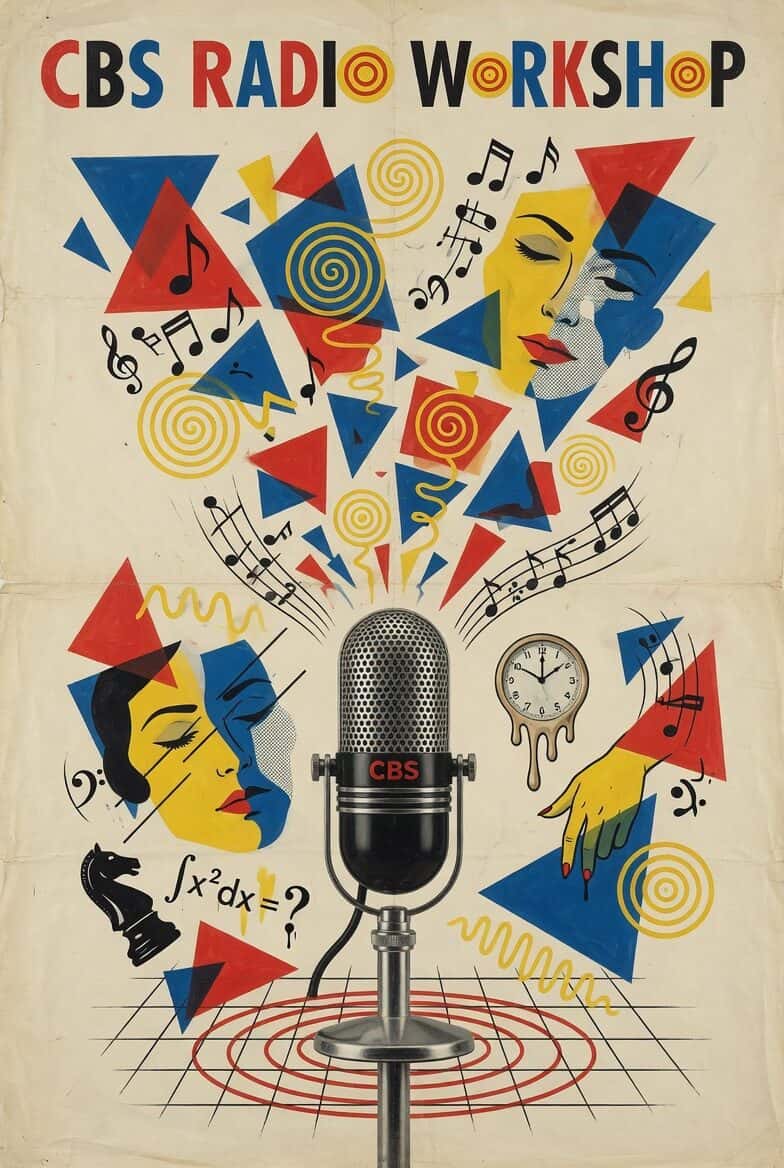
You've been listening to the CBS Radio Workshop, dedicated to man's imagination, the theater of the mind. Today's presentation, Norman Dello Joio's Pulitzer Prize winning composition, Meditations on Ecclesiastes. Conducted by Alfredo Antonini. Program originated in New York. Production, Dee Engelbach. Associate, Dick Muller. Audio, Harold Bridges. Next week from Hollywood, Gettysburg. Ted Pearson speaking. This is the CBS Radio Network.