
The written record
Read the transcript
Read along with the recording · About 15 min to read
<!-- kimi_cleaned -->
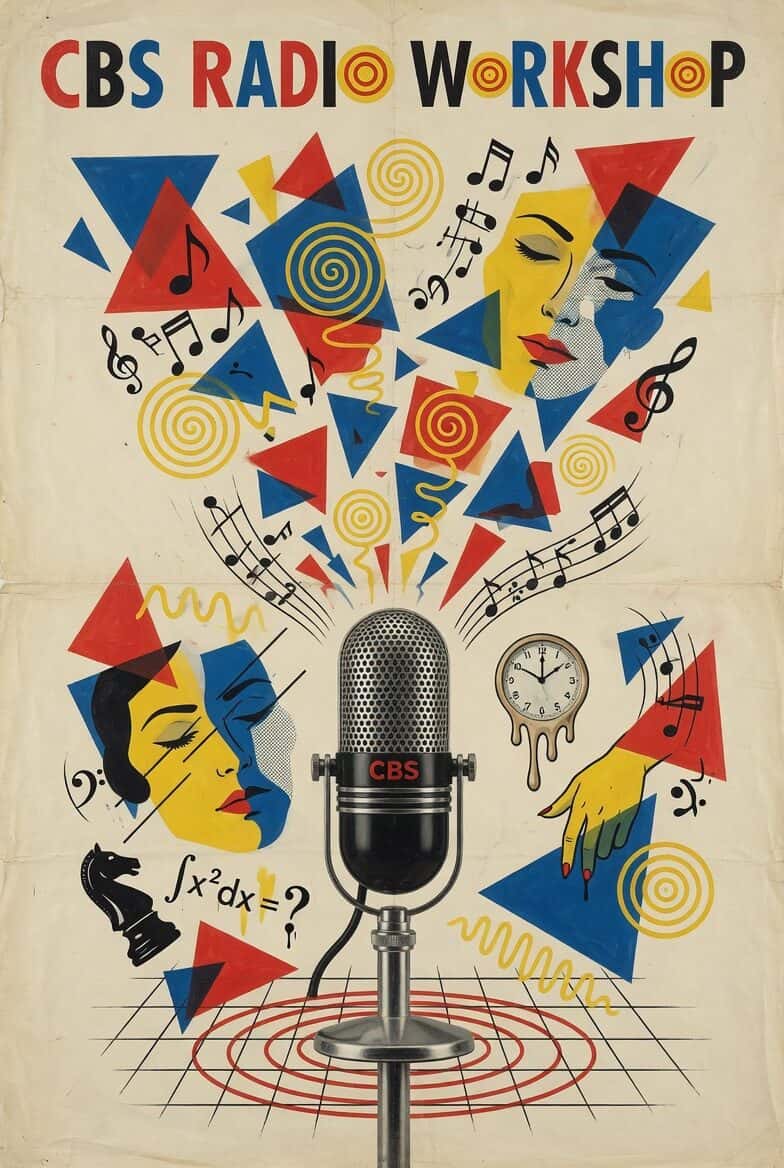
From Hollywood, the CBS Radio Workshop.
In a larger sense, we cannot dedicate, we cannot consecrate, we cannot hallow this ground. The brave men, living and dead, who struggled here, have consecrated it far above our poor power to add or detract. The world will little note, nor long remember what we say here, but it can never forget what they did here.
The CBS Radio Workshop, dedicated to man's imagination. The Theater of the Mind presents William N. Robson's production of Gettysburg. It began 94 years ago, tomorrow morning. Gettysburg, before July 1863, was known only to its neighbors. It was neither a place for battle, nor a place for immortal oratory. Gettysburg, before July 1863, was a sleepy Pennsylvania village, hemmed in by the rolling green ridges of the Appalachians, and crisscrossed by several dusty farm roads. It is quite difficult to think of it now as it was then. Only the monuments remain, and the yellowed pages of the report.
Gettysburg, 94 years ago today, was warm sun and ripening wheat, and a strange quiet. A quiet expectancy.
Today we heard that the rebels were crossing the river in heavy force, and advancing onto this state. No alarm was felt until Governor Curtin sent a telegram, directing the people to move their stores as quickly as possible.
Sally Robbins Broadhead was a teacher who lived on the Chambersburg Pike, near the center of the town. Day by day, as the rumors she heard grew into reality, Sally put them down in her diary.
June 20th. The report of today is that the rebels are at Chambersburg, and are advancing on here.
June 21st. Great excitement prevails, and there is no reliable intelligence. One report declares that the enemy are at Waynesboro, 20 miles off. Another that Harrisburg is the point.
June 22nd. The report now is that a large force is in the mountains, about 18 miles away.
General Robert E. Lee had planned his invasion for two important reasons. First, to feed and supply his troops on the bountiful harvests of the North, and to lure the Army of the Potomac away from his native Virginia.
And now, as he neared Pennsylvania, Lee needed Jeb Stuart, the dashing cavalry officer, who, frisky as a mischievous colt, rampaged through Maryland, tearing up the tracks of the B&O. On the same day that Jeb captured a federal wagon train at Rockville, President Abraham Lincoln appointed George G. Meade to replace Fighting Joe Hooker as commander of the Army of the Potomac. That day was June 28th.
June 28th. About 10 o'clock, a large body of our cavalry began to pass through town. I hope they may catch the rebels and give them a sound thrashing.
June 29th. Quiet has prevailed all day.
June 30th. We were told that a heavy force of our soldiers was within five miles, and the rebels learning that a body of cavalry was quite near, retraced their steps and encamped some distance from the town. It begins to look as though we will have a battle soon, and we are in great fear.
Sunrise, July 1st. General Henry Heth, at the head of a column of infantry, advanced down the Chambersburg Pike toward Gettysburg. His mission, most unmilitary in function, but nevertheless vital to the success of the Confederate campaign, was to find shoes for the barefooted men of the Third Corps. Where Willoughby Run flowed under a covered bridge, a mile and a half from Gettysburg, General Heth halted, watchful, uncertain, observing the terrain. To his right was a cover of woods. Union forces could be there, waiting in ambush. Heth had to be certain. He ordered the woods shelled. It was here that the first shot of the battle was fired.
I got up early this morning to get my baking. I had just put my bread in the pans when the cannons began to fire. And true enough, the fighting had begun in earnest.
In his headquarters at Cashtown, Lee had heard the sound of battle and had hurried forward to Gettysburg. Heth supplied his commander-in-chief with a full report. Lee seemed satisfied. He cautioned, however, that a major battle should be avoided until all southern columns had converged.
That afternoon of July 1st, there was the fire in Gettysburg. There was the sudden confusion of a major clash. On the Union side, the cannoneer Augustus Buell remembered seeing the Confederates coming.
First we could see the tips of their color staffs coming up over the little ridge. And the points of their bayonets. And then the Johnnies themselves coming with a steady tramp, tramp, tramp, and with loud yells. Seven or eight minutes ensued, probably the most desperate fight ever waged between artillery and infantry at close range without cover on either side. They gave us volley after volley in front and flank, and double canisters as fast as we could load. The very guns became things of life, not implements, but comrades. For a few moments, the whole rebel line, clear down to the Fairfield Road, seemed to waver. And we thought maybe we could repulse them single-handed. But the second line came steadily on. The ordnance sergeant gave the order to limber to the rear. The 6th Wisconsin and the 11th Pennsylvania behind us having begun to fall back down the railroad track toward the town, turning about and firing as they retreated.
As the fiery sun settled behind the Pennsylvania hills, the seminary to the town and didn't run. I remember seeing Hall's battery and the 6th Wisconsin halt from time to time to face the enemy and fire down the streets.
We lay on our arms that night. We lay on our arms that night among the tombs of the village graveyard. So suggestive of the shortness of life and the nothingness of fame. But the men were little disposed to moralize on themes like these, and were too much exhausted to think of anything but much-needed rest.
In the Confederate camp, hot southern blood went to southern heads. Younger officers insisted on striking at once. Follow up the advantage. Give no quarter. But Lieutenant General Ewell hesitated, remembering that Lee had said a general engagement must be avoided until all the corps of the army had converged. And while Ewell diluted his valor with discretion, the Army of the Potomac got its second wind.
It was sometime after midnight, July 2nd, when Meade reached Gettysburg. He established his headquarters at a shabby little farmhouse on the left of the Taneytown Road. There he could view the rugged terrain that gave his force a natural defense. For during the night, the Federal Army had added the names of Big Round Top and Cemetery Ridge and Culp's Hill to their war map. By morning, they would be well dug in.
Of course, we had no rest last night. Part of the time, we watched the rebels rob the house opposite. It was a moonlight night, and we could see all they did. The cannonading commenced about 10 o'clock this morning, and we went to the cellar and remained until it ceased.
General James Longstreet eyed the menacing heights of Cemetery Ridge. He had no taste for the battle that was taking shape. Any fool could see that Gettysburg had become Fredericksburg in reverse. Brigadier General John B. Hood reported to Longstreet.
General Lee was seemingly anxious you should attack this morning. He remarked to me, "The enemy is here, and if we do not whip him, he will whip us." You thought it better to await the arrival of Pickett's division at that time still in the rear in order to make the attack. And I remember you said to me subsequently while we were seated together near the trunk of a tree, "The General's a little nervous this morning. He wishes me to attack. I do not wish to do so without Pickett. I never like to go into battle with one boot off."
The report minces no words. It explains the delay and Longstreet's pouting impetuousness. Although he disagreed with the tactics, Longstreet would stubbornly carry out Lee's orders to the letter, despite a recommendation from Hood's scouts to skirt Big Round Top quietly and attack the Federals from the rear. Hood pleaded, but Longstreet held fast.
General Lee's orders are to attack up the Emmitsburg Road.
And so Hood led the attack. And some days later, while nursing a wound, completed his report.
In about twenty minutes after reaching the peach orchard, I was severely wounded in the arm and borne from the field. I shall ever believe, had I been permitted to turn Round Top Mountain, we would not only have gained that position, but have been able to finally rout the enemy.
Meanwhile, Robert E. Lee sat on a stump of a tree and watched the panorama of battle through his field glasses. Behind him, a Confederate band played polkas and waltzes. Before him, a cannonade played its song of death. Throughout the terrible siege, the General sent only one message, received only one report. Perhaps this was his system, to plan thoroughly with the three Corps commanders, then leave it to them to modify and carry out his plan to the best of their abilities.
How did the plan look close up to the scene of action? Colonel Perry of the 48th Alabama.
Upon the decision of a moment, it depended the honor of my command, and perhaps the lives of many brave men. I knew that if called upon, they would follow me, and felt confident that the rocks of Devil's Den could be carried by an impetuous charge. But then what? There were no supporting troops in sight. Before the enemy had time to load their guns, I made my decision. Leaping over the prostrate line before me, I shouted the order.
Forward! Charge!
Charge and countercharge. On the Union side was Theodore Gerrish of the 20th Maine.
Our line is pressed back so far that our data was in the lines of the enemy. Our ammunition is nearly all gone, and we're using the cartridges in the boxes of our wounded comrades. We can remain as we are no longer. We must advance or retreat. Colonel Chamberlain understands how it can be done.
Fix bayonets!
The whole air roared with the conflict but a moment since. Now all is silent. Not a gunshot sound is heard, and the silence comes distantly, almost painfully to the senses. And the sun purples the clouds in the west, and the sultry evening steals on, as if there had been no battle. And the furious shout and the cannon's roar had never shaken the earth. And how look these fields! We may see them before dark, the ripening grain, the luxuriant corn, the orchards, the grassy meadows, and in their midst the rural cottage of brick or wood. They were beautiful this morning. They are desolate now. Trampled by the countless feet of the combatants, plowed and scored by the shot and shell, the orchards splintered, the fences prostrate, the harvests trodden in the mud. And more dreadful than the sight of all this, thickly strewn over all their length and breadth, are the habiliments of the soldiers. The knapsacks cast aside in the stress of the fight, or after fatal lead had struck. Haversacks yawning with the rations the owner will never call for. Canteens of cedar of the men of the Rebellion, and of cloth-covered tin of the men of the Union. Blankets and trousers and coats and caps, and some are blue, and some are gray. Muskets and ramrods and bayonets and swords and scabbards and belts. And last, but not least, numerous, many thousands of men. And there is no rebellion here now. The men of South Carolina are quiet by the side of those of Massachusetts. Some composed, their upturned faces sleeping the last sleep. Some mutilated and frightful, some wretched, fallen bathed in blood. Survivors still, and unwilling witnesses of the rage of Gettysburg.
For the Confederates, the 3rd of July completed a tragic cycle. There had been hesitation and loss of the heights of Seminary Ridge the first day, an assault too feeble and too late on the second, and now on the third day, dawn began to break over the crests of the hills, rising out of the bed of Rock Creek.
This day was to begin with an attack too early in its timing to support Lee's revised plan. Culp's Hill, there at the barb of the Federal's fishhook defense. Confederate gray, fixed bayonets, and rose to the charge. The forces met, fused in one fighting force, fell apart at length, leaving their dying and dead. And a decision still unsettled.
Behind the Confederate lines, the bitter dispute between Longstreet and Lee continued. To Longstreet, there was only one sane course now.
To move around the right of Meade's army and maneuver him into attacking us.
But Lee stood firm for another attack on Cemetery Ridge.
The Army of Northern Virginia is not yet ready to confess repulse. The whole of the First Corps must be thrown into the new assault.
And so it was. First, the review. Men standing lined up before Lee, Longstreet, and General George Edward Pickett. Then, five hours later, in the stillness of a merciless July sun, the men heard the shot, the signal, and flattened themselves in the tall grass. The Confederate artillery thundered the beginning of the end.
Two hours later, the artillery duel ceased, and Longstreet rode up to Pickett.
Pickett, I am being crucified at the thought of the sacrifice of life which this attack will make. I've instructed Alexander to watch the effect of our fire upon the enemy. And when it begins to tell, he must take the responsibility and give you your orders. For I can't.
Even as he was speaking, a note was handed to Pickett from Alexander.
I showed it to General Longstreet, asking if I should obey and go forward. He looked at me a moment, then held out his hand. Clasping mine without speaking, he bowed his head. I shall never forget the look in his face when I said, Then, General, I lead my division on.
July 4th. It's been a dreadfully long day. We know, however, that the rebels are retreating and that our army has been victorious. And for the first time for a week, I shall go to bed feeling safe.
As Sally Robbins Broadhead retired for the night, as Robert E. Lee led his thin, wavering line of defeated Confederates back south across the mountains, as rain drenched the battleground debris, and as black clouds settled low over the unburied dead of Big Round Top and Cemetery Ridge, so ended the Battle of Gettysburg.
Two days later, Frank Aretas Haskell, aide-de-camp for General Gibbon, revisited the battlefield.
No soldier was to be seen, but numbers of civilians and boys, and some girls even, were curiously loitering about the field. And their faces showed not sadness or horror, but only staring wonder or smirking curiosity. All along through those bullet-stormed woods were interspersed little patches of fresh earth raised a foot or so above the surrounding ground. Some were very near the front of the works, and nearby, upon a tree whose bark had been smoothed by an axe, written in red chalk would be the words, not in fine handwriting, seventy-five rebels buried here, fifty-four rebs here, and so on. Such were the burial, and such the epitaph, of many of those famous men once led by the mighty Stonewall Jackson. Oh, this damned rebellion will make brutes of us all if it is not soon quelled.
Already, as I rode down from the heights, nature's mysterious loom was at work, joining and weaving on her ceaseless web what the shells had broken there. Another spring shall green these trampled slopes, and flowers planted by unseen hands shall bloom upon these graves. Another autumn and the yellow harvest shall ripen there, all not in less but in higher perfection for this poured-out blood. In another decade of years, in another century or age, we hope that the Union may repose in a secure place, and bloom in a higher civilization.
You have just heard the CBS Radio Workshop's production of Gettysburg, adapted by Leroy Bannerman, from the book of the same title by Earl Schenck Miers and Richard A. Brown, with a musical score composed and conducted by Leith Stevens. John Dehner was the narrator, and others in the cast included Ellen Morgan, Barney Phillips, Joseph Kearns, Byron Kane, Ted de Corsia, Daws Butler, Raymond Burr, Ed Jerome, and Howard McNear. Sound patterns by Gus Bayz and Ray Kemper. Next week, from New York, the Workshop will present You Could Look It Up by James Thurber. This is the CBS Radio Network.