
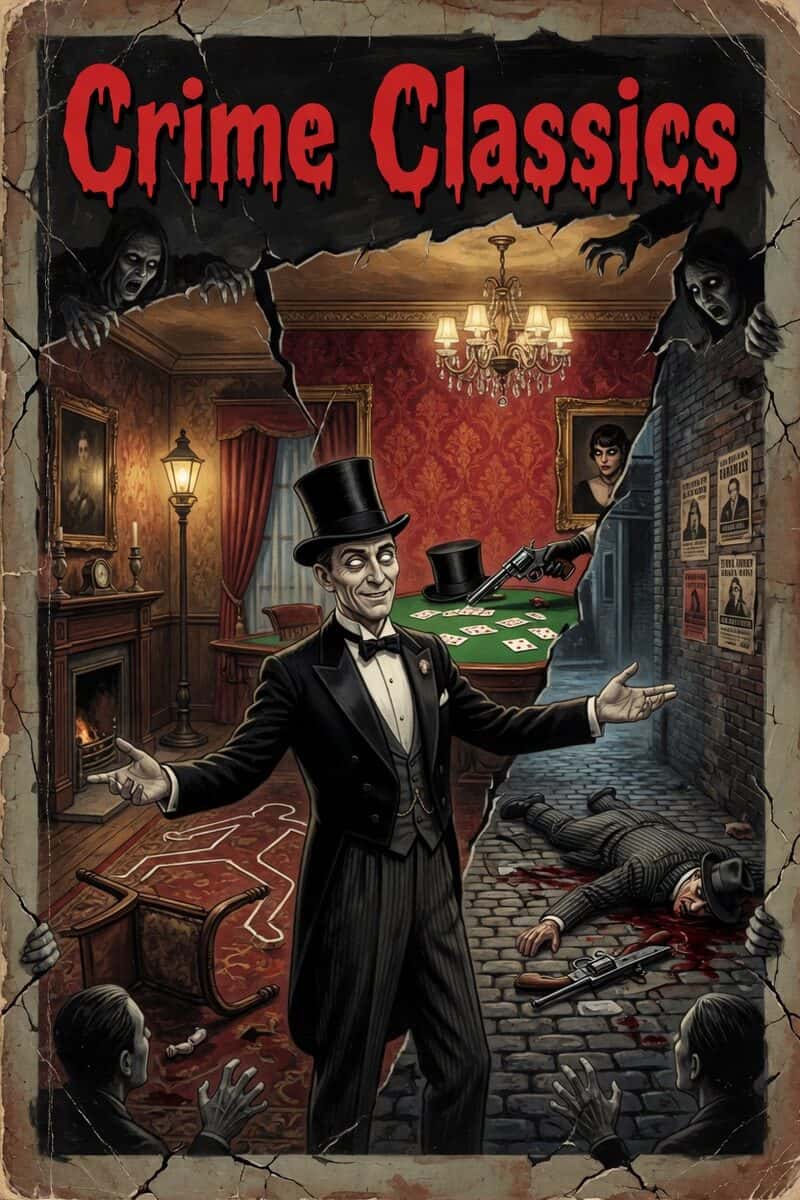
The written record
Read the transcript
Read along with the recording · About 17 min to read
Good evening. This is Crime Classics. I am Thomas Highland. I'm going to tell you another true crime story. Listen. The man who just fell down the stairs is Colonel James Fisk, Jr. Although the colonel is a man given to the consumption of dozens of Blue Point oysters and bottles of heady wine at a sitting, his friends were given to pointing him out as a man inordinately steady on his feet. So why did he tumble down the stairs? And in New York's Grand Central Hotel, no less, where stair tumbling was frowned upon. The colonel didn't slip, he wasn't pushed, he was shot. The sudden presence of two bullets in him had upset his equilibrium.
The man who's running away is the man who just shot the colonel. His name, Edward S. Stokes. Until recently, the colonel's very dear friend. There he goes.
And tonight? My report to you on the checkered life and sudden death of Colonel James Fisk, Jr.
Crime Classics. A series of true crime stories taken from the records and newspapers of every land, from every time. Your host each week, Mr. Thomas Highland, connoisseur of crime, student of violence, and teller of murders. And now once again, Thomas Highland.
Colonel Fisk lay at the bottom of the stairs a few minutes before four o'clock on a Saturday afternoon, January the sixth, eighteen hundred and seventy-two. He was dying. His life was coming to an end. And he would be sorely missed by his family, Mrs. Fisk and the children, and by his intimates, among whom were Jay Gould, Boss Tweed, and the heavier stockholders of the day.
A man dying, and I know the precise instant when his dying began. It started some months ago in a rather ornate house in Washington Square. Two women were talking. And the younger one said...
Annie, how can I meet Colonel Fisk?
That was the instant. And the older one said...
Oh, dearie, dearie, dearie.
But the younger one was not young enough to take dearie for an answer.
I mean it, Annie. I want to meet him. He's so wealthy, isn't he? And all I have is a black and white silk dress and an empty purse. So very empty, dear Annie. Oh, orphans in the rain and empty purses sadden me so, dear Josie. And I... I've heard he's coming here tonight to visit with you. The dear colonel says I set such a good table.
Dear Josie.
Yes?
Walk over there to that cabinet, dear Josie. In the very bottom drawer you will find two candlesticks given to me by the minister from Egypt. Get them.
Yes.
They are heavy, aren't they? Now put them on the table and light them. Now blow them out, gently.
Well, Annie?
Dear Josie. Will you join the dear colonel and me for dinner tonight?
Nice of you to ask. I'd be delighted, dear Annie.
So it was that Colonel Fisk and Josie Mansfield met. It was a highly successful meeting.
I kiss your hand, Josie. You're a very sweet man.
Isn't she a dear? So lovely. And so poor. So sad.
The colonel was a man easily touched. And this was the era for young widows... Beautiful and penniless. It was the era for weeping at the mere thought of such a situation. It was a decade of compassion. And champagne. And this night, the meeting night, was one of the most poignant of the decade.
Tomorrow, Josie, a jewel to lie against the throat.
Oh, Colonel.
My carriage will call for you at noon and bring you to me.
And where will you be?
At Tiffany's.
The necklace counter?
Of course, my dear. More wine.
Diamonds become you.
Oh, Colonel. Oh, Colonel.
Do you like it?
Very nice. And it's all yours.
Oh, thank you. I've always wanted a home of my own. And servants of my own. Six.
Kiss me, Colonel.
Good evening, Colonel.
Evening, Quimby. This is Mr. Stokes.
May I take your cane, sir?
Thank you, Quimby. Is, uh...
The mistress is in the drawing room. She's waiting for you.
This way, Stokes.
Oh, Colonel. And you must be the Colonel's best friend, Mr. Stokes.
I hope this is no imposition, ma'am.
Preparing dinner? Certainly not. I just sat here all day, listening to the new present the Colonel sent me, while the servants made ready.
Do you like the new music box, my dear?
It reminds me of you when you're away from me.
Such a pretty speech. How fortunate you are, Colonel.
Oh, wait till you taste her pheasant a la Esther.
I can hardly wait. Now, will you two excuse me for a moment?
Where are you going, Colonel?
I left a small package for you out in the carriage, my dear.
Oh, of course. We'll excuse you.
You're Mr. Stokes.
So you're Josie. I must say, he was right. You are elegant.
He was right. You are very lovely. You're younger than he told me.
And you... You're... What?
You are... Will you help me light the candles?
Josie.
Will you help me with the fire?
Josie.
The music box is run down. Will you help me?
Josie. You won't help me with anything. You're wicked.
Yes, I am.
You're very wicked.
At the time Josie whispered this tender criticism, Mr. Edward Stokes was five feet nine inches high. His head was covered with glossy curls, his complexion clear, his features regular, and his eyes dark blue. He was dressed in the height of fashion, and his diamond studs gleamed brilliantly.
And after the colonel returned with a forgotten package...
Oh, a ruby pendant. Thank you, colonel.
You're very welcome.
And after the wine was drunk and venison devoured, and the fingers dipped in the lemon water, after that evening of old friends anew, after that, there was a new day. And there was this.
Good morning, Mr. Stokes.
Good morning, Quimby. Is, um...
The mistress is in the sitting room. She's waiting for you.
Thank you, my man.
Josie.
Edward. Oh, wait, Edward. I was out this morning early shopping. Here. I bought something for you. Open it.
Josie. A pearl stick pin.
There was no need for you to...
Oh, yes, there was. Now be quiet.
Several other scenes between these wild, storm-tossed lovers you might care to eavesdrop upon, since they'll give you a better understanding of the current sweeping these two upon violent shores. Like this one.
The best show... Champagne in New York. Now take off your little shoe. Here, use my mallet, dear. This croquet has brought the pink to your cheeks. Make your shot.
As is always the case in skullduggery of this sort, there is an in the meanwhile. So, in the meanwhile, in the Park Avenue home of Colonel James Fisk, Jr., the colonel and his lady, the children have been tucked away for the night, the servants... Tucked in their quarters, as were the animals. A quiet hour. An hour for a man and his wife. And for family discussions.
Dear, the children, you'll awaken them.
A woman like that. Have you no compassion in your heart? She's a widow.
Ha, ha. Alone in the world. I... I am but her advisor.
Ha! Now that's all you are.
What are you talking about?
What all of New York is saying. And that is...
Ha, ha. And that is...
The most concerned is the last to know.
Know what?
Your precious widow and Edward Stokes.
What?
Oh, you know what I've been through. The aggravation. The shame. I'm sorry, Colonel. It's so late at night. Where is the mistress? In her boudoir? Go awaken her.
Who is it, Twimby?
It's not Mr. Stokes, ma'am.
Why, good evening, Colonel. What's this I hear about you and that... that scamp, Edward Stokes?
What? What? What? What? What? What? What? What? What? What? What?
Why, what have you heard?
That you and he...
Who told you that?
My wife.
You'd better go back to her, Colonel.
Then it's true.
I love him very much.
Josie.
Go back to your wife. I warn you.
You warn me. You, Colonel?
Listen to me. I'll ruin your life.
Please. Go home.
You and Edward Stokes. Mark my word. I'll ruin the both of you. My promise to you. If it takes the rest of my life.
The Colonel left. The Colonel was driven to his club where the Colonel spent the night. And the next morning, early, the Colonel began the final week of his life.
You are listening to Crime Classics and your host, Thomas Highland. And his report to you on the checkered life and sudden death of Colonel James Fisk, Jr. I'd like to set the coordinates for you again. Take a reading of exactly where we are in time and space. The year is 1872. The place is New York City.
Now, 1872 was a vintage year for pearls in the bottom of champagne glasses, of fatted railroad stocks, and the diamond harvest was spectacular. The term rags to riches was coined on a day in this year when a raggedy sewing machine girl was summoned from her chores, taken by the hand, dressed in silk, then released into a gilded cage.
New York City at this time was a center for many, one of which we're concerning ourselves with. Colonel James Fisk, Jr. had compassion for a widow named Josie Mansfield. Josie Mansfield had compassion for the Colonel's friend, Edward Stokes. The Colonel, upon hearing of this arrangement, immediately went into action in a Colonel-like manner.
Your Honor, I want to swear out a warrant for the arrest of Edward S. Stokes for embezzlement.
Why, certainly, Colonel. We'll have the culprit in jail in no time at all.
Inside, will you, Mr. Stokes?
Taylor.
Yes, sir, Mr. Stokes?
Do you have the list?
Yes, sir. Your living room furniture, the portraits, and the bed. I'll have them here in no time at all.
Edward Stokes was a model prisoner for two days. He was then released when the charge against him was dropped. Not to be outdone, he went into action in a manner which gained the plaudits of his cronies.
Your Honor, I want to swear out a warrant for the arrest of Colonel James Fisk, Jr. for false imprisonment.
Why, certainly. Certainly, Mr. Stokes. We'll have the culprit in jail in no time at all.
Yes, sir, Colonel. The living room furniture, your easy chair in the library, and the bed. I'll have them here in no time at all.
Tactics and strategies and reprisals. And the real victors, the gatherers of the loot, the lawyers. So the Colonel and Mr. Stokes called a truce. Waved white napkins at each other across a gleaming table at Delmonico's.
Stokes.
Stokes, I think we've both acted like children.
I agree with you, Colonel. Let me fill you a glass. Here, a toast. To a friendship.
Our friendship, Colonel. Enough of jails and lawyers and arguments. Life is too short.
I'll drink to that, too.
Colonel.
And we can settle our affairs like men.
I'll drink to that, too. No, wait. Let's settle our affairs first.
Delighted.
There is only one thing which stands in our way.
Obviously.
Josie Mansfield.
You're right.
Stokes, you're not ever to see her again.
Colonel.
You agree?
Colonel, you're a fat, stupid fool.
I accept that. But you're never to see Josie Mansfield again.
Josie told me that if I saw you, I was to tell you you are a fat, stupid fool. And you are.
I warned you once, Stokes. I'm not going to warn you again.
Then I'll warn you. If you make any trouble, Colonel, you won't live to enjoy it. My promise to you.
Josie. Josie, wake up.
Oh, Edward. How nice, Edward. Dearest, listen. It's important.
Are you awake?
Of course. I just drowsed off. I'm awake. I was reading, waiting for you. And now you're here.
Josie, listen. It's about Colonel Fisk.
Oh, please don't talk about him. Not now.
He's ruined me.
What are you talking about?
I'm a pauper.
You? Why, you're one of the wealthiest young men in the world.
No, no, not now. I don't have a penny.
What happened?
The stocks I had, all my assets.
Well?
The Colonel forced down the value of the Erie Railroad stocks, wiped me out.
Oh, Edward. I'm so sorry.
Josie.
Yes?
I'm poor now. Do you want me to leave? Never come back?
Darling Edward. Darling, dearest Edward.
Josie.
We'll beat him. We'll destroy the Colonel. You and I, together.
That's impossible. He's too powerful.
He's a weakling.
What?
I can prove he's a weakling. He writes letters.
Letters?
I saved them. And that's not all.
What do you mean?
Dealings he's had. Dishonest business dealings. Would you like to look at them?
Dearest Josie. I love you so much.
So that's why I thought it more discreet to hire a cab, Colonel. Surely you understand.
I must tell you, Stokes. When I agreed to meet you to ride with you in a hired hack at night...
As indeed you did not. You merely said secrecy. That is why I must tell you I am confused. Have you made another decision about Josie?
A tentative decision, Colonel.
Tentative?
Yes. It depends on you.
Oh?
I need money. I need money.
I know.
Badly.
I know.
Colonel.
Yes?
You love Josie very much, don't you?
I understand you now, Stokes.
I thought you would. Do you want me to reimburse you for the money you've lost?
A quarter of a million dollars.
I know. In return for which, you'll give up Josie.
That's right.
I'm sure there must be a name for you, Mr. Stokes. I'm sure of it. I had an experience last night. I had dinner at home with my wife. The children were with us. After dinner, I played on the floor with my children. I was on the floor with my children. I heard them laugh. I heard my wife laugh, too. And I laughed, too. And there was no other meaning behind my laughter except enjoyment of my family.
Very touching.
And rewarding.
Then you're not interested in my proposal.
I'll get off at the next corner, Mr. Stokes. Tell the driver.
Of course. Next corner, cabbie.
Well, Mr. Stokes, give my regards to Josie. Tell her I'm truly sorry for what's going to become of her. Goodbye, Mr. Stokes.
Colonel, wait.
I'm sorry. We have nothing else to talk about.
Except the letters.
What letters?
You have a rich way with words, Colonel. I congratulate you.
I don't understand.
Oh, of course you do. The letters you wrote to Josie.
I see.
All of them.
I see. They could ruin you.
Perhaps. I remember one of the letters opened with, "Dearest Josie, my poor little widow, your sad tears still on my shoulder." Ten thousand dollars. And another, "Dear Josie, this morning I was at Tammany, and with Boss Tweed, arrangements were made to relieve the city." Ten thousand dollars. A quarter of a million for the letters, Colonel. Ten thousand, or you may publish them, or do what you want with them.
Surely you're not serious.
Good night, Mr. Stokes.
Ten thousand. Bring your letters to me tomorrow, and you shall get your money. Good night.
An old almanac I have occasion to call on now and then says that Saturday, the 6th of January, in the year 1872, is the 66th anniversary of the Volunteer Fire Department of Roanoke, Virginia. Also, it predicts the day will be cold and clear with high westerly winds. So, we'll make an assumption. On a cold, clear Saturday morning, buffeted by the high westerly winds, Mr. Edward Stokes made his way to the Wall Street office of Colonel Fisk. Here, he received more coldness, and ten thousand dollars. Here, he deposited with the Colonel a stack of letters, wrapped in blue ribbon, and sachet.
Then, Edward Stokes called on Josie Mansfield. He told her of the transaction. We must imagine that Josie's reaction went something like this.
You idiot! You bumbling, spineless idiot!
But, Josie...
I should have known better than to trust you with those letters.
But, ten thousand dollars is better than nothing.
If you'd had the courage... He told me ten thousand or nothing.
If you'd had the courage, he would have given you everything he owned. By the mere possession of the letter dated June 16th, 1871, would have been a fortune ten times the amount you got.
But...
But what? You have your jewels, this house. Surely, you must be worth nearly a million yourself.
I love you, dear Edward, but that's my money. You'll just have...
What is it, Quimby?
Miss Annie Wood wishes to speak with you.
Tell her I'm busy.
She said it's extremely urgent.
Extremely urgent?
Hello, Annie.
Josie, dear Josie, and dear Mr. Stokes.
Hello.
The judge came to see me for lunch a little while ago.
Judge? What are you talking about?
Judge Tripler.
Well, I don't see...
He'd just come from court. He'd just signed a warrant.
Yes?
For the arrest of dear Mr. Stokes on the charge of blackmail.
Colonel Fisk?
Yes. The dear judge told me that the colonel asked him to sign such a warrant.
Josie?
Yes?
We'll be seeing each other more often, won't we, dear Josie?
Publication of the time. I quote, "The next that was seen of Edward Stokes as far as is known was at a few minutes before four o'clock when he was walking carelessly up and down the main corridor of the Grand Central Hotel on the parlor floor. This corridor is one story above the street, is parallel with Broadway, and at its northern end is reached by a staircase from the street. Passing and repassing the head of the staircase, Stokes glanced furtively down the stairs. It was nearly four o'clock when Colonel James Fisk, Jr. drove up in a carriage to the door. Stepping out of his carriage and walking briskly across the pavement, he passed through the outer door of the hotel. When he had done so, he was heard to inquire for a certain Annette Latour. He was told she was in and started up the stairs."
Good afternoon, Colonel.
Stokes, don't you ruin me. For the love of heaven, someone help me!
Edward Stokes was restrained a block away. The colonel didn't die immediately. He was lifted by three, free bellhops and taken to chambers supplied by the management. Doctors were called, and the colonel joked with them, as he joked with his many friends who came to visit him. He joked with everybody. The next day, in the middle of a joke, he died.
Thomas Stokes pleaded self-defense. He was convicted of manslaughter in the third degree. Josie Mansfield spent her remaining days with her aunt, Miss Annie Wood.
Again is Thomas Hyland. Next week, Long Melford in the county of Suffolk in England. The year, 1739. My report to you will be on the shrapneled body of Charles Drew, Sr. Thank you. Good night.
James Fisk, Jr., tonight's crime classic, was adapted from the original court reports and newspaper accounts by Morton Fine and David Friedkin. The music was composed and conducted by Bernard Herrmann, and the program is produced and directed by Elliot Lewis. Thomas Hyland is portrayed on radio by Lou Merrill. James Fisk, Jr. was played by William Johnstone. Featured in the cast were Mary Jane Croft, Martha Wentworth, Steve Roberts, Harry Bartell, Paula Winslow, and Charles Calvert. Bob Lamond speaking. Crime Classics has come to you through the worldwide facilities of the United States Armed Forces Radio and Television Service.