
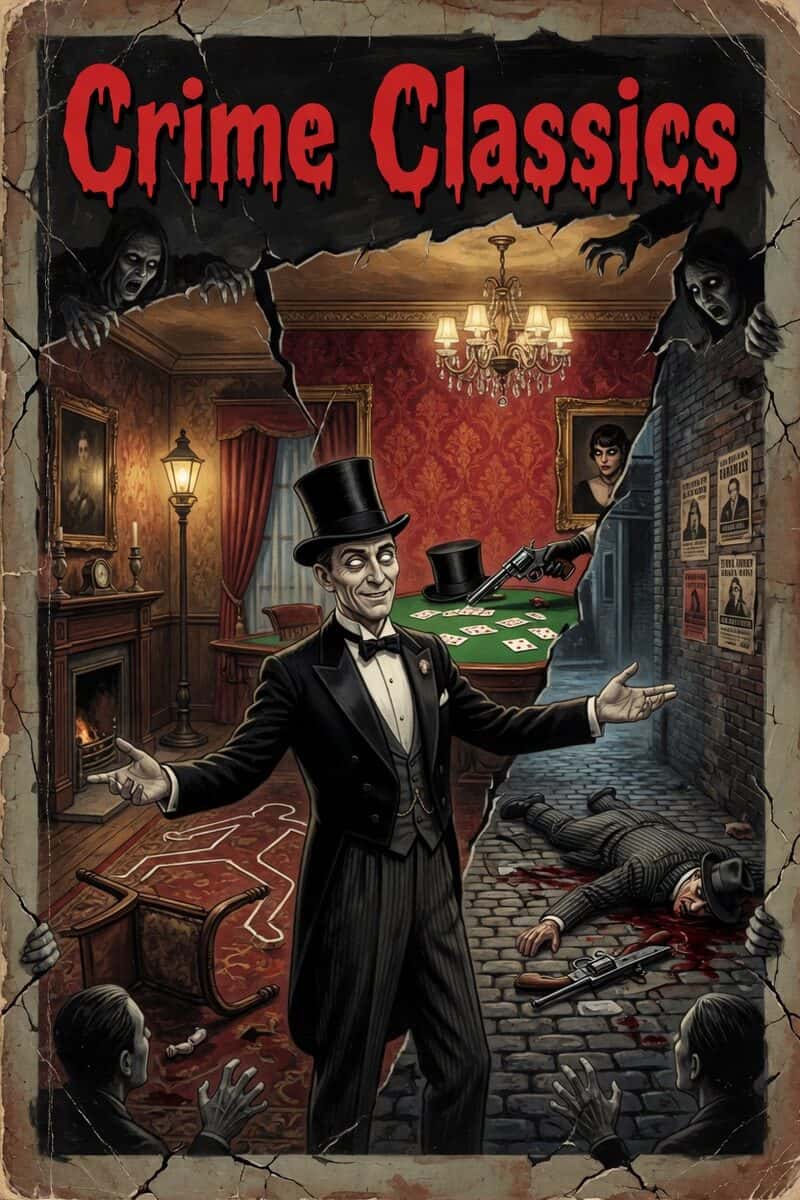
The written record
Read the transcript
Read along with the recording · About 17 min to read
Good evening. This is Crime Classics. I am Thomas Highland with another true story of crime. Listen. William Palmer always did that when he walked past the tombstones in Rugeley Cemetery. He ran his walking cane across the closely spaced tombstones as if they were a picket fence. And he whistled a jaunty tune as if he didn't have a murder in his heart. It might concern you a little that the tombstones were so near to one another. Well, it so happened that the path William Palmer took was through a section dubbed the popular section. A segment devoted to the turning into dust of folk in the lowest income bracket. William Palmer is using this path because it's a shortcut. He's anxious to see his sweetheart. He carries candy for her and poison for her husband. Thoughtful man.
So tonight, my report to you on the hangman and William Palmer. Who won?
Crime Classics. A new series of true crime stories from the records and newspapers of every land from every time. Your host each week, Mr. Thomas Highland. Connoisseur of crime, student of violence, teller of murders. Now once again, Mr. Thomas Highland.
A word about Rugeley, England in 1854. It was about as large as Twickenham. Most of the people of Rugeley toiled at Bladen's Brass Foundry. England's prime source of supply for ornamental door knockers. The foundries of Rugeley, too, are famous as originators of the claw and ball design. Later adapted as legs for bathtubs. The town itself in its better sections was spoken of as quite pretty. There was a heroic fountain in the center of the square. A statue of three abducted maidens of 1152. And to this fountain of a forenoon would come the wives of the town to nudge each other and gossip. Down the street from it, the town hall. And around the corner from the town hall, the home of Mrs. Katie Abley and her husband George. Mr. Abley is in bed waiting for his lunch. And Katie is waiting for that.
William, and you've brought me... Five pounds.
Oh, cool. Where is he?
He's in bed, doctor. How does he feel?
Moist. Did you give him the medicine?
I did. And no sooner than it went down him that he sat up with a start, looked about him and lay down again. From then on, he was in bed. From then on, he slept fitfully.
Katie.
Oh, now don't you dare, doctor.
No, no, no. Listen, Katie. What is it? I stopped in the laboratory of the hospital and I got a new medicine.
The ones you've given my husband so far have just been keeping him sick, doctor. Your husband has an amazing constitution. What is the name of this new medicine?
Strychnine.
Why haven't you used it before?
Traces of it are easily to be detected.
And why are you using it? Why are you using it now?
Well, this morning at the pub, I stopped in for a dram. I met a man, a doctor. He's 80 years old and has newly come to Rugeley. He wants so much to make friends.
And Katie?
Yes?
He has the authority to sign birth certificates.
And if someone should die?
He has the authority to sign death certificates.
Doctor.
Yes?
I've got some piping hot broth.
Of what?
Kidneys and such. Seasoned well?
With rosemary and thyme and basil.
Add this to it.
To all of it?
Your husband's constitution should be written up in the journal.
All of it.
I'll ladle out the broth. George! I've brought you some nice broth. Here. Let me spoon it for you. That's a nice boy. Eat up all the kidney broth.
And it was on that day that George Abley's constitution finally gave out. Dr. William Palmer summoned his new 80-year-old friend, Dr. Bamford. And in deference to the age of doctor's failing eyesight, Palmer moved the deceased over into the light. Dr. Bamford corroborated on the diagnosis of death due to internal strictures and closures and signed the death certificate. Dr. Bamford had found a friend.
It was barely six weeks after George Abley had been deposited in the hospital. George Abley had been deposited in Rugeley Cemetery in the north plot above the popular section when this happened.
You don't love me anymore, doctor.
Of course I do. Katie. I've no more money if that's what you want. But your husband left you a thousand pounds. And I've given you all but a pittance. And you've no more? You don't love me. And you've no more? No. Once I loved you, Katie. But no more.
Do I amuse you, Miss Brooks?
Oh, you're very witty, doctor.
You'd better listen again with your stethoscope and make sure. My diagnosis is correct. Your heart is kind and generous. And it beats quickly.
Does it?
Now, listen to mine.
Oh, surely you're joking.
No, no, of course I'm not. Here, put these pieces in your ears. And do you hear it? Bum, bum, bum, bum. Bum, bum, bum, bum. Just the way yours goes. Bum, bum, bum, bum. Bum, bum, bum, bum. Bum, bum, bum, bum. Here, let me take that stethoscope.
May I make a confession, doctor?
As if there were anything for you to confess.
Oh, but indeed there is. Yesterday. At the racetrack? I, I contrived to meet you, doctor. You were so handsome, so dashing, so from London. I hardly watched the races.
Then the handkerchief you dropped.
Yes.
Naughty. Naughty. Naughty.
I'm bold. Bold. Bold.
That's what you are. Bold.
Doctor.
Yes.
I'm ashamed. Miss Brooks.
No, no, don't touch me. Listen to me. I'm ashamed. What I did yesterday, dropping my handkerchief at an opportune time, I'm ashamed.
The 50 pounds I borrowed from you at the track yesterday, well, it so happened...
Oh, don't talk about it. Not now.
They were wed. He, a young doctor. She, the daughter of an English colonel who had collected a lot of rupees in India. It is interesting to note that this is the same Colonel Brooks who was known around Calcutta in the 30s as Adorable Brooks, a name which stemmed from leading a charge against the Gurkhas, armed with only a polo mallet, this on a wager. His daughter Annie, as we have seen, had inherited a good deal of his dash, all of his big-game hunting trophies, and every month, a check. This check represented a monthly allotment from the colonel's estate, the rupees having been translated into pounds.
Well, the young doctor and the colonel's daughter lived happily for some months. Champagne for breakfast. And in the afternoon, when the season was right...
Come on, mermaid. Come on, mermaid. Mermaid. What do you want? Don't be cruel. Here's some more money. I love you. I love you, Annie. Good, good, Annie.
Dear.
Yes?
That's the last of it for this month.
But it's only the fifth. And we've been to the races for five days.
Don't worry about it, dear. You can always borrow until my next check.
You always do.
And you write all kinds of insurance, Mr. Hamrick?
Ship, fire, theft. Casualty, storm, life.
Life. A policy on your life, doctor?
My wife's.
In what amount?
£13,000.
How old, woman, is your wife?
Twenty-seven.
Her health?
Excellent. Well, you're a doctor. You should know.
Well, I don't want you to take my word for it. I've brought a report on the condition of my wife's health from a colleague, Dr. Bamford. Here.
Yes. Art. Excellent. Aspiration. Excellent. And... Oh, that's a very fine report. I'd say you were a lucky man to have a wife in such condition. How about the policy?
Oh, no question about it. How much is the first premium?
Annually. That way to save money.
By the month? Oh, let me see. Um, £13,000 policy. £50, £12, and £3. Oh. Yeah. £50, £12, and £3. Oh, thank you. Thank you very much.
Annie. Annie, wake up. Wake up, dear.
Hello. Champagne.
Hello. Drink it.
Hello, hello, hello. Drink it all, then I've got a secret for you.
Tell me a secret.
I know who's going to win the third race today.
Who?
Oh, gold finder.
Oh, you're very clever, but...
But what?
We have no money today.
How do you think I got the champagne?
Oh, you borrowed it.
Gold finder in the third. Get dressed. Get dressed.
Yes.
Dear?
Get dressed.
You... I don't know. I... I can't seem to...
You just lie here. Let me feel your head. Hmm. Warm. A little fever. I don't want you out of bed today.
Yes, doctor.
I leave you a powder to take.
Yes, doctor.
Take care of yourself.
Yes, doctor.
Doctor?
Yes?
You love me. I know you love me.
I do.
Kiss me.
Annie. Come here and kiss me.
All right. Bump. Bump. Bump. Bump. Bump.
Dear Annie. Bump.
Just before the third race, a messenger located Dr. Palmer at the clubhouse turn. He told the doctor that his wife had been found dead by the cleaning woman. Gold finder paid four pounds three to place. Dr. Palmer had him to win.
You are listening to Crime Classics and your host, Thomas Highland. This Friday night, Mr. Keene, tracer of lost persons, takes on the beautiful widow murder case. It's a thrilling seesaw battle between ruthless underworld forces and the old investigation. Mr. Keene, the investigator, as Keene closes in on the facts of death related to one of his most fascinating and dangerous assignments. Mr. Keene, tracer of lost persons, Friday nights on most of these same CBS radio stations. Don't miss him.
And now, once again, Thomas Highland in the second act of Crime Classics and his report to you on The Hangman and William Palmer, who won.
In 1855, the town of Rugeley had forged ahead of Twickenham in population. Therefore, Rugeley was sending more men into the Crimea to fight the war of 1854-56. Queen Victoria had been on the throne for 18 years, and her son, Edward, was the Prince of Wales. This was the year, too, when Haskell Blaine of Virginia came to England to astound the royal court with his frontier wit and jackanapery. And in this time of movement and stress, the town of Rugeley little noted the passing of Mrs. Anne Palmer. She was laid to rest in the Rugeley Cemetery in the South Plot, below the popular section. Not before, however, the venerable Dr. Bamford had signed a death certificate certifying that Annie had died because of congestion of the heart and attendant malcolouring of the blood. Dr. Palmer grieved, collected the 13,000 pounds insurance, and bought a couple of horses. One of them, the roan named Lodestar, won a race, but Lodestar pulled a tendon prancing in the winner's circle and had to be destroyed. In six months, Dr. Palmer was... He was 20,000 pounds in debt.
But Dr. Palmer had a system.
And these visits of yours, brother, are like freshets of spring rain.
How did Dr. Woolsey treat you here, Walter?
Oh, he's tapered me whiskey down to a glass in the forenoon.
William?
Yes?
My being a drunkard, blood brother to you, a drunkard, what's it done to you in the city, William?
Why, nothing. Oh, not much. Physician. Brother to a drunkard. Dr. Woolsey will take care of you.
William, what have you got in that package you're carrying?
Let's walk a bit. The sea air's tonic. From these cliffs on a clear day, you can see France.
What have you got in that package, William?
A gift purchased at the inn for a friend of mine. I have a surprise for you, Walter.
A what?
Here, hold this package while I...
No, no, no, no, no. Don't open it, Walter. It's not for you.
Then what's my surprise?
Here, a life insurance policy.
The what?
Life insurance for 13,000 pounds.
My life's worth that much to you, brother.
So that you'll take care of it better, for my sake.
Such a brother you are.
Brother. What is it?
What's in the package?
Why? The shape of it, it feels like a bottle.
What kind of a bottle, Walter?
Whiskey.
Again, then. What kind?
A kind of whiskey. And if I guess? We'll open it and see.
Yes.
Scotch whiskey.
Yes, but whose?
Macnaughton's.
Open it and see.
Macnaughton's Scotch whiskey.
Brother.
What, Walter?
May I open it?
No. I'll run with it. I'm fleeter than you are and you shan't catch me.
And when I run away from you, I'll open it.
Where will you run to?
There. There, to the point there on the cliff where the hedgerow stops.
Oh, please, William. Please, please, please. If you run from me and I can't catch you, it'll not be my fault. Run. Run! Run, run, run.
In Scarlet Town where I was born There was a fair maid dwelling
Come on, Walter.
There was a fair maid dwelling
On your feet. We'll walk away your drunkenness. Up we go.
There was a fair maid dwelling
Don't walk in that direction. Walter, you'll fall off the cliff.
That's not a horse race. That's a funeral.
By some misadventure, the black stallions which drew the hearse of Walter Palmer had been frightened and they bolted and ran away. Walter's coffin was thrown to the ground and torn open, revealing to the stunned housewives in Rugeley Square the broken form of a man who had fallen off a cliff. Or, as the death certificate that was signed by Dr. Bamford read, multiple skull separations.
Now that's a horse race.
A week later.
Run, C-Neddle. Run, run, run!
Dr. Palmer on a typical afternoon. While he goes to bet on another loser in the next race, let's do a little figuring here. He was 20,000 pounds in the hole a few months after his wife died. And he collected 13,000 after his brother died. That left him still 7,000 in debt, as of a week ago. It took the doctor seven days to get himself another 10,000, altogether 17,000 pounds in debt. That's how much Dr. Palmer owed his various acquaintances.
You might be wondering what he's been doing in the medical line all this time. Nothing. Not a thing. A few pills prescribed in return for favors received, and that's about all. As far as his office was concerned, he had long since given it up and had sold his equipment and had sent his magazines on to his friend, Dr. Bamford.
Now we come to a turning point in Dr. Palmer's life. He met a fellow named Cook, John Parsons Cook. It was a turning point in Cook's life, too.
Ganymede. That's the horse who'll win the fourth. Ganymede. Bet handsome lad can't lose.
Well, if you say so.
Handsome lad can't lose. Yes, he could. He did. And the next day...
Fleet King and the Lady Barbara Stakes. I have information. Don't be a fool. What have you heard?
The gelding from India, Mokdjur.
Oh, very well. Mokdjur. The jockey told me.
The jockey told a fib. What's more, it was whispered he had a few kid on Fleet King, who, incidentally, kicked Lady Barbara while she was draping him with the flower blanket and made her all right again.
In spite of consistent losses because of Palmer's advice, John Cook remained a loyal friend to the sporting doctor. In fact, he grew poor with him, but always with a smile.
Oh, Palmer, Palmer. You're my friend. My friend.
And one morning...
Palmer! Palmer, I've done it! I've done it!
Hmm?
I've won. Did you hear me? I said I won.
A bob? Two bobs?
Twenty-five thousand pounds. You're crazy.
Twenty-five thousand pounds, old friend. I've had one of those days we talk about, one of those days we think about when we're trying to sleep or when we're getting drunk. Twenty-five thousand. Show me. Show me! Show me. Look! Look, look, look!
We're rich.
Yes. Rich. Cook. Cook, you're my friend. Cook. Talk to me. What do you want? What? What are you going to do with that money?
It's our money, isn't it? Yours and mine. Our money. What are you going to do with it?
I'm going to America.
What? America. What about me? You're my friend. What about me, Cook?
You wish me wealth. And the money?
I'll be rich in America. Without me? Without you. I... I bear you no malice, Cook.
Well, why should you? We've been good friends. I'll be so sorry to see you go. I'll remember you well.
Cook, Cook, listen.
What?
A last drink with me.
I don't mind.
A special drink.
Well, of course.
Oh, I'm very happy for you, Cook. Friend. Friend of mine. Wait. Wait here.
Where are you going?
A special brandy in my belongings in the next room.
Good. Wait here.
All right.
Twenty-five thousand. Oh, I'm very happy for you, Cook. Open the door for me. My hands are full. Special brandy, Cook. Dear friend. This one's yours. Dear friend. America. Hmm. Greedy. Greedy, greedy. Greedy. Greedy. Greedy. Greedy. Greedy. Greedy. Greedy. Greedy. Greedy. Greedy. Greedy. Oh, I'm in a hurry. That's why I swallowed down the brandy. Greedy, greedy, greedy. Ah. Ah. The taste.
You've been poisoned. On my word. It can't help you. I want your money. You'll die quickly. You're doing it now. Dr. Bamford. Dr. Bamford, come quickly. A friend of mine just died, Dr. Bamford, from occlusion of the heart valves. Come quickly. Bring your pad of death. And your death certificate, doctor, and your indelible pencil. Quickly. Here. I'll help you, sir.
It would have worked, too, except that it had happened three times before. Mr. Hatton, local police superintendent, noted a sheaf of thousand-pound notes peeking out of the doctor's back pocket. An arrest was made. A trial was held. The doctor was found guilty and hanged. And the physician who pronounced him dead was named Bamford. Death? Death due to dramatic separation of the cervical spine, the doctor wrote. Which is what happens in cases like these.
In just a moment, Thomas Hyland will tell you about next week's crime classic.
William Palmer, tonight's crime classic, was adapted from the original court reports and newspaper accounts by Morton Fine and David Friedkin. The music was adapted from themes of the period and conducted by Bernard Herrmann. And the program is produced and directed by Elliot Lewis. Thomas Hyland is portrayed on radio by Louis Hayward. In tonight's story, Jay Novello is heard as William Palmer. Featured in the cast were Betty Harford, Ellen Morgan, Joseph Kearns, Van Rytte, and Alastair Duncan. Bob Lamond speaking.
And here again is Thomas Hyland. Next week, Blondier, France, in the year 1840, and the interesting events which occurred when an iron smelter's wife sent her husband a gift. My report to you will be on the seven-layered arsenic cake of Madame Lafarge. Thank you. Good night.
It's true that things happen. It's true that things happen. It's true that things happen. It's true that things happen. It's true that things happen. It's true that things happen. It's true that things happen. It's true that things happen. It's true that things happen. On a smaller scale, and fewer things happen at one time in a small town, but human interest is at a higher level in rural America, where people have more time to stop running and to live. That may be why Rogers of The Gazette, starring Will Rogers, Jr., is such an interesting radio series. It's packed with human values and human interest. Hear Rogers of the Gazette tomorrow night on most of these same CBS radio stations. Thursday nights, Marlene Dietrich stars in Time for Love on the CBS radio network.