
The written record
Read the transcript
Read along with the recording · About 19 min to read
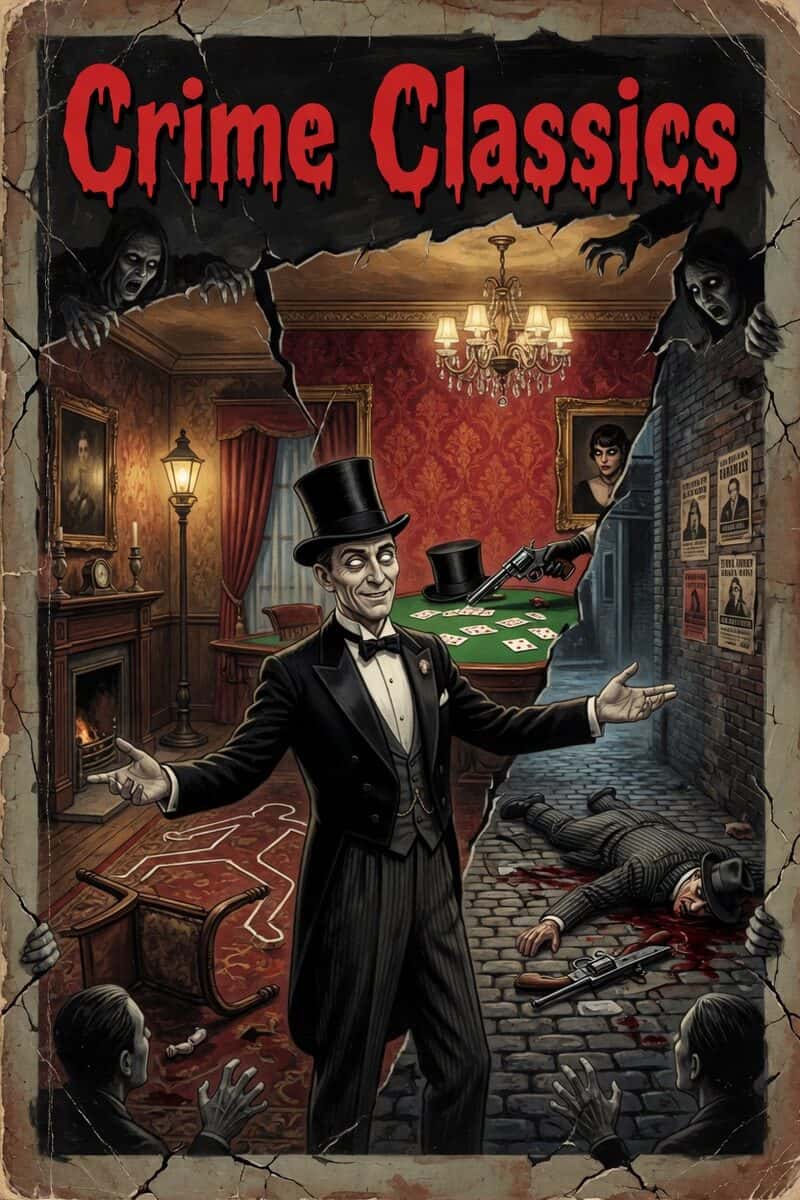
Crime Classics, brought to you by Plymouth, with a reminder that tomorrow is the day for your first look at the big, bright, beautiful new '54 Plymouth, on display tomorrow. Good evening, I am Thomas Highland with another true story of crime.
Listen, that was a cake baker breaking an egg, and separating it, the white here, the yolk here. That was the last of twelve eggs to be separated. Next step in the recipe, beat the whites. Our cake baker is French, and a good baker too, so of course the cake will be of a lightness and a delicacy that, a cake that kisses back. Pour in the sugar, the flour, and now the ingredient that makes this cake different from all other cakes. You didn't hear anything because it was only a smidgen, and smidgens don't make any more noise. Not even a smidgen of arsenic, which that was. The noise comes later.
So tonight, my report to you on the seven-layered arsenic cake of Madame Lafarge.
Crime Classics, a new series of true crime stories, taken from the records and newspapers of every land, from every time. Your host each week, Mr. Thomas Highland, connoisseur of crime, student of violence, and teller of murders.
First, a message for all of you. This is the week, tomorrow's the day. The day the great new '54... High Style Plymouth comes to town, and the $25,000 contest, with a chance for you to win a brand new '54 Plymouth, or one of hundreds of cash prizes. You'll love the new '54 Plymouth. It's big, bright, beautiful. Longer this year with a low, wide, sleek silhouette. And inside, ah, Plymouth brings to the low-price field the luxury of high-style interiors, with an exciting array of new fabrics and color combinations for you to choose from. Power Steering is available in the new '54 Plymouth. Full-time power steering, to help you every mile you drive, and you'll like the way it makes parking in tight places a cinch, because it does 80% of the work for you. Three new Plymouth lines this year, too. New Plaza, new Savoy, new Belvedere. Three separate lines, and in every line, a wide selection of body styles and color combinations to choose from. The '54 Plymouth has 64 new features and advancements. Yes, it's 64 for '54. And tomorrow's your day for a first-hand look at the new '54 Plymouth. And tomorrow's your day for a first-hand look at the new '54 Plymouth. And tomorrow's your day for a first-hand look at this dramatic new car. Tomorrow starts the Big Plymouth Contest, too. So be sure to get your entry blank from your Plymouth dealer when you go in to see the big, bright, beautiful new '54 Plymouth tomorrow.
And now, once again, Mr. Thomas Highland and his report on the seven-layered arsenic cake of Madame Lafarge.
As the fourth decade of the 19th century was closing, Louis-Philippe was on the throne. It was late summer of 1839. A season of unrest in Paris. In the dark alleys and dank cellars, a populace seethed and grumbled and wrote slogans in chalk on the cobblestones. Phrases such as, which meant that in this stage, people were either for things, or against things, or wanted them up, or down, or forward, or guillotine.
This was in the city. But a few kilometers away in the country, in Glandier, it was peaceful. Summer was dying gently, and the folk took their cue from nature.
I'm quite sure she will be eminently satisfactory, Madame. Her name is Marie Fortunée Capello. It is music, no? Marie Fortunée Capello.
Is she rich?
She has 25,000 francs in her own name. Marie Fortunée Capello. She will make a most excellent daughter-in-law to you, Madame. I personally... I personally will guarantee it.
I only meant that she is of quality.
I personally knew her father, an artilleryman to Napoleon.
Stunning.
Who froze to his cannon outside of Moscow.
Commendable. So, you see, you have come to the correct marriage broker.
Madame.
Yes?
Your son, Charles, he has been apprised of the arrangement you are negotiating for him.
25,000 francs.
Yes, and her own trousseau.
He has been apprised.
Go to him, then, and tell him he is most fortunate. His beloved is not only of wealth, but of beauty.
We are in agreement, Madame.
She is in good health?
Excellent.
She has never been married before?
Never.
Then we are in agreement. Therefore, if you please... 10% of 25,000. 2,500 francs.
Ah, here. 3,000.
And? And?
500 francs change.
Madame.
Yes?
Your son, your fortunate son, Charles.
Yes?
He still spends his time at the blast furnace?
I cannot get him interested in anything else.
Strange. I only say this because I recall in my youth there were other things to do. Strolling, picnics in the bois.
My son, Charles, is a young man who likes to spend his time at the blast furnace. To each his own. Eh, Madame? Goodbye, Madame.
Charles Lafarge was one of those rare individuals who was just a natural-born smelter. An unsung Bessemer, as it were. In his early youth, he evinced a healthy interest in iron things and tongs and anvils and blast furnaces. His father had died while fishing for bloaters in the Seine. This when Charles was three years old. His mother, a good woman, was quick to recognize her son's natural bent... and indulged his talents. As a matter of fact, she invested nearly all her savings in a blast furnace and an ironmongery business for her son. Charles spent most of his waking hours in the shop. Shaping things on the anvil. Cooling metal. Or, what he liked best to do, smelting.
He was doing that the day his mother broke the news to him.
Her name is Marie Fortunée Capello.
And he was six feet four inches tall.
What of her?
You will marry her.
Why?
All young men get married. You'll have a wife now, son.
Son.
Yes, Mama.
Come here to me, closer. I want to look at you.
At what do you look, Mama?
Nothing. You'd better get cleaned up.
And he did. Charles got cleaned up. He bathed, shaved, and got into the clothes of a gentleman of the country. He was introduced to his fiancée. Made guttural noises of approval. And, in a few hours, they were married. The ceremony took place in the empty and dismal halls of the Lafarge Castle. In attendance were Mama Lafarge and one Denis Barbier. Denis, it should be mentioned, was an employee and bosom friend to Charles. And it must be assumed that Denis was happy for his friend for having brought such a winsome and lovely creature into an abode, usually a reek with odors of sulfur and slag. At the end of the ceremony, Denis offered his arm to Mama and they left.
Then, this is what happened to the newlyweds.
Frightens? Please.
Frightens? How?
The terrible heat of it. It is a fire. It is hot.
How frightens? Please. Look to me.
Yes?
This bar. This iron bar. Do you see? Do you see it?
Why did you not look?
I do not know. My Mama said to me you would do what I say you do.
I will. I will. I will. I will. I will. I will do. I will do. I will do. I will do. I will do. I will do.
Then look to me.
Yes?
This metal piece, this round metal piece. You see?
Yes.
For you.
What?
For you. I do not...
To talk about you if you will run away from me.
A shackle?
Do not run away from me.
Oh, do not touch me.
Husband to you.
It is not your husband, Madame. It is I. It is Denis. It is Denis. It is Denis. It is Denis.
My husband.
Hello. Oh. Oh, how are you?
Denis?
What do you want?
Your husband sent me to speak with you. May I come in?
Your husband said I was to enter your rooms and to speak with you.
To speak to me of what?
Madame, how long has it been since you've been here in the chateau?
You know it. Four months more.
Such joy you have brought to all of us. Of course, we have not seen much of you since you've locked yourself in your room for the most part. But if this makes you happy, all of us are happy.
Say what you wish to say and get out.
But I bring sad news.
What?
Your husband has gone to Paris alone.
I will turn my back while you weep.
You finished?
Madame, you look so radiant after a good cry.
When did he go?
This morning. Oh.
He has a plan for a blast furnace, a new principle.
My husband?
He was introduced to pencil and paper just last week and already he has the theory for a new furnace. Remarkable, is it not?
I wish him well.
He, uh... Asked me, shy man that he is, to say another thing. The 25,000 francs which is banked in your name, he wishes it.
Where are you, madame? Poor madame. Where are you, madame?
I would give it to him.
Just a while ago, below at the furnace, he fashioned a thing. Oh, it's diabolical, the equipment your husband can make. Before he left, he lifted it up with both hands and said, just my wife's size.
Oh.
And if I give it to him?
He will have compassion for you. He says only that. He will honor your desire to remain alone.
Very well.
Oh, you are a good wife.
Oh, a word.
Yes?
I too have compassion for you. You must understand that.
Compassion? Why?
Your husband is a brute. He is a brute. He is also an imbecile.
Yes.
He is better off if he is dead.
Dead?
Yes.
What?
I said yes. He is better off if he is dead. Of course he is.
Madame?
Madame, I take your leave.
Madame Lafarge, open quickly. Open.
Monsieur Denis.
Madame. What are you doing in my chambers?
A terrible thing, so terrible.
What are you talking about? What she has said.
Who?
The wife of your son.
She said she...
What? What is it?
That she wished your son dead.
I'm sure every wife in the world is the same. Every wife in the world has wished her husband dead at one time or another.
But the way it was said.
How?
With a kind of madness, with a curling of the lips, a clawing of the hand, with hate, with purpose. I wish my husband dead, she said. The heavens give me strength to make it so, she said.
No.
Yes.
This banter kept up a few moments more. Then Mama became firmly convinced that she had a potential murderess for a daughter-in-law. Denis, on the other hand, went to the pharmacy. And bought some arsenic.
You are listening to Crime Classics and your host, Mr. Thomas Highland.
How would you like to win a smart new '54 Plymouth convertible? Well, you couldn't get one for doing less. So be sure to enter the exciting Plymouth contest that starts tomorrow. $25,000 worth of prizes in all, six sleek new '54 Plymouths to be given away, and hundreds of cash prizes. How do you enter? Easy. Tomorrow, visit any Plymouth dealer and see the exciting new '54 Plymouths. Look it over, sit in it, ask questions. Then, on an entry blank your Plymouth dealer will give you, just tell in 50 words or less what you like most about the new '54 High Style Plymouth. And with 64 new features and advancements to choose from, there's plenty to write about. For instance, find out about Plymouth's new Hy-Drive. Newest, smoothest, no-shift drive in the low-price field at only slight extra cost. So be sure to visit your Plymouth dealers tomorrow. See this big, bright, beautiful new '54 Plymouth. And enter the contest. Don't put it off either, because the contest closes Monday at midnight. Be sure to see the new '54 High Style Plymouth tomorrow.
And now, once again, Thomas Highland and the second act of Crime Classics. And his report to you on the seven-layered arsenic cake of Madame Lafarge.
If you happen to pick up any standard almanac of France for the year 1840 and look up the climate for the first week of the year, you will read il fait froid. That's the French way for putting it, that there were blizzards and snows and hails and sleets and cold rains. As a matter of fact, this was one of the most miserable weeks in the annals of French weather. It is only legend, but it's worth mentioning. A freak storm up from the provinces caused a fall of frozen bloaters on the banks of the Seine. And northward, in the town of Glandier, the blizzard swirled bleakly around the parapets of the Lafarge Castle. But on the main floor, in a kitchen lighted by a roaring blaze and warmed by a scene of domestic enterprise...
No, you must take the dough and roll it.
There, on the table of my aunt.
Your aunt must have been too generous, Madame Lafarge, to have given you so much furniture.
Knead the dough, daughter-in-law.
And now I must ask you a question.
What is it?
Do you hate my son, your husband?
I will answer you. At times I do hate him.
This I can understand. But do you wish him dead?
Oh, no. Oh, perhaps in a burst of fury, yes, but... Oh, no, he is... he...
Yes?
Like a child. Like a small child.
Dennis said...
What?
Nothing. Dennis is so quick to take offense. He cares so much for my son. Have you noticed?
Truly a friend. Truly. I feel for your son. Somehow, right now, I feel for your son a warmth. So the baking of these cakes, which I will send to him in Paris. I am the most fortunate of mothers-in-law. I have resolved to give my marriage every chance to forget what has happened. Therefore, I will do as my husband bids.
You will send him the money?
All of it that is in my name.
Twenty-five thousand francs?
To the zoo. I will send it along... I will send it along with the cakes.
Marie.
Yes, dear mother-in-law?
You are good. It is important that Charles build his blast furnace. When that is done... Never mind. Here, will you put the dough in the pan? There should be enough to fill those five small ones.
Gladly. I will wash my hands and write Charles a note.
You will find the pen on the desk of my aunt. And when you are finished, we will put it with the cakes and the money. And Dennis will mail all of it.
Let me kiss you.
And they offered each other their cheeks. Then Marie washed her hands and wrote her husband a tender note. Madame Lafarge put the cakes, five small ones, into the oven which her aunt had willed to her and dozed for a while in her aunt's favorite chair. Then the cakes were ready. They were iced and wrapped. Into the parcel was then inserted an envelope containing twenty-five thousand francs and a few words of encouragement and endearment and new resolution. Then...
Dennis?
Madame and Madame.
Dennis, take this parcel and mail it to Monsieur Lafarge in Paris. It contains cakes and money, so mail it with dispatch. And Dennis, my mother-in-law and I would appreciate an opportunity to become more... Well, you may spend a few days where you wish, Dennis. Not here. Not here, Dennis. Not here, Dennis.
Oh, Charles Lafarge got the parcel all right. All right. It was mailed all right and he got it. But if you think for one moment that Dennis was there when it arrived, you're right.
So, my dear friend Charles, I thought that you would be lonesome in Paris. So many of the young men get lonely in Paris.
You are good.
So, I thought to... Now, who could that be?
Charles? Now, who could that be?
May I see? I will see. Thank you. Thank you. This is a package for you, Charles.
Package?
Yes, it is. May I open it for you? I will open it for you. It's from Glandier. From your wife.
What could it be? I feel kindly toward my wife. Perhaps...
Yes?
When this of the blast furnace is done, when I get back to Glandier, I will...
A cake. I like cake. Such a large cake. And here, an envelope. Oh, money. How much? Ah. Ah. Three thousand francs. I hoped she'd send the twenty-five. Oh, there is a note here, too. Read it to me. Ah. Dear Charles, keep warm. Here is cake. Here is money. Your wife, Marie.
Charles?
Yes?
May I cut a piece of cake for you? I will cut a piece of cake for you. Myself, I will eat none of it. My stomach is turning into a paunch. It is a fine-looking cake. Here. Eat.
Ah.
Do you like it? Is it good? Is it light?
Yeah. More. Here. Eat. What's the matter?
Cake lies against my heart.
Oh?
Painfully. With much pain. My friend is sick. Doctor! Doctor! Doctor! Doctor! Doctor! Doctor! Doctor! Doctor! Doctor! Doctor! Doctor!
He has eaten of cake and he is sick! His wife sent him cake and he is sick! His wife sent him cake and he became sick, Inspector. I do not wish to say it, but you forgive me, do you not? Yes, you do. I was in the presence of his wife when she said she wished her husband dead. That she thought him a brute and an imbecile and she wished him dead. And then she sent me to buy arsenic for mice, she said. For mice. Then this cake comes to my friend, Charles Lafarge, and he eats of it. And now he is dead. Inspector, you forced me to say it. I did not wish to say it, but you forced me.
Marie Fortunet Capello Lafarge was arrested on the charge of murder. She was put in prison in January 1841 and brought to trial in July. It is safe to say that this period was a time of travail, for Marie lost 40 pounds, her golden hair turned to silver, and her youthful complexion turned ashen. These in the main were observations. Observations made by Raoul Lassie, the George Garvey of the fourth estate of that day. Nor, during the trial, were the interrogations less unmerciful.
She was asked, first of all, whether she loved her husband.
Less, perhaps, than other women. More, perhaps, than some.
And did she ever say she wished him dead?
No, not meaningly.
May I make a statement? My name is Dennis Barbier. Charles Lafarge was my good friend. We addressed each other. We addressed each other. We addressed each other. And the second person, singular, familiar as two. I grieve for his death. I grieve that his widow has been placed in such a precarious position. Yet, I am forced to say that I, Dennis Barbier, friend of Charles Lafarge, did hear Marie Lafarge wish her husband dead meaningly.
You provoked me. Poor little thing. You did. You provoked me.
If you wish to say so, I will not disagree.
Wife to my friend Charles Lafarge, now dead by poison. Of arsenic, indeed, which Dennis himself... I myself purchased the arsenic and gave it to you.
It was for mice.
For mice, if you wish to say so, I will never disagree. It was for mice. For mice. Ask my mother-in-law.
Madame Lafarge.
Very well. I recall no mice. I run a clean chateau.
And your daughter-in-law says for mice.
I say you killed my dear friend Charles Lafarge.
Murderous!
No!
Murderous!
What of the cake?
I have small cake. I have small cake.
There was but one cake, a large cake of seven layers. Ask my mother-in-law. Ask... Madame Lafarge.
I do not remember.
You yourself put them in those five pans.
I do not remember.
And what of the money?
From the bank, I took 25,000 francs and put them in the parcels.
There was only 3,000 francs in the parcels.
Murderous!
Marie Lafarge was found guilty and sentenced to life imprisonment at hard labor. Also, occasional exposures in the pillories. Then, Marie Lafarge was found guilty and sentenced to life imprisonment at hard labor.
Mama, 12 years later, on her deathbed, suddenly... I remember. I remember. It was not a seven-layered cake. It was five small ones which Marie sent to my son. Something must be done.
And something was done. Marie Lafarge, who had already served 12 years, had her sentence reduced to just five more years. Then, she was sent to a home. Then, she killed herself.
Thomas Highland will return in just a moment to tell you about next week's crime classic.
Yes, the new '54 High Style Plymouth is the car for you, and tomorrow's the day to see it. Tomorrow's also the day to enter the big $25,000 Plymouth contest. You'll find all the easy rules and a complete list of prizes on the entry blank your Plymouth dealer has for you. So remember, you have a date tomorrow to see the big, bright, beautiful new 1954 Plymouth.
And here again is Thomas Highland.
Next week, the broad state of New Mexico, at a time when it was worth your life to walk down the street, armed or unarmed, day or night. My report to you will be on Billy Bonney Bloodletter, also known as The Kid. Thank you. Good night.
Madame Lafarge, tonight's crime classic was adapted from the original court reports and newspaper accounts by Morton Fine and David Friedkin. The music was composed and conducted by Bernard Herrmann. And the program is produced and directed by Elliott Lewis. Thomas Highland is portrayed on radio by Lou Merrill. In tonight's story, Eve McVeigh was heard as Marie, Irene Tedrow as Madame Lafarge, Joseph Kearns as Dennis, Edgar Barrier as Noonie, and William Conrad as Charles. Roy Rowan speaking. Crime Classics was brought to you by Plymouth. With a reminder that the new '54 High Style Plymouth comes to town tomorrow. Be sure to see it. This is the CBS Radio Network.