
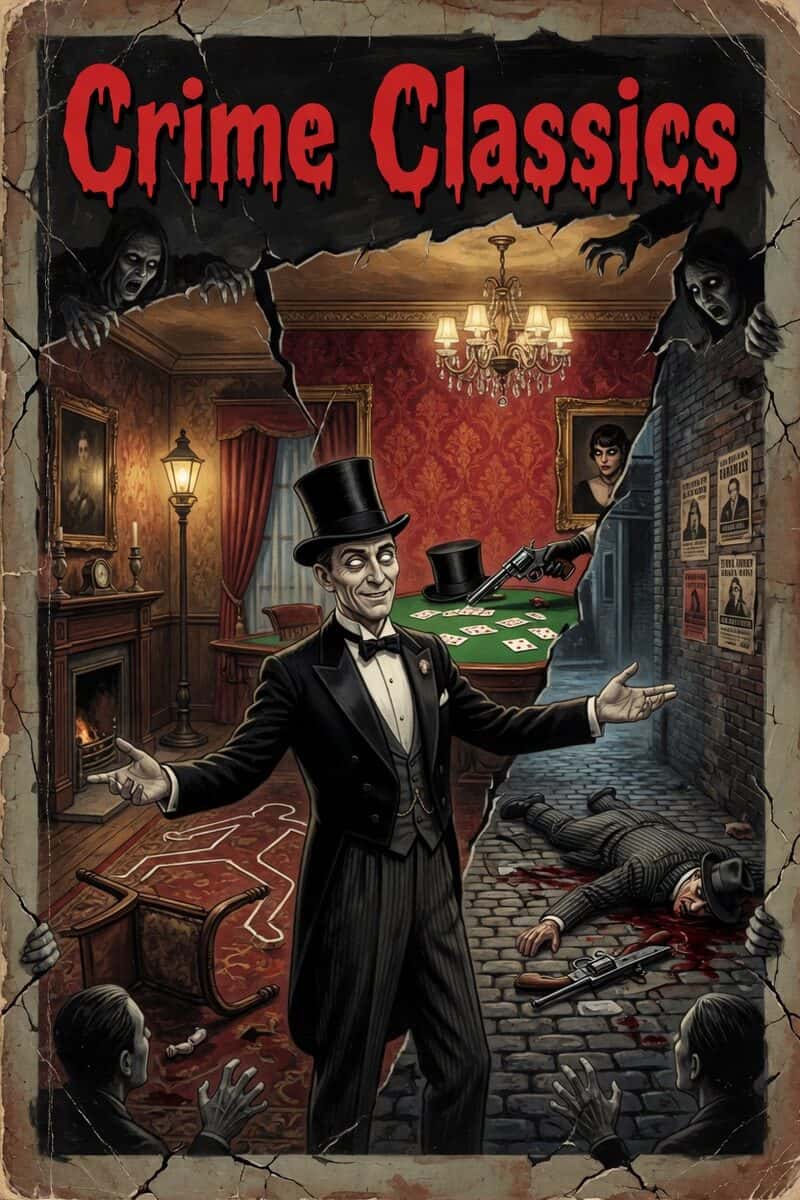
The written record
Read the transcript
Read along with the recording · About 18 min to read
Good evening. This is Crime Classics. I am Thomas Hyland with another true story of crime. Listen. The glass you just heard broken was not ordinary glass. It was a closed vessel of exact contour of the man's head which it held. It was raised exactly one millimeter above the skin, all around, and above the hair. No small feat since the hair on the head was lush and curly. Another masterpiece by Dom Llewellyn, whose secret of blowing glass to enclose human heads died when he died. Dom Llewellyn had been called in to do a job of work on what was left of Mr. John Hayes, which was all above the neck. So tonight, my report to you on John Hayes, his head, and how they were parted.
Crime Classics. A series of true crime stories from the records and newspapers of every land. From every time. Your host each week, Mr. Thomas Hyland. Connoisseur of crime, student of violence, and teller of murders. Now once again, Mr. Thomas Hyland.
The 18th century was only a few years old, and the town was Warrington. And the season was spring. Things were budding all around. Trees, flowers, and there happened to be a 16-year-old girl named Catherine Hall. She appears suddenly in history, this girl walking down the road. Suddenly, because nobody knows what parentage put her there. Isn't that nice? A young girl swinging down a road in May. Lying. Skipping. Stops. Gathers nuts. And alongside her, three soldiers. Officers of His Majesty's Dragoons and gentlemen. Gentlemen three, and guardians of Catherine. And Lieutenant Ombersley has the papers in his bandolier to prove it.
Guardians and their ward at a crossroad.
Catherine?
Yes Uncle.
Uncle Fred and Uncle Ned and I think the time has come...
For what Uncle?
The time has come... Do not be shy. How is it always you are shy when the sun shines? We have a wedding gift for you.
Uncle?!
From all of us to you.
Uncle?
The gift, here, a scarf.
Uncle?
We'll miss you.
And I, you. And the time now to tell you of him. Of the man you... marry, of the man who comes down this road anon to take you from us, from Uncle Fred and Uncle Ned and myself.
Is he as tall as you?
He is very rich.
Is he as handsome as Uncle Ned?
He is very rich.
And has he the strength of Uncle Fred?
He is very rich.
Then I know I shall love him well.
Catherine.
Yes, Uncle.
Your duties as wife?
Yes, Uncle.
Always water in the pail, and loving nuptials cannot fail.
And?
Happy marriage in a springtime day, child in the cradle on New Year's Day.
Oh, yes, Uncle. Oh, yes, Uncle. He is prompt. I die with impatience.
He has a fine span of horses, see.
Oh, trembling. Oh, John Hayes. Oh, girl. If your name be Catherine, get in.
Uncle.
Get in, girl, get in.
A kiss, Uncle, for farewell to you and Uncle Ned.
Which we did in tears and kisses the whole night past.
Get in, girl. Get in. Get in. Get in.
Here's your money, Lieutenant. Small sack full, as was contracted for. Giddy up.
Married that night, these impetuous 18th century lovers, these young people, Catherine Hall and John Hayes. History records that it was a rather hectic marriage. The groom's father went temporarily blind from drink before the ceremony. There was unruliness among the servants, and some sources state that the bride herself tried to sneak off and had to be restrained. But married they were. Married they were, just as evening sun went down. And that evening, after the house of John Hayes had quieted down, after the pig had been eaten and the toast drunk, after the celebrants had gone home and the windows bolted and the doors barred, after all these things...
There you are. There you are. Come on out now. There you are.
Liberty bird.
You know what you ought to do.
What? What?
Join the army.
Join the army? Join the army. Why should I do that?
I'd be so proud of you.
Aren't you proud of me now?
Think of you in a uniform.
I never did.
Then let's do it.
All right.
The scarlet trousers and the scarlet coat.
Oh, my.
And the golden sash and the gleaming scabbard.
And I'd stand up straight like this.
On your curly hair, a three-cornered hat and a cockade.
And I'd march. And I'd march. And perhaps...
What?
They'd send you to America.
Yes.
No.
You could volunteer for it.
Oh, no.
You'd miss me too much. You'd suffer.
Oh, I'd write to you every day.
The boats to America do not sail very often.
I'd knit things for you and bake things for you.
But mostly...
What?
I'd be proud. Oh, so proud.
Do you know what I'd do?
What would you do, dear John?
Well, I don't know. Join the army.
Proud.
Yes.
What would you do?
Well, tell people.
John.
Yes?
A golden sash and gleaming scabbard. And on your head a three-cornered hat with a cockade, John. And you'd march so straight and tall. You'd march.
Like this?
Yes.
Like this?
Yes.
Wow, John.
Father, I am writing this letter to tell you that I have just come back from a 20-mile march under full pack, and I do not like it. In the six months I have been in the army, I have not found a thing that I like about it. It is march, march, march, march. In spite of my education, I am still but a grenadier. Two of the lads who joined the army with me are lieutenants and wear cockades. So, please, dear father, present the government with 20 pounds and secure my release from this life. I would do it with my own funds, but I had wisdom enough to assign my wealth to my wife's name before joining the army. I do not wish to bother Catherine in this matter, as I am going to surprise her by my appearance in civilian garb and put an end to her loneliness. Please, father, do me this favour, your loving son John.
Oh, P.S. Yes, please, father, just consider it alone.
This is Taylor from Tottenham. You're the one.
And how about me?
Oh, you're a one too, Mr. Billings.
If it's the butcher boy, Mr. Wood.
Yeah, I'll send him on his way.
Aye.
Who are you? Who are you?
I am John Hayes.
Who?
John Hayes.
Oh. He be in the army.
Not now. I am John Hayes, and I've come home to my wife. Where is she?
Catherine!
Who is...
Catherine! Catherine, I'm home!
Dirty deserter.
No. Oh, shame. Listen, I'm out of the army.
But you cannot be. I just sent you a sweater.
I'm out. My father paid a bounty for me, and I'm home again.
Who are these men, Catherine?
I'm, uh... Billings.
Mr. Cooper.
I be Wood, the alehouseman.
Tradesman?
Aye.
What do we need a cooper and an alehouseman here?
Are you questioning me, husband?
Well, I'd like to know why a cooper and an alehouseman...
Welcome home!
Aye. Welcome home!
Ready here! Come to home! Drink us here, boys! Run to here, oh, come to home! Run to here, oh, come to home! Come to home! Come to home! Come to home! Come to home!
Oh, husband. Dear wife. I was so proud of you when you were gone. And you told people.
Oh, yes. Drink a cheer! Here, drink a cheer!
And now, wife. We will celebrate, you and me, and Mr. Billings and Mr. Wood.
Well, I thought...
Happy thought. We'll have a celebrate.
John, you're dusty from the road. Go wash. There's a full pail, always a full pail. Always. Waiting for your return. Go wash.
Yes.
Mr. Wood.
Aye, Katie.
Mr. Billings.
How did you come to marry such a one, Kate?
He's very rich. And he's come home. His wealth is assigned in my name. I receive it but in driblets.
Poor lady, shame.
If I were a widow...
The money?
All at once. All mine.
Billings?
Aye.
Let's make a widow.
And how to do that?
You kill a husband, you make a widow.
Ain't that an axe above the fireplace?
Oh, dear friends. I washed, Catherine. I was proud.
Radio.
A soldier had come home, to his wife, to his neighbours. There was wine in the room and a good fire. But it was one of the shortest. It was one of the shortest celebrations on record.
You are listening to Crime Classics and your host, Thomas Hyland. This Saturday night, learn the true details of the Wheel of Misfortune case on Gangbusters. When a wheel, gangland terminology for a driver in a crime, runs afoul of the law, he cuts himself out of the crime in question. After the robbery comes off, the wheel declares himself in for a cut of the spoils and murder results before police clamp the lid on the crooks. Gangbusters, this Saturday night on Gangbusters. The same evening to listen for CBS Radio's thrilling Gunsmoke series. And now, once again, Thomas Hyland and the second act of Crime Classics. And his report to you on John Hayes, his head, and how they were parted.
Historical background. We are concerned here with England in the early 1700s. George I sat upon the throne and the terms Whig and Tory were being muttered and bandied about. And chalked on walls. During one February, the great Sir Hugh Baddely took time away from the Navy, went ashore long enough to invent the side pocket, only to die a year later in the Fijis. And in April, a month which concerns us most, King George put his queen in prison because of her part in the Von Königsmark affair. But we are concerned most with a citizen of the time, Mr. John Hayes.
We hear of him next on the evening of April 22nd. Two lovers who had never heard of him strolled along the Thames. Strolled.
Let's sit here, duck.
No, Thomas.
So they strolled on.
Mary. Duck. Let's sit here.
Oh, no.
And on.
I like it here beneath the bridge, don't you?
Well.
See how the shadows lie like lacy web?
Where?
Yon.
Oh.
Let us sit and watch and see how they quiver as riding moon, a trail in the sky.
Here?
Just so.
Mary, duck, you are dear to me.
Hush.
And how to wash this torrent inside me. Fair Mary, fairest and most lovely. And now the blushes to your cheek beneath the moon.
Thomas.
Yes, Mary.
I, too.
Thomas.
This is an unreality which we see, Mary. A conjugation of shadow and moonlight.
But it has such curly hair.
Lacy shadows. And eyes and lips that grin. A head with no body. There in the mud.
It'll go away.
How can it? It's an abomination.
Come.
It's not real.
It is real. It is not. Go see.
Duck.
Go see.
All right.
Well?
Go.
A head. Of a man. Of a curly-headed man.
I knew it.
Thomas Ascot. I did not want to come down here in the first place. You made me.
So they discovered the head in the mud of the Thames. And after they married, they had a lot to talk about. It was the head of John Hayes, all right. But nobody knew it then. Thomas Ascot reported his unusual find to the constabulary, who went to the spot, saw that the lad was indeed a truthful lad, poked about searching for a body to go with the head, failed, and then brought back what had been found to the sheriff's offices. They cleaned and combed the find, known as dressing the head in the trade. Then they mounted it neatly on a ten-foot pole. This was the custom of the day. Whenever an extra head was found, mount it on a pole, exhibit it in the town square so it could be identified. Nobody, however, came forward in the prescribed three days, so Dom Llewellyn was called in.
Do that thing you do with glass, Dom, he was told, with heads, and close this one for preservation purposes.
And Dom did, with caliper and a secretly fashioned glass and blowpipe. And Dom did.
In the meanwhile, back at the home of Catherine Hayes, she's just stepped out of her door on her way to the cheese stall.
Mrs. Hayes!
How d'you do? A-marketing?
A-marketing.
Mind you, if I go along, if I walk with you?
Neighbour who walks alone, neighbours alone.
Aye. Wise was the poet who first said that.
Mrs. Hayes!
Yes?
A question.
Ninny-doo.
How go your two boarders?
A-pace.
So?
Yes?
Mr. Wood is an attractive one, wouldn't you say?
In truth, I had not noticed.
Nanny, nanny, nanny! In truth? I suppose you'll say you have not noticed the prettiness of Mr. Billings.
Not at all. Through the goodness of my heart for poor tradesmen, they live in my cellar. In truth, I never see them.
And Mr. Hayes, your husband?
Of him, what?
I have not seen him. I heard he has returned from the army, but I have not seen him.
No wonder. No wonder? If he is on his way to Portugal, how could you see him? How indeed! But Mrs. Hayes! Yes? So long he was in the army. Then home to such a young and comely as you. Then within four days he offs to Portugal. Restless, John. My last words to him as he left. Restless indeed. Would that my husband were restless like that, and off to Portugal. And a cooper like that Mr. Billings about. Some has all the luck. And Mrs. Martin shook her head sadly all the way to the cheese stalls. There she selected a good round Edam and went home. And told all the neighbors that John Hayes had hied off to Portugal. And neighbors told neighbors and everybody was satisfied. For a week.
For it was a week later that Mrs. Martin went down to London on a visit to a friend. It was an infrequent trip for Mrs. Martin and her friend took her around to all of the sights. The finest statuary, the best inns. And on a Sunday afternoon he took her to see a head. Which had been encapsulated by Dr. Llewellyn. And which was on exhibition at the Constabulary Museum. And seeing it Mrs. Martin said this. Why I do believe I know that man. And her friend took her to the sheriff to whom she repeated herself. Why I do believe I know that man. What man? Why the man in that room. The one whose head's in the glass. You know him you say? Did he? You're certain? Did he? Did he do? Who is he? A neighbor to me. Husband to a young lass. Poor lass. Ah? Poor lass barely seventeen I'd say. And her husband dead in such a way. Who is she? What's her name? Catherine. Catherine Hayes. And he who you've got like you've got. Is her hubby dear. John Hayes. I be confused I be. How? What's he doing in that room like he is. When he's in Portugal. What's he doing there indeed? Madam. Aye? Will you take me to your neighbor? Did he? Did he I will.
Katie and I. We've had enough of you around. Katie and I. What say you Katie? We're settled between you. Listen to me alehouse man. I'd as soon slit your gullet as look at you. And I'll do it if you don't leave us alone. Talking. That's all you're good at Billings. Come to me so I can let the air out of you with a knife. Aye. We're settled in between you. You. Sheriff of London town. For what? If you be Mrs. John Hayes I come to take you with me. For what? To show you of your husband. If he be the one whose head we have. Head? Aye. And madam. Aye? The two men I spy over your shoulder. May I inquire of their worth? Friends to me. And your husband? I would say so. We will all ride down to London town.
And now Mr. Wood I will show you a thing. Come with me. Look you. Who is this man whose head is in this glass? I do not know. Who is this man? I do not know. I swear it. I am a pious man. When I swear a thing it is sworn to. And it is the truth. Very well. Sit there. Mr. Billings. Close the door please. Walk to that table Mr. Billings and tell me whose head is encased there. Mr. Billings. Aye. What have you done with the rest of Mr. Hayes? Mr. Hayes. Did you put an axe in such a way as to sever his head? Me? You. No. Very well. Sit there. Mrs. Hayes please. Is that your husband's head who is on the table? No. You are not looking at the head Mrs. Hayes. Nor do I need to. For my beloved husband, my strength and my love is in Portugal. Mrs. Hayes. What? Will you look at the head please? I will not. I will bring it to you so you can see. Do not. For what reason? Do not. Do not. Do not. Do not. How can it be my hubby love John when he isn't? Pretend Mrs. Hayes. Pretend he is not in Portugal and so pretending tell me is this your husband? No. Are you sure? It is not my husband. Perhaps you need a better look. No. No it is not John. Not him. I hold him by the hair and close to you. Now tell me. John. John hubby love. Your husband? Yes. Yes. Oh yes. And how got he here? They. They did it. Billings and Wood. Say liar. No shame and no lies. You. The two of you evil men killed him and severed his head. I. While you fetched the pail to catch his head. And laughed as you caught it. In the name of His Majesty I charge the three of you. Charge them not me. The three of you.
And the three of them were tried. Billings and Wood on the charge of murder. Catherine on the charge of petty treason. Which was 18th century talk for killing one's husband. All were found guilty. Wood died in jail. Billings was hung in chains. And Catherine. Let me read to you from a journal of the times concerning Catherine. An iron chain was placed about her body. And fixed to a stake. On these occasions when women were burned for petty treason. It was customary to strangle them by means of a rope passed around the neck. And pulled by the executioner. So that they were dead before the flames reached the body. But the flames leaped so high that the executioner burned his hands. So that he could not strangle. So that Catherine Hayes was burned alive. It is interesting to note that a graph of petty treason in England for a whole year after that. Shows a decided drop. Before it picks up again.
In just a moment Thomas Hyland will tell you about next week's Crime Classic. John Hayes tonight's Crime Classic. Was adapted from the original court reports and newspaper accounts. By Morton Fine and David Friedkin. The music was composed and conducted by Bernard Herrmann. And the program is produced and directed by Elliott Lewis. Thomas Hyland is portrayed on radio by Lou Merrill. Tonight's story Betty Harford was heard as Catherine. Jeanette Nolan as Mrs. Martin. And Alistair Duncan as John Hayes. Featured in the cast were Ben Wright, Richard Peel. Charles Davis and William Johnstone. Bob Lemond speaking. Here again is Thomas Hyland. Next week Mahadwa, India in the year 1894. We will concern ourselves with a father and son who just didn't get along. To the point where one of them had to go. My report to you will be on. Rashi among the crocodiles and the prank he played. Thank you. Good night.
From the stars of old Vienna to Rodgers and Hammerstein. Hear a cavalcade of musical treats. Illustrating how easy it is to become stage struck. The Broadway musical way. With Guy Bolton and P.G. Wodehouse as guides. Hear the evolution of musical comedy Friday night. When CBS radio presents Stage Struck. Lionel Barrymore's Radio Hall of Fame is great Sunday night drama on the CBS radio network.