
The written record
Read the transcript
Read along with the recording · About 17 min to read
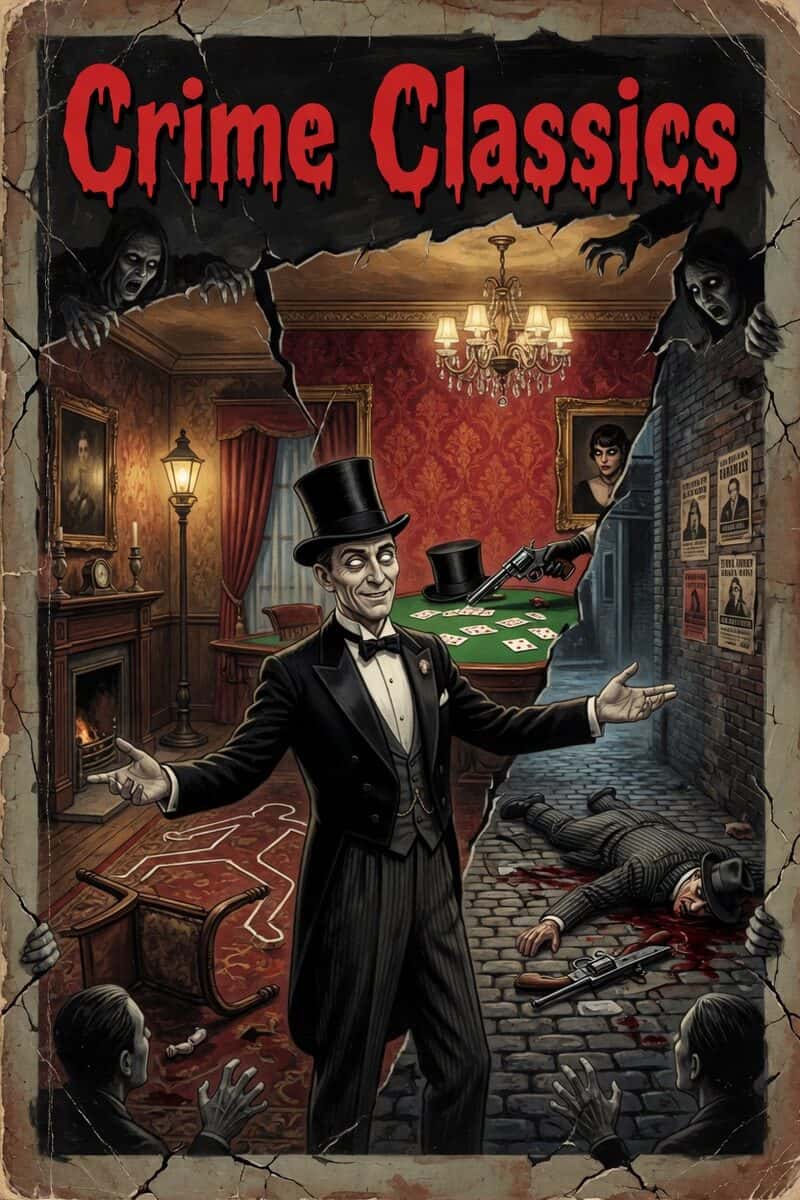
Good evening. This is Crime Classics. I am Thomas Highland with another true story of crime. Listen. Six shots from a Colt .44. For no reason whatsoever other than to get your ear attuned to what you're going to hear. Of course, I might have said that the Colt .44 belonged to our hero, and our hero happened to be walking the field and plucking off rail birds, but he would have done that for no reason whatsoever, too. So, here we are. Our hero's name is William Bonney, a lad who was a product of his time, and whose time may be described as a blot. So, tonight, my report to you on Billy Bonney, Bloodletter, also known as The Kid.
Crime Classics, a series of true crime stories from the records and newspapers of every land, from every time. Your host each week, Mr. Thomas Highland, connoisseur of crime, student of violence, and telltale. Now, once again, Mr. Thomas Highland.
William Bonney got to be 12 years old by being born in New York City in 1859, and being in Silver City, New Mexico in 1871. He was not tall for his age, but he was a smart one. Give him a pack of cards and say, Billy, let's see you deal a full house from the bottom. And the boy's nimble fingers would flip three aces and two ladies in front of you quicker than a shot with a cut snout. Or put a cue stick in his little fist, and if he didn't hit you with it, he'd run the rack. In rotation, life is not real smart. On a sunny day, you could see him walking down the shady side of the street, whistling and handling the oddments in his little pocket. A slingshot, a pair of dice, shaved, and a knife, razor sharp.
There he goes.
Hey, Mr. Garvey.
I'm playing cards, Billy. Get away.
I know you're playing cards, and I wish you luck. But I gotta talk to you. Skedaddle.
My mother was crying this morning, Mr. Garvey. And she said your name. Skedaddle.
Mr. Garvey. Put that knife back in your pocket or I'll spank you.
If you ain't the one, Billy.
Now, Billy dearly loved his mother, and he couldn't stand to see her cry. A good boy. He stabbed Mr. Garvey in the chest three times. Killed him. When he went back to his mom, he told her that he taught that Mr. Garvey... ...could do a thing or two. And she did this. Patted her son's tousled hair. Gave him five silver dollars and told him to get out of town. Billy did.
I'd like to now pick out a couple of more highlights at random. Events in Billy's life before he was 17. Um, here's one.
Morning, Mr. Carper.
Morning, son.
What you doing feeding my horse, Mr. Carper?
Ain't your horse, son.
Tis. Tis. Tis. Tis. Tis. Twas.
Uh, here's another one.
Kid.
Yeah?
Bet.
Bet what?
Like I've been saying.
Bet you $25 I'll kill someone today before you do.
You mean it?
I mean it. Stack me 25 on the table and I'll stack mine.
Sure. Now it's a bet, all right, ain't it?
Now it's a bet.
Draw.
What?
Hot out there on the street, I'm staying here. So I'm provoking you to draw.
You're an egg sucker, Tex. Ain't no short horn like you gonna call me.
$50 on the red.
One of the outstanding events of Billy's life was the Lincoln County War. This was a war between two opposing factions in New Mexico. One led by Mr. Murphy. The other led by Mr. Chisholm and Mr. Tunstall. Now, Mr. Murphy had the law on his side, but Mr. Murphy and the law happened to be thieves. Mr. Chisholm and Mr. Tunstall were outside the law. But they were the good guys. And Billy the Kid was on their side. During this war, Billy killed five men. The fifth man died hard. The war was never really resolved in spite of the United States Cavalry appearing at a fast trot from time to time, stopping, someone shouting forward, someone's blowing a bugle, and then trotting on again. And it was in this war that Billy grew to full stature, 5'8". Also, his reputation as a killer. Sixteen men since he was 12.
Also, he liked to have his tousled hair played with.
What did you say your name was?
Paulita.
Paulita. And you they called Billy?
Yeah.
Billy. Billy.
Nino.
Nino?
Boy. Young boy. That's right. They called me Billy the Kid.
Listen.
What?
When I see you riding through Fort Sumner. When I see you. The way you are. Riding the way you do. Here is where the wings beat inside of me. Here.
I've been to your country. Did you know that?
Mexico?
Sure. Three years ago. Killed a man in El Paso and a posse chased me clear across the border.
And did you like my country?
Sure. Sorry to leave it, but I had to.
What kid?
Killed a man in Sonora. Mexican police chased me back over to Rio Grande.
Billy.
Yeah?
Nino. Nino. Many girls in Fort Sumner do as I do. Watch you as you ride by. Then they meet together and talk of you and giggle. What do they say?
Listen, I will tell you.
Kiss me, Billy.
Yeah.
Billy. You do that. What you were doing, Paulita.
Que?
To my hair.
Like this?
Yeah.
At the very moment that this was going on and not dreamt of by our star-crossed lovers, who couldn't read anyhow, Ben-Hur was being written. The writer's name, as we all know, is Lew Wallace. He was in the area at the time being governor and peacemaker.
Ah, that's that. Another chapter done. The one where Ben-Hur and Messala meet face-to-face and toss jibes. But the general's day is not over. I guess I'd better. Yeah. There's writing to be done.
So the general picks up his pen, writes, and when he's finished, reads over what he's written.
Dear Billy, you don't know me, but I know you. I'm your governor, and I want to see you. I've got a proposition that I think you might be interested in.
Hello, governor.
Oh, hi, Billy. Had your letter read to me by my partner, Charlie Bowdre. He says you got a proposition that's interesting to me.
I'm offering you amnesty, Billy.
What's that?
Don't wear your gun anymore, and no law is going to touch you.
I killed a lot of men, governor. I come, you're offering...
Just let's start having a little peace around here, that's all.
Oh, I'm for that, governor. I've always been for that.
Well, now, I'm glad to hear it. Except nobody will let me be peaceful.
Well, it's going to be different now. Governor.
Governor, you know what would happen if I put away my gun. I'd be shot down like a dog. I could name 12 men. They'd shoot me down as soon as they see I was wearing no gun. There's Bob Olinger.
It's going to be different.
You take Olinger for instance. He's a deputy. He works for the sheriff. He'll be wearing a gun, won't he?
Yes. Yes, he would, but...
He'd shoot me like a dog.
How old are you, Billy?
18.
You got a lot of living ahead of you, son.
Not without no gun.
It's going to be different. You say I got a lot of living to do, and I aim to do it, governor. Just because you... You say words like am... Amnesty. Ain't no magic words can make me front Bob Olinger, for instance, without no gun.
Billy, I've got something else to offer you.
What else?
When all the shooting's done, when the killing's over, how'd you like to be a sheriff?
Look down there, Bowdre. Bottom of the hill.
Yeah, I see him. What you reckon that doing?
Digging, I guess. Just digging. Maybe for a waterhole or something. I don't know. A man has to be crazy to be digging in this hot sun.
Yeah, local. You got to admit something, Bowdre.
What?
I'm facing into the sun now, you know.
What are you going to shoot those three fellas for? They ain't doing nothing.
You admit about the sun?
Sure. You betting any money they ain't dead?
What did you shoot them for?
For nothing at all. Because you felt like it.
Because I felt like it.
Yep.
I think it's safe to say that at this stage in his career, and until he died, Billy the Kid was a mad dog.
You are listening to Crime Classics and your host, Thomas Highland.
Driving tonight? Then remember this. Most highway deaths are caused by two temptations. To cut out of line and to go too fast. Crossing the center line of the road is more dangerous than you realize. Statistics prove it. Excessive speed is just as dangerous as officials say. You can predict your own impulses, but you can never predict the other drivers when driving tonight. Drive cautiously, please.
And now once again, Thomas Highland and the second act of Crime Classics. And his report to you on Billy Bonny Bloodletter, also known as The Kid.
You'll recall that earlier I referred to this era and scene of American history as a blot. Well, I've been thinking it over and I must say that blot is a good word. It was a terrible time in New Mexico. Pillar? And murder and looting by a breed of men who did these things with no sense of shame or remorse. This bleak country was a kind of trail's end. The spoilers came here and the buffalo killers and the gunslingers. I suppose it was as good a place as any together because while they were killing each other off, they couldn't break anything. There was hardly anything there. A grand piano owned by a Mrs. McSween early went up in smoke during the Lincoln County War. And once a stray shot shattered Mrs. Gaffney's fluted terrines. But aside from these, a clever hand could mend anything in the area with adobe or a piece of wood. You may ask then, why did all these people kill each other? My answer to you is, that's what happens in a blot.
But in 1880, government officials in the area received notice to clean up. Therefore, General Lew Wallace summoned one Pat Garrett.
Got a paper here, Pat, from Washington. Says to clean up. We're going to do it.
We do. But we're going to need your help.
I heard you used to be a friend to Billy.
Billy Bonney, Pat. The kid.
Uh-huh.
That's why I'm forgetting all the things I've heard about you. Probably lies anyhow. Want you to get Billy for me. Take a look. Pretty badge, isn't it, Pat?
Uh-huh. Take it. Go ahead, take it. That's the boy. Now you just pin it on. I heard Billy's up around Fort Sumner, Pat. Headed that way, anyhow. Heard he sees a little Mexican girl who's kind of related to your wife.
Uh-huh.
I think you ought to go up to Fort Sumner. Take half a dozen men or so and go up there.
I'm not making a mistake, am I, Pat? You are the man to take, Billy, aren't you? Good luck, Sheriff.
About the events which took place outside of Fort Sumner. Well, let's see how they told about it at the time. Let's see how the boys who wrote the... What the 19th century paperbacks had at it. Ah, here's one. Written by Bledsoe Sheridan, Jr. And entitled, Hero in Ambush or The Daring Escape of Brave Billy Bonney. Mr. Sheridan starts out this way.
Pat Garrett squinted steely eyes off into the distance. He saw six horsemen. The sheriff turned to his lieutenant and he said, Men, that is Billy, the young boy, and his desperado friends. The West will be a better place to live. When he and his breed are six feet under. Get out your pistols, men, and make sure they're loaded up. You there, pick us, Bob. Get behind that boulder or else they see you. Here they come.
And Bledsoe Sheridan, Jr. goes on. The desperados came within a hundred feet of the boulders and were not aware of the ambush until... In spite of all the steely eyes that must have been on both sides of the ambush, and in spite of all the six shooters and shotguns, there wasn't a scratch in the crowd.
They were all dead. They were all dead. They were all dead. They were all dead. They were all dead. They were all dead. They were all dead. They were all dead. They were all dead. They were all dead.
The brave Billy Bonny and his merry band turned tail and fled.
Bledsoe, Jr.'s next chapter is aptly entitled Stinking Springs. For that is where we pick up the boys.
When we gonna rest, Billy?
Down the way.
Then what?
They gonna come after us. You know that boulder. I asked you.
Then what?
We gonna rest at Stinking Springs down there. Down there's a place. Cabin place.
Fight it out there, Billy?
Yeah. Yeah.
You scared?
You must be. You ask me a question like that. Four of us. You, me, Wilson, Pickett. How many you figure they got?
That was Pat Garrett, wasn't it? What I could see it was.
He can get all he wants.
You scared, Billy?
You're talking foolish, Bowdre. Sure I am.
Billy.
Yeah?
It's starting to snow.
Yeah. One thing I'm glad about.
What?
Well, inside here, ain't as cold as outside there. Bet Garrett and his boys are plenty cold. Plenty cold. Hey, Garrett. Garrett, you cold? Man, I'm hungry. Been in this place for five days. Bet you hungry, too, ain't you, Wilson? Pickett. Come on in here, Garrett. Hey. Hey, Garrett. Man, they got you.
Billy. Looks like... Let me see. Looks like they got you. Listen, Bouldery. Listen. Listen, Bouldery. You go on out there, you hear? You're done for anyhow. You go on out there and get one of them before you die. Go on, Bouldery. Just keep your cold pointing out, just like that. Now, you get one of them, you hear?
Dead, Bouldery. Let me take a look. Dead. Hey, Billy. Charlie Bouldery's dead. Coffee's hot, Billy. Won't you come on out? Pickett, Wilson, you hear me? Hey, coffee's hot. Those are ham and eggs. Nobody's gonna hurt you, boys. All you gotta do is... Hello, Pickett. Just keep your hands way up there. You're not gonna get hurt. Hi, Wilson. Glad to see you. Come on, get some coffee for yourself. Just take his gun and feed him, boys, like we promised to do.
Hey, Billy. Won't take you back to Fort Sumner, Billy. Take you to Santa Fe. How's that sound to you, Billy? Santa Fe. I swear, Billy. Ha, ha, ha. Ha, ha, ha. And then you know what? I'm gonna tell you what, Billy. You're gonna kill yourself throwing yourself against those bars. My name ain't Bob Arlington. You ain't gonna cheat the rope, Billy. They found you guilty and you're gonna hang.
Before I do.
Before I do.
You're gonna do what? You're gonna do what? You're gonna do what?
Kill me, Bob Arlington. Ha, ha, ha. Ha, ha, ha. You ain't killing nobody. I'm making me a promise. I'm gonna kill me you. Ha, ha, ha. Ha, ha, ha.
Okay, Arlington, I'll take guard now. Explain to Billy how we're gonna hang him and watch how he does his thing. You gotta watch him. He don't kill himself. See you tomorrow, Billy.
Now, you know what, Billy? That Arlington's a man I don't like. He did a thing to me once, and I'm gonna tell you about it. Tomorrow, you're gonna die anyhow, and you won't have a chance to tell anybody. It was Arlington, and it was my sister. My sister's dead now. Some people say it. Billy, some people say it. Billy, how'd you get my two-barrel shotgun out of my hands without me knowing it? Open her up. Where'd I get me Bob Arlington? Room up in front where he sleeps. This time around, I'm gonna get him. And I guess that's where he just went.
Hi, Bob. You ain't a lad.
It's safe to assume that this was one of the happiest moments in Billy's life. He had killed a fellow he hated. He felt so good about it, he didn't even stop to wave ta-ta to Sheriff Pat Garrett. Just walked right out of there and drifted along down the trail, which trail wound up across the street from Pete Maxwell's, which just happened to be Paulita's place.
I love you, Billy.
Paulita.
I love you and worry for you.
You just love me, just don't worry about me, that's all.
Billy.
What?
We can go to Mexico. I've been thinking that.
Oh, bueno. When? When shall we go?
When you want to. Right now. Let's see. Let's see. We will go. We will go to Mexico and marry and...
You are serious?
Hungry, too. I'm going across to Maxwell's. Bring us back a something other to eat.
Billy.
What do you want?
Be careful.
Billy Maxwell's my friend.
But be careful.
Let go of me.
Let it go.
No. You say you'll be careful, I'll let go.
I'll be careful.
Kiss me. Hurry.
Somebody there? Somebody? Eat it? Hey. Eat Maxwell? I could. Billy, don't. Billy, what happened to... Kid. What? Billy, the kid. He's dead. Oh, well. Dead, is he? Well. Billy, the kid's up here.
That was July 14th, 1881. A killer was killed. A bloodbath was over. July 15th, 1881 was one of the finest days in the history of New Mexico.
In just a moment, Thomas Hyland will tell you about next week's Crime Classic.
Billy, the Kid, tonight's Crime Classic, was adapted from the original court reports and newspaper accounts by Morton Fine and David Friedkin. The music was composed and conducted by Bernard Herrmann, and the program is produced and directed by Elliot Lewis. Thomas Hyland is portrayed on radio by Lou Merrill. In tonight's story, Sam Edwards was heard as Billy. Featured in the cast were Jane Webb, Clayton Post, Anthony Barrett, William Conrad, Dick Beals, Harry Bartell, Barney Phillips, and Fred Shields. Bob Lamond speaking. Here again is... Thomas Hyland.
Next week, Warwickshire, England, in the year 1705. And a lovely young lady whose married name was Catherine Hayes, and whose ambition was to be a widow. My report to you will be on John Hayes, his head, and how they were parted. Thank you. Good night.
Right after station identification, keep tuned for a CBS Radio Sports exclusive as the middleweight champion of England meets the middleweight champ of America, Randy Turpin versus Bobo Olson, fighting 15 rounds for the title of the world. Yes, it's next, presented by CBS Radio. So stay tuned and hear it over most of these stations, coming right up. For newspaper adventure, Rogers of the Gazette, on the CBS Radio Network.