
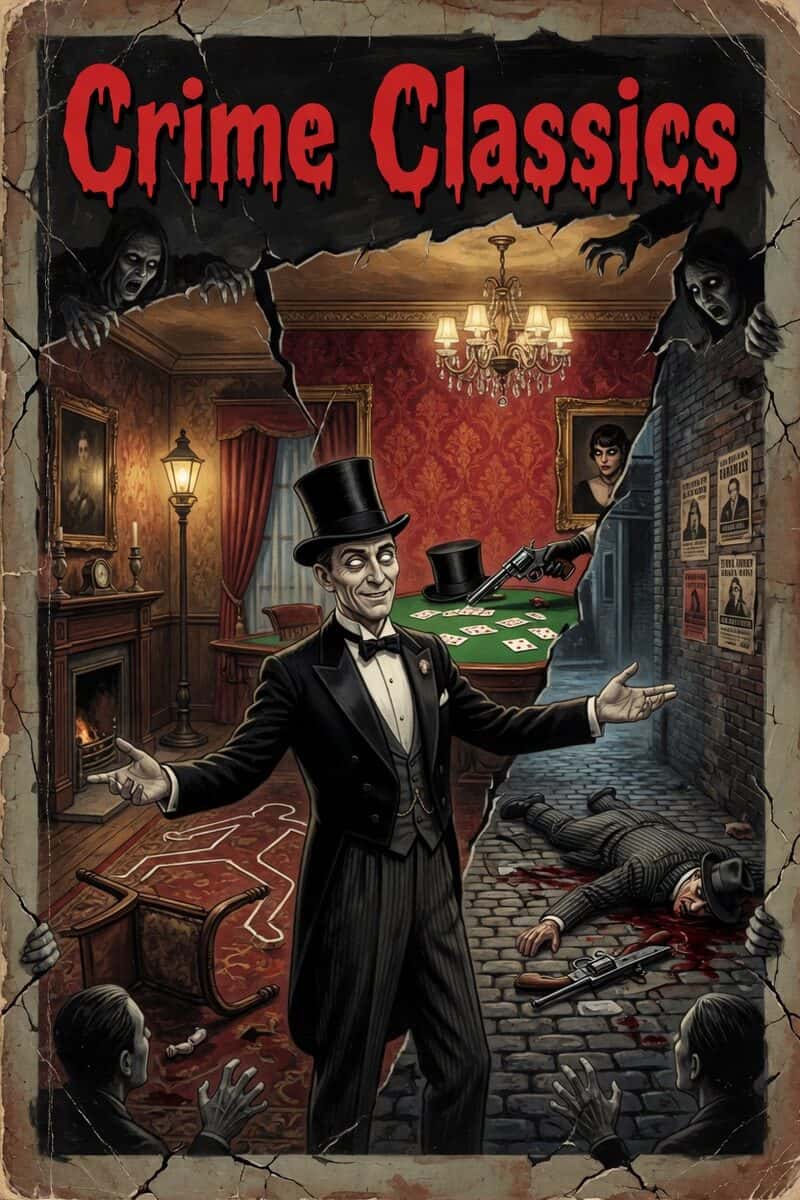
The written record
Read the transcript
Read along with the recording · About 17 min to read
Good evening. This is Crime Classics. I am Thomas Highland with another true story of crime.
Listen. That's a cricket. A Suffolk County cricket.
And he's chirping away at a merry pace. Therefore, he's a male cricket. For among crickets, only this sex can chirp.
At the present moment, this particular fellow happens to be in a hayloft in an English barn. The year is 1827, and it's spring, and it's evening, and it's warm.
And if you're going to be a cricket, now is the time, for the hay lies sleek against your antenna. Oh, my, yes. Dead cricket.
120 pounds of country girl just fell on him. Girl's name, Maria Marten, and she was a dead weight.
So tonight, my report to you on The Killing Story of William Corder. And the farmer's daughter. Crime Classics.
A series of true crime stories from the records and newspapers of every land, from every time. Your host each week, Mr. Thomas Highland. Connoisseur of crime, student of violence, and teller of murders.
Now, once again, Mr. Thomas Highland.
1827 was between periods. A decade before, Napoleon had met his Waterloo. And a decade later, Victoria was to sit on the throne.
True, in this year, which concerns us, the country was briefly stunned by the Affair Lavarie, which almost cost England the continent of Australia, until cooler heads and more honest bookkeeping prevailed.
And when the shuddering was done, and normalcy returned, people returned to normal pursuits, which included the young folk. For instance, Maria Marten. A giggler.
5'2", 120 pounds. Pretty. Demure.
And the most chuckable chin in Polstead. Which chin-chucking was being done by William Corder.
Maria. Pinklin. Pinklin Maria.
Oh, you're the one, William, you are. Twice over, Pinklin. Yes, you be.
And sweet-smelling you are, too. So does the hay you smell in the month of May. In your dilly hair.
Oh, God. Just to think, William. To think what?
All the seasons from now on, from May to December, and then start a new year, and all that near in the next. What? What talk you?
For every month, for every season, you are mine. Well, uh, well, no, uh, oh, I have not said that, or perhaps sometimes... What? Oh, I want to go.
I want to leave here. I want to... Oh, your dilly mouth moves so sweetly, and says nothing at all. You'll not go from me, William.
Oh? Because you will marry me. You must marry me, William.
Must I? Oh, yes, else... Else what? I will tell.
I will tell what you did, William. I would. Maria.
How you stole from my poor daddy. Maria. I cannot understand how his poor money was dug up and taken away.
Maria. Maria, I want to say a word. And should I say what happened?
The jail you would go, lad, may be hung. I heard in Ipswich they did a hanging recent to a lad which stole a heifer. Maria, will you listen to me?
And I do so love you, a thiefling, but I love you. Maria, will you marry me? Oh, you've been trying to say it all the time.
Of course I have. Of course you have. Pinklin.
Oh, go on.
I would like to read to you a description of William Corder as taken from a 19th century journal. He was about five feet six inches in height.
He usually affected a drab greatcoat, plaid lilac handkerchief, a black dress coat and blue pantaloons, and had rather a large nose, a small face, and a ring on the little finger of his right hand. That was William Corder.
Of course, since this was spring and a warm one, he took off his drab greatcoat, especially on the evening when he left Maria and went home and sharpened a knife.
Oh, he was a handyman. That's why he was so useful around the various farms in Polstead. Everybody loved him.
Everybody needed him. To mend a plow or stretch a thong, the cry went up, Aye, Billy Corder! This with smiling affection.
And the next morning when he went to the farm of his betrothed, Aye, Billy Corder! From Maria's father. From her mother.
A morning. A morning to each of you. You're worried, Billy.
Come into the house and I'll tea you nice and with some dilly biscuits. Now, Ma. He looks weary.
Leave him be, Ma. What you been doing, Billy? A sharpening.
Oh, what a sharpening? Knives. For the farmers all about.
I give you a hand whenever you'd want, Billy. How do you? But I, uh, I come this morning with another favor to ask.
Oh, my. What favor, Billy boy? Concerning.
Oh, my. Oh, my. Concerning what, Billy boy?
My love, my pinklin, my dilly girl, Maria. I be losing her, Billy boy? You be good to Billy, Maria.
Now, Ma. Just be good to him, you hear? Yes, Ma.
Then you be saying yes to what I'm asking? Oh, I'm saying it. Then, uh, here's a thing, uh.
Oh, a dowry thing, eh? Oh, since there was the stealing. Oh, since there was the stealing.
Since my poor money was dug by robbers. There's not very much I have. But, Billy.
I am a farmer, but my ground is clay and rocks. And you are a mole-catcher. And I cannot run fast, Amor.
Come here to me, Billy. Here I be. But close as a mother to a son.
Son. Son. Yes?
I have a farthing put aside for Maria and for you. Oh, Teddy-o. And, uh, there's a pistol I like so much in the house.
A pistol I like so much in the parlour. For what? A pistol.
Which I must have. Travelling as we are, Maria and me, to London for the marriage. To London you go?
To be wed? Yes. Oh, lad.
Oh, Billy. Tis every girl dreaming London to be married in. You're my true love, Maria.
Tonight I'll fetch you and we'll go down to London. Or better... What better could there be? The Red Barn.
You know it. I'll meet you there at the crossroad. Oh, whatever you say, love.
Ain't he a love, Mar? Oh, he's a love, all right. He's a real love.
Doing back in this dark barn, Willie. Why are we not off to London? I showed you the jewels I got from Mar, Willie.
I made her give me the cameo necklace, too. Now, please, can't we go to London to be wed? I do so want to wed with you, Willie.
Maria. That's what you are? I bring you daddy's wedding.
I bring you daddy's pistol like you ask and what you do. It goes off in your hand. Now, let's off to London, Willie.
It's a pride I'm dying to be. Willie? Are you there?
I can hardly see you, Willie. Where are you? Here I am.
The lovey pinklin man. With the knife he sharpened last night.
Then he carried Maria down from the loft into the empty corn room. He left her there for a moment and ran down the road a piece. Evening.
Can I borrow the use of a spade? Teddy-o. And Billy boy went back to the red barn and there he dug a hole.
Six by three by three. And put Maria in it. And filled the hole again.
And Billy took the high road to London. He also took the gun, the jewels and the farthings. Not a care had he as he whistled his way down the road.
For Maria's parents thought Maria was with him.
And in London... Step ye up, lads. I'm just a country bumpkin trying to make my way in London town. So step you up.
Here we have it. Here's a pea and here's three shells from walnuts. I place the pea beneath the shell in the middle and move the shells about.
Now who's a brave lad? Who's a clever lad? Tell me under which shell is the pea?
Oh, not for free, lad. For a wager. A pound?
A pound. Now watch your clothes. This one on the end.
This one on the end? Ah, we shall see. Ah, well, you lose.
It was under this one in the middle. Now let's try it again.
And in six months, William Corder had enough money to purchase a house and a bakery shop. A feather bed upstairs, a parlor beneath it. And beneath the parlor, bread and buns.
He needed only one more thing. So he went to the newspaper and he inserted an ad. Lady for matrimony wanted.
A private gentleman, age 24, entirely independent, whose disposition is not to be exceeded, has lately lost his family to the hand of Providence.
If this meets the eye of any agreeable lady who feels desirous of meeting with a sociable, tender, kind, and sympathizing companion, they will find this advertisement worthy of notice. Honor and secrecy may be relied on.
Mr. X, 68, Leadenhall Street. Here, sir, insert this in the next edition. Sir.
At your service.
There was an advertisement. At your service. Are you the gent... Mr. X. Hire me if such as you are seeking him out.
The advertisement said sociable. You were comely. It said tender.
And your hair a shade of brown that will sweeten in the sunlight. It said kind. And hazel eyes.
It said a sympathizing companion. How could such as fair as you need sympathizing? Gently.
I kiss. Your hand. Oh.
Pinklin. That's how they did it in 1827. At least that's the way William Corder did it.
Quite a handyman, wasn't he? The way he got rid of one girl and found another. And in his neighborhood, when a pipe needed mending or a bun baked, Aye, Willie Corder, the cry went up.
Aye, Willie Corder.
You are listening to Crime Classics and your host, Thomas Highland. England's winter of 1827 was a mild one, except for the big blow of November 12th to 20th, which temporarily crippled the fleet.
It was a season of cool freshets and sunny bright days. Not all was peaches and cream, however. Because of the locust plague of that year, many people starved to death.
Two, an unprecedented series of coal mine mishaps around Newcastle in December finally caused Lewis Ternan, a gazetteer of the day, to write, and I quote, What with the fleets having to be refurbished, What with the cruel cries of the starving in the streets, And what with the shawled widows at the mines, This winter, though a gentle one, has been quite disastrous.
We await spring. Unquote.
Well, spring came. And one of the nicest sights on an April day on Leadenhall Street in London was the new Mrs. William Corder. She would lean her head against her husband, and arm in arm, they would stroll.
Willie. It's the truth, every bit of it. When Wellington called for volunteers, I stepped out of their ranks and... Oh, Willie.
It's the truth, Birdie. I know it's the truth, Willie. It's just that my heart is thumping because you might have been killed.
Me? Oh, Willie. But, Birdie, I knew when I volunteered nothing was going to happen.
I hadn't met you yet, and I had to live to do that, so... What else? Nothing. Huh?
What else happened to you before you met me? Well, before I met... Right before I met you, I was in Italy. You said France.
You said France, Willie. Before France, I mean. And the Italian women, what of them, Willie?
Oh, I didn't have no time to bother with them. I was on a secret mission. Oh, Willie.
And don't you tell nobody. Brave, Willie. You happy, Birdie?
Happy as is happy do. Happy do indeed. Oh, yes.
Me? Yes. The jewels you're going to sell to my brother, how come you buy them?
By a gamble. A game of cards. But they're a lady's jewels.
Then isn't it obvious, duck? I gambled with a lady. In Genoa, it were, while on secret assignment.
Gabbed I was like a gypsy. I would have lost to you, too. Downy bird.
Oh. Come.
How, sister? Hi, Willie Corder. Hi, lad.
Nonny, Brother Sidney? Twice and go to grass, brother-in-law. For what luck you had at the cards last night.
And, uh, will we cheat me at this transaction, too? Isn't he priceless, Brother Sidney? He's a good brother-in-law.
But how good? What price will you give me for these jewels to add to your stock? Hmm.
Middling good. You see, wife, your brother becomes a haggler when it comes to money. Be generous, Sidney.
What you give us, we'll buy a new oven. 50 pounds. Done.
For this cameo necklace alone. This other stuff, not worth a shuck for. 50 pounds, then.
I'll write you out a cheque. Sterry. Good brother.
And of me? A duck. A dilly duck.
A love.
The very jewels Willie had stolen from the late Maria Marten. And you remember where Maria got them from. Her mother.
And you remember her mother. Maria writes such nice letters, Huey. Well, we can be proud.
I never knew she could write. I guess Willie Corder's taught her lots. That's right.
Mr. and Mrs. Marten were getting letters from Maria since the very first week she was away. Once every fortnight. For a year now.
Letters written on scented stationery in a feminine hand by Willie Corder. Chatty letters.
Having to do with the shops in London. Oh, I'd like stroll Piccadilly myself sometime. In ribbons like my daughter Dee does.
Newsy letters. About trials and tribulations of her married life. What's your love?
Oh, Vera, read this. Here. Oh, I don't think that's very funny.
You. You wouldn't. Warm letters.
Oh, isn't that a sweet thing she says here, Huey. I miss you, Ma, she says. I miss you, Pa, she says.
And how's the farming, she asks. And how's the mole catching. And the field of my father's clay and rocks.
Oh. A good one. A likely daughter.
Only. Only what? Here she says, don't come to London, Ma, she says.
Now why would she say that? Aggie. What do you want?
Mariah could not write when she left here. She writes good now. Better than me.
Oh, that will. Order, eh. I frightened you, Will.
Uh, no. Oh, no, no. What were you doing? Writing. Writing what?
Nothing. Now, now. Now, now, now.
Don't try to hide anything from me, Will. Oh, Pinklin, I, I wouldn't do that. Then what writing were you doing?
Promise not to tell. What writing, Will? Promise.
I promise. Come here. See this.
Oh. Oh. Oh.
Oh. Oh. Oh.
Oh. Oh. Oh.
Oh. bestehted out of your poorBERT? Not a big one.
Oh. Oh. Oh.
Oh. Oh. Oh.
Oh. Mrs. Ours? stall those?
I don't, I don't own any more sex. Well, the check my brother gave you. Look again.
For a 150 pounds. Uh-huh. But he gave you a check for only 50.
Uh-huh. And what you were writing. I fixed the check.
Oh, what a joke on your brother. Hey. Hey.
Ah, hey. Ah, hey. Ha, ha, ha.
Well. Downy bird. Forgery.
It is. Isn't it? What a one.
Who? Now, who could that be? The tradesman, I think.
Let's go to the window and see. The tradesman. And see what he has for us.
A new bed warmer. A new quilt. A new feather quilt.
And a pillow. And look down there. A new bed.
Oh, what a one. What a one you are. Oh, husband.
And later on, they chuckled about what a wonderful joke he had played on his brother-in-law, Sidney. History does not record Sidney's reaction. It's true what Bertie said.
What a one was William Corder. Especially what a one he was with the quill. Not only had he taken up hiking checks, but he was still penning those letters I told you about.
Only the scent had been changed. This latest letter I have here, Huey. Mariah says should I ever be so bold as to come to London.
She would. She would not receive me. She never could write.
Ow. Go to sleep, old man. And according to court reports and testimony, this is what happened then.
Go on. Go to sleep, old man. Then Mrs. Martin said she fell asleep too.
Then. Don't you like London? Not in London.
Aye. Aggie. Aye, aye, aye.
London. London. Wake up, Aggie.
Put the tea to a bubble. Not in. Oh.
Had me a fight. It's, Huey, a terrible, awful nightmare. Poor the sheet you did.
Now up to the tea lady. Dreamt she wasn't in London. Dreamt I... Up to the tea lady.
Up. Yes. And the next night... I never got to London, Ma.
Where did you get to, Mariah? Hardly away from here. You... May be not far from here.
Wake. Wake, Aggie. Bubble the tea for me.
And on the third night... Crossroads. I'll come. In what place?
And... Daughter, dear. She lies three feet under the corn room in the red barn. Oh, daft you be daft.
Mariah told me. In a dream. In a three-night dream.
She told me, get shoveled. He got up all right, and he got shoveled to him. And together they went down to the red barn.
And they dug. And they found a skeleton. And Mariah's shawl.
And Mariah's shoes. And Mariah's dress. But the thing that clinched it.
The thing that made them sure. The skeleton had the four front teeth missing in its lower jaw. Exactly the four teeth that had been missing from Mariah's mouth when she was alive.
Police! And again and again as she ran down the road toward Paulstead. Police!
Which was finally heard by Constable James Lee, who viewed the body and rubbed his chin and took a trip to London, where he sought for and found William Corder, who was tried and found guilty.
And a half hour before he was hanged, wrote a letter in his own hand on... printed paper, and of course, signed in his own name.
Dear Bertie, Good wife, I am fully aware of the shame and disgrace which I must have cost you.
So that there be some vestige of pride remain, such as a woman should have for her husband, I suggest you bury me in the finest vestment obtainable, such as silk.
My coffin, I do pray you, for your own sake, should be of mahogany. With moulding of silver. A cherubin on my tombstone of marble, with some fitting sentiment, such as... William Corder, of sweet and gentle memory.
Though not innocent of deed, I am innocent of heart. Good-bye, dear wife, William Corder. On the scaffold there was some embarrassment because the trap would not work.
Corder, who was, you'll remember, a very handy man, fixed it. But after the trap was sprung, it took him 12 minutes to die. So he probably didn't do a very good job.
William Corder, tonight's crime classic, was adapted from the original court reports and newspaper accounts by Morton Fine and David Friedkin. The music was composed by Bernard Herman and conducted by Wilbur Hatch.
And the program is produced and directed by Elliot Lewis. Thomas Highland is portrayed on radio by Lou Merrill.
In tonight's story, Richard Peel was heard as William Corder, Betty Harford as Mariah, Alma Lawton as Bertie, Jeanette Nolan as the mother, Joseph Kearns as the father, and Donald Lawton as Sidney. Gil Warren speaking.
This is the United States Armed Forces Radio and Television Service.