
The written record
Read the transcript
Read along with the recording · About 18 min to read
Good evening. This is Crime Classics. I am Thomas Hyland with another true story of crime. Listen.
That was a beaten iron baling hook. A native of India named Kanak just plunged it into a bale of cotton. It was his favorite tool. He used it to plunge into logs when he needed logs. He used it to tear up the hard sun-packed earth when he wanted to plant. And mighty hunter that he was, he used it to plunge into charging wild boars whenever he wanted to show the fellows how it was done. And when Kanak went to kill his brother Supan, oh, this beaten iron baling hook was a veritable handy home workshop.
So tonight, my report to you on how Supan got the hook outside Bombay.
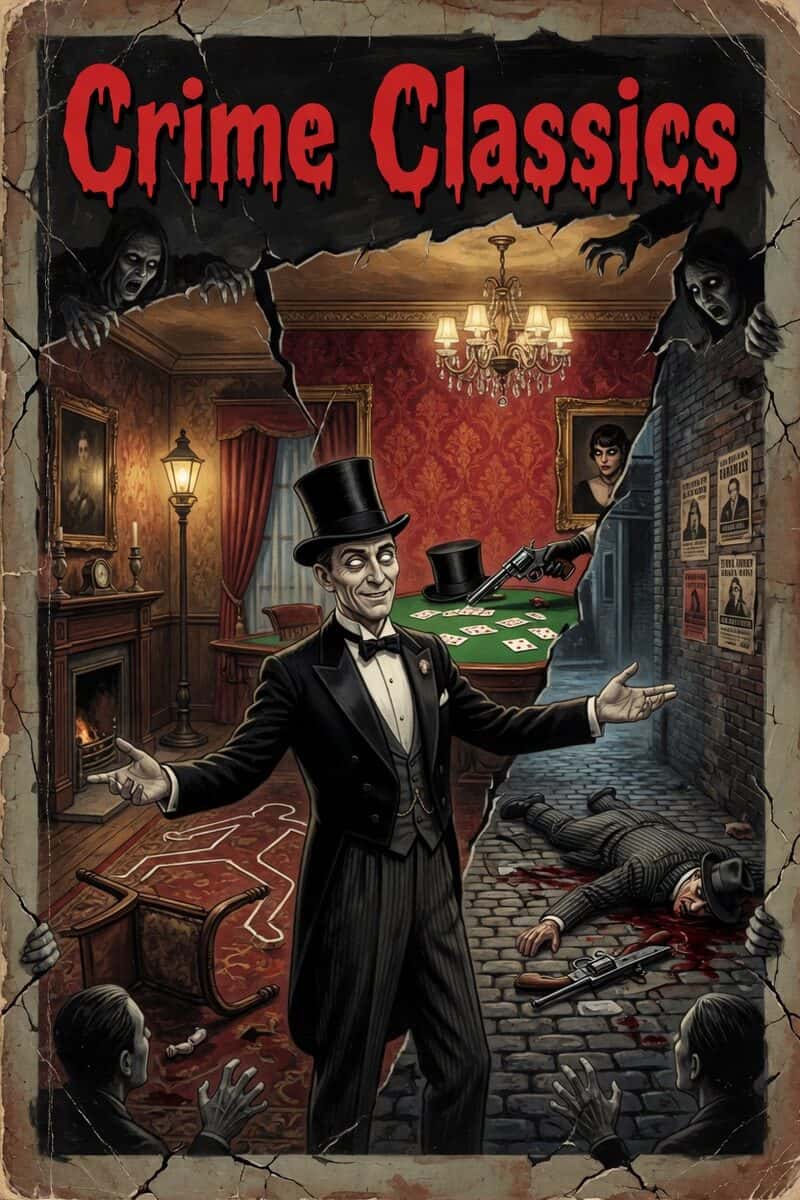
Crime Classics. A series of true crime stories from the records and newspapers of every land, from every time. Your host each week, Mr. Thomas Hyland, connoisseur of crime, student of violence, and teller of murders. Now once again, Mr. Thomas Hyland.
I would like to address a few pertinent remarks to those of you who may never have been in South Konkan Province, India. It lies athwart the Western Ghats on the Arabian Sea. In 1856, the time that concerns us, the province claimed many more vultures than it does now. It was a place of contrasts, of beggars and marble temples, of havildars and pukka sahibs, of monsoon and searing sun, barren fields, jackals, pomegranates, cobra, Englishmen, fakirs, and veiled maidens, and life and death.
Now there lived in this section of the country two brothers whose names were Kanak and Supan. And on an early April evening, they were consoling each other.
Weep not for our dead father.
That was Kanak, tall and well-formed, of sinew, and who could not bring himself to cry over his dead father.
No, I shall not. For he was a good man, and gentle, and he goes to his peace.
That was Supan, brother to Kanak and younger. He couldn't cry either.
See how he burns there on the Ghat. The end of a man. The just end of a man. Ashes. The last of the wood, brother. Let us together throw it upon the pyre. Together.
Noble thought. Ready. Together. Now. He taught us well, our father. How to be brothers. To love each other.
I must tell you something.
Then I to you. Often our father would lead me to the clearing below the tent of the unveiled women, and there he would say to me, whatever betide, love thee your brother. Love thee your brother, which is what I wish to tell you. Then he would pour the oil. The oil of blessing on my head and on my shoulders.
And to me.
Brother. Brother. Brother. Yes, brother. Our father left no will.
Fret not, brother.
Nor should you fret. How should I fret when our father left to me all his worldly goods, and also the fertile acres near the waterfall?
Poor brother, you are mad with grief.
How can I be mad when I remember so well our father's very words? Supan, he said. To you, all my worldly goods, and also the fertile acres near the waterfall, which is what our father said to me.
Supan.
Yes?
I am the older. I was the favorite.
Well, you are a liar. You are poison-hearted. You are a thief. You are an usurper of your father's will.
Supan.
Yes, brother?
Our father's wealth is mine.
No.
Well, we shall see.
Yes. Oh, infamous one. Oh, vulture. The wealth is mine. Mine. And your wife is just like me. You and your wife.
People who were cremating dear ones this evening were diverted by two fighting brothers. It was a macabre scene. Violence in a field of burning bodies. Hate being shouted. Names bandied about concerning each other and their wives. And so on for another hour. Then, bloodied and singed, they were separated. Not by onlookers, and not by mourners, but by their wives who had been told of what was going on.
Come, Kanak. Do not fight with your brother.
Not with your brother, Supan. Come, let us go home.
And they went. And in the tent of Supan, while washing wounds.
I watched. For some time before I came to you, I watched how you fought. And the dancing shadows the flames made on your body were lovely to see.
Lono.
Wife. But close to you now. The bruises are new. It should heal them quickly.
Lono. Lono. Lono. What of him, husband? My brother?
Yes. He says my father's wealth is his.
And did he tell you the other thing?
What?
How he covets me.
Foolish. I am not one to attract.
No. No. But the names he called you this night. He has guile.
You tell me the truth?
As long as he lives, he will covet me. He has said things to me of my hair and my ankles in such a way.
He should be dead. Then we would have wealth. And no one to argue it. And the other thing. What you've wanted for so long.
A handmaiden.
A handmaiden. A silently moving handmaiden who would clean our tent and wait upon us. Who would walk in bare feet. And who would wear a jewel at her throat. And hear bells. To make joyous the times of her waiting upon you.
Lono.
Yes?
I'm sorry. I'm sorry. I'm sorry. I'm sorry. I'm sorry. I'm sorry. I'm sorry. I'm sorry. I'm sorry. I'm sorry. I'm sorry. I'm sorry. I'm sorry. I'm sorry. I'm sorry. I'm sorry. I'm sorry. I'm sorry. I'm sorry. I'm sorry. I'm sorry. I'm sorry. I'm sorry. I'm sorry. I'm sorry. This is terrible that my brother should covet you. He should be dead.
Yes... It is very logical, Kanak.
Careful how you bathe my shoulder. The pain will pass. But what has happened tonight, Kanak... It is very logical... Always you say it is logical. What now is logical?
That in some way you should arrange the passing of your brother.
Huh? What do you speak of?
It is written. A thing is either logical or it is written. Now what?
It is written, sons are brothers only when a father can keep them away from each other.
What fool wrote that? What... Gentle, gentle woman. Then listen to me. It is logical that since there is no will, your brother, your younger brother, can legally claim half of what should be yours.
Well, he's done that already. That's why we've fought.
And will you keep fighting and screaming at each other while the fertile acres near the waterfalls turns to weed? Or will you be rich?
Huh? And if I be rich?
It is logical you will be able to afford what you dearly want.
Truly?
A handmaiden. A handmaiden. It is written, a man's tent needs two women. A wife to heal the hurt and love, a handmaiden to carry goat's milk.
Yes, yes, yes. Well?
It will be... Pleasant to be rich.
I know.
You must admit both brothers had a pretty busy day. Father dead, taking him out to the ghats, burning him, fighting over his possessions, then home to wives who whisper murder in their respective ears. No wonder they didn't sleep. They tossed all night on their pads. And it wasn't until almost dawn...
Hush, Kanak, hush.
And down the street...
Sleep, Supan. Now sleep.
And morning came. Hot. And bright. And over it hung the vultures and the smoke from funeral fires. And in the fields, Kanak was piling bales of cotton with... That's right. The beaten iron baling hook. Piling high the cotton and thinking about what happened yesterday. Thinking about it so hard that...
Snake.
That one would say it had gotten the better of him. Vulture crawling.
Hoo, brother.
What?
With such vigor you attacked the cotton you did not hear me approaching.
Ha, ha. What do you do here in the fields?
I came for my spinning to ask you to walk with me.
Walk? I've been thinking about yesterday. And I want to talk with you.
Ha, ha. All right. Let's walk.
Need you take along your hook?
Well, in case a wild boar attacks.
Six months have passed and there have been no boars. Leave your hook, brother.
Oh, very well, brother. Ah. Let us walk. Toward the waterfall.
Good.
Brother. Brother. Yes. We should not quarrel.
No. We are brothers.
Yes. And these fertile acres should belong to both of us.
Indeed. It would be wisdom.
Hey, do you speak in truth?
We are brothers. Yes. Could I have a serpent's tongue when I speak of brotherly things? I would not be worthy then of the name brother.
Nor I. Let us walk then with arms about the shoulders as brothers do.
Yes. Ah. Young brother.
Old brother and dear to me. Our father must be proud seeing us now.
Yes. Brother. Yes. Look at the waterfall. Our esteemed waterfall. See how its spray makes a rainbow and...
Kanak.
Brother.
Yes. Let us contemplate the rainbow-making waterfall. I want to. You stand here.
Where will you stand?
Here. Near... Brother! Brother! The edge where I can watch you. You will be washed by the river and be carried to the sea. And so to me. You are now a widow. My brother Kanak, your husband, fell from the heights into the torrent of the waterfall.
Oh.
Nor should you weep, for as he fell, he cried your name.
Oh.
And though he could not hear it, I yelled to him that I would always take care of you, my brother's wife.
What will you do with me?
I have discussed it with my wife, and we have concluded...
What will you do with me?
I am rich now.
Oh.
A handmaiden is wanted in my tent.
Oh.
Why do you look beyond my shoulder and call to him? He is dead. I saw him myself fall into the...
It was Kanak, all right. A beaten iron baling hook in hand. A rather wet Kanak, but certainly not a drowned one. Not a dead one. But his brother was dead. This is known as turning the tables.
You are listening to Crime Classics, and your host, Thomas Hyland.
Your contribution of $10 or $6.95 for the budget relief package will send more relief overseas than the same money spent any other way. To help people in foreign countries with food or clothing, send your check to Nonprofit Care New York. That's Care New York. Send your check, your name and address, and full particulars about who's to get the package. Care will do the rest.
And now, once again, Thomas Hyland and the second act of Crime Classics. And his report to you on how Supan got the hook outside Bombay.
The spring of 1856 in South Konkan Province, India, was a good one. The season was fair for the cotton and the butternut. The grain was gold almost to the sea, and the hives were overflowing. And it was this spring you'll remember, when... Lady Mae Smallwood appeared briefly on the pages of history to make her mark in Indian affairs, only to disappear with her secrets up the Khyber Pass with a wave and a smile never to be heard of again. And it was this spring when Kanak bludgeoned his brother to death with a hook.
Now, Kanak was no fool, for, as he told his wife...
If the authorities find out, they'll hang me.
Then see to it that they don't.
Good advice. And Kanak was a man who heeded good advice. So, within an hour after he'd committed murder, he presented himself to the mayor.
Have you paid your taxes, Kanak?
Which was always the mayor's opening gambit. For collecting taxes was the mayor's chief duty, and to this particular mayor, duty was an obsession.
Good. What brings you to me?
Yesterday, my father died.
I know. I will inherit.
You will inherit. And your brother?
My brother? Today, my brother... He knelt in the field, and a tiger sprang upon him.
A tiger?
A tiger. I have heard that tigers do spring upon those who kneel in fields when tigers are about, and who are hungry or who have become frightened.
A huge tiger with great talons and foam-flecked muzzle. An angry tiger.
What angered him?
Who knows the way of tigers?
Who, indeed? We were speaking, my brother and I, and my brother knelt to pick a pebble that had lodged in his sandal.
Which frightened the neighbors?
The near-passing tiger. The huge near-passing tiger.
And made the beast angry?
Caused him to make terrible roar. And spring?
And with one blow nearly severed my brother's head.
And so killed him.
Bow not down your head, Kanak. Lift it up, and tell to me of the fertile acres by the waterfall.
They are mine. So many acres. Some people may doubt my story of how my brother died. I have heard...
How fertile are your acres, that one need but throw the seed upon the earth, and it flourishes, and brings riches.
Some may say like this, we saw no tiger, we heard no tiger.
Then they would be wrong, for I heard a tiger.
How perceptive you are. And saw him, carrying your brother between his jaws.
A huge tiger.
Do not recall the hugeness of him. I tremble. For the fright I caused you a gift.
The quarter section south from the stream. Did I pluck the words from you, wise mayor?
My brother, my poor dead brother, is for some reason at my house now. I will see he is not there for long. Then I go with my grief.
Go then.
For the good of the village, according to the mayor in later testimony. That's the only reason why he'd made such an arrangement. For should word drift down to the authorities that foul play was suspected, the whole village would have been packed up and moved to Bombay and held for questioning. Which is the way things worked in those days. The animals would have been untended, the fields unwatered and seared by the sun, and who would look after the shops? In effect, the questioning over, the village would hardly be worth coming back to. With this in mind, I made the foregoing arrangement with Connacht.
But why did you accept a bribe of the quarter section south of the stream?
For the good of Connacht, so that he would have a quarter less to worry about.
Didn't you suspect that he might have murdered his brother?
Let he who suspects others suspect himself. For so it is written.
Connacht having made an arrangement with the mayor, he, Connacht, had another arrangement to make. He went to the home of his brother to seek out Lono, his brother's wife. She wasn't there. So he followed the smallest footprints in the warm dust. And eventually...
I did not mean to startle you, sister-in-law.
No way. You swooped upon me.
I didn't swoop. As I washed my hair in the stream.
Do it.
What?
Your hair. In the small current of the stream.
Why?
Beautiful.
If your brother Supan heard you speak so to me...
He cannot.
To speak to me so? To say I am beautiful?
Do you think me beautiful? I can say so now, and your husband will not hear.
How can you be sure?
He is dead.
Oh.
A huge and hungry tiger sprang. What happened upon him?
A tiger? Ask the mayor.
And if I did, what would he say?
That a huge and hungry tiger sprang upon your husband and killed him.
Can I?
Yes.
What will become of me?
A widow.
What will become of me? Now that I am rich, my tent needs a handmaiden. I have discussed it with Chumi, and she has said a handmaiden is needed. It is written a man's tent needs two...
I know.
Yes.
What?
What?
Someone calls.
Connock. Oh, Connock. It is well I have found you before it is too late.
Too late? Too late for what?
The policeman has come.
Policeman? Britisher from Bombay. On his inspection tour.
Inspection tour?
Lono. Tell him what I have said. To me, he but repeats and does not react.
The British policeman has come from Bombay on an inspection tour.
And?
Already he has heard that your brother is dead.
Of course my brother is dead, Claude, by a huge tiger...
Connock.
Yes.
A quarter section is not enough.
A half section, then.
All of it.
All the fertile acres?
All. Else. Well, it tigers.
Very well.
What you say is quite true, Mayor. As you will see, it was a tiger.
Claude. Pity. Pity, pity. A chap who does not know any better but to turn his back on a tiger. How big did you say? Oh, my. The broken grass here is the path of the tiger as he carried the poor man to the clearing. Quite. Quite. Who knows about tigers?
Oh, I do.
Who knows about tigers, indeed?
I said, I did, old chap.
Oh? Oh, yes, yes. Quite a studier of tigers. I am. Habitat, manner, etc. Oh, yes.
What brings you to our village, Major?
Passing through, old boy. Just passing through. Now, what is it you wanted to know about tigers, old chap?
Will you be coming back next month?
Unsteady beggars, tigers. Major. Desert their mates when the cubs come. They're good swimmers, though. Major. It hardly ever attacks a human unless it's an old fellow. This tiger you saw must have been an old beggar.
But huge.
Oh, and here he is, Major. Supan. The man who was struck down by the...
My pity. Pity, pity. You see here the force of the tiger's blow. The depth... Pity. Pity, pity.
Will.
Yes?
You make your arrangements, old boy. I've seen enough. We will mourn Supan as he burns on the ghats tonight.
Yes, I'm sure of it.
Let us go back to the village, then. And we will have some tea.
I'll have some. Most remarkable time of an Indian day, don't you think so, old chap?
Yes. Yes, I do. Paddling into it like this.
Mayor.
Yes, sir.
The population of your village, please.
Three hundred and twelve.
Mayor.
Yes?
A very huge tiger.
Do not recall it.
And old.
Oh.
Mayor.
Oh.
There hasn't been a tiger in these parts for five years.
Sir.
Not one of those striped beggars in five years. I know. This area against the Arabian Sea has been shot clean of tigers, driven them inland. I know. A student of the chaps, you know. Well, here we are.
Sir, that chap there, throwing more wood on the ghat, he would be...
Connock. I'll wait here.
Sir, I was only...
Of course. Of course, you were. Wait here.
Mayor.
Oh, grieve with me, Mayor. Grieve with me.
Murderer.
What?
Murderer. But of our arrangement.
You struck your brother down with a bailing hook.
But our arrangement.
Murderer. Now, you are under arrest. Come. Get in. Here he is, sir. That tiger thing, ridiculous, you know. There hasn't been one in these parts for five years. Went inland. Sorry, old boy.
Connock was taken to Bombay and the rest of the village, too. So eager were the townsfolk to get back to their town that each one pointed an accusing finger at Connock. He was found guilty. He was hanged. He was sent back to the village. He was burned on the ghats. It is interesting to note that three weeks later, Connock's wife, as she bent over to pick a pebble out of her sandal, was carried off by a tiger and eaten.
In just a moment, Thomas Hyland will tell you about next week's Crime Classic.
Supan, tonight's Crime Classic, was adapted from the original court reports and newspaper accounts by Morton Fine and David Friedkin. The music was composed by Bernard Herrmann and conducted by Wilbur Hatch. And the program is produced and directed by Elliott Lewis. Thomas Hyland is portrayed on radio by Lou Merrill. In tonight's story, William Conrad was heard as Connock. Byron Kane as Supan. Lillian Buyeff as Lono. Jack Kruschen as the mayor. Julie Bennett as Toomey. And Alistair Duncan as Major Ellison. Bob Lemond speaking.
Here again is Thomas Hyland.
We would like to thank the editors of TV Radio Life for judging Crime Classics the finest radio crime series of 1953. Next week, Edinburgh in the year 1857. My report to you will be about a young lady who purchased enormous amounts of arsenic and an attractive gentleman who died of stomach cramps. It's listed in my files as Madeline Smith, maid or murderess. Which? Thank you. Good night.
This Friday marks Arthur Godfrey's 20th anniversary on CBS Radio. Just as sure as you're born, you've got two chances to celebrate. Celebrate the big birthday with Arthur and all the little Gs. During the day on their 90-minute mirth-a-thon and at night on Arthur Godfrey's Digest. Yes, this Friday, it's the 20th anniversary of a great entertainer at the star's address, Arthur Godfrey.
For integrity and accuracy, hear Edward R. Murrow reporting weekday evenings on the CBS Radio Network.