
The written record
Read the transcript
Read along with the recording · About 21 min to read
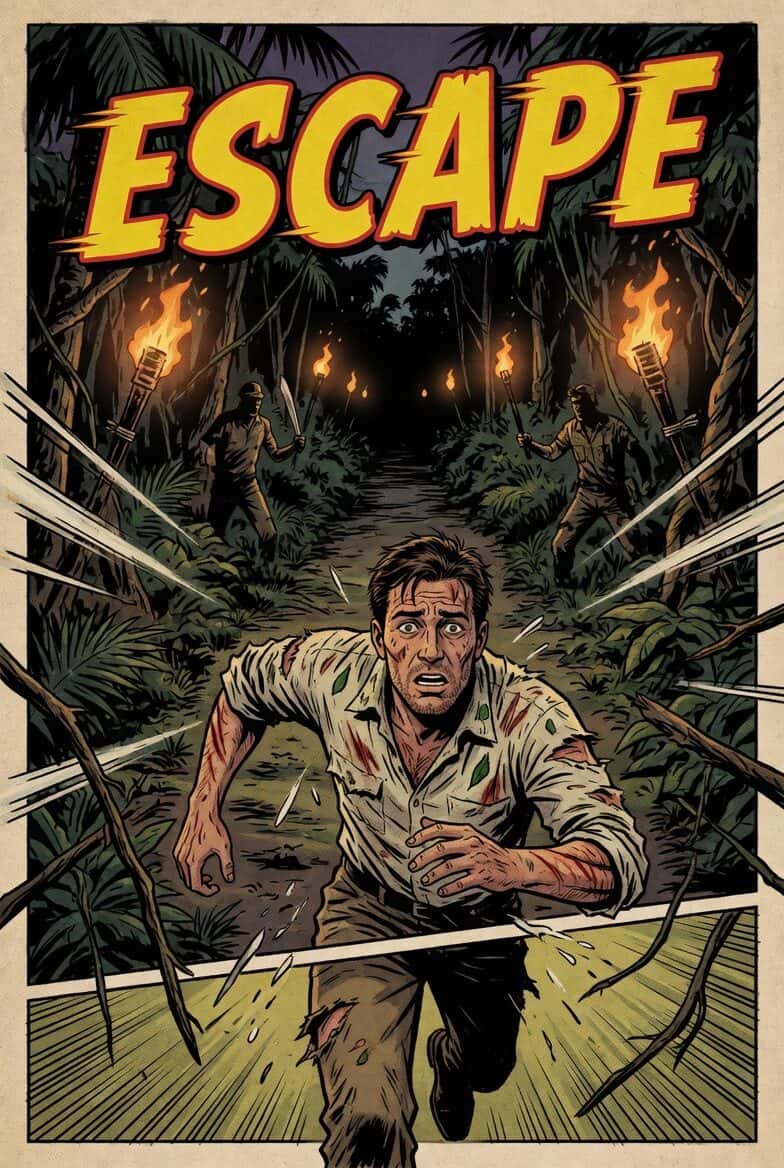
Tired of the everyday grind? Ever dream of a life of romantic adventure? Want to get away from it all? We offer you... Escape!
Escape! Designed to free you from the four walls of today for a half hour of high adventure! You are in the suffocating depths of a jungle, listening to the words of your companion. While the native people, seemingly friendly and quiet, are awaiting the moment to strike. Which, when they do, will mean a fate from which there is no escape. So listen now, as Escape brings you Somerset Maugham's exciting story, The Out Station.
The new assistant, Alan Cooper, arrived in the afternoon. Mr. Warburton, the resident of the government control station, went down to the river landing stage to meet him. The guard, eight little Borneo Dyak soldiers, stood to attention as he passed, and he noted with satisfaction that their bearing was martial, their uniforms neat and clean, and their guns shining. Mr. Warburton was a rather small and precise man. He wore a topi, spotless shirt and ducks, and white shoes, and held under his arm a gold-headed Malacca cane, which had been given to him by the Sultan of Parac. As the prahu peered around the bend in the river, he felt a slight misgiving, caused, no doubt, by the arrival of another white man. He was accustomed to loneliness and his own way of life. Still, he smiled affably as the boat landed and held out his hand.
How do you do, Mr. Cooper, I presume?
That's right. Were you expecting anyone else?
My name is Warburton. I'll show you to your quarters. The boys will bring your kit along.
Feels good to walk again. I was cramped to the devil from that little scow.
I'm so sorry. Oh, by the way, I brought your mail. Lots of newspapers in it.
Can't be worth much, I shouldn't imagine. They must be at least six months old.
Old news is very fresh to me here, Mr. Cooper. It's the only news I get from London.
Those my digs over there?
Those are your quarters, Mr. Cooper. I've had it made as habitable as I could, but of course, no one has lived in it for a good many years.
It'll do me all right.
I hope so. I dare say you'll want to have a bath and a change. I should be very pleased if you'll dine with me tonight. Will eight o'clock suit you?
Any old time will do for me.
Yes, one of my boys is inside. He'll take care of you until you get your own boy.
Right.
Mr. Warburton left the new man in his house and returned to his own residence. The impression which Alan Cooper had given him was not very favourable. Cooper seemed to be about 30. He was fairly tall and rather heavy in build and was dressed in khaki shorts and shirt, but they were shabby and soiled, and his battered topi hadn't been cleaned for weeks. These things Mr. Warburton noticed, but then, being a fair man, he reflected. Well, after all, he has spent the last 48 hours coming up river in the prahu. We'll see what he looks like when he comes in to dinner.
A little later, Mr. Warburton went down to the bath house and sluiced himself with cold water, and after that, he carefully dressed. And he dressed as he did every night. Boiled shirt, high collar, silk socks, and patent leather shoes. The only concession he made to the climate was to wear a white dinner jacket. Then Mr. Warburton went into the sitting room to await his guest.
Go on, Cooper.
Hello, you're all dressed up. I didn't know you were going to do that. I very nearly put on a sarong.
Oh, it doesn't matter at all. I dare say your boys hadn't finished unpacking. You needn't have bothered to dress on my account, you know.
I didn't, Mr. Cooper. I always dress for dinner.
Even when you're alone?
Especially when I'm alone.
Well.
Mr. Warburton saw a twinkle of amusement in Cooper's eyes, and he flushed an angry red. He resented the man's attitude, and he resented the same dirty khaki shorts and shirt augmented by a ragged jacket. Still, he knew that he was going to have to get on with the fellow, and as they sat at dinner, he amplified his theories on dinner dress.
When I lived in London, Mr. Cooper, I moved in circles in which it was as much an eccentricity not to dress for dinner every night as not to have a bath every morning. When I came to Borneo, I saw no reason to discontinue so good a habit.
Well, look at it, I suppose. But if you expect me to put on fancy dress in this heat, I'm afraid you'll be disappointed. Fine champagne you got here. You do yourself like this every day?
I haven't noticed that the dinner is any different from usual. Oh, by the way, while you were in Kuala Selor, did you meet a lad called Henley? He's come out recently, I believe.
Henley. Oh, yes, in the police, I remember. Nasty little swine.
Oh, I should hardly have expected him to be that. His uncle is my friend, Lord Barraclough. I had a letter some time ago from him asking me to look out for Henley.
Ah, I heard he was related to somebody or other. Pass the chutney, will you? That's how he got the job, then. He's been to Eton and Oxford, and he doesn't let you forget it. All his family have been to those schools for generations.
I should have expected him to take it as a matter of course.
I found him a bloody bore and a snob. To what school did you go, Mr. Cooper?
I was born in Barbados. I was raised and educated there, too.
Oh, I see.
That's right. And in the war, I didn't get a commission, either, because I didn't have influence, and I hadn't gone to public school. But things are changing, Mr. Warburton. In England, things are changing. The old school tie is going down the drain. Perhaps you haven't heard. Things are changing, Mr. Warburton.
Mr. Warburton was a snob. He'd endured financial ruin in England and found a haven for his memories in Borneo. Now he was faced with a reminder of the outside world, a common world that he rather despised. The breach between the two men was not long in coming. It started a week after Cooper had arrived.
I see. Cooper.
What, sir?
I've talked to my head boy about finding you servants, and he recommends his nephew as head boy for you. He's waiting outside. Would you like to see him?
I don't mind.
Abbas.
Tuan?
This is Tuan Cooper. Abbas. It will work for him.
Tuan Cooper? It is my honor.
You'll have to look sharp with me, Miller. No stealing. Mind your P's and Q's, and we'll get along, all right?
Will he do?
I dare say he's no more of a scoundrel than any of the rest of them. Cut along, Abbas. You're hired. Take care of finding a cook and the others.
Tuan?
You're lucky to get a boy like that. He belongs to a very good family.
Doesn't matter a blast to me if he's got blue blood in his veins or not, just so long as he brings me a drink when I want it.
You have a lot to learn about the Malay natives, Mr. Cooper. You do well to study.
I understand them. I was born in Barbados, and I was in Africa during the war. To me, a native's a native. And don't worry, I can handle them.
We were talking of Malays.
Well, what's the odds?
You're very ignorant, Mr. Cooper.
There was another day not long after that. The two men had been up the river, and they were on their way back in the prahu. Cooper was becoming increasingly aware of Warburton's disapproval, and because he was a colonial and had lived little in England, had a peculiar dislike of the English. He resented especially the public school boy, since he feared to be patronized, and he felt that offensiveness was the best defense against him.
Well, at any rate, the war's done one good thing. It smashed up the power of the aristocracy. This war really put the lid on it.
It's a pity, an era of greatness, a lost era.
Bloody good job, too, in my opinion. My poor Cooper, what can you know of the glory that was Greece and the grandeur that was Rome?
That's a lot of rot. I don't give a row of pins for a lord. I tell you, what's wrong with England is snobbishness, and if there's anything gets my goat, it's a snob. Particularly a snob who's gone broke and still likes to kick his weight about. Lots of them like that out here in Malaya. Have you noticed, Warburton?
Warburton knew that Cooper was referring to him. A man's life in open history in the colonial service, and Cooper must have heard about his failure before he'd come up river. The resident's hands trembled, and from that moment on, he saw to it that they lived apart, and except for work, spoke little to each other. It was not until Cooper had been on the station for a couple of months that an incident happened which turned Mr. Warburton's dislike into bitter hatred. It was a small, petty thing, but it was the beginning of the end, an ending that was to mean a terrible and a lonely death.
We will return to Escape in just a moment, but first, last year, the smoke of great forest fires blotted out the sun over vast regions. Such tragedy of human loss and property must not be repeated in 1953. By working together, we can eliminate nine forest fires out of ten. And now, back to Escape.
Mr. Warburton was obliged to go upcountry on a tour of inspection, and he left the station in Cooper's charge. In spite of the tension which existed between them, he knew that the assistant was a capable man, although he had no sympathy for the natives. He was hard and a bully, and the Malays disliked and feared him. Anyway, Mr. Warburton was gone for three weeks, and when he returned, Cooper came to his house to make a report. The resident was in his sitting room, and the head boy stood quietly at his side. Mr. Warburton was white with anger.
My boy tells me that you were the one who opened my newspapers, Cooper.
Newspapers? Oh, well, while you were gone, the mail came, and I wanted to read about the Wolverhampton murder, so I borrowed your Times, so I knew you wouldn't mind.
But I do mind. I mind very much.
Sorry, I couldn't wait until you came back. I wonder you didn't open my mail as well.
That's not the same thing. There's nothing private in a newspaper.
I very much object to anyone reading my paper before me. I think it's extremely impertinent of you.
They're all mixed up. I read them every morning at breakfast in the order of their issue.
We can easily put them in order. Only take a sec.
Don't touch them.
Look here, aren't you being a bit childish making such a fuss about a little thing like that?
How dare you speak to me like that? Go! Go to blazes!
Tuan.
Tuan.
Yes? Oh, what is it?
While you have been away, there has been trouble.
Oh?
Tuan Cooper's servants, they have left him, all but my nephew Abbas, and he too wishes to go. He says it is not a good house. He wants to do as the others have done.
No. He must stay with Tuan Cooper. The Tuan must have servants, have those who went replaced.
No, Tuan. No one will go.
Then find the boys who ran away and tell them that I expect them to be back in Tuan Cooper's house at dawn tomorrow.
They say they will not go, Tuan.
On my order, I will find them, Tuan.
The next morning in the office, the two men met again. There was no word of the newspaper incident, and after Cooper had given his complete report, Warburton dismissed him.
I don't think there's anything else, thank you.
All right. Oh, Cooper, I understand you've been having trouble with your boys.
No trouble. They had the cheek to run off, probably trying to blackmail me for more money. But they've all come back to heel again.
What do you mean by that?
This morning, they were all back on their jobs. I suppose they decided I wasn't as big a fool as they thought.
By no means. They came back on my express order.
I should be obliged if you wouldn't interfere with my private concerns.
They are not your private concerns. When your servants run away, it makes you ridiculous. You are perfectly free to make a fool of yourself, but I cannot allow you to be made a fool of.
That'll do. You may go.
May I? Now, shall I tell you what I did? As soon as I saw them back, I called the old bloody lot in and gave them the sack. I gave them ten minutes to get out of the compound.
I think you behave very foolishly. Good masters make good servants.
Anything else you want to teach me?
I should like to teach you manners, but I haven't the time. I shall have to see that you get new servants.
Don't trouble. I'll get them myself.
Allow me to say, Cooper, that no one will come except...
At my order. Would you like me to give it?
No! As you like. Good morning.
That's the way the matter stood. Only Abbas remained with Cooper, and he opposing his master with sullen resistance, not doing more than he chose. The days, the weeks went on, and the heat became terrible. Mr. Warburton from time to time heard vague complaints from the natives concerning Cooper's harsh treatment, but when he looked into what he thought were specific cases, all he could say was, that Cooper had shown severity where mildness would not have been misplaced. He had done nothing for which he could be taken to task, and Mr. Warburton found himself waiting for an opportunity to do that. One day it came.
A half a dozen civil prisoners were engaged in repairing a road on the station until their sentence was up. Their hours of labor were from seven in the morning until four. Mr. Warburton was taking a stroll at dusk, and he saw the prisoners still at work. He called the warder over.
Why are these men still at work? It's past six o'clock, warder.
I know, Tuan, but it was Tuan Cooper who gave the order.
When did he do that?
Yesterday, Tuan. They are now to work until seven.
That is contrary to regulations.
Tuan Cooper gave the order, Tuan.
Mr. Cooper is under my orders, warder. The prisoners are to finish their work at four o'clock and are then to be returned to the jail. There will be no more work for them after that time. Do you understand?
And the next afternoon, Cooper was astounded to see the prisoners strolling back to the jail. It was five o'clock. He learned of the resident's new instructions from the warder and with a terrible fury strode quickly to Mr. Warburton's house.
Slam the door, Mr. Cooper.
I want to know what the devil you mean by countermanding my orders that the prisoners were to work until dusk. Are you out of your mind? You can't be so ignorant that you don't know how to address your official superior.
That's a lot of muck. You've no right to interfere. The prisoners are my job. I want to know why the devil you did it. Everyone in the place will know, and you made a bloody fool of me.
You had no power to give the order you did.
I haven't made half the fool of you as you have your own. I know your kind. You disliked me from the minute I got here. You've tried to make the job impossible for me because I wouldn't lick your boots for you, because I wouldn't flatter you.
You are wrong, Cooper. I thought you were a cad, but I was perfectly satisfied with the way you did your work.
A cad, eh? Fine old English word. Cad. I'd rather be that than a snob. You, you're a ruddy little snob. Anyone who hasn't been to Eton or Oxford is a cad. Down in Kuala Lumpur, they laugh at you. You're the laughingstock of the whole country with your fine ways and your silly rot talk of... Old this and lady that. They told me all about you, and I tell you this. I'd rather be the cad you think I am than the dirty snob I know you are.
If you don't get out of my house this minute, I'm going to knock you down.
Go on. I'd like to see you hit me. I'd like it.
You want me to say it again? Snob. Snob. Rotten little snob.
Don't be a fool. I'm not a gentleman. I know how to use my hands. I could knock you through the wall if I wanted, but you're smaller than me, and it wouldn't be sporting. Besides, you get your pretty white suit all wrinkled.
It was a few days later when Warburton's head boy came to him and spoke of his nephew, Abbas.
Is Tuan Cooper leaving, Tuan?
No, he's staying.
There will be a misfortune.
What do you mean by that?
Tuan Cooper is not behaving rightly with Abbas. He holds back his wages so that he may not run away. He has paid him nothing for two months. I tell Abbas to be patient, but he is angry. He will not listen to me. If Tuan continues to use him ill, there will be a misfortune.
You did the right thing to tell me this. I shall attend to it.
Did you wish to see me?
I understand that you have held back Abbas's wages. I consider that a most arbitrary proceeding. The lad wishes to leave you.
I'm not going to let him go.
I must insist that you pay him what is due.
No. Well, I don't choose that he should leave me. I'm holding back his wages as a pledge of his good behavior.
It is my duty to warn you that if you drive this boy beyond a certain point, you run a great risk.
What do you think he'll do?
I think he'll kill you.
You think I'm afraid of a Malay native?
It's a matter of complete indifference to me whether you are or not. I only feel the official obligation to give you proper warning.
I'll tell you this. That Abbas is a dirty, thieving rascal. And if he tries any monkey tricks on me, I'll wring his bloody neck.
That was all I wished to say to you. Good evening.
Cooper flushed and walked from the room. Mr. Warburton watched him go with an icy smile on his lips. He had done his duty. That he might have been surprised had he seen what happened when Cooper got back to his bungalow, though silent and cheerless. Dirty smile. When Cooper regained control, he got very drunk. It was his only means now of salvaging his self-respect. And with the whiskey, he managed to finally lose it all. It came about as he searched for a clean shirt in his chest of drawers.
Where is that bloody... Abbas! Abbas, come in here!
You called me, Tuan?
I called you. Where's my clean shirts?
They're being washed, Tuan.
You're a liar. My clean ones were here yesterday.
No, Tuan. They are being washed.
You sneaky little pig. You've been stealing them, haven't you? Haven't you?
No, Tuan. I do not steal.
Liar. Get out. Get out. I'm sick of you. The whole stinking lot of you. Get out. Out. I catch you stealing again, you're going to jail, do you hear me?
Tuan. Tuan, I will not come back. Give me my wages.
Blast you and blast your wages. I'm keeping your wages for the money you stole. Now get out of my sight.
When Cooper sobered later that evening, he knew he had gone too far with the native boy. He was worried and he felt ill. He saw the lights of Mr. Warburton's house across the clearing and for a moment he considered going over to tell him what he had done. But he knew with what icy scorn the resident would listen to his story, he could see the patronizing smile. So he didn't go.
On his veranda, Mr. Warburton was strangely restless. Of course, he had heard what had happened and it had been his immediate impulse to send for Cooper. But each time he had tried to reason with the man he had been insulted, it was no business of his anymore. And if anything happened, it was not his fault. But when the resident's boy came out to fill his whiskey glass, Warburton asked, where is Abbas? Do you know where he went?
Not I, Tuan. I think maybe he has gone to the village of his mother's brother.
After a time, Warburton sighed and went into his house. He read late into the night and at last slept. The night was very sultry and still. It was a little before dawn when a slim young figure moved across the clearing. It was the boy, Abbas. And in his hand, he carried a kris.
For you, Tuan.
When Warburton was called to the bungalow by his boy the next morning, Cooper was lying in bed with his mouth open and the kris sticking in his heart.
Where is Abbas?
Abbas is at the village of his mother's brother. He will be arrested there, then.
Tuan, Abbas, my nephew, was in the village all night. It can be proved. His uncle, everyone will swear that he did not leave the place.
Tuan Cooper was killed by Abbas. You know it as well as I do. Justice must be done.
Tuan, you must not hang him. The provocation was very great. Abbas will be sentenced to a term of imprisonment. When he has served part of his sentence, I will take him into my house as a boy. You can train him in his duties. I have no doubt that under Tuan Cooper he has got into bad habits.
Shall Abbas give himself up before the police are sent, Tuan?
It would be wise of him.
The boy withdrew. Then Mr. Warburton stood a moment looking at the cold body of his assistant, Cooper. Suddenly he felt a glow of exaltation. A great burden had been lifted from his shoulders. He thought of the freshness of the morning outside and the newspaper which would be waiting unopened on his breakfast table. Abbas would make a good houseboy.
Escape has brought you Somerset Maugham's The Outstation. Direction and adaptation of the story were by Anthony Ellis, starring Ben Wright as the narrator, Alastair Duncan as Warburton, and Richard Peel as Cooper. Featured in the cast were Dave Young and Terry Kilburn. The special music for Escape was composed and conducted by Leith Stevens.
Next week. You are in an open boat with three desperate men. Two hundred yards from land and safety. But while you scream frantically for someone to rescue you, you realize that from the mountainous breakers between you and safety, there is no escape. So listen next week, when Escape brings you Stephen Crane's unusual story, The Open Boat.
The Wizard of Odds should be an odds-on favorite at your house every Monday through Friday in the daytime on most of these same CBS radio stations. Be sure to hear Walter O'Keefe in The Wizard of Odds, a colorful quiz show that makes winners out of people just like you. Next session tomorrow in the daytime at the star's address.
This is Roy Rowan speaking. And remember, you are invited to Art Linkletter's House Party every weekday on the CBS Radio Network.