
The written record
Read the transcript
Read along with the recording · About 23 min to read
The Johnson Wax Program with Fibber McGee and Molly. The makers of Johnson's Wax for Home and Industry present Fibber McGee and Molly, written by Don Quinn, with music by the King's Men and Billy Mills Orchestra.
In your homes, you've known for a long time how to protect surfaces of all kinds with wax. I wonder if you realize that manufacturers of war material took a tip from your housekeeping methods and are using wax to protect the surfaces of many war products.
That is true. And they should thank you women for this very good idea.
Of course, the makers of Johnson's Wax helped them to discover these war uses for wax polishes, but it was your use of wax on your floors, furniture, and woodwork for metal, wood, paper, and leather surfaces that really showed them the way. For example, a very large optical manufacturer just wrote in recently to tell how Johnson's Wax solved one important problem for them by providing smooth, polished surfaces needed in testing fire control instruments.
No doubt. The smooth, polished surfaces of someone's floors or furniture first suggested this war use for wax. I guess you ladies should take a bow.
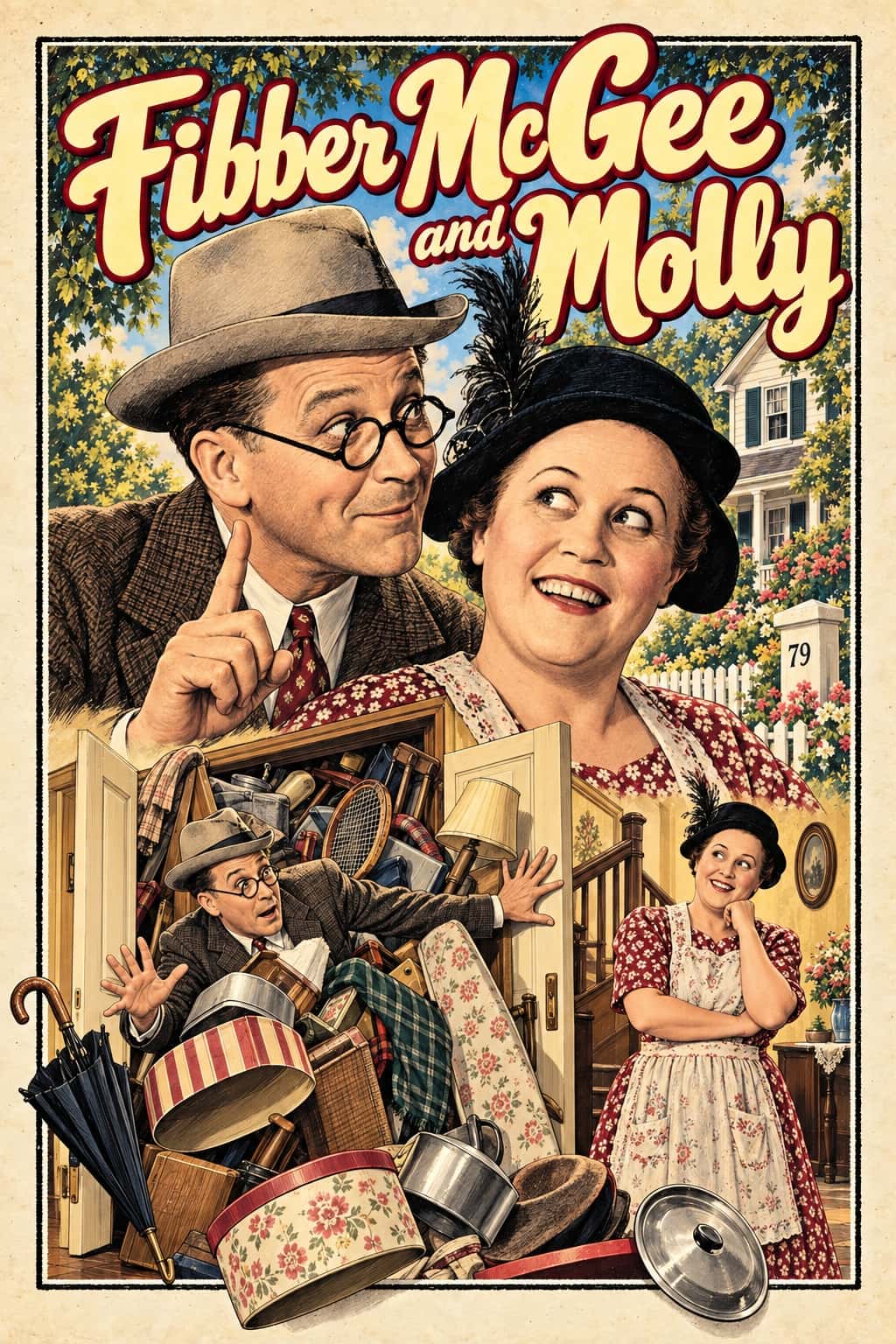
Omar Khayyam dashed off those immortal lines about how the moving finger writes. He must have seen the squire of 79 Wistful Vista poking away at the typewriter. Yes, the old firm has taken in a new member. It's now Hunt, Peck, and McGee, as we meet Fibber McGee and Molly.
Ah. Ah, let's see what I got. And so I say to all you listening in tonight that if all of us do our part, part of us won't have to do it all. Hey, Molly, how's that?
How's what, dearie? I didn't hear what you said.
Well, gee whiz, listen. Wait a minute. Where was it? Oh, yeah. And so I say to all you listening in tonight, if all of us do our part, part of us won't have to do it all. That's a kind of a cute way of saying it, don't you think?
Very tricky. But what's all this about listening in? I thought you were giving this speech at the Elks Club.
Oh. Well, the committee changed its mind. I'm going to give it over station WVIS.
What?
Yeah, they gave us 15 minutes tonight. We can reach more people that way, they say.
You mean you're going to talk on the radio? Heavenly days. Isn't that exciting? Aren't you nervous?
Nah, nothing to it. I was practicing all morning with an umbrella for a microphone and never had a quiver.
You know, they say when you get in front of a real microphone, though, it's pretty scary.
Nah, nah, not for me. What's Fadiman got that I haven't got?
More booze.
More booze, that's all. Now, look. Here's how I'm going to start my speech. Ladies and gentlemen, this is Fibber McGee speaking.
Now, wait a minute. Why do you have to tell them your name? Won't the announcer introduce you?
Yeah, but I'm not taking any chances, baby. That announcer they got over there now, so used to reading the Russian war news, he can't be trusted with a simple little name like McGee. I'd likely wind up as Fibber Onovich, McGee and Ravaprasakoff.
The Red Network, huh?
Besides, when I go on the air as a speaker, I want people to know, who's talking to them. You never know who might be listening in, and I ain't so tied up this fall that I couldn't handle a political campaign here and there.
For which side?
The one that offers the most dough. Politically, I have my own ideas, but financially, I'm nonpartisan.
Incidentally, what made them pick you as the speaker tonight? I thought Mr. Wellington was the one who always did the oratory.
Well, there's a funny thing about that. At the luncheon last week, Wellington was supposed to give a little speech, but when it come time, he just sat there. He sat there looking funny and licking his lips. So I leeched up and I gave a nice little speech. Entirely extraneous, of course.
No, you mean extemporaneous. But, uh, what was wrong with Mr. Wellington?
Well, it seems like somebody had poured a lot of salt in his coffee, and he couldn't even pronounce his own name for two hours.
Who on earth would do a dirty trick like that to poor Mr. Wellington?
Well, I guess I better finish this here. Now, let me see. Where's my notes? Oh, yeah. Ladies and gentlemen, the Red Cross needs your money. All right. This campaign is to raise $200 million. The Red Cross is the greatest symbol of practicing humanity in the world today. And when you give generously to it, you are helping people all over the world. Remember that it's as easy to give a dollar as it is to pass the buck. And when you...
Hello, Mrs. McGee.
Hello, Mr. McGee. What are you writing? A novel?
No. I'm writing a speech for the Red Cross campaign, Alice.
Himself? He's going to be on the radio, Alice. Maybe when the Red Cross hears him talk, they may want him to go all over the place.
All over the country.
Oh, I don't think it will be that bad, my dear. Creepers!
Hey, wait a minute. What do you mean, that bad?
She meant that good.
Oh. Imagine my very own husband talking to thousands of people on the air. I'm so thrilled.
Oh, shucks. It's nothing. Roosevelt does it all the time. Hey, you coming to the radio station with me tonight, Molly? Or are you going to hear it at home?
Oh, I want to come with you, dearie. I'm going to sit out in the audience and clap till I split my gloves. Why don't you come with me, Alice?
Oh, I'd love to, Mrs. McGee. But it's Tuesday night, and always on Tuesday nights I...
Oh, you got a date, eh? Can't let your bobby socks cool off long enough to go hear a speech for a great organization like the Red Cross, eh?
Well, I...
Do you realize, my girl, that between January and November of 1943, the Red Cross taxed over 5,300,000 food parcels?
Yes, but you see, Mr. McGee...
I can see that you've got no sense of responsibility for the war front.
Oh.
Alice, for the war effort. Here I am, typing my fingers to the bone, trying to do what I can, raising dough for a good cause, and what are you doing? Out dancing the Charleston.
Oh, the Charleston, McGee, is as dead as the minuet. Just because you stopped dancing when the two-step went out, don't get the idea that Arthur Murray tossed in his chips.
Gee, I remember my father talking about the Charleston, Mr. McGee, but I never...
The name of the dance ain't important, Alice. What I'm getting at is your flimsy reasons for not attending my speech tonight.
But, Mr. McGee, every Tuesday night I...
Has it got to be every Tuesday night? Won't he let you off one night?
Who?
Whoever your date is with.
But it's with the Red Cross. Every Tuesday night I roll bandages for four hours.
So can't he...
Oh. Well, why didn't you tell me?
Well, she was doing her best to, McGee, but you were acting like a lot of other people.
Huh?
You were so busy waving the flag, you couldn't see what was going on.
I was not waving the flag. I just thought Alice wasn't interested, that's all. So you roll bandages for the Red Cross, do you, Alice? Every Tuesday?
Yes, except Thursdays. On Sunday nights I dance with the servicemen at the canteen and help serve coffee and things. And on Saturday afternoon I take books to hospitals.
Can I help you type out your speech, Mr. McGee?
Oh, no.
Oh, thanks. I'm only making one carbon anyway, Alice. One copy for me and one for the sound effects man at the radio station.
Sound effects? Well, what sound effects do you need just to make a speech?
Oh, I ain't so dumb. I got some applause and cheers queued in at different places. Thanks for offering to help, Alice. And I'm practically through typing it anyway.
Well, that's why I thought you ought to know.
Know what?
He's got the carbon in upside down. His extra copy will be backwards on the back of his original.
Huh?
Well, good luck, Mr. McGee. I got...
Well, I'll be...
I have an interesting message for you tonight.
I've got one for you too, McGee.
You have?
Yes, you put the carbon in backwards again.
What?
Well, dead red for dead red.
Billy Mills and the orchestra. Billy Mills and the orchestra playing when they ask about you.
In conclusion, may I say that the Red Cross is the link between the serviceman and his family. So give generously to the Red Cross and this campaign for funds so we can give every possible serviceman every possible service. I thank you. Applause, cheers, and whistles. Hey, Molly, you can whistle through your teeth, can't you?
Yeah, but I only do it on special occasions like trying to catch a waiter's attention or something. Why?
Well, look, after I say I thank you, I want you to leap up and start yelling and clapping and whistling, see? Kind of start a big spontaneous demonstration.
Well, haven't they got a phonograph record of crowd cheering they could play?
Oh, no, that wouldn't be ethical. This has got to be spontaneous. Like you starting it and then maybe four or five guys I could hire at a buck apiece joining in, see?
I don't really think that you... Come in.
Oh, hello, Mr. Wellington.
Ah, good day, Mrs. McGee. It gives me great pleasure to see you. And, McGee, it gives me censored.
Hi, Wellington. Take off your coat and park your overstuffed frame on our ditto Davenport.
Yeah, I think you'll know. I was merely calling to ascertain whether or not you have or have not the speech or not, which you are, I think, to deliver, I'm sure, tonight, if possible, over WVIS, I am certain.
Yes, he has, Mr. Wellington, and it's a dandy if I ever heard one. Got it all type-wroten out, Wellington. It's the best talk I ever gave her. My name ain't Fibber McGee.
Really? May I have a copy of your address, old fellow?
Sure. 79 Wistful Vista.
No, he means... He means the speech, McGee.
Oh, oh, yeah. Sure. What you want it for, Wellington?
Why, the... The... The morning papers, old chap.
Oh.
For a cause of this scope and magnitude, the widest possible publicity is desirable. Thus, the public prints should have a copy for the morning editions, for that portion of the public which, unfortunately...
Mm-hmm.
...is unable to hear the broadcast.
Well, McGee never would have thought of giving copies to the newspapers, Mr. Wellington. He's so modest, you know.
Mm-hmm. Yes. Here you are, Wellington.
Yeah. Here, take this copy.
Thank you very much.
I was saving it for the sound effect guy at the studio, but he can read off mine.
The sound effect man, my dear fellow...
Hmm?
...this is a dignified appeal, appeal for funds, to carry on the great work of the Red Cross. It is not an Olsen and Johnson somethings-a-poppin'.
Well, uh, McGee just thought that...
Oh, never mind, Molly. And don't you worry your little six-and-five-eighths head about it, Ziggy old boy. I know what I'm doing. And it is a secret which will be kept down through the ages, I have no doubt.
Oh, yes, McGee, be at WBIS no later than 8.30.
Okay, and take good care of that manuscript, Zig. And don't show it to anybody.
Why, of course not. My, you certainly look nice today, Mr. Wellington. I wish McGee had paid more attention to his clothes.
Thank you.
Yeah, you're a regular bro-bumble, Wellington.
Mm-hmm. What's the idea of such a short cane?
I'm out for such a short walk. Good day.
I like Mr. Wellington. He's so clean-cut.
He would be if I could find my Boy Scout hatchet. Now, let me see. I'd better run over to the speech again. See, uh, did you put in that bit about how the Red Cross operates all those, uh, 350 service clubs and recreation centers for men and women overseas?
Yeah, I got that in. But to me, the most important thing was the fact that the Red Cross gets information about war prisoners wherever it's possible.
My gosh, that alone is enough to make you sit down and write them a big check.
Yeah. It really is. Incidentally, how much time did you say WVIS gave you?
Fifteen minutes. They told me I'd have about 12 minutes for my speech.
How many pages did you write?
Eighteen. But it's all single-spaced. It'll go pretty fast.
I see. How about music?
I didn't ask them. But if necessary, I'll sing myself on and off with a few bars of Pretty Red Wing or something. You know, I gotta get showmanship into this thing. I remember one time I was... Hello, Walter.
Hello there, Mr. Wilcox.
Hi, Junior. Hey, uh, what are you doing tonight? I'm making a speech for the Red Cross. A speech for the Red Cross campaign fund on the radio, and if you could...
Yes, yes, I know. I'm going to be at WVIS myself, so I'll see you there.
What are you doing at the radio station, Junior?
Oh, I do some spot announcements.
Some what?
Spot announcements. I tell how easy it is to wipe up spots.
Oh.
If the kitchen linoleum is protected and beautified with Johnson's self-polishing glow coat. And, uh, in my spare time, I've been working out some sound effects. I've got them right here in this box, all wired up.
Oh, my gosh, Junior. That's a pretty complicated-looking gadget.
Yeah. How does it work?
I'll show you. Look. Every time I need a certain sound effect, I press a certain button. See? I want a splash, I press the splash button. See?
Yeah, that's kind of hard to work into a conversation unless you're talking to a drip.
Well, I use it in my glow coat announcements, like this. I say, folks, give yourself a break. Stop knocking yourself out. Scrubbing your floor is the old-fashioned way. Use Johnson's self-polishing glow coat. And stop working like a . It'll give your tired, dull linoleum the best beauty treatment you ever saw. Try it today and give yourself time for recreation. Get your housework done so you can go out and kick the around. Remember, Johnson's self-polishing glow coat shines as it dries. Requires no rubbing, no buffing. Give your dealer a today. Well? What do you think of it?
Well, offhand, I'd say...
Yeah, me too. Get it off your hands as quick as possible.
You mean you don't like it?
Well, to be subtle, no.
Then I know I'm on the right track. See you tonight.
I think I heard that routine from KDKA in 1926, McGee.
Well, something's always new to somebody. We thought. I'll never forget the time. Hey, what time is it?
Well, you haven't got much time to get dressed and get down there, McGee. I'll never forget the time. Hey, what time is it?
Well, you haven't got much time to get dressed and get down there, McGee. I'll never forget the time. Hey, what time is it?
Well, something's always new to somebody. We thought. I'll never forget the time. Hey, what time is it?
Well, you haven't got much time to get dressed and get down there, McGee. I'll never forget the time. Hey, what time is it?
Well, you haven't got much time to get dressed and get down there, McGee. Are you taking a cab?
Well, you haven't got much time to get dressed and get down there, McGee. Are you taking a cab?
No, Doc Gamble said he'd pick us up. He'll find out from Wellington what time to be here. I'll run upstairs and take my cab.
All right. Ah, there goes a good kid. As excited over this speech as if he hadn't copied almost everything out of the Red Cross booklet. Maybe I'd better read it over for him. During the past two years, the disaster preparations of the Red Cross have been widened to include storage at strategic points of blood plasma, blankets, cots, and clothing for emergency use. We hope enemy action may never strike our own cities, but if it does, the Red Cross stands ready.
Come in.
Hello, Beulah.
Beulah. Good evening, ma'am. I just thought I'd stop by and see... Has you done something to do?
Why, no, Beulah. Everything's the same except the...
Well, everything's the same except that black streak on the wall there. Who do that?
Well, Mr. McGee did that. He started to strike a match on the back of his pants and missed. Struck it on the wall instead.
Oh. You see him do it, ma'am?
No. He told me about it.
Yes, ma'am. Don't you believe it?
No, ma'am. Why not?
I don't believe it. I don't believe it. I don't believe it. I don't believe it. I don't believe it. I don't believe it. Why not?
Because, ma'am, if Mr. McGee wanted to strike a match on the back of his own pants, it ain't a target a man could reasonably miss. You sure you ain't done something to this room, ma'am?
Oh, it's that easy chair. That's what it is.
What's the matter with it?
Mr. McGee ain't sitting in it.
Oh. Don't look. Look natural. That way it's tall. But the reason I stopped in, ma'am, is to ask you, how did the luncheon go last Friday, of which I helped you prepare and disperse?
Oh. Oh. Oh. Oh. Oh. Oh. Oh. Oh. Oh. Oh. Oh. Oh. Oh. Oh. Oh. Oh. Oh. Oh. Oh. Oh. Oh. Oh. Oh. Oh. Oh. Oh. Oh. Oh. Oh. Oh. Oh. Oh. Oh. Oh. Oh. Oh. Oh. Oh. Oh. Oh. Oh. Oh. Oh. Oh. All right.
What'd you say?
Never mind.
Oh, I thought you said all right.
I did.
What?
I did.
You did what?
I said all right.
Oh.
I just said all right.
Oh. Love that man. I need around here, ma'am, is somebody to take care of his clothes. And it better be me. You see, I arranged with Miss Toots to work over here every Tuesday after this, and you can expect me next week.
Oh, but, Beulah, I don't think we can...
I don't think you could either, ma'am. Get along without me.
Yeah, but how much...
Who cares how much work it is? I like you, Mr. McGee, and I'm moving in. Good night, ma'am.
Well, good night, Beulah, but I wish you'd wait till...
Till Tuesday, ma'am. That's what I thought, too. Good night.
Housekeeper. I didn't know we had a new housekeeper.
Neither did I. Wait for the broadcast. Hurry!
The Kingsmen sing The Kid with the Rip in His Pants. Johnny Jones was just a country lad Who tore his pair of trousers that he had And he climbed the apple tree Was then his richest company The country lay All of romance Tusky little shoulder Twice a week He's always taking a chance Men was in the brook Admired and thanked Jingle on the hook of the kid With a rip on whistling Groot with a rip in his pants Nine a little boy of six Would rip his pants And more would have to fix Forty-four and...
I wish Doc could get here. I go on the air inside a half an hour.
Well, at least you present a novel appearance theory.
What do you mean?
Well, most men start pacing the floor after the doctor gets there.
Gee whiz. What an important speech I... Hey! Hey! Where's my speech? I've lost my speech! I've lost my speech!
Did you have it upstairs when you dressed?
No, no, I don't think so. Or did I? No, I didn't. I don't think I... Anyway, oh, my gosh, I...
Oh, now, here's Dr. Gamble. Come in.
Hello, Doctor.
Hello, Molly. Hello, Pip. Well, what's your 50% common stock running around for, Molly?
He's lost his speech.
Lost his speech? Great Scott, and he's got to go on the air. Maybe I can fix it. Come here, McGee. Open your mouth. Ah. Oh, this looks bad.
Hmm?
No inflammation. No swelling. Must have strained at talking too much. When did this come on?
When did what come on?
Your loss of speech. The time elements are...
Say, what is this? You're talking, all right.
Why, of course he is, but he's got nothing to talk about. I've lost my speech.
Now, wait a minute. I distinctly heard you speak, McGee, and...
No, no, no, Doctor. His typewritten speech. He can't find it.
I've lost it. I've lost it. I've lost it.
Oh, stop singing a tisket a tasket. Your speech didn't run away. Now, calm down. Where would you put an important paper if you're going to need it immediately?
He'd keep it in his hand.
Yes, I'd keep... Oh. Here it is. In my hand.
Gosh, that's... That's great psychology, Doc.
Yes, I'm quite a mind reader. I'd read your mind, McGee, but the small type hurts my eyes. Well, are we ready?
Are we late, Doctor?
Oh, no. We've got lots of time. How'd the speech go, McGee?
Gonna knock him cold, Doc. Ought to raise a lot of dough for the Red Cross.
Are you going to mention the home service for servicemen's families and the 50,000 Red Cross nurses serving all over the country?
Yes.
And the 180 Red Cross service buildings already up are under construction?
I think he's covered all that, Doctor.
But how did you get all that information?
Well, as a doctor, I know pretty well what they're doing. And believe me, it's worth every dolly you can dig up for them. They're doing a tremendous job for every boy and girl in the service and for their families at home.
I know, Doc. And, oh, by the way, I got a great finish for my talk, too. I say, quote, so give generously to the Red Cross in this campaign for funds so we can give every possible serviceman every possible service. Thank you and good night. Applause, cheers, whistles.
That sounds very good.
Well, come on, folks. My car's right outside.
Come on, McGee. Now, don't be so nervous.
Who's nervous?
Oh, no one. But you're the only one here who's wearing an overshoe on his head and got his foot in his hat.
Huh? You ready, Molly?
Ready, Doctor.
Yeah. In Studio J, McGee, right down this corridor.
Okay, okay, okay. Ladies and gentlemen, my name is Red Cross. And I want to tell you about the Fibber... No, no, no. Ladies and gentlemen...
He's starting his speech by telling the audience that he doesn't have to tell them anything about the great work the Red Cross is doing, Doctor.
Splendid. Then what does he do?
Then he tells the audience what a great work the Red Cross is doing.
Oh. Well, my gosh, you've got to give them the main points of the thing. You've got to put...
Hold it, McGee. Now, hold it. Here's Studio J. It's worn in.
What are we waiting for? Look at the sign, dear. It says, On the air. Keep out.
Who?
Just finishing. Just finishing the program that precedes you, McGee.
Oh, I see. Now, come on in here and we'll listen to that.
Okay. And so, ladies and gentlemen, in conclusion, may I say that the Red Cross is the link between the serviceman and his family back home.
Why, that's Mr. Wellington.
Hey, he's giving my speech.
How do you know it's your speech?
Listen. So give generously to the Red Cross in this campaign for funds so we can give every possible serviceman every possible service. I thank you. Good night. Applause, cheers, and whist...
What is this?
I don't know.
Oh, dear, oh, dear. So, so that's why he told me what time to bring you over here, is it? That dirty double-crosser.
Dirty double-crosser. He said he wanted a copy of my speech for the newspapers.
Speech for the newspapers. I'll kill him.
No, don't kill him. I'll beat the big junior up.
You know the expression fair weather friend, meaning the kind of person who stands by you while the sun is shining but disappears when you run into trouble? Well, you know, some products are like that. They look good, but they just can't take the punishment. They break down just when you need the most. Well, I can assure you that Johnson's glow coat is certainly not in that class. As you discover for yourself when the weather turns bad and your linoleum floors get all tracked up with wet and snow and outside dirt, how quickly and easily you can wipe up all that dirt with a damp cloth in a jiffy. That's because the film of glow coat acts as a protective shield, saving the surface underneath. And because you don't have to scrub linoleum floors anymore, you can save yourself hours of work, and you make your linoleum last six to ten times longer. Johnson's self-polishing glow coat needs no rubbing or buffing. You simply apply and let dry. It's one way you can practice conservation in your own home.
Ladies and gentlemen, the goal of the 1944 Red Cross War Fund is 200 million dollars. It's important that they get it. Important not only to us, our families, and our country, but for the comfort and well-being of all our men and women in service. Remember, the Red Cross is not a government agency. It is dependent on you and me for support. So let's see that they get it. Send your check or donation to the Red Cross in your community tomorrow morning. Wear the Red Cross on your lapel. It will show where your heart is. Good night.
Good night, all.
The character of Mr. Wellington heard on this program was played by Ransom Sherman. This is Harlow Wilcox speaking for the makers of Johnson's Wax for Home and Industry, inviting you to be with us again next Tuesday night. Good night. This is the National Broadcasting Company.