
The written record
Read the transcript
Read along with the recording · About 13 min to read
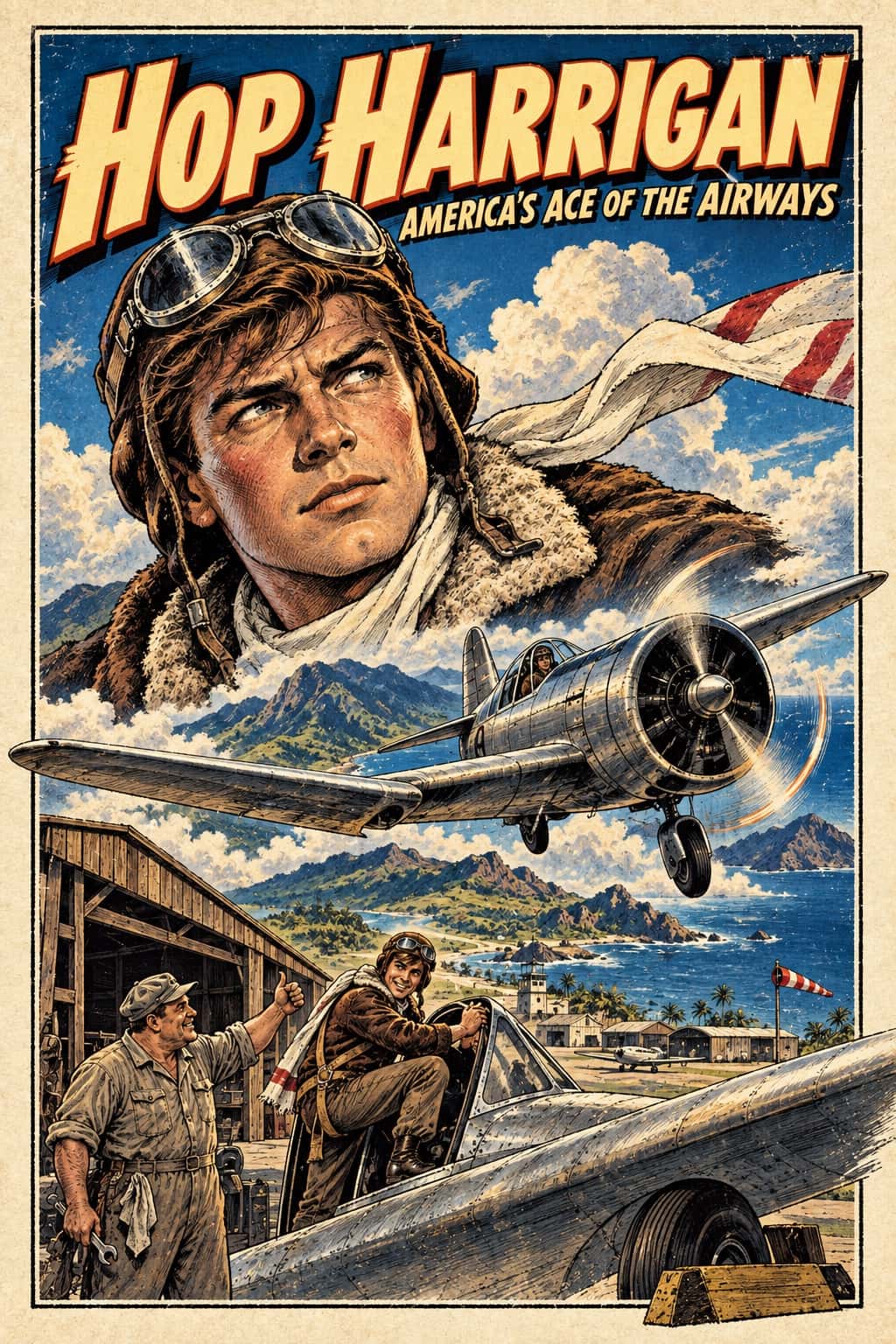
Presenting Hop Harrigan, America's Ace of the Airways! CX-4 calling Control Tower, CX-4 calling Control Tower, standing by. We're back to cell B-1200, all clear. Okay, this is Hop Harrigan, coming in. Yes, it's America's Ace of the Airways! Coming in for another transcribed episode in the adventures of Hop Aragon. Say, gang, one of the least publicized branches of aviation, yet one that played an important role in the war, is the Civil Air Patrol. This is an organization of private flyers who have their own planes, men who give their own time and risk their lives sometimes in voluntary missions for the Air Force. The CAP still carries on despite the war's end, and they're doing mighty important work.
The history of the Civil Air Patrol goes back to 1941, just seven days before Pearl Harbor, when the CAP came into being as a part of our system of civilian defense. What was intended to be only a wartime group now has become a full-fledged auxiliary of the Department of the Air Force and has just observed its sixth birthday. Recently, I was able to get hold of the complete story of the CAP, its history, organization, and purpose. What I read convinced me that the CAP is doing great work. not only for the Air Force, but for young fellas and girls interested in aviation. I know many of you are interested in aviation and want to know more about it. Well, the CAP recognizes that many young people today have that interest, and they're helping out, giving Civil Air Patrol cadets realistic courses in aeronautics, mechanics, and many other air subjects. This work is so important to the aviation future of America that I'm going to take the next few days to tell you the great story of the CAP. I know you'll listen closely as the story of the CAP unfolds.
In just a few minutes, gang, I'll be back to begin the history, so don't forget to listen. And now to our story. As a mysterious organization symbolized by a jagged streak of lightning slowly and relentlessly gains control of private flying in the United States by acts of terror and blackmail, Pop and Tank find themselves fighting a losing battle. Through no fault of their own, they face a complaint of reckless flying. and are under suspicion of murder charges that will not be dismissed unless the boys give in and sign with the organization. Now, it is early morning. We find Hop and Tank in their airport office with Gail Nolan, checking over a list of airports in a radius of 500 miles from Lakeville, trying to figure out a way of fighting back against the overwhelming power of the organization. As he scans the list, Tank shakes his head. Out of 25 airports, 20 are already signed up with the organization.
What chance have we got? And in the remaining five, three plan to join, and the other two haven't been approached yet. Yeah, but they're small potatoes, just a couple of landing strips. Hey, let me see that list again, Tank. Sure, but it ain't good reading. Thanks. Hey, Gail, you've crossed off three fields. Are they included in 25? No. Then why'd they cross down? No longer in business. Huh? The Ashton Field, Waynesburg Field, Clark Field. Hey, why should Clark fold up? They're doing pretty well. I don't know. When I called them, they just said they were no longer in operation. So Ed Blake ran Clark Field, didn't he, Tank? Yeah. He was doing a good job, too. Ed isn't the kind of fellow to take this organization and stop lying down. I wonder... See if you can get hold of him, will you, Gail? All right. What's the number of the field again? Ellington 249. Thanks. Ellington 249, please, operator. I'm just wondering if Blake closed the field rather than joined the organization. Hey, it could be. Hello? Is Mr. Blake there?
Oh, well, could you tell me how I can reach him? Thank you. They're getting his home number. Well, who's at the field now? You said it was closed down. He probably left a watchman there. Hello? Yes, go ahead. Ellington 683. Thank you very much. I have his home phone. Should I call him there? Please. Hello, operator. Give me Ellington 683, please. Then let me talk to him, Gail. Right. Well, look, Hop, supposing Blake did fall on account of the organization, you won't be no help to us now, will you? Why not? He's out of business, ain't he? The organization licked him. He was flying alone the way we are now, but if we can join forces... Yeah, we wanted to do that with Harry Charles, and look what happened. Oh, just a moment. Here you are, Hop. Oh, thanks. Hello, Ed. Liz. Hop Harrigan. I'm not too good right now. Listen, I understand you've closed your field. Yeah. Mind if I ask why? Especially since you'll probably be doing this... Maybe not. Then you know... I certainly do. Well, if you don't mind my saying so, Ed, you really did knuckle under.
What? No offense meant, but by closing your field, you just backed out of the fight. There wasn't anything else I could do. Okay, then. How about joining me? Not a bit. If we could organize ourselves, we might have a pretty good chance. Not against them, Harrigan. Look, Ed, you flew a B-17 out of Clark Field in the Philippines when the Japs made their first sneak attack, didn't you? That's why you called your own airport Clark Field. Well, the way I heard it, you kept your ship flying with glue and bailing wire until you were almost the last ship in the Philippines. And then you carried on from Australia. Look, Harrigan, you don't have to tell me what I did. Now, don't get sore, Ed. I'm just trying to point out that you were fighting an organization then, an organization called Japan. Well, Ed. Now, look, can you run up here sometime today? Yeah, how about this afternoon? Fine. And listen, do you know the fellas who operated Ashton and Waynesburg? Uh-huh. They pulled it for the same reason. Can you get hold of them and bring them with you? Why not? Okay, then. Maybe between the four of us, we can put up a real scrap. Four against that mob? I'm not an optimist, Harrigan, but I'll play along. Good. See you this afternoon, then.
Well, you look like the cat that swallowed the cannery. Canary tank. That's what I said. What gives, Hop? Blake is coming up, and he's bringing the operators of Ashton and Waynesburg. So what does that prove? Nothing yet, but who knows? This may be the start of something. When are they coming? This afternoon. Hey, ain't you forgetting the big boss? Brown said he'd bring him over sometime today. But he didn't say when, Ted. And what if the boss does show up when Blake and the others are here? Won't make him like us any better. I don't think I'd worry too much about his liking us, Tank. Uh-oh, maybe that's him now. You want me to answer it, Hop? Please. Lakeville Airport. Is that him? Quiet, Tank. Oh, yes, Mr. Jenkins. Oh. When? How big a load? Just a moment, please. Hop? Yes? Mr. Jenkins wants you to fly a load of eggs to New City for him. They have to be there by 2 o'clock this afternoon. Oh, tell him we're busy. Now, Tank.
Tell him we'll pick them up in about 45 minutes. But, Hop, this ain't no time to be ferrying cargo. It's our business, isn't it, Tank? We can't stop operations. Go on, dear. Right. Hello, Mr. Jenkins. Hop will be there in 45 minutes. And tell him to build a bonfire out in his pasture so we can judge the wind drift. And, Mr. Jenkins, build a fire in your pasture. Just a small one. Now, don't worry. He'll get the eggs to New City safely. Bye. He'll be ready to load as soon as you get there, Hop. Right. Let's go, Tank. But what about that meeting with Blake and the other guys? We'll be back in plenty of time. If you're not, they'll wait.
Go on now, boys. See you later, Gil. With Tank lumbering along behind him, Hop leads the way out of the office to the hangar, where, after refueling the Beechcraft, they take off and head for the Jenkins Dairy Farm, a short 20-mile jump to the east. But as they roar through the clear, bright morning sky, Tank quickly spots a now all-too-familiar escort. Now, lad, don't that guy ever give up. What is it, Tank? Look, what the starboard and back. It's Stinson again. I asked. Tender one, that kid Dudley is flying her. What do you think he's doing following us all the time? You've got me. This time he seems to be keeping his distance. Guess we taught him a thing or two. He won't come stunting around us again. Hey, there's Jenkins' farm. Stand by for a landing. Does he have that fire going? No, wind is from the south. I'll cut around. Give me wheels and flaps. Wheels down. Flaps down. Where's Stinson? Holding off. About a quarter of a mile to the west. He ain't going to bother us none this trip. Okay, stand by. Going in.
But even as Hop lowers the nose of the Beechcraft and prepares for a landing on the broad pasture of the dairy farm, George Dudley, flying the Stinson and watching the activity on the farm through a pair of binoculars, puts through a strange call over his radio transmitter. Hello, Lightning Base from Dudley. Lightning Base from Dudley. Arrigan and Tinker landing on farm 20 miles east of Lakeville Airport. Apparently going to run a cargo trip. Suggest bringing out the special and doing a job on them. I'll call you again as soon as he's airborne and give you his course. That is all. What is the meaning of this strange report, and what is the special? We'll know in a moment, gang, so stand by. You know, gang, the Civil Air Patrol had its beginning on the 1st of December, 1941, just before we were plunged into war by the Japanese attack on Pearl Harbor. It was intended to act as a part of the civilian defense program.
But its work became so closely tied in with the war that it soon became a vital part of the Air Force. Well, now the CAP has become a full-fledged auxiliary of the Department of the Air Force. During the war, the CAP ran up an impressive record for a civilian group. And that's all they really were then. Members gave their own time and many times risked their lives on important missions. Members of the Coastal Patrol spotted 173 enemy subs and attacked 57. Its aerial patrols found 17 floating mines in our sea lanes and perhaps averted a few tragic sinkings, which might have hurt the war effort. On their various missions, these aerial patrols flew a total of about 90,000 hours. These included search missions, towing gunnery targets, and courier trips. Now, in peacetime, the goal of the CAP is 100,000 trained ground and flight personnel who would be qualified for commercial or military aviation in time of an emergency.
Incidentally, one direct result of the CAP these past six years has been the increase in the number of flyers in the United States. According to Mr. T.P. Wright, Civil Aeronautics Administrator, pilot licenses are now at an all-time high. The total is over 450,000, at the same time the number of planes and airports has shot up. The CAP knows how much this country needs flyers and technicians for the future, and they're looking to you young people to provide the raw materials. So always remember, gang, America needs flyers. And now back to our story. Picking up a cargo of eggs from the Jenkins dairy farm, Pop and Tank are flying a routine cargo flight to New City. But the Stinson piloted by George Dudley continues to follow like a menacing shadow. And Tank squirms in his seat uncomfortably.
I wish I knew what that young punk is up to. Well, he isn't bothering us any time, so forget it. He ain't bothering us now, but maybe he's got another cute chick up his sleeve. If he does, we'll handle it, just like we've handled all the others. Yeah, but he's been on our tail for over a half hour now. He's sitting there like a vulture. Oh, forget it, William. Uh-oh. What now? He's venturing up to us, putting on steam. I suppose that makes you happy now? Open up, Pop. Pull away from him. No, let's see what he does first. He's less than a quarter of a mile away. He's really piling on the cold. I'd like to get a look at that ship sometime. Must be souped up something fierce. Jumping jetty. Somebody's shooting at us. Hank, look. That's T-38. My gosh, where'd it come from? I don't know. I was so busy watching the stints and I didn't see it. Hey, it's cutting around sharp. Making another run at us. Look, the insignia on the fuselage. The streak of light. It's them. Hey, clear out. Pull away. Hey, he isn't shooting straight at us. He's aiming in front of us. The idea. Hello, Harrigan. Hey, come and call us over the radio.
What's going on, Dudley? Never mind what's going on. There's an open field off to your left. Turn in and land. What? Nothing's doing, Dudley. I said land, pal, or I'll have that P-38 chop your wings off. Pop, don't do it. Come on, Harrigan. Turn or you'll go down in pieces. As Dudley's voice crackles grimly through his headset, Pop hesitates momentarily, but then, seeing the P-38 roar in, its nose guns black and threatening, and the Stinson following, he gives up and turns the Beechcraft in a sharp bank. heading for the indicated field. What are Dudley and the organization up to now? What will happen? You'll find out in our next action-packed episode, gang, so don't fail to listen. Tune in and fly with Hop Aragon, America's ace of the airwaves. So long, Hop. We'll be seeing you same time, same mutual station.
Pop Harrigan is a transcribed, copyrighted feature appearing in all American comics, magazines.