
The written record
Read the transcript
Read along with the recording · About 13 min to read
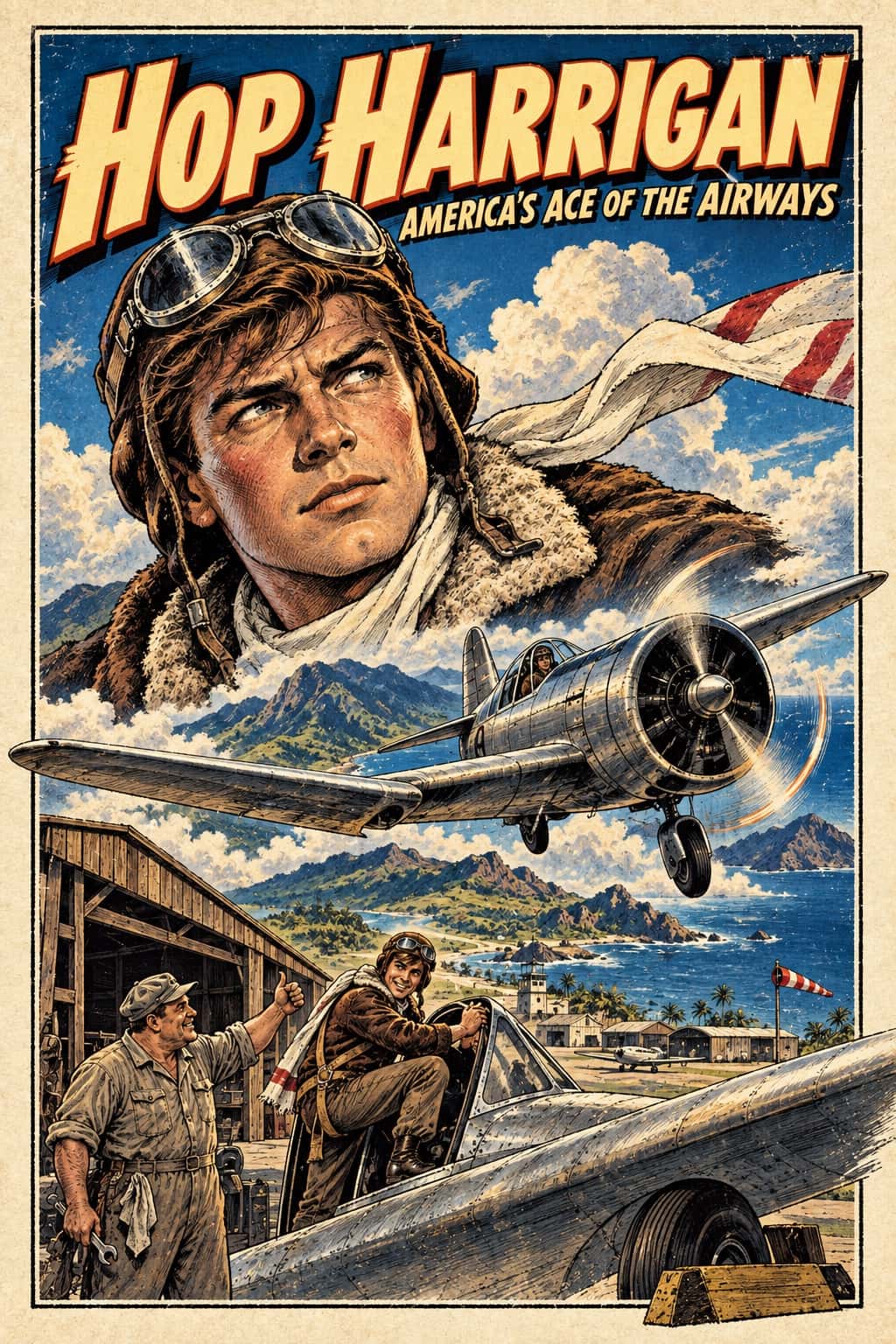
Presenting Huff Harrigan, America's Ace of the Airways. CX-4 calling Control Tower. CX-4 calling Control Tower. Standing by. Control Tower, back to CX-4. Okay, this is Huff Harrigan coming in. Yes, it's America's Ace of the Airways. Coming in for another transcribed episode in the adventures of Huff Harrigan.
Say, gang, here's the second in our series on the Civil Air Patrol, its great job during the war and its plans in the years ahead. First of all, a large majority of the officers of the CAP are civilian volunteers. There are a few exceptions to this, mainly the personnel at national headquarters at Washington's bowling field. The national commander is appointed by the commanding general of the Air Force. Under him works a staff of Air Force officers and civilian employees. At each of the state wing headquarters, there's a liaison officer coordinating the work of the wing with others in the nation. That, in short, is the organizational setup of the CAP. Now, right from the beginning, the patrol was called upon to send airplanes and pilots on military missions. It was set up and went into action almost overnight. Early in 1942, when German submarines were attacking American vessels within sight of our shores and were cutting the vital supply lines to our troops, The Army and Navy were not able to fight back as powerfully as they had hoped. There just weren't enough planes and ships to guard the coastal waters. To meet the powerful attack of the subs, CAP volunteers organized three experimental bases with their own planes and equipment. They were unarmed except for radios, and any time they spotted a sub, the word was immediately flashed back for a bomber to come in for the kill.
Many times the U-boats crash-dived as soon as they sighted CAP planes, and many convoys were saved from attack. More later, gang, so don't forget to listen. And now to our story. Overwhelmed by the attacks of the powerful Lightning Organization, which, by blackmail and terrorism, is trying to gain control of private flying in the United States, Huff and Tank have taken the first steps in a campaign to fight back. They have called a meeting of three other airport operators who closed down their fields rather than join the organization, hoping that a common united front will destroy the insidious racket. But now the boys find themselves under attack again. En route to New City in their Beechcraft on a routine cargo run, they have been intercepted by a reconverted Army P-38, heavily armed, its pilot flying under orders of George Dudley, following in a stinson. The P-38 roared down the Beechcraft, firing a burst of machine gun fire not ten yards in front of the streamlined biplane. And by radio...
George Dudley snapped out a strange roll. That's all, Harrigan. Your fight ends right here. Turn your ship and line up field to your left. The P-38 will chop your wings off. Immediately realizing the futility of even trying to fight back against such overwhelming odds, Hop complied with Dudley's command and headed in for a landing on the designated field. Dudley followed close behind, parking his Stinson at the wingtip of the Beechcraft, and as the P-38 circled overhead like a menacing vulture, stepped out and sauntered arrogantly over the hop and tank. That's it, boys. Just stand where you are and nobody will get hurt. And a cocky little pipsqueak will tear them apart. Easy, Tank. Okay, Dudley, what's the idea? Well, since you don't belong to the organization yet, we figure you don't have any right to carry cargo, Harrigan. We don't have any right. You heard me, Tinker. So I'm taking over from here. Meaning what? I'm taking that stuff in the new city for you. Listen, punk, you'll take them eggs over our dead bodies.
If I have to, Tinker, I will. You're wasting my time. Get to work. Start unloading that stuff for that P-38. I'll chop that old crate of yours into kindling and make an omelet out of that cargo. I don't think old man Jenkins would thank you for that. Seems to me he needs the dough for those eggs. You've got it all figured out, haven't you, Dudley? Right down to a capital T. So how about it? You gonna cooperate? Nah, don't do it, Hop. Okay, Dudley, you win. Oh, Hop! It was only us, Tinker, all right, but we've got to think of Mr. Jenkins. Sure you do. Okay now, boys, if you don't mind, get to work. A mocking smile on his sallow face, Dudley gestures with his gun, and Hop and Tank begin the task of transferring the cargo from their beach craft to the Stinson. In 15 minutes, the job is finished, and Dudley leaps into his ship. As he starts the engine, he calls out, Thanks a lot, boys. You did a great job. If you'd like to work as porters sometime, let me know.
I'll give you a recommendation. Stay where you are, Tank. Now, I'm sorry to have to do this, but you'd better stick around a while. He's lifting his gun. He's going to shoot. The rat! Tank, he isn't shooting at us. What? No, he's aiming to the left. Great Scott, our engine. So long, boys. Hope you're aware of your walking shoes. Come on, Tank. You sure he shot into our power plant? Yeah, I see the whole three of them. He must have missed with one. Oh, murder. Give me a hand with a colic. Right. Hey, what about the P-38? Where is it? I'm following the stinson. We don't have to worry about them anymore. Lift her off the chair. How does it look? Much damage? Enough to keep us sitting here for a while. What do you mean a while? Can't you fix it? Yeah, but it'll take me at least an hour. Stand back and give me elbow room. Me and my little pal, I got work to do. Reaching into his back pocket, Tank fishes out his ever-present screwdriver, and as Hop is forced to stand idly by, ducks under the engine housing and begins repairing the damage.
An hour and a quarter passes before he finally straightens up, wipes his forehead with grease-smeared hands, and announces... Okay, Hop, that does it. You turn over now, or I'll start selling magazines. Good. Pile in, then. We've got to get back to Lakeville fast. Replacing the engine cowling quickly, the boys leap into the Beechcraft, and Hop energizes the starter. After an anxious second when there is no response, the engine roars into life. The tank settles back in his seat, a satisfied smile creasing his oil-stained face. Twenty-five minutes later, they circle the Lakeville Airport, preparatory to a landing. Hey, look at all them ships down there. Yes. Fairchild, 24, twin-engine Cessna, and Navion. Where did all the company come from? Must be Ed Blake and the other airport operators. Huh? Don't you remember? We called a meeting with them this afternoon. Oh, gosh, yeah. Then we're late. Give me wheels and flaps. We're going in. Cutting his landing pattern short, Hopp sideslips into the runway and taxis to the small airport office.
In a matter of moments, he and Tank are being introduced to the two unfamiliar airport operators by Ed Blake. This is Shorty Candler and Frank Bullen. Glad to know you, Shorty. Frank, fellas. Hi. Will Harrigan. We're here. Glad you made it, Ed. And sorry we're late. Yeah, we had a run-in with them punks in the organization again. Oh, what happened? They hijacked the cargo out of our ship. That sounds familiar, doesn't it, Frank? Yeah, still have the old tricks. Why not? They work. That's what drove us out. Yeah, but they're not going to drive us out. Wait a minute, Tinker. We didn't just throw in the towel. That's what you're getting at. Oh, no, fellas. You'll have to excuse Ed. He's kind of touchy on the subject. Oh, sure. Well, how about it, Harry? What's your idea?
Well, frankly, I don't have anything concrete just yet. I wanted to get together with you fellas, find out what you knew, and maybe by, well, pooling our brains and our abilities, we could come up with something. Well, if the organization's been hitting you as hard as it hits us, you know what as much as we do. Don't any of you know who the boss is? No, I never saw him. How about you, Shorty? No, I don't know. Me neither. Well, we'll find out soon enough. That's a cinch. He's coming here. Here? Yes, I told Brown I wouldn't deal with anyone else. Who's Brown? The man who's been contacting us. Works with a partner, Luigi.
Luigi? You mean the big guy that looks like an overgrown gorilla? Yeah, that's him. Well, Brown is bringing the boss here for a showdown, so we'll know the score there pretty soon. Now, do any of you fellas know where the organization is based? As far as I know, they operate everywhere. Sure, most of the private fields in the country are signed up. Out of fear, yes. But they couldn't be trusted with the dirty work. He keeps that Stinson and that P-38 someplace special. I'll bet he does. Is there nothing of the other ships he probably uses? I wouldn't know where his field is. Hey, speaking of planes, you expecting somebody else at this powwow?
No, only the three of you. There's a ship just heading down your runway, a C-47. Yeah, Hop, look. I've never seen it before. I wonder... Oh, for Jetties. What is it, Tigger? Look, there in the fuselage, just behind the door. A streak of lightning breaks gun. Then it's... it's the big boss himself. Gripping the edge of the windowsill until his knuckles show white, Hop stares at the slowly taxing transport as it nears the small office. In a moment, he will know who the big boss of the organization is. We all will, gang, so stand by. Now, gang, let's get back to the story of the Civil Air Patrol. Early in the war, after experimental anti-submarine bases, the CAP set up 21 permanent bases to cover the entire Atlantic and Gulf coasts from Maine to Mexico. Bombs and depth charges were attached to the light civilian planes, and they were in constant radio touch with their bases. Often, these single-engine planes went out as far as 100 miles over the sea in winter weather.
or over high waves, when the failure of an engine meant almost certain death. In this service, 26 CAP men were lost. But against those fatalities, hundreds of survivors of ship sinkings and dozens of Army and Navy airmen forced down at sea were rescued when spotted by CAP observers. Aircraft of the Coastal Patrol were flown more than 24 million miles over water, spotting and attacking many subs. From other bases inland, the CAP flew missions along the Rio Grande, to look for illegal crossings of the border in either direction. They flew so low they could read auto license numbers. In every phase of its military flying, the CAP lost more than 50 men and 150 aircraft. These men, mostly volunteers, gave their lives in the line of duty just as much as any soldier or sailor. Now, Civil Air Patrol ground parties and airplanes may be called into action upon request of the Air Force.
These missions are given the CAP when military airplanes are lost over mountainous, desert, or woody country. Gang the Civil Air Patrol knows how much we need men and women to man the planes of tomorrow. Always remember, America needs flyers. And now, back to our story. The meeting between Hop, Tank, and the three former airport owners to discover a way of fighting back against the Lightning Organization has suddenly been interrupted. by the arrival of a twin-engine C-47 transport at the Lakeville airport. And as the plane taxis up to the small office building, the boys can clearly see the jagged streak of lightning emblazoned on the fuselage. The boss of the organization has arrived. The three airport owners wait anxiously as Hop and Tank watch two familiar figures step out of the plane. That's Brown. Yeah, and that's Loogie behind him. Couldn't miss him. But where's the boss?
There, I must be him. Just climbing out now. His coat collar's turned up. I can't see his face. Awful fat, ain't he? Hey, I've seen him before. You recognize him, Harrigan? I'm sure I know him. If I could only get a look at his face. You will in two seconds. They're almost at the door. Hey, maybe we better beat it. Hide in that back room there. No, no, stay put, Shorty. We'll stick with Harrigan on this deal. Thanks, fellas. Get set. They're at the door. Afternoon, Brown. Hello, Harrigan. Quite a party. What do you got here? Hello, Brown. Ed Blake. Well, well. And Shorty Candler and Frank Bowen. What's the matter, fellas? Coming around to see Harrigan for John? How about getting out of the doorway, Brown, and letting your friend in? Yeah, we'd like to meet him. I bet you would. Lugey. Yeah? Come on in and keep these guys covered. Sure. Take my advice, fellas, and don't try anything. Lugey's very quick on the trigger. Don't worry, Brown. Just taking some necessary precautions.
Okay, boss, come on in. You've got a welcoming committee waiting for you. Yeah, indeed. Hop, that voice. Of course, now I know. Good afternoon, gentlemen. It's a pleasure to see you here. And an exceedingly great pleasure to renew your acquaintance, Mr. Hannigan. That's different. Sea snakes. Tobias Finley. Yes, yes, my friend Tinker. It's been a long time since our last encounter. One in which, I must admit, you emerged victorious. The results of our meeting this afternoon will be quite different. I might say, most exceedingly different. Throwing his head back, Tobias Finley laughs uproariously as Hop and Tank stare at him amazed. So this is the mysterious boss of the Lightning Organization. Tobias Finley, their old enemy, with whom they had fought on many an occasion.
and the last person in the world they expected to see. Well, gang, this looks like the showdown. Who will win? You won't want to miss our next exciting episode, so tune in and fly with Bob Farraghan, America's ace of the airwaves. Go on, Bob. We'll be seeing you same time, same mutual station. Bob Farraghan is a transcribed, copyrighted feature appearing in all American comics magazines.