
The written record
Read the transcript
Read along with the recording · About 21 min to read
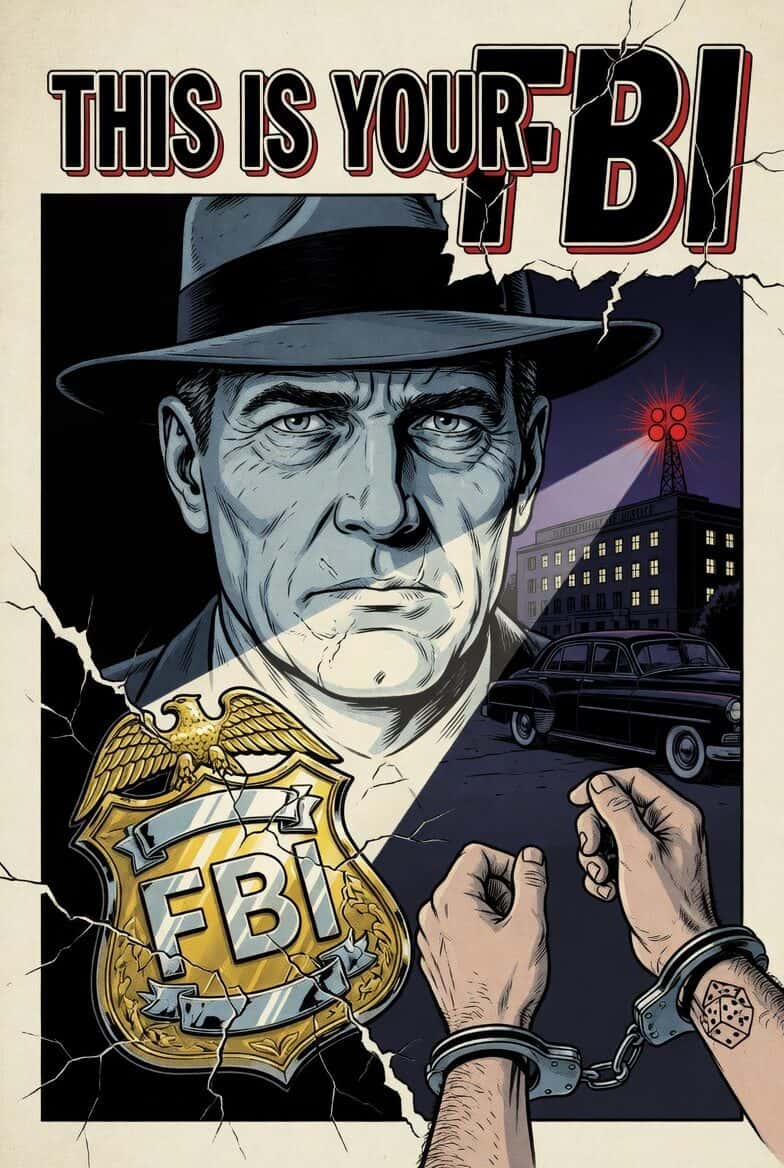
This is your FBI. This is your FBI, an official broadcast from the files of the Federal Bureau of Investigation, presented as a public service by the Equitable Life Assurance Society of the United States. To your FBI, you look for national security, and to the Equitable Society for financial security. These two great institutions are dedicated to the protection of you, your home, And your country. Tonight, the story of a crime against the community. Bank robbery. A man walks into a bank, calls up a teller, and walks out a few minutes later with thousands of dollars. How was he finally caught? How was he traced? What is the clue to his identity? The answer seems easy. A teller could describe him, that's true. But until 1934, there were about 600 bank robberies every year. Most of them successful.
Last year, there were 37, most of them unsuccessful. What brought about the change? The explanation that in 1934, Congress gave the FBI jurisdiction over certain banks is not enough. The main clue to work on is still the same, the robber's description. The real explanation lies in the FBI itself, in its organization, in its coverage, in its methods of following up a description, of tracing bank robbers, of hunting down, for example. The two men who began plotting a bank robbery in a small rooming house in a Midwestern city a few months ago. Hi, Artie. Oh, hi, Phil. What time is it? Two o'clock. Was I sleeping that long? Yep. Who were you riding with? Nora. Oh. Tell her I'd hit Cincinnati around the 20th. Uh-huh. That'll be the blow-off for us then, kid. You're gonna marry her, huh? Yep. Then what? Then I lay off for a couple of years. That's what's weird. So I want it. We're gonna take her.
Got a spot all picked out, kid. Up in Minnesota. Nothing to do all day but fish and hunt. Yeah, yeah. Cigarette. On the table. She know about you and larceny? Nope. And she ain't gonna. What's in this box? Look out for that. Huh? Handle it real easy. Load it with dynamite. Real dynamite? Yep. I've been working on it all morning. What for? It's Betsy's. What? She's gonna go with us on the bank job tomorrow. I don't get it. You figuring on blowing that joint up? Nope. He just makes the job easy. Look, Artie. Let me give you the setup. We take Betsy into the bank with us. Uh-huh. I hand one of the tellers a note. Yeah? The note says if he don't hand over all his cash, Betsy will go off in his kisses. And you go with it? No, no. He ain't that brave. He hands over the cash. Look, what's the matter with using a gun? That's for kids. This makes it a nice...
quiet, clean operation. Oh, wait a minute. I ain't gonna... Phil, that's how we're gonna do it, see? Marty. Yeah? Special accounts window is free now. We can still do it the other way. Just stand by, kid. This'll be essential. Help you, mister? No, thanks. Okay. Good afternoon, sir. Good afternoon. Are you making a withdrawal? Yeah. Well, may I have your passport, please? I don't think you'll need it. I beg your pardon? Just read this note. What? Read it. If this is some sort of a joke... It's no joke, mister. Don't try any funny stuff. I wasn't going to. Betsy here wouldn't like it. She could go off real easy. Well? How much do you want? Everything you've got. Singles, too? Everything. Use that money bag, then. Yes, sir. Hurry up. That thing won't go off by itself, will it? It might. Just keep on moving. Yes, sir. Don't forget them 20s.
I was just putting them in. There, that's all the currency. You want the silver, too? No, just give me the bank. Yes, sir. Remember what the note said about not giving any allowance. I know. You better let me have that note. Oh, of course. Here. Thanks. So long, Tim. What is the next step in the holdup of a bank? What do the criminals do next? In this case, they stopped a taxi, drove to the downtown section of the city, and rushed into a busy, crowded department store. That took 15 minutes. Long enough for the bank to notify the local police and the FBI. Long enough for the teller to give a description of the robber. Long enough for both robbers to have disappeared before the FBI and the police could throw a cordon around the department store. 15 minutes and the trail was cold except for a description of the man. But for the agents of the FBI, that was a beginning. That was a lead. That was a clue which would lead to other clues sooner or later. Is he Jim? No. Come in, Ray. Thanks.
Any further developments? No. No trace of either one of them. Well, they probably went in one door of that department store, not another. Yes. Did you get a description of that second man? Not a very good one. The teller gave us a detailed picture of the first one, though. The one with the dynamite? Yes. Was it given to the police? Yes. They're sending out a general alarm. Good. Fowler speaking. Oh, yes, Sergeant. Yes. Yes, go ahead. Want to take this down, Ray? Sure. Black Chevrolet sedan, four-door, two-door. Got it. 1940 model, Illinois license plate Y235. Y235. Stolen from employee's parking lot. Where? Behind the federal building. Thanks, Sergeant. We'll put that on the teletype right away. That might be the getaway car, Ray. The federal building is in the same block as that department store. Yes. Well, it sounds like we've got work to do.
Now there are two descriptions. The description of a man and the description of a car. Now there is more to work on. Now the trail picks up again. But what of the bank robbers? If they have planned this crime well, they know that the stolen car will be reported, will be watched for, will lead to their capture. What do they do? They keep off the main highways, keep clear of the state road, keep driving swiftly along lonely, unused back roads. Artie? Yeah? Do me a favor, huh? What? Get rid of that box, will you? Betsy? Yeah. What for? Well, you done what you wanted with it. I know. I just feel better having her around. What's the matter? I don't know. Great. Take it easy. No dice, huh? No gas. Look at the needle. Empty. Now, don't get excited, Phil. This is no problem. One car goes dead on you, so you pick up another one. Where? What's wrong with that one up ahead there? It's coming around the bend. Hey. Come on. Hop out quick.
What do we do? Flag him down. I mean, how do we grab the car? Just tell him we want it, that's all. Look, you're not gonna use that Betsy routine. Why not? It takes too long. I've got a better idea. Well, put that gun away, will you? Give him a wave. I'll go get Betsy. All right, flag him down, will you? Okay. What's the matter? Our car ain't running. Oh. Looks like we gotta borrow yours. Huh? Pile out, mister. Oh, no. I told you to wait till I got Betsy. We got the car, didn't we?
When the FBI works on a case, it does not work alone. It has the cooperation of the local police and the city and the surrounding counties and the whole state, if necessary. It was a local policeman who found a wounded man and telephoned in his report. Immediately, the special agents checked the engine number of the abandoned car, checked on the man who was shot, found that he had a car, and broadcast a description of it. It wasn't long before that broadcast got results. Followers speaking. Hello, Jim. Ray? Yes. We traced our men across the line into Missouri. Are you sure? Positive. They held up a farm family in Monticello. Took some food from them and stole their car. How about the car belonging to the man who was shot? They abandoned that. The sheriff who reported it checked the motor number. Let's see. How badly was that man wounded? I think he'll pull through. I hope so. Ray. Yes? What's the dope on this latest car they took? 1938 Ford. We've got all details on it. An alarm has been sent out. Good. Another small lead. Hmm? This farm family heard the two men quarreling. They talked of splitting up.
In that case, one of them would leave the car. Yes. Well, let's send the descriptions to every bus depot, airfield, and railway terminal in, let's see, Missouri, Iowa, and Illinois. That ought to cover it. The more stops a criminal makes in his flight, the more perfect is the description he leaves behind him. When the bank robbers held up the Missouri farmer, they indirectly presented the FBI with a portrait of themselves. Now the special agents knew what both men looked like, and that knowledge was broadcast throughout the whole region. That's why when a short, dark man of 35 with several moles on the right side of his face boarded an eastbound bus at Fairchild, Iowa, the local police who received the report from the station notified the FBI. The agents immediately checked the schedule, found where the bus would stop next, found when it would stop, and found that they could get there ahead of time.
This is a five-minute stop. Five minutes only. They're starting to get off, Jim. Yeah. The bus is pretty crowded. We want to do this as quietly as possible. Jim. I see him. Come on. Just a minute, sir. We'd like to talk to you, please. What for? Just step over here. What is this? We're special agents of the Federal Bureau of Investigation. Ah. You might be able to help us. Well, I will if I can. We're looking for two men who held up a bank on Saturday. Later that day, the same two men shot a farmer over in Easton County. They stole his car. So? The farmer they shot is still in the hospital. Would you mind letting him look you over? Don't bother. He'd know me. Never mind the frisk. I'm clean. How about money? From the job? Yes. I got my cut. What's your name? Bardo. Phil Bardo. Where's your partner? I don't know. We split up the other side of Fairchild. What was his name?
Told me it was Artie Clinton. Where was he headed? He was going to see a dame in Cincinnati. Where in Cincinnati? I don't know. What about that dynamite gadget? You mean Betsy? Betsy? That's what he called it. Oh. He kept that with him. Which was okay with me. Well, Jim, at least we can tell Washington headquarters that one of them is in custody. Yes. But Arthur Clinton and Betsy are still at large. That means this case is still pure dynamite.
momentarily close the Federal Bureau of Investigation file on Arthur Clinton, bank robber. We'll return to this case in just a moment. Tonight, we'd like to introduce two widely separated members of the Equitable Life Assurance Society of the United States to each other and to you. Mr. Litton, we'd like you to know Helen McGrath. And Helen, we want you to meet Mr. Henry C. Litton, president of the Hub, Henry C. Litton & Company of Chicago, Illinois. Having attained the remarkable age of 98 years, Mr. Linton ranks as a senior member of the Equitable Society. Helen is one of our youngest and newest members. Yesterday, she was four months old. Mr. Linton, when you became an Equitable member in the year 1861, the society was facing its first great crisis, the financial difficulties brought on by the Civil War.
Since then, the Equitable Society has continued to grow and expand through three more wars and seven major depressions. And so, Mr. Lytton, after your 73 years' experience with the Equitable Society, we think you could tell little Helen McGrath that her father showed excellent judgment in making her a member of this society. You can assure her also that as long as she lives, The funds of her society will be put to work in many different ways that will benefit her and her family. Equitable dollars are invested in a farm that helps feed her and in industries which provide jobs for her father and millions of other fathers. By serving its members, old and new, the Equitable Society serves America. Now back to the file on Arthur Clinton, bank robber.
Almost every criminal has a great sense of loyalty and equality. His loyalty is to himself, and his belief in equality is a belief that if he's caught, his partner should be caught. Fellow Bartow told the special agents of the FBI everything he could about his partner. Told them his name was Arthur Clinton, told them he was going to Cincinnati, and told them that he was going there to marry a girl. That was a clue, but Cincinnati is hardly a small town. And like every town these days, the majority of its population is women. Still, it was a clue. A clue to be followed while other agents investigated Arthur Clinton. A clue that later on turned out to be accurate. For Arthur Clinton was in Cincinnati, had married a girl there, and was living with her in a quiet hotel. Oh. Hello, baby. Hello, darling. How you coming to your packing? I'm afraid I haven't made much progress. I brought the car on, honey. Now sit. Oh, hurry then. Aunt Mary phones. Yeah? Mm-hmm.
Kept me talking for almost half an hour. What'd she want? Oh, you know. Why was I going away? Why didn't we have a church wedding? What'd you tell her? I said we were married by a justice of the peace because that was the way we wanted it. That a girl. Can I get those dresses out for you? Oh, thanks. She wanted to know all about you. Yeah? You tell her? Well, just about ten minutes worth. I said you were wonderful, but I was very happy. Suppose she wanted to know where we were going on our honeymoon? Of course. I just said we didn't know. We were going to get in the car and travel. Get some dresses, honey. I'll put them on the bed, will you, dear? Okay. You can close that bag there. Sure. You know, Aunt Mary really is very sweet, but she still thinks that I'm about 12 years old. She doesn't want us to go away at all. Why not? Oh, on account of my painting, mostly. She thinks I should stay here in Cincinnati and study.
Did you tell her you were going to take your paints along with you? Yes. I said I'd get more work done that way than ever. There. Now then, anything else I can do? No. No, I think I'm just about ready, dear. Okay, honey. Oh, would you put these shoes in your bag? Yeah, sure. You know, I didn't realize how much... Oh, look out, honey. Huh? Don't touch that little box. Just put the shoes on the other side, huh? Oh, all right. What's in it? The box? Yes. Nothing really. It's just kind of a good luck thing I carry around. Oh. Well, I'm all packed. The description of a criminal can sometimes lead to his capture. But the chances are better if that description can be checked against something else. The FBI had something else, the fingerprints that Arthur Clinton had left on the abandoned cars. The prints checked were those of a man who had been arrested four years back in Jackson, Mississippi. The name was different, but the description.
It was the same. The trail was easier to follow now. It was smoother and it led straight to Cincinnati. To a marriage bureau. To the family of the girl Clinton had married. But after that, once again, the trail stopped dead. Let's see what we have here now, Ray. Well, there's the description of Clinton. Yes. Description of the girl. Yes. Also some data on the second-hand car he bought in Cincinnati. This girl knows nothing about Clinton's background. Not a thing. Her family was quite shocked when they heard about him. Too bad. He had told them that he had his own business out west. But a relative had died and left him money. That's how they could afford this long honeymoon. Has the family had any word from him? One postcard. Mail from Chicago. I have it here. No indication where they were going. No. They appear to be heading west, though. This car must have Ohio license plates. They went out on the teletype. But Clinton's probably changed them by now. Yes. One possible lead is the girl's interest in painting. Oh? She studied art for a number of years.
In fact, she sold one or two watercolors to some local dealers. I see. Her family said she brought her equipment, you know, paints, canvases, along with her. That could be a very good lead, Ray. By the way, you see this? A wanted notice on Clinton. Yes. Mr. Hoover ordered that for national distribution. In cities, in towns, in villages, wanted notices for Arthur Clinton appeared. And local police were on the lookout. But the FBI did not stop there. At the same time, special agents went to every art material store in the region and left photographs. Two photographs, one of Clinton and one of his wife. Then there was nothing to do but wait. Wait for what had to happen sooner or later. Wait for what finally happened in Duluth, Minnesota. Can I help you, ma'am? Oh, hello. I wanted to look at some brushes, please. Sure. There's a whole tray full, right? Oh, thank you. That's a new shipment. They just came in.
Yes, I see. I can't say that they're too good. Do you sell painting? Well, that's not my regular line, you know. Well, I have some watercolors here. I did them myself. Let's have a look at them. Well, surely. Let's see now. There's just the two of them. Landscapes. Mm-hmm. My husband and I have a camp up in the lake country, and these are local sketches. Mm-hmm. Well, not bad. Well, I've sold several canvases back home in Cincinnati. That's nothing. Would you be interested in them? I don't care about the money. It's just the selling of them. That's very satisfying. Well, why don't you leave them here and I could handle them for you on a commission basis? Well, that would be wonderful. Where do you live? Well, we're buried up in the woods right now. I'll just drop in here from time to time and see if you've had any luck with them. And I'll take each three brushes. That'll be three dollars.
Very well. Here you are. Thank you. Can I wrap them up? No, no thank you. I'll just put them in my bag. I should be in again by the first of the month. Mm-hmm. Hope I sell them for you. Oh, thank you. Goodbye. Goodbye. What's the matter? Hey, miss! Miss! Oh. Operator. Operator. Get me FBI headquarters. And you positively identify this photograph, Mr. Wehman? Yes, that's the girl, all right. Oh, what a... Fool I was. Her signature is on both these landscapes, Jim. I let her walk right out of here. Did she say she'd return? Yes, she said she'd drop in. I don't think we can wait for that. Gentlemen, I wish that there was some way... Mr. Weymouth. Yes? These landscapes. Where did she say she'd painted them? Why, right up near that camp. Are you familiar with the country around here? Of course, I know every inch of it. That's what makes me so mad. If she'd told me where that camp was... I think she has. Huh? If these scenes are near her camp...
You should be able to recognize them, right? I never thought of that. Do they look familiar to you, Mr. Weymouth? Let me look at them again. Surely. Here. Say, I believe I do know this spot. Yes? It's changed around some, but that's Ebens Lake. Where's that? About 40 miles north of here. Could you take us there? Be glad to. When? Right now. Well, this is the day, honey. This is the day I nail that pike. Say, he's really got you going, isn't he? Oh, look, baby. If you spend as much time as I have watching that guy flirt all around the hood... But, darling, aren't there other pikes? Sure, sure there are. But this one is big casino. Well, I wish you luck. You want to come out in the boat with me? No. Huh? I want to finish that watercolor of the hills. How's it coming? Oh, I've changed it about four times. You'll be running out of paint. Practically. I'll leave the car here, sweetheart. We can walk down to the lake. All right. I'll get your stuff out of the back. Thanks.
Oh, what a lovely day. All right, Clinton. Just keep your hands where we can see them. Arthur. Don't be loud, miss. Who are you? Special agents of the FBI. FBI? You want to hand me that box? Of course. Wait. Would that be Betsy? Yeah. Never mind, honey. The trail of a bank robber begins with a description, continues on with a stolen car, leaps across state lines, and ends finally with capture and arrest. Along that trail are clues. Good and bad, big and small, right and wrong. The agents of the FBI follow them all. That thoroughness is a great factor in its success. But there is another, a vitally important factor that must never be forgotten. In every region, every area, every section of this country. Local policemen, sheriff and deputy in the entire nation. That cooperation is invaluable. And it extends beyond to the cooperation of every loyal citizen of this country. That is a formidable opposition.
That's a defense to stand up against any criminal. That's a protection which could only be found in a country where the people not only make the law, but are the law. You'll hear about the file on next week's case in just a moment. Will you join the Equitable Society in a salute? A salute to the man on the tractor and to all men who plow the good American earth. Yes, a heartfelt salute to the farmers of these United States. In spite of manpower losses... Our hardworking farmers have managed to increase this country's food production by more than one-third. Authorities in England and Russia say that the war might easily have been lost without this extra food raised by America. Today, as it has for many years, the Equitable Life Assurance Society of the United States is lending the farmer a helping hand. Equitable funds make it possible for thousands of farmers to own their own homes and lands.
and realize that typical American ambition summed up in the words, I want to run my own business. In addition to helping to raise the food that fights for freedom, equitable funds are heavily invested in other industries, which make and transport the weapons of war. Still, other equitable dollars are invested in war bonds. For in wartime, equitable society dollars are fighting dollars. And at all times, they are security dollars. For you, your home, and your country. Next week, a crime against the nation. Espionage. The incidents used in tonight's broadcast are taken from the files of the Federal Bureau of Investigation. However, all names used are fictitious. Any similarity thereof to the names of persons living or dead is accidental. Artie Clinton was played by Mandel Kramer.
The music was composed and directed by Van Cleave. Your narrator was Frank Lovejoy. This Is Your FBI is a Jerry Devine production. Now this is Carl Frank speaking for the Equitable Life Assurance Society of the United States and inviting you to tune in again next week at this same time for This Is Your FBI. This is the Blue Network of the American Broadcasting Company.