
The written record
Read the transcript
Read along with the recording · About 20 min to read
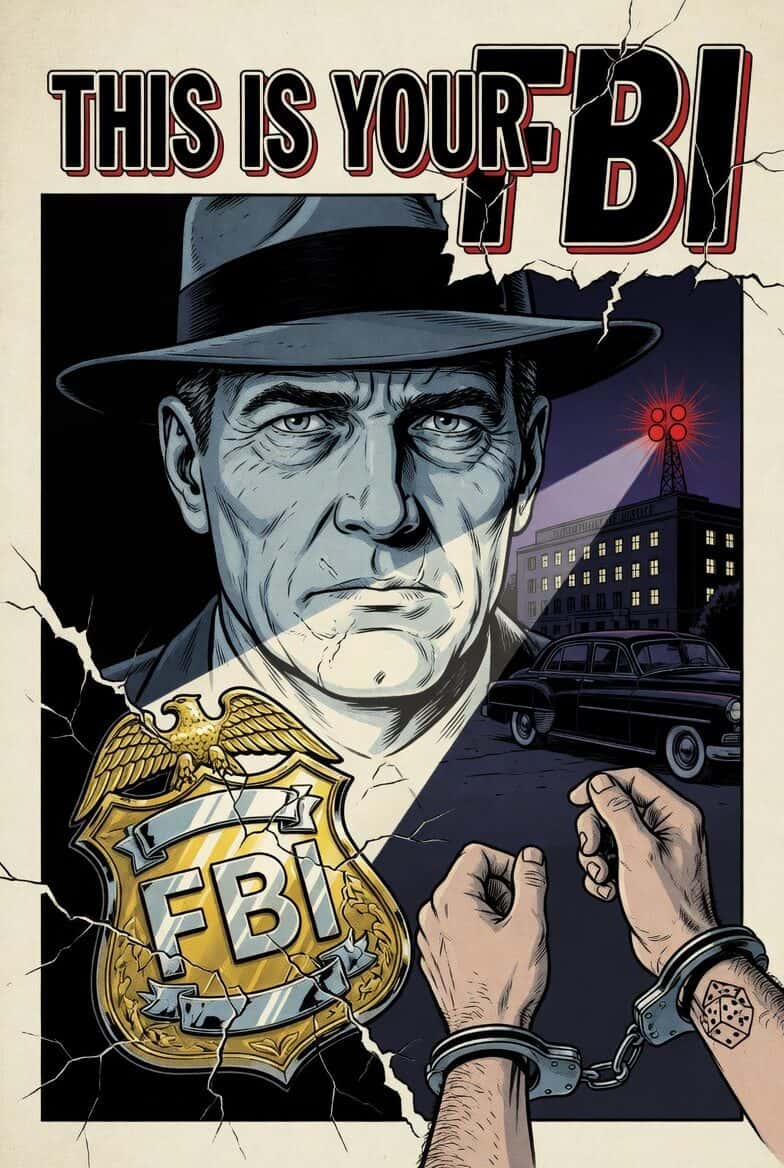
This is your FBI. This is your FBI, an official broadcast from the files of the Federal Bureau of Investigation, presented as a public service by the Equitable Life Assurance Society of the United States. To your FBI, you look for national security, and to the Equitable Society for financial security. These two great institutions are dedicated to the protection of you, your home, and your country.
Tonight, the story of a crime against our nation. Espionage. 1939. That year, the continent of Europe already echoed the cries of people under aggression. On the continent of Asia, far beyond our western shores, was Japan. A dedicated nation, a dedicated people, dedicated to war upon the United States. But we did not know this yet. Within our western gates were more Japs, thousands of them. Were they dedicated to being good American citizens, or were there among them some dedicated to our destruction? Here was a vital task for the FBI. The safety and security of America might depend on what they found out. A Sunday afternoon in 1939, two FBI agents from the San Francisco office stood on a pier at the San Francisco waterfront watching a Japanese cruiser warp into the dock. How big would you figure that crowd, man?
Oh, I'd say, uh, oh, at least a thousand. Pretty excited for Japs, aren't they? Well, it's a big day for them, Larry. It isn't often they get a chance to pay their respects to a big shot from Japan. I know. Larry, is this Prince Tsuji a member of the royal family? Yes. They sure are giving him their Sunday bows, all right. Funny how they conformed to that caste system of theirs. That first line that shook hands with the prince were all top bracket boy. I know. I've checked them off. Japanese Council General, head of the Jap Association, leaders of the prefectural groups, second line of the middle bracket bunch, bankers, nip businessmen. All they got from the good prince was a nod. Well, that's more than the small fry are getting now. Housewives and farmers, they bow and the prince doesn't even acknowledge their presence. Hey. Hmm? Look at that bull-necked little man in the chauffeur's uniform. What about it? You notice something?
He's not cringing or bowing. He's standing in line with his head up and shoulders back like a soldier. Oh, yes. Hey, did you see that? Yes. The prince bowed to him. I know. I don't like that, Jim. They don't play it that way in their league. Princes don't go around bowing to chauffeurs. Unless our chauffeur is a big shot back in Japan. Yes. That's something you and I better check on. One Jap bowing to another Jap. A pair of striped pants and cutaway coat bowing to a chauffeur's uniform. The two FBI agents, troubled by what they saw, investigated and learned the chauffeur's name and background. Then they took their information to the agent in charge of the San Francisco office of the FBI. That's the story, Mr. Walker. A prince bowing to a chauffeur. That is unusual. Yes. Did you follow this man? Yes, sir. He lives at the Osaka Hotel. His name? Yasu Kajioka.
Did you learn anything about his work? Yes. He drives a big Cadillac. He owns it. He runs some sort of escort service with headquarters at the hotel. Anything else on him? We found out that he's been a very active worker for many of the local Japanese associations. Well, I think we should do a thorough check on Mr. Kajioka's activities. Won't be too easy. We could use some help. From whom? Someone of his own race. A Japanese who is loyal to us. Well, we might try the university. They have quite a few Japanese-American students there. That's a good idea. Suppose I arrange with the dean of studies out there for you to have a talk with him. Fine. Get him on the phone right now. The two FBI agents spent almost an entire day with the dean of studies at the university. They poured over the personal records of many Japanese-American students and finally narrowed down their choice to one man, a student by the name of Tom Tanaka. His record showed he lived in the same neighborhood as the Jap chauffeur.
Gentlemen, have you reached a decision? Yes, sir. This man, Tom Tanaka, looks good to us. Well, I think you've made an excellent choice. He lives in the same neighborhood as the man we want to watch. If he measures up in other ways, that's a definite plus. I understand. You realize, sir, how important it is to us that we be able to trust this boy implicitly? Yes, I do. We've got to know if he's loyal. He's a real American at heart. He thinks and acts like an American. There are thousands of men and women who live here on the West Coast, Mr. Scarborough, who look Japanese. nor the sons and daughters of Japanese. But I know them as true Americans. They're as loyal as any of us whose ancestors were German, English, French, Irish, or whatever. I say that this boy is an American just as you or I. Good. Can we meet him at once? Junior Dean has told you that we're special agents of the Federal Bureau of Investigation. Yes, sir. He has. We've selected you, son, from the list of the entire enrollment of Japanese Americans here at the university. As a student?
No. No, he's an American. Well, what about it? I am an American. We believe you are, in every sense of the word. Has somebody been talking about me? No. Then what's this all about, sir? Tom, we want you to help us. How? In a very important, perhaps very dangerous way. You... you want me to work with the FBI? Yes. You know a man called Kajioka? Yasu Kajioka? Oh, yes. We're neighbors. I helped him compose letters in English. Several times. Good. Would he remember you? I think so. He said once that he might give me a job doing secretarial work in my spare time. Why do you ask me about Kajioka? We need a loyal Japanese-American like yourself to help us investigate this man. We want to know if he is connected with any un-American activity. Hmm. What do you want me to do? Help us to get information.
Tom, all we want are facts. I see. You said that you know Kajioka. That he offered you a job once. We want you to go to him. Take the job. We're giving you the opportunity to do this as an American, Tom. Well, what would I say to Kajioka? How would I ask for the job? You'd tell him that you're in need of money to finish your studies. If he hired you, you'd undertake at once to impress him with your love of Japan and the Japanese. We don't want you to put your life in danger. You'd be cautious. Never inquisitive. What do you say, son? I'll do it. No. What do you want, young man? I want to talk to you, Mr. Kajioka. What about, please? A job. Why? To earn some money. Why do you come to me, lowly chauffeur, if you need money? You told me someday you might give me a job. Okay. Why do you want to earn money? To keep up my studies.
You got father, mother. I don't want to ask them. So, but you ask lowly chauffeur. Why? Everyone says good things of Kajoka. Oh, good. You hear perhaps I visit cruiser. They say Kajoka was greatly honored. Oh, they say correctly. Please, you sit down. Thank you. Now, how you think? What do you mean? It could be important. for me to know. I think Japanese. And what are those thoughts, please? I love my people. I love Japan. Oh, I think maybe you lie. Why should I? Who can read my thoughts? Oh, very, very good. Yes. Will you give me a job? Yes. You work for me now. Come every day. I'll try to read your thoughts. Very good. Very good.
Once the all-important inside contact had been made, many FBI agents took up the trail. They learned that Kajioka always drove Japs who were easily identified as high-ranking naval officers on vacation. They learned that he was the head of a secret Jap organization on the West Coast, the Hamushikai, boasting over 10,000 members all eligible for military service in Japan. The society masked itself as a charitable one. Charity in the sense that thousands and thousands of dollars were drafted from the members and sent back to Japan. Why? The answer came quickly and dramatically. One night on a street corner, young Tom Tanaka reported to the special agents of the FBI. Tom. Tom. Yes, sir. Here we are. I haven't much time, sir. I've got to get back. What have you got, sir? Something big is cooking. There's a great meeting called in the basement of the Japanese high school for tonight.
Kajoka will make an appeal to get more funds to send back to Japan. I see. Also, they are to show preparedness movies sent over from Japan. Are you supposed to attend this meeting? Yes. Kajoka will expect it. Tom. Yes, sir. We need a list of the members in that organization. Practically everything depends on our getting it. Do you think you could go to the meeting, get the list, and get away alive? Yes. The pictures may go on about 8 o'clock. I'll try and sneak out and meet you here then. Good boy. Good luck. We'll be waiting. We momentarily closed the Federal Bureau of Investigation file on Kajioka, enemy alien. We will reopen this file in just a moment. Yesterday, Thomas I. Parkinson, president of the Equitable Life Assurance Society of the United States, received an interesting letter. It was from a member of the Equitable Society, and it read...
Mr. Parkinson, just how many businesses is the Equitable Society in anyway? Our radio program talks about millions of equitable dollars invested in war bonds, and more millions in key war industries like shipyards and railroads, in oil, steel, and aluminum. Friends tell me how the Equitable Society helps keep kids in school and helps people own their own homes and farms. It all sounds mighty complex to me. Yes, investing the premium dollars of 3,200,000 members of the Equitable Society is of necessity a very complicated operation. For safety's sake, those equitable funds have to be spread out widely, must go into thousands of different enterprises. And yet all this is done to make it easy and simple for Equitable Society members to attain greater security for themselves and their loved ones. And so you see...
By employing its funds in all kinds of activities that are useful to the nation as a whole, the Equitable Society is able to offer sounder and safer protection to its members than any one member could achieve by his own unaided efforts. By serving its members, the Equitable Society serves America. And now, back to the file on Kajioka, Enemy Alien. 1939. In that year, there wasn't even a slight buzzing in our ears to warn us that enemy planes were warming up for an attack. There was nothing in the word protocol to make us think of anything but where the wife of some ambassador might have to sit at some state dinner. Yet two men of the FBI, standing on a dock at San Francisco, had seen in a bit of Jap protocol enough to make their blood run cold.
Enough to make them, on their own initiative as Americans, set up a series of patient, exhaustive, dangerous investigations which inched down 1939 through 1940. And brought them on the evening of February 3rd, 1941, to stand tense in a darkened hallway near a high school in the daft section of San Francisco. Watch it, Jim. Don't let that streetlight hit you. I've counted about 2,000 that have gone into that meeting so far. Still coming. Kajioka, you don't have to pass the word along. What time is it? Almost 7.45. Looks like the meeting is getting started. Somebody coming along to see the channel. I'll go back here. Tom. Tom, here. Oh, hello. We've got a wonderful break. Kajioka forgot to bring the records. He wants me to go to his house and get them and bring them to the meeting. What part of the meeting is on now? They're going to run off to the movies. How long will that take? Until about 9.15. Good. I'll go with you. Get the records.
Bring them to the FBI office. We'll have them photographed and back in your hands by 9 o'clock. Can you do it that soon? We've got to. Jim. Yes? You stay here. Call the office. Tell them what we have to do. Ask for the entire staff to stand by. Right. I'll drive Tom over. It's going to be tight going. I know. This is the first break we've gotten, and it may be the only one. Let's go. While the movies whip the Japanese audience up with blatant pictures of Japan's armed might, while distinguished visitors sat rigidly straight in the front rows, their cropped heads marking them high officers of the Emperor's Army and Navy, while almost 3,000 sons of Nippon shared a new sense of oneness, of dedication to Emperor and country. An alerted FBI office, brilliant with lights, crowded with 100% staff, worked feverishly to photograph the secret documents and make the deadline. I don't think we can wait any longer, Mr. Logan. It's 8.54. I know. I've got to be back to the hall before the lights are turned up. We'll make it.
One minute's the deadline. How are you coming? Two more sheets. The others are finished. Come on, men. Hurry it up. Please. You've got to give me the originals. I can't wait. The movie ends at 9.15. Let's start correlating pages in the originals. You know how they go, Tom? Yes, sir. I'll grab them as fast as they're finished. Number two is finished. Come on. Snap up on number three machine. Please. Hurry. Hold an elevator. Right. Here you are. This is the final. Thanks. We'll put them together in the car. It's 8.55. Let's go. We'll just make it. Mr. Kadioka. Where have you been? It took you a long time to get papers.
I stood in the back of the hall to see the pictures. I thrilled with the people. Give me the records. Here you are, sir. Good. I have news. We have received orders to change names of all branch chapters of our organization, and we must at once seem to stop our activities. Why? Why? Because soon, glorious Japan will win honor or downfall, and we are ordered to prepare for duty as soldiers behind the guns.
The FBI had everything it needed now on Brother Kajioka. His position as head of the Secret Society. His activity as a chauffeur deluxe for visiting Japanese officers. His role as collector extraordinary of funds for the Japanese war machine. His devious role as espionage agent. Everything the FBI needed except the right to go out and arrest. Under our way of government, we do not go about arresting citizens of friendly nations. The FBI could watch and wait. and to add insult to injury while it fretted over its watching and waiting, one of the FBI agents had reason to phone in to the agent in charge of the San Francisco Bureau. Yes? Mr. Logan? Yes, Larry. Jim and I have been following Kajioka. Yes? We followed him from the Osaka Hotel. He drove straight to Sutter Street. Yeah? Parked his car, proceeded on foot to 111 Sutter Street. Why, that's our building here. I know. Well, where did Kajioka go? He's in your foyer.
Waiting to see you. He's what? Oh, thanks, man. Bye. Yes? Mr. Kajioka to see you, sir. Send Mr. Kajioka right in. Mr. Walker? Yes. What can I do for you? I am Kajioka. Down, Kajioka. Now, uh, what do you want to see me about? I come to FBI because I am honorable man. I see. I wish to offer my services to the United States. Why? I hate Japanese. Oh? Tell me about it. I was born in Japan. One time in Japan, they arrested my father. He was a good man, harmed nobody. They say he was disloyal, but they have no proof, and it is a lie. What happened to him? I never see him again. They murder my father. And so you hate Japanese? Yes, very much. I would be good agent for FBI. What makes you think so?
Japanese government tried to get me to work against United States. You know how it is. You have information on certain secret Japanese organizations here. No? A little. Oh, that is too bad. With me, you get to know much. I know all Japanese tricks. I make valuable agents. Perhaps you would, Mr. Kajoka. You think about it. And remember, I want to work for United States. Great country. I work for FBI and kill many Japs. Well, we're not interested in killing Japs nor anyone else. Sometimes it will be necessary. Then you tell Kajioka what to do, where to go, and he goes. Well, thank you very much for your offer, Mr. Kajioka. We'll take it under consideration and we'll let you know in due time. Thank you so much. Not at all.
It will be a pleasure. Mr. Kajioka might have smelled a rat. That is, if a rat can smell himself. But his surprising offer was politely refused. And his intensified wanderings by day and night were as equally matched by the more intensified watching by the many electricians and workmen, laundrymen, truck drivers, cabmen, innocent motorists, who sent in their reports under the names of special agents of the FBI. Still, all they could do was watch. Watch and follow the little man who was dedicated, like his country, to the destruction of America. Then came December 7th, 1941. On that fateful day, the entire staff of the FBI was gathered in tense silence in each of the Bureau's offices. In San Francisco, even the local law enforcement officers were present. Waiting. Waiting. Everyone here? Everyone, sir. Larry, you and Jim can stand by and watch the teletype. Right, sir. The names are coming in from Washington.
Names and addresses of enemy aliens to be picked up when the word comes through. We'll take them. I know a name you two will want to watch for. Yes, sir. Thank you. Getting into the K's now? Yeah. Hello? Yes, sir. Right. That's the word. Get going. In Kajioka. K is in Kajioka. And teletype. There it is. Capital K for Kajioka, the little rat. We got him now. Come on. Now you see who I am. Major Kajioka. How do I look in my uniform, pal? Very well, sir. Yes. No more lowly chauffeur. Glorious Japan has stuck. American fleet, no more. Pearl Harbor, no more. Oh, God. Soon, planes come. Then, transport. Yes. I have two revolvers, see? Wild and loaded. I give you one. Soon, our soldiers marginally steep. And you and I will go out and kill every dirty American we see. Yes? Yes.
Yes. You watch at the window. Tell me when you see plague. Tell me when you see glorious soldiers of our brave army. I will pour drink for ceremonial toast. Yes, sir. I'll keep watch. Soon I will be cornered. Then dinner. Wait until you see how they will reward me for what I've done. I will be big man. Yes, of course. I hear planes. Do you see them yet? Not yet. Listen. Our soldiers are coming. I drink to glorious Japan. They are here. Come in. Come on, Kajioka. Uncle Sam wants to see you about a place called Pearl Harbor. Kajioka was rounded up with thousands of his kind. Rounded up with the aid of a loyal Japanese American. Like the rest, Kajioka wondered how the FBI had known of his work. Does he remember that little incident back in 1939?
When a pair of striped pants and a cutaway coat bowed to a chauffeur's uniform on the hard deck of a Japanese cruiser? Probably not. He wouldn't understand the things that make Americans tick. The American willingness of those who serve our country in the ranks of the FBI. No, Kajioka probably will never understand until it's too late. And how will he ever know that it was too late that day back in 1939? You'll hear about the disposition of this case in just a minute. On the beaches of Normandy, our boys were seeing the latest movies 24 hours after landing. And not long ago on a Pacific island, two Japanese snipers were captured when they tried to join a GI audience to see an American film. Yes, movies follow the flag because Uncle Sam knows that they're first-rate morale builders for battle-weary men.
So will you join the Equitable Society in a salute to the motion picture industry? A salute to the daring cameramen who risked their lives in every American attack. To the technical men who developed special equipment to photograph Tokyo from 45,000 feet in the air. To the actors, musicians, and directors who made tens of thousands of valuable training films for our armed forces. And to the 16,000 theater managers... who have sold millions of war bonds in every drive. Members of the Equitable Life Assurance Society of the United States will be proud to learn that their premium dollars have helped finance this great industry, which has proved such a vital asset to the nation at war. For years, the Equitable Society has invested in the motion picture industry as well as in other essential American industries and American agriculture. Yes, in wartime, Equitable Society dollars are...
fighting dollars. And at all times, they are security dollars for you, your home, and your country. As an enemy alien, Yasu Kashioka was placed in an internment camp to remain there for the duration of the war with Japan. The incidents used in tonight's broadcast are taken from the files of the Federal Bureau of Investigation. However, all names used are fictitious. and any similarity thereof to the names of persons living or dead is accidental. Programs in this series of particular interest to servicemen and women are broadcast overseas through the worldwide facilities of the Armed Forces Radio Service. Tonight, Tajioka was played by Ted Osborne. The music was under the direction of Van Cleave. The author was Frank Wilson, and your narrator was Frank Lovejoy.
This Is Your FBI is a Jerry Devine production. Now this is Carl Frank speaking for the Equitable Life Assurance Society of the United States and inviting you to tune in again next week at this same time for This Is Your FBI. Now the Equitable Life Assurance Society of the United States brings you a message from the Office of War Information. It may seem slightly ridiculous these hot July days to be thinking, of winter heating problems. But actually, it's the most sensible thing you can do. The fuel situation is still critical, so don't put off your heating problems and forget all about them. Check your heating equipment now. Order insulation for the walls, windows, and doors of your home. Talk with your fuel dealer and take his advice. Fill your coal bin or your oil tank right away before the fall rush begins. This is the American Broadcasting Company.