
The written record
Read the transcript
Read along with the recording · About 22 min to read
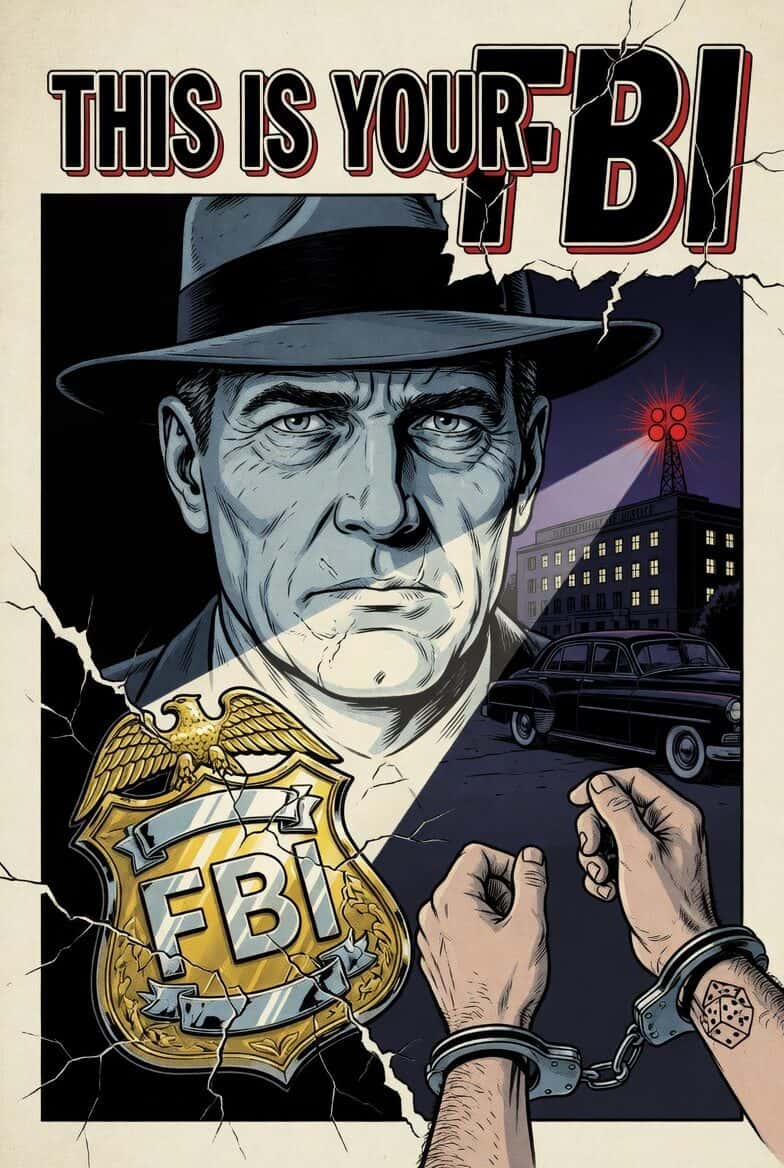
This is your FBI. This is your FBI, an official broadcast from the files of the Federal Bureau of Investigation, presented as a public service by the Equitable Life Assurance Society of the United States. To your FBI, you look for national security, and to the Equitable Society for financial security. These two great institutions are dedicated to the protection of you, your home, And your country. Tonight, the story of a crime against society. The Confidence Game. There are many ways for a thief to steal. There are many forms of larceny. They range from the simplest stick-up to the involved manipulations of a big-time swindle. This present war period has created a fertile field for the swindler. Increased salaries, increased employment set up a ready market for his get-rich-quick activity.
On May 22nd, 1934, Congress, by passing the National Stolen Property Act, put into the hands of the FBI an effective weapon against confidence men. In spite of this, however, swindlers still pursue their losing game. That drama is an old one, and it's worked with little variation. Its first act might begin, as this one does, in the office of a respectable businessman. He is greeting a visitor. Sit down, Mr. Perry. Thank you, sir. Thank you. Well, warm enough for you? I should say so. Phew! You know, I thought they called this the Windy City. I haven't even felt a breeze since I've been here. Why don't you take off your coat? Well, sir, I don't mind. There. I feel better already. How long are you planning to be here in Chicago, Mr. Perry? Just long enough to complete my business with you. You mean you came here just for that? Exactly. Well.
As I told you in my letter, Mr. Mitchell, this is a really big proposition. Yes, it must be. You're coming on here from New York. Suppose I give you some of the details. Yes, I wish you would. Well, as you know, I'm the American representative of British Farm Equipment Limited. Our headquarters, of course, are in London. I know the place. My principal asked me to contact you and find out just how much interest you might have in working along with us. on a very ambitious post-war program. Here in the States? Yes. Confidentially, we plan to open a factory here as soon as possible. I see. We'd like you to take charge of the plant. Me? Me take charge? That's right, sir. But why should you be interested in me? Well, we made a complete survey of all men in the farm equipment field. It should flatter you to know, Mr. Mitchell, that your name came out at the very top of the list. You don't say. So that's why I'm here. Well, I certainly am glad. Now, I'm not authorized to close any deal with you. I merely came to sound you out and turn in a report. Of course. What can I tell the Home Office, Mr. Mitchell? Are you interested? Yes, very interested. Good. Sir Richard Barton, our financial director, is arriving in this country in the next few weeks.
He'll undoubtedly want to get together with you. Can I cable and say that you're willing to talk to him? Of course. Thank you, sir. Well, this has been a very satisfying visit. The first act in any swindle must sound completely authentic, must convince the victim, must stand up under any investigation he might make. The facts the confidence man gave regarding the farm equipment company was true, with only one exception. He did not represent the company. His victim, naturally, did not know this. So, several weeks later, in answer to a summons from the swindler, Mr. Mitchell traveled east to meet one Sir Richard Barton at a hotel in Newport, Rhode Island. Some more bread, Sir Richard? No, thank you. And how about you, Mr. Mitchell? I have some, thanks. What was I just talking about?
The patent rights on that tractor, Sir Richard. Oh, yes, of course. We have exclusive rights, you know. The tractors can be produced at an extremely low cost. We can undercut the whole market. You mean here in this country? All over the world, Mr. Mitchell. Where? I can tell you confidentially that the British government is interested in our company to quite a large degree. That we don't talk about, though. Of course. Frankly, that's the main reason for my visit to America. Oh? I have to contact your State Department on some corporation matters. I'm doing it through our own embassy. I may have to ask you to come to Washington with me, Mr. Mitchell. Why? Because of your extensive knowledge of this type of manufacture. You might be called on for some off-the-record testimony. Whoever. I'd like to help any way I can. Fully for you. I had an idea that we might... Yes? What is it? What's this? What? A wallet. I felt it with my foot.
It was under the table. Is it yours, Sir Richard? No, it's not mine. Mr. Mitchell? No, it doesn't belong to me. Well, what do you think I should do? Look inside, Perry. See if there's any identification. Oh, well, I hate to. Well, then, here. Let me have it. Yes, sir. Probably dropped by whoever was dining here. Oh, look here. What? $1,000 bills. Five of them. Here's an identification card. Lee Jackson. Surf Hotel. He's a guest here. Evidently. Pretty careless fellow. I should say. It's fortunate for him that we were the ones who found it, eh? Yes. Perry, contact Mr. Jackson. After dinner, have him come to my suite, will you? Oh, answer that, will you, Perry? Yes, sir. Another drink, Mr. Mitchell? Not right now. Yes? My name is Jackson. Lee Jackson. Oh.
You told me to test. Somebody up here found my wallet. That's right. That's right. Come in. Thanks. This is the man who lost the wallet. Oh. How are you, sir? Okay. You're Mr. Jackson? That's right. Well, I have your wallet here. I think for obvious reasons you should identify its content. Sure. Will you check the items, Mr. Mitchell? Oh, yes. Yes, of course. Five $1,000 bills. The money order receipt is three, I think. That's right. An Elks card, an address book, two letters, and a racetrack badge in my name. I think that's all. Does that tally, Mr. Mitchell? Yes, yes, it does. Very well. Let him have the wallet. Thanks. But you're a very fortunate man, Mr. Jackson. I know it. I'd like to do something for you. Oh, that isn't necessary. Look, take this grand and cut it up for me. Oh, thank you, Mr. Jackson, but we're really not interested. Definitely not.
Right, Mr. Mitchell? Of course. Well, I've got another idea. Yes? This you can't beef about. I'm around racetracks, what you call a betting commission. I'll take this grand and put it on a horse for you. The right kind of a horse. Please, Mr. Jackson. He wins, we cut up the profit. Now, what's wrong with that? Well... How about it? What do you think, Sir Richard? Oh, I suppose we have to make some compromise with Mr. Jackson. And you, Mr. Mitchell? Well, I have no objection. Okay, gentlemen? Good deal. Act two of the swindle is always the buildup. The victim is let in on the ground floor and given something for nothing, usually in great abundance. Mr. Jackson, the latest addition to the rapidly growing confidence ring, returned to the hotel suite the following evening. Returned with a $3,000 profit. His confederate suggested that the money be bet again. He agreed to this, and the second horse won, and the profit was $14,000.
Another horse was played, and another. Until at the end of three days, the trio had a profit of $120,000. There's the figures, gentlemen. It's amazing. Amazing. Well, where do we go from here? Well, I don't know. What do you think, Perry? Is that me? Mr. Mitchell. $120,000 is a lot of money. Yes, indeed. That's $30,000 apiece. I know, Mr. Mitchell. Can I put in my two cents, please? By all means, Jackson. Please do. These horses I've been playing weren't exactly stiff. Naturally, I had to have information. Of course. I can just about guarantee you that the information is going to continue. Really? I'm expecting a bookmaker up there. He'll have the payoff money with him. Means I'm doing a little thinking for a minute to see whether you want to take one more step. Very well. Look, I don't have to do any thinking. My mind is made up. In which direction, Perry? I'm for playing one more horse. Well, that's very sporting. And...
By Jove, I think I'd spring along. I still say $120,000 is a lot of money. Oh, come now, Mr. Mitchell. After all, we're gambling with their money. That's true. Well, then, why hesitate? Well, all right, I agree. Capital, capital. That's probably the book. Come in. Mr. Jackson. Yeah, come in, come in, come in. Okay. This is Mr. Perry, Mr. Mitchell, Mr. Barton, Frankie Stevens. How do you do? He's been holding a stockholder's meeting, Frankie. Uh-huh. Just about made up a mountain to play the 120 grand back with you. Oh, just like that, huh? Now, what's the matter? Well, I come here to have a little talk with you about that 120. Does this mean he's reneging? Now, look, mister, I don't operate that way. I've got your dough right here in this little bag. But first, I've got to find out something. Well? You guys have been getting a free ride. How? Suppose you had lost 120,000.
Would I have collected? Well, would I? Well, that's hardly the point. It's very much the point, mister. In fact, that's the only way you're going to get your money. What do you mean? Show me $120,000, and I mean cash. Then I'll make my payoff. Now, look, Mackey. That's my deal, boys. Now, get it up. After the fourth member of the confidence ring, the bookmaker, had departed from the hotel suite, a conference was held. a conference which resulted in the victim, Mr. Mitchell, returning to Chicago accompanied by Perry to negotiate a loan to pay his share of the bookmaker's demands. Now the second act of the swindle has been completed. The victim is primed for the kill. Obtaining $30,000, $30,000 in cash, Mitchell and Perry return to Newport, return to the Surf Hotel, return for the final act. Now let me see. You've given me your $30,000, Perry. That's right.
I have a draft here for $60,000, which was sent to me from New York. I'm putting up Mr. Jackson's share, you know. Yes. And you have your money, Mr. Mitchell? Yes, right here. Splendid. Let me have it, please. What for? Perry has agreed to go to the bookmaker's establishment. He'll show him our capital and collect our profits. Oh. Oh, very well. What about the bet? How's that? I thought we agreed that we were going to take a stab at one more horse. Oh, of course, Mr. Jackson, of course. It completely slipped my mind. Perry, you'll still have to bring the dough to the book. Well, how much are we betting? Our winnings? We don't touch any of this money that we're putting up. This credit money? Of course not, Mr. Mitchell. What's the horse, Jackson? Oh, yeah, here. I wrote it out in a slip. You play him the place. Is that for seconds? Yes. What's the name of the horse? Why? Well, shouldn't we know who we're betting on? You know who we were betting on before? You know what horse has put us 120 Gs ahead? No. Jackson's right, Mr. Mitchell.
He has more than established his honesty to date. Let me have the money. Very well. Here you are, Perry. I'd better be getting over this. We'll wait for you here. Good luck, old boy, and good hunting. Did they announce any results yet, Mr. Jackson? No. Are you sure you're tuned to the right station? Yeah, yeah, we'll get it any minute now. You know, this is most exciting. Do you agree, Mr. Mitchell? Yes, a bit nerve-wracking, too. Well, I always say a sporting chance is better... ...or race that Jamaica. Off at 321 and a half, they win a post three sun boy. Is that our horse, Tom? A second post 11 victory ride. That's us. That's our bet. We won? Yes, sir. We picked him in the right slot, too. We played him to play. Congratulations, Mr. Jackson. Congratulations. This is wonderful. You should pay better than three to one. Heaven, we've made a fortune. Come in. Perry, you're just in time. We won, Mr. Perry. We won our bet. On the level? Yes.
The horse won? No, ran second, but that's good enough for us. Second? Yep. You mean it didn't win? What's the difference, Mr. Collect? Oh, that's awful. What's wrong? Oh, I did a terrible thing, gentlemen. What do you mean? I bet on him to win. You did what? But I told you, Perry. I know, I know, but he was ten to one. I figured you'd been lucky right along. Perry, that's disgraceful. Yes, you haven't heard the whole story. What do you mean by that? I... I bet our credit money, too. Why, you... Now, keep away. Jackson, don't. Perry has a very bad heart. Jackson. Good heaven. Perry. Perry, are you all right? He's unconscious. Yes. Mr. Mitchell, get a doctor, please. There's one on the second floor. Second floor? Yes, hurry. Very well. All right, boys. Let's blow.
We momentarily close the Federal Bureau of Investigation file on the confidence ring. We'll return to this case in just a moment. We Americans must think very highly of life insurance because we buy more of it than all the rest of the world put together. Seventy percent of the life insurance now in force on this globe is owned by citizens of the United States, all of which goes to prove that we Americans believe in self-help and self-reliance, believe in watching out for our future. believe in educating our own children and in taking care of our families. Of the large number of Americans who feel that way, 3,200,000 have joined forces as members of the Equitable Life Assurance Society of the United States. Please take particular note of that word, society, in the Equitable's name. It means that the Equitable is not a profit-making enterprise, has no stockholders, is entirely owned by its members.
that is to say, by its policyholders. Dollars entrusted to the Equitable Society to build security for its members are put to work in ways that benefit the whole country, are invested in homes, farming, and in scores of the key industries on which our national security and prosperity depend. By serving its members, the Equitable Society serves America. And now, back to the file on the confidence ring. The confidence game has an ancient and dishonorable history. Its existence can be traced back to the very beginning of time. Through the years, through the centuries, the pattern has varied, but one element has always remained. The gullible victim. Mr. Mitchell returned to the hotel suite in Newport, Rhode Island to find that his erstwhile companions had left, had disappeared along with his $30,000.
Stunned and bewildered, he returned to his home in Chicago. After a lapse of several days, after carefully thinking out his entire adventure, he decided to tell the whole story to agents of the FBI. When I finally located the doctor, I brought him right to the suite. To my amazement, I discovered that everyone was gone. Including the men who'd been assaulted? Yes, sir. What did you do then, Mr. Mitchell? Well, to tell you the truth, I was too mixed up to do much of anything. Did you inquire for them at the hotel desk? see if they'd checked out. Eventually, yes. They hadn't paid their bills. They'd just left the suite and never returned. I see. I wound up paying for it myself. Now, this money you gave them, the $30,000, what were the denominations of the bills? Twenties, fifties, and hundreds. Did you by any chance keep a record of the serial numbers? No, I regret to say I didn't. You see, at the time, I... Well, I just didn't suspect. I understand.
How did this man who called himself Perry first contact you? He wrote to me from New York. Did you keep the letter by any chance? Yes, I have it on file in my office. We'd like to see it. Sure. How accurately do you think you could describe these men? Oh, quite well. I'm sure of that. Then suppose you give us the description. We'll send them to Washington, have them checked in the general appearance file. The general appearance file is an excellent example of FBI thoroughness. This file consists of photographs and descriptions of approximately 15,000 outstanding criminals. Special agents for the identification division check this file for information on the confidence ring. They remove punch cards of all persons falling into the general classification of the descriptions furnished. They place these cards in a sorting machine. A machine adjusted to sort and finally select by mechanical means cards bearing descriptions similar to those of the suspect. Within a short time, the machine had done its job.
Photographs which bore the same numbers as the cards that had been mechanically selected were sent by airmail special delivery to the Chicago field office. Can I see you for a minute, Ross? Yes, come in, Lou. Right. I've just been with Mr. Mitchell. Had him check over the photograph. Any results? Yes. He positively identified all four men. Good. He really was up against a pretty strong team. Here, take a look at them. Very well. The old boy there, the one who calls himself Sir Richard, is one George Willis, an English confidence man. I see. The rest of the gang all have quite impressive records, too. I received a report from the Providence office this morning. The agents did a check at the Newport Hotel. They uncover anything? No, there was no indication as to where the gang had gone. How about Scotland Yard? We heard from them late yesterday afternoon. British Farm Equipment Limited is a legitimate company. How about Sir Richard Barton? Oh, he was financial director of the company, but he died in 1940. Hmm. This gang stayed reasonably close to the facts. Yes.
Oh, by the way, Mr. Mitchell gave me that letter he received from the man who called himself Perry. May I see it? Sure. Here you are. Thanks. Take a look at the letterhead. British Farm Equipment Limited. I doubt that it's genuine. New York address? Probably a vacant lot. Yes, but the letter was mailed from New York. I know. If this stationery is fake, it might have been printed there, too. You're right. Let's send it on to the New York office and find out. A slender lead, a letterhead. A letterhead that might have been set up in any print shop in the country. But the letter had been mailed from New York. So agents in that city were given the assignment of checking with every print and stationary shop in the five boroughs. It was a slow job, but tedious job. A seemingly endless job. But a job that finally brought results. Lou. Yes, Ross. A teletype just came in from New York. On the Mitchell case? Yes. What's the story? That letterhead really paid off. How do you mean? Well, first of all, they checked the address.
You were right on that. It was a vacant lot. Well, that figures. But checking on the print shop really uncovered something. They picked the men up? No, it wasn't that strong. But they did find the printer who'd done the job. He said it was for a man named Phil Renville. He lived in a midtown hotel. I see. The agent went to the hotel, contacted the manager, and found that Renville had checked out just this morning. What a break. Judging by his description, Renville is really Mr. Perry. The hotel manager also revealed that three other men had shared a suite with him. Then they're all still together.
It would appear that way, yes. Any idea where they went? I believe we have. Good. The hotel manager recalled that Renville had done some business with the transportation desk. The agent checked there and found that Renville had bought four railroad tickets. Well, we'd better have that train covered. We don't have to. Why not? We're going to cover it ourselves. What? Sir Richard and company are aboard the 20th Century. They're due in Chicago here tomorrow morning. Cleveland Local. Ah! Oh, it feels good to stretch the legs again, eh, boys? Yes. Frankie, you look as if you're still asleep. I am. This early morning deal was murder. How long away do we have between trains? A couple of hours. Shall we take a stroll about town? We'd better get over to the other station first. Other station? That's where the chief leaves from. Oh, we ought to get our bags over there. Very well. Mr. Perry? Huh? Mr. Perry? It's the umpjay. Good heavens. Hello there, Mr. Perry.
Sir Richard. Greetings, old boy. Mr. Mitchell. Well, this is a tense strike. You've no idea how worried we've been about you. About me? Yes. What in the world ever happened to you? Whatever happened to my $30,000? Oh, you already know that. I mean, what really happened to it? Look, Sir Richard. Yes? We're wasting time. We have to make that train. I think you should answer Mr. Mitchell's question, gentlemen. Who are you, sir? We're special agents of the FBI. Just stay together, all of you. May I ask a question? Yes, what is it? Where can we dispose of four tickets on the cheap? The swindler's drama is an old one, and it's worked with little variation. It's three acts of the meeting, the build-up, and the payoff. But since 1934, since the passage of the National Stolen Property Act, the FBI has been able to add a convincing finish, a finish that was not in the swindler's script.
This finish is apprehension and arrest. Confidence men, as well as all criminals, are a blot on the American way of life. Special agents of the FBI will continue to ferret out these individuals, and with cooperation of the public and law enforcement agencies, bring them to justice. You'll hear the disposition of tonight's case in just a moment. Will you join the Equitable Society in a salute? A salute to a man so familiar to you that you tend to forget how important his wartime services are. A salute to the hardworking merchant who runs your corner store. Yes, your butcher, grocer, druggist, and the other small but important businessmen on America's main streets deserve an overwhelming vote of thanks. In spite of shortages, point rationing, and manpower difficulties, they're still doing business at the same old stand.
still proving that in a land of opportunity, the right kind of men can always get ahead. The Equitable Life Assurance Society of the United States is proud of its many associations with these typically American institutions. And we firmly believe that the millions of dollars of Equitable Society funds that help finance business may truly be called investments in victory, just as are the other equitable millions that have gone into war bonds and war industries. In wartime, equitable society dollars are fighting dollars. And at all times, they are security dollars. For you, your home, and your country. In tonight's case, a federal grand jury convening in Boston indicted Barton, Perry, Jackson, and Stephen. They were tried, found guilty, and sentenced to eight years in a federal penitentiary.
The incidents used in tonight's broadcast are taken from the files of the Federal Bureau of Investigation. However, all names used are fictitious, and any similarity thereof to the names of persons living or dead is accidental. Tonight, the music was under the direction of Van Cleave. Your narrator was Frank Lovejoy. This is your FBI is a Jerry Devine production. And now this is Carl Frank speaking for the Equitable Life Assurance Society of the United States and inviting you to tune in again next week at this same time for this is your FBI. This is Infantry Day, a day dedicated to the doughboy, the foot slogger, the indispensable soldier who storms enemy beaches, knocks out pillboxes, meets the foe face to face and hand to hand.
No war was ever won without infantry. And no infantry ever surpassed the heroic American troops we honor now. But remember, they can't reload their weapons with words of praise. So be practical about Infantry Day. Cheer G.I. Joe and his leaders by giving them ample material aid for the tremendous task ahead. On Infantry Day and every day. Buy war bonds in the seventh war loan draft. This is the American Broadcasting Company.