
The written record
Read the transcript
Read along with the recording · About 21 min to read
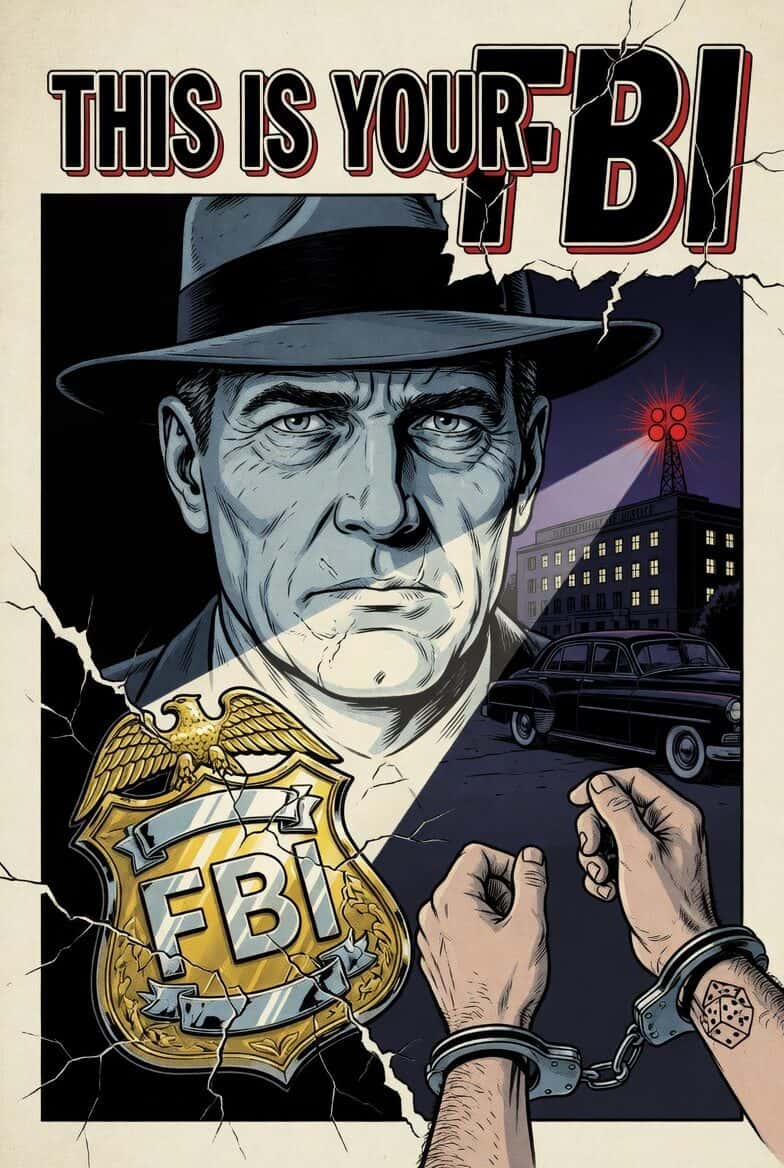
The Equitable Society presents This is Your FBI. This is Your FBI, an official broadcast from the files of the Federal Bureau of Investigation, presented as a public service by the Equitable Life Assurance Society of the United States. To your FBI, you look for national security, and to the Equitable Society for financial security. These two great institutions are dedicated to the protection of you, your home, and your country. Tonight's file, The Strange Extortion. Hardly a day passes that some person of large income or great wealth does not receive a letter demanding that he pay the sender a certain sum of money or suffer the consequences. The usual implication is death to himself or some member of the family. True, most of these extortion letters are written by cranks who never carry out their threats.
But the FBI must investigate them all. And quite often, the letters are the real thing. Tonight's case from the files of your FBI involving attempted extortion is one of the most extraordinary stories of its kind on record. Flint Rock was a wholly appropriate name for the old secluded Long Island estate. For it not only described the volcanic outcroppings about the place, but it suited the character of the despotic old woman. who ruled the cold gray stone house with perpetual ill temper and a passionate contempt for all under its jagged roof. Although Lettie Bradford could seldom leave her bed, her irascible spirit haunted every room and had long since made Flint Rock a house of mutual hate. It is now one minute after nine o'clock in the morning. Lettie Bradford reaches for her stick and... Janet! Janet! Oh, that stupid nurse. Janet!
About time, young lady. Good morning, Mrs. Bradford. Nearly two minutes after nine, Janet. I'm sorry. That's no excuse. You know very well I want my breakfast at nine o'clock, and nine o'clock doesn't mean two minutes after nine. Yes, Mrs. Bradford. I suppose you stopped the poison, the orange juice. No, Mrs. Bradford. Don't tell me the thought hasn't occurred to you. No, Mrs. Bradford. Of course it has. It's occurred to all of you. And why should it? Don't question me and don't look at me that way. You're all too impatient to me to die. You can't wait for my affliction to kill me. You're too eager to get your ungrateful fingers on the money I've left for you in my will. I don't expect any money. You've always paid me for my services. Inefficient, as they are. Shall I pour your tea? Don't you always? You want me to drink it, don't you? You said for me to pour it.
There are some poisons that cannot be detected in a body, aren't there? Yes, there are several. I won't drink the tea. Take it away. Take it away, I say! As you wish. Well, don't stand there tapping like a woodpecker, Charles. Good morning, Mrs. Bradford. Good morning, Janet. Another Judas. I beg your pardon, Mrs. Bradford. Take the tray, Janet. How long have you been my secretary, Charles? It will soon be ten years. Hmm. You must have robbed me of a tidy sum in that length of time. If you think I have, why don't you have me arrested? Nonsense. I admire your ability to hide your pilfering. What have you got there? The morning mail, of course. Oh, don't bother me with mail this morning. Where is my adoring niece? Miss Daryl is... I know. Sleeping it off under a pile of ice bags.
Miss Daryl stayed in New York, I think. Well, they have ice bags there, too, don't they? What's that? A letter addressed to you, Mark. Confidential. Confidential. Poppycock. Open it. I didn't want to without your permission. Open it. Mrs. Bradford. Well? It's an extortion letter, and they threaten to... Well, don't have a stroke about it. But they threaten your life unless you... Unless what? Unless you pay them $30,000 by noon tomorrow. Pay who $30,000? You are to wrap up that amount in bills of small denomination and see that the package is left in the alley behind the North Shore Bank building in Island City and say nothing to the police or... Or they'll bash my head in, I suppose. I'd better get Judge Madison on the telephone right away. You'll do nothing of the sort. Some cranked nonsense. Throw the letter away. But, Mrs. Bradford... You heard me. Throw it away. Very well. Charles.
Wait a minute. Yes? Should anyone ask for $30,000? Why not $25,000 or $50,000 or $100,000? Why $30,000? It is an odd amount. Ah. There may be something to this after all, Charles. Get Judge Madison over here right away. I wouldn't be surprised if all this weren't some scheme of your own, Tom Madison. Oh, my dear lady. Of course, I could use $30,000 to good advantage, but... Can't you wait until I die, either? As executor of the estate, you'll be able to milk it for a whole lot more than that. Come now, my dear. This is a serious matter. What's serious about having my head bashed in? That would be a happy event for all of you. Oh, please, please, my dear. If the letter is a genuine extortion letter, you have until noon tomorrow. And you may rest assured, my dear...
Before then, I'll see to it that you have ample protection. I don't want a lot to do about this in the papers, you understand? The FBI doesn't operate that way. What does the FBI have to do with it? This is a federal crime, and I must report it to the FBI at once. Judge Madison drove swiftly into New York and went directly to FBI headquarters, where he reported the case to Special Agent Hugh Barnes. And here is the letter, Mr. Barnes. Uh-huh. Now, this looks like the type of stationery ordinarily used for social correspondence. And whoever sent the letter was careful to use a typewriter. Now, typewriting can be as incriminating, Judge Madison, as handwriting. Each set of type leaves its own peculiar mark. But they don't necessarily prove who did the typing. No, but it's a good clue anyway. Oh, yes. Yes, of course. Now, who occupies the house with Mrs. Bradford? Besides the servants, there's Mrs. Bradford's personal nurse, Janet Smith.
What do you know about her? Not much, except that she has attended Mrs. Bradford for three years. Single? Yes. A young man calls on her once a week, I believe. What's her attitude toward Mrs. Bradford? Frankly, Mr. Barnes, no one has any real affection for Lettie Bradford. From your description of her, that's understandable. Who else lives there? Her secretary for almost ten years, Charles Forbes. Single. About 34. Does Mrs. Bradford have any children or other relatives? Only a niece, Daryl Bradford. About 27. Very attractive. Also single? As Daryl says, she's still playing the fiend. Nightclub style. Has a generous allowance, I suppose. Not always generous enough. I've had to clear up her gambling debts from time to time. For a large sum? They varied in the past. I say past because...
Three months ago, Mrs. Bradford swore she would never settle another one. Now, what about the servant? Well, there'd be no reason to suspect any of them, except, well... Except whom? The chauffeur, Floyd Parker. He likes his drink a little too much, and occasionally he's disappeared for two or three days at a time on what he calls little bottlenecking. I see. Mrs. Bradford says she had a row with Floyd on the subject two days ago and fired him. Anyway, Parker's gone. More late. Yes, fine. Get a complete description of Floyd Parker from Judge Madison and start trying to locate him, will you? Right. There are a couple of angles I want to go out on for a while, Judge. Would you be good enough to meet me this evening at the Bradford house? Certainly. And please see that everyone's there, including Daryl Bradford. Good evening, Miss Daryl. What's good about it, Charles? I'm sorry I had to call you. You didn't tell anyone where I was? Certainly not. Thanks. Now, why should I have to come all the way out here because that old you-name-it got some kind of crazy letter?
The FBI agent wanted everybody here. FBI agent? Yes. He's been all over the house for the last two hours. He's in the library now, and he's already fingerprinted all of us except you. What? Yes. You mean he suspects that one of us? I guess it's their job to suspect everybody. Mr. Barnes, the agent, asked me to have you come into the library as soon as you arrive. All right. I'm Daryl Bradford. They say you want my fingerprint. Please, if you don't mind. Were you expecting me to object? Do you? Why should I? It'll only take a moment. Now, press your right fingers on this ink pad, please. Good Lord. I wonder if I've robbed any safes lately. Probably not, or you would have paid off your gambling debt to Nick. Now, press your fingers on this card here. What do you know about Nick? Well, he's a dangerous man to owe $30,000 to. Now, the left finger, please. All right, so you know about it. But I didn't write that letter.
I didn't say you did or you didn't. If I didn't, who did? I haven't found out yet how many people know about your death. And a lot of people, including you, would benefit by Mrs. Bradford's death. Have you finished with me? Not for now, yes. Oh, please send the nurse, Miss Smith, in, will you? And I'd rather you wouldn't leave the house. Very well. You're in charge. Barnes speaking. This is Moore. Any trace of the chauffeur? Oh, not yet. I just called to tell you I've all... Good. I'll be here for a while yet, thanks. Well? Oh, this is a sheet of your stationery, isn't it, Miss Smith? Where did you get it? Out of your room. Then I guess it's mine. Why? Well, the extortion letter was written on a sheet of paper exactly like this. That makes me guilty, I suppose. I didn't say so. If anybody wanted to get $30,000 from Mrs. Bradford, it probably would have been... Then you knew about Daryl Bradford's gambling debt? Charles knew about it. He told me.
I thought he was supposed to be a confidential secretary. Charles gets sort of confidential with me, too, Mr. Barnes. Oh. Excuse me, Mr. Barnes. Oh, yes, Charles? Judge Madison called over the other phone a few minutes ago. Said he'd been detained but was coming right on over. Thank you. Well, that's all for now, Miss Smith. Charles. Yes? Do you recognize the typing on this sheet of paper? Well, it's the same style, I think, as... As the typewriter are you. That's right. I typed this on your machine. What for? I mean... Well, it's just possible that under a microscope, it'll exactly match the typing on the extortion letter. Look, Mr. Barnes. I didn't have anything to do with it. We don't reach conclusions until we get all the facts. Why should I try to extort money from Mrs. Bradford? I'm well and taken care of. I will and... What? Come on. It's Mrs. Bradford, Janet. She's been shot. Miss Daryl. I'm coming.
We momentarily close the Equitable Society's presentation of the Federal Bureau of Investigation file on the strange extortion. We will return to this case in just a moment. A quarter of a century ago, a great American president, Woodrow Wilson, saw the need for world cooperation. He urged the nations to get together to drop their rivalries to form a united front for world peace and security. Today, the ideals of this farsighted leader... are an inspiration to those who are planning to banish injustice, war, and aggression from the face of the earth. Members of the Equitable Life Assurance Society of the United States will be proud to learn that this great advocate of international cooperation was a member of their society. Like Woodrow Wilson, this society also stands for security through cooperation. In fact, the Equitable Society...
is an excellent example of the advantages of cooperation. Instead of trying to struggle with their security problems alone and unhated, three and a quarter million Americans have joined forces in the equitable society. Instead of continually worrying about the financial future of their families, equitable members have shifted that burden onto the broad shoulders of their society. The peace of mind which they gain makes them better workers, better fathers or mothers, better citizens. Yes, by serving its members, the Equitable Society serves America. So remember that name, the Equitable Society, the Equitable Life Assurance Society of the United States. And now back to the file on the strange extortion. In the case of Lettie Bradford, Mailing the extortion letter was a federal offense. But when Mrs. Bradford was found apparently dying of a bullet wound above the right temple, Special Agent Hugh Barnes called Inspector Blanton of the Homicide Bureau, who took charge of the house and posted men to see that no member of the household tried to leave. Agent Barnes, however, continued to conduct the investigation. Letty Bradford's doctor, Inspector Blanton, Barnes, and the nurse, Janet Smith, herself under suspicion in connection with the letter, have been in Mrs. Bradford's room for some 30 minutes now. Judge Madison, who arrived shortly after the shooting, is standing outside in the hall with Charles Forbes, Mrs. Bradford's secretary. The door opens and Barnes steps in. Well, Mr. Barnes. Mrs. Bradford. The bullet didn't penetrate as we thought at first. The pistol was evidently fired at such an angle as to cause only a deep scalp wound and severe powder burns. You mean... She's unconscious now, but largely from shock. She'll live. Oh.
Judge Madison, did you ever see this gun before? Why, yes. Was that the pistol that's found on the floor behind her bed? That's Mrs. Bradford's, Mr. Barnes. Mrs. Bradford? I didn't know she had one. Yes, Charles. I bought it for her myself three weeks ago. Said she wanted one for protection, so I humored it. Thank you, gentlemen. You know where I can find Miss Darrell? Oh, yes. She went downstairs just before you came out, sir. I saw her going toward the library. Thanks, Charles. And, uh, Judge Madison. Yes? Inspector Blanton says no one is to leave the house just yet. If you'll excuse me now, please. Look, Nick, it's not my fault if she doesn't die. I didn't do the shooting. What? Well, if she lives, you'll just have to give me more time. I can't raise $30,000 like an umbrella. All right, do anything you like about it. I didn't intend to eavesdrop, Miss Bradford. I didn't call Nick, Mr. Barnes. He called me to hound me about the money.
I told him what had happened, and I... Oh, all right, believe what you like. I'm on my way to New York. I merely stopped to give you the doctor's verdict. Your aunt will live. Good night, Miss Bradford. Morning, Barnes. You don't look very happy. Ah, just mixed up, I guess, Morley. No trace of the missing chauffeur yet? Not yet. What about the pistol? There are no fingerprints on it. I can't understand anybody leaving it behind the bed in the first place. You got tourists so fast, I don't see how they had time to escape. Well, they didn't use the window. That's a cinch. You suspect anyone in particular yet? Look, Morley, it's easy to suspect nearly everybody out there. Most all of them have acted funny about one thing or another. The nurse about the stationary, the secretary about the type. Daryl Bradford about $30,000. And they all stood to gain by Mrs. Bradford's death. Yes? Here's the laboratory report on the extortion letter, Mr. Barnes. Good.
What's the verdict, Barnes? It's very interesting. The extortion note was typed on the secretary's machine. Yeah? The only fingerprints on the letter are his. Oh, wait a minute. Here's something else. Also found on the stationery were microscopic traces of purple suede fuzz. Uh-oh. As if it had been handled by someone wearing purple suede gloves. I'll take it. Barnes speaking. Oh, hello, Doctor. Yes? Yes, I see. I'll be there. Thank you very much. That's Mrs. Bradford's doctor. He wants to keep her quiet for the rest of the day, but says she should be able to talk to me by tonight. Good. In the meantime, I'm going to do a little checking on Nick today. And if you get any word on the chauffeur, call me at the Bradford house tonight. Right. Special Agent Barnes spent the rest of the day investigating the movements of the gambler Nick and his men during the past 24 hours, but could uncover nothing involving them with the shooting or the extortion letter.
Shortly after dark, Barnes forged his car through a rain and windstorm sweeping Long Island up to the Bradford house. Letty Bradford could talk, but claimed she could remember nothing that happened. Barnes then assembled the others in the library. Charles. Yes? The extortion letter was typed on your machine. But, Mr. Barnes, I tell you that... And your fingerprints were also found on the letter. Of course they were. I read the letter to Mrs. Bradford. I had to handle it to read it, didn't I? And, Miss Smith, your fingerprints were not found on the stationery used, but there were traces of fuzz from purple suede gloves. I never owned a pair of purple gloves in my life. And Mrs. Bradford was shot with a pistol which you say you bought for her, Judge Madison. Lord, Barnes, you don't think I... I'm not accusing you or anybody else here of anything, Judge. I'm merely setting down some facts, and I... Excuse me for butting in, Barnes. Morley, I thought you were in New York.
Well, I thought I'd better bring him out instead of phoning. The police found our man. All right. Come on in. Parker. I don't get the idea of all this. Are you Mrs. Bradford's chauffeur? Mrs. Bradford's ex-chauffeur. You're just the man I've been waiting to have a talk with. Will you come into the other room with me, please? Thirty minutes later, Special Agent Barnes emerged from his talk with the chauffeur, whispered something to Janet Smith, the nurse, who immediately set off upstairs. Then Barnes called Judge Madison to one side. Well, Barnes? I think I have it all cleared up now, Judge. Parker, the chauffeur? No, but he was very helpful. He knew something? Yes, something that completely clears Miss Darrell, the nurse, and Charles. Oh? I was finding it awfully hard to suspect any of them anyway. Why so? Well, Miss Smith wouldn't have been so obvious as to use her own stationery. The same reason Charles wouldn't have typed the letter on his own machine.
And Miss Daryl? She needed $30,000, all right, but she's too intelligent to have demanded a sum which everybody, including Mrs. Bradford, knew she owed to make the gambler. That sounds reasonable, but... I think I found what you want, Mr. Barnes. Yes. I'm afraid you have, Miss Smith. Judge, I think you'd better come upstairs with me. All right. Fair enough. Mrs. Bradford? Well, what are you and Tom Madison up to? When you fired Floyd Parker three days ago, you gave him a handsome sum of money to soothe his feelings. What if I did? It's my money. You also gave him a letter to mail. A letter addressed to yourself. What are you trying to say, young man? Are these your purple suede gloves? Well, I... Oh, certainly they're mine. What are you doing with them? The person who wrote the extortion letter used Miss Smith's stationery, Charles's typewriter, the amount of Miss Darrell's gambling debt...
and wrote it while wearing purple suede gloves. Well, what did they do? And furthermore, she sought to escape an uncomfortable death from disease. At the same time, put the suspicion of murder on the beneficiaries of her will, whom she holds in contempt, by attempted suicide with a gun registered in Judge Madison's name. Well, Mrs. Bradford? All right. All right. I did it. It's all true. And I have only one regret. It didn't work. As a public servant charged with protecting the lives, property, and general welfare of all citizens, the FBI is just as diligent in establishing the innocence as well as the guilt of persons involved in a crime. In the case of Lettie Bradford, there were five persons on whom the shadow of guilt fell.
but Special Agent Barnes was not willing to arrest any one of them for the crime because of lack of sufficient incriminating evidence. Instead, his investigation was directed at removing from over them what shadow of suspicion was there. And in doing so, he discovered the person who was guilty. You'll hear about the disposition of this case in just a moment. But now will you join the Equitable Society in a salute to the American industry which employs more men than any other except farming, an industry which is most typical of democracy and free enterprise because it is made up of many thousands of little businesses. A salute to the architects, engineers, lumbermen, the contractors, plumbers, electricians, masons, and carpenters who constitute America's great building construction industry.
During the war, these were the men who built army camps and vitally needed factories almost overnight. During the post-war years ahead, this is the industry which will be the wheelhorse of our national prosperity. Authorities estimate that the building construction industry will erect one million homes a year for the next ten years and will give employment to four to five million men. Today, the need for more manpower is acute in this industry. and it can be counted on to provide large numbers of jobs for ex-war workers and returning servicemen. For many years, the Equitable Life Assurance Society of the United States has been closely associated with the building construction industry. Equitable Society funds have made possible the construction of countless homes, factories, and business buildings. Every time a member of the Equitable Society pays a life insurance premium, He knows that his money is helping to make jobs for millions of his fellow Americans. For just as equitable society dollars were fighting dollars in wartime, so at all times they are security dollars for you, your home, and your country. Because of her physical ailments and extreme old age, No formal charges were filed against Lettie Bradford. Next week on the Equitable Society's presentation of This is Your FBI, be sure to hear the adaptation of the forthcoming 20th Century Fox motion picture, The House on 92nd Street, relating the counter-espionage work of the FBI in protecting the secret of the atomic bomb. Featured on this broadcast will be the original stars of the picture, William Ive, Lloyd Nolan, and Signy Hassel. The incidents used in tonight's Equitable Society's broadcast are taken from the files of the Federal Bureau of Investigation. However, all names used are fictitious, and any similarity thereof to the names of persons living or dead is accidental. Tonight's broadcast was directed by William M. Sweets. The music was under the direction of Frederick Steiner.
The author was Frank Fares, and your narrator was Dean Carlson. This Is Your FBI is a Jerry Devine production. And now this is Carl Frank speaking for the Equitable Life Assurance Society of the United States and inviting you to tune in again next week at this same time for This Is Your FBI. Want to sit in on a thrilling court case? Well, then join the audience of famous jury trials which follows now over most of these stations. This is the American Broadcasting Company.