
The written record
Read the transcript
Read along with the recording · About 20 min to read
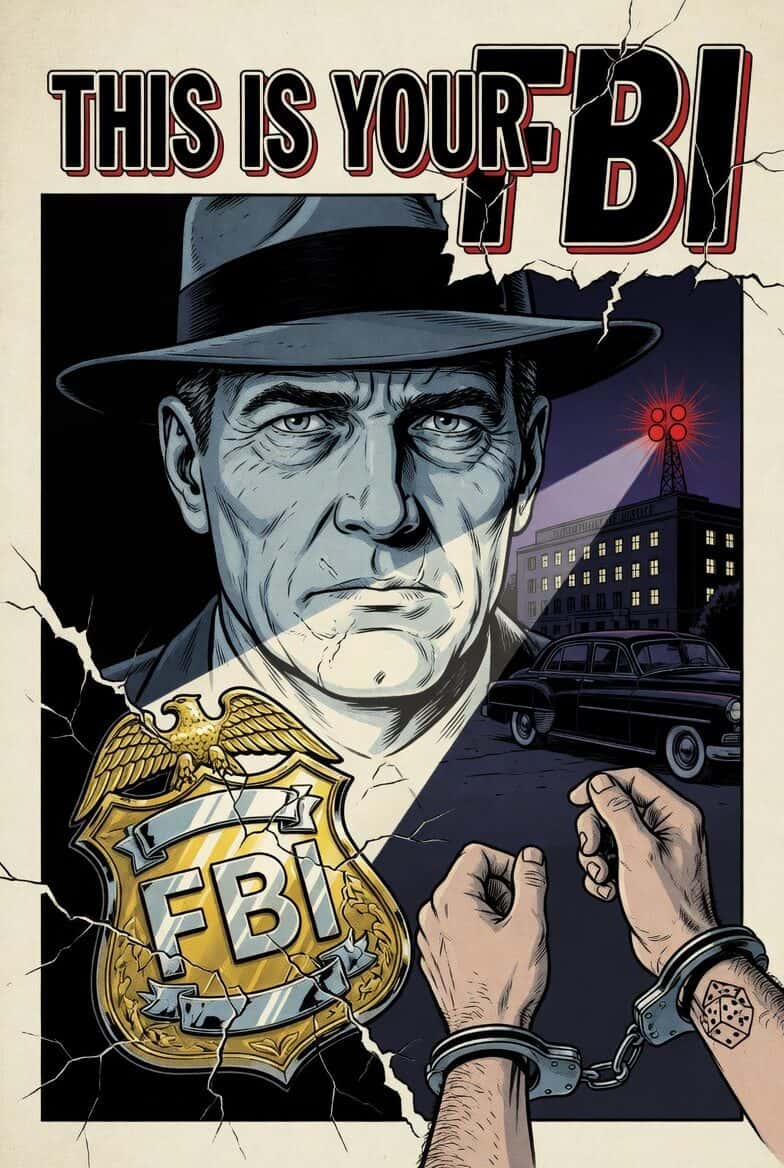
The Equitable Society presents, This is Your FBI. This is Your FBI, an official broadcast from the files of the Federal Bureau of Investigation, presented as a public service by the Equitable Life Assurance Society of the United States. To your FBI, you look for national security, and to the Equitable Society for financial security. These two great institutions. are dedicated to the protection of you, your home, and your country. Tonight, as a departure, we bring you the preview of a sensational motion picture, The House on 92nd Street, produced by 20th Century Fox, with the actual cooperation of the FBI. It reveals the most daring espionage plot of World War II. This dramatic screenplay stars William Ice, Lloyd Nolan, and Sidney Husso.
And we have them here in person for our preview. This is your FBI presents The House on 92nd Street. Back in 1939, the mechanized legions of Adolf Hitler were overrunning the face of Europe, crowding civilization into a dark corner. The ever-increasing number of Nazi bunds in this country, the growing network of German spies, clearly indicated that Hitler would not stop at the borders of Europe. And so the FBI... always on the alert to protect the safety of the nation, went to work. Every known suspect was watched, their every move recorded for the file. The FBI could not declare open war against the treacherous Germans in this country, but it could and did keep a 24-hour watch on them, so that when the time came, those Nazis could do nothing to help Hitler make good his threat of yesterday Germany, today Europe, tomorrow the world.
As our story opens on an afternoon in the spring of 1939, William Dietrich, a good-looking, husky young man, is standing near a pole-vaulting pit on a college athletic field. He's in track uniform, and as he flexes his muscles before making his first jump, he is approached by two men. Pardon me. Are you William Dietrich? That's right. We would like to talk to you. What about? My name is William Gross. How do you do? And this is August Klopman. How do you do? Hello, Mr. Klopman. Dietrich, we came here to talk to you about, well, joining our society. What society is that? The German-American Society. Oh? You're a good German. Your parents came from Stuttgart. You should join us. Well, Dietrich, you're going to graduate in June? Yes, at least I think so. Well...
Would you like to take a trip back to Germany after you graduate? No, I couldn't afford it. I have to go to work when I leave here. Oh, the trip would cost you nothing. You would be paid, in fact. Paid? What would I have to do? Oh, go to school in Germany for three months. What kind of school? A place where you will learn how to help the fatherland. Oh. And when you're finished there, you come back here to work for Germany.
William Dietrich was a first-generation American, and like most first-generation Americans of German descent, he was a loyal citizen of this country, not a loyal Nazi. He asked the representatives of the German-American society to wait for his answer, because he had a plan. With that plan in mind, he telephoned the FBI in Washington. The next morning at FBI headquarters, William Dietrich was seated across the desk from Inspector George A. Briggs. Well, that's... Just about the whole story, Mr. Briggs. I see. I've had you checked since you called. You have? Yes. I find you can be trusted. And it's all set? I can really go? Oh, no, wait. Not so fast. Before you do anything, I have to tell you what you'd be up against. Well? If the Nazis could find out that you're working with us, they wouldn't think any more of killing you than of striking a match. And they only kill people they like with bullets.
Yeah, I know that. And furthermore, the FBI doesn't command anyone to take his life in his hands. That's why I called you, Mr. Briggs. I understand. When did your, uh, your friends, when did you tell them that you'd let them know? Wednesday night. Well, you've got almost a full week to make up your mind. After you give them an answer, call and let me know what that answer is. Mr. Briggs, I think I can save your phone call. I know what I'm going to tell them. Then let's go to work. After his graduation, William Dietrich left for Germany. Arriving at Hamburg, he went to the famous Nazi school in that city, the school for spies and saboteurs. When he had learned his lessons well, he was ready to return to the United States. He was given counterfeit identification papers and some genuine credentials with which to introduce himself to the Nazi contact in New York. While he was still on the high seas, en route back to New York from Lisbon, Inspector Briggs and a special agent named Walker were busy at the FBI headquarters in Washington. Here's a report you should see, Walker. Oh? What's it about? A man was hit by a cab in New York three days ago. Some papers were found on him that looked suspicious, so they sent them down to us. He was carrying a forged passport, but his fingerprints show that he was Captain Franz von Wirt. Well, he's one of the top men. He was. He died on the way to the hospital.
I see. Anything come out of his papers? Yes. We sent one of the letters he was carrying to the laboratory. They found some numbers written between the lines in disappearing ink. Cryptanalysis just broke it down. And? It said, concentrate on process 97. That means nothing to me. It didn't to me either. So I called a meeting this morning of Army and Navy intelligence. I read them the message. Any response? Plenty. Process 97 is our new secret weapon. Oh. Nobody was even supposed to know that we were working on it. What's our move? First, we've got to find out how much the Nazis know about it. And second, how they found out. Well, young Dietrich ought to be able to help us out on that one. Maybe, yes. His German credentials came in on Clipper this morning. I have them here. Oh, read them to me, will you? They're in German, and translated they say...
William Dietrich is specifically authorized to receive all reports for transmission direct. That's the first paragraph. Uh-huh. Leave that one as it is. Right. Paragraph two says you are instructed to look to him for all payments. Well, that's fine. That means that they've got to come to him. Leave that one alone, too. Okay. The last paragraph says it is forbidden for him to have any contact with agents known to you. I don't like that. Now, let's see now. Have it changed to read, he is? authorized to contact all agents known to you. Right. And after that, pack your bags. We're going to New York. A few days later, a Portuguese freighter came into New York Harbor. William Dietrich, one of the passengers, brought his luggage down onto the pier, where it was checked by a customs inspector. The customs man was FBI Inspector George A. Briggs. As Briggs went through the bags, he quietly slipped Dietrich the new credentials.
The forged credentials which would give Nazi spy and counter-espionage agent William Dietrich more freedom. When he left the pier, Dietrich took a cab to the house on 92nd Street. There he rang the bell and was admitted into the ground floor dress shop, a dress shop run by Elsa Gebhardt. You're Elsa Gebhardt? That's right. Well, they didn't tell me you were so pretty. Who are they? Oh, pardon me, I'm sorry. My name is Bill Dietrich. Oh. I've been expecting you. Good. Here's a message for you from Colonel Strassen in Hamburg. Who's that, Elsa? This is William Dietrich. Ah. Is he the new one? Yes, ma'am. He brought this message from Felix. He is William Dietrich. He's authorized to receive all reports for transfusion rate. He's authorized to PRC. He's authorized to contact all agents known to me. That's what Colonel Strassen said. But I don't understand.
He never sends anybody else with orders like that. I'm going to check these credentials. Oh. I'll write to a friend of mine in Argentina. He'll get a message through to Hamburg. Okay, but meanwhile, I've got to go to work. What do you want? Enough parts to build a radio transmitter. Here's a list of what I need. Why don't you buy them yourself? I can't afford to be caught buying radio parts. He's right, Max. Here's the list. Get them. Okay. That will be all for now, Mr. Smith. Very well. Don't go out through the front door. How then? Use this back door. And then walk out through the alley into 93rd Street. Okay. Goodbye, Miss Gabbard. Goodbye. Yeah. Follow him. William Dietrich got his radio parts and set up a transmitter in a secluded house on Long Island. He never transmitted to Humboldt, though. Every message he sent was picked up by a nearby receiver. A receiver operated by the FBI.
After all harmful portions of the message had been removed, the FBI then shortwave the rest in proper code to Germany. One day at this radio shack, Dietrich received an urgent summons from Elsa Gebhardt. She had to see him immediately. An hour later, he was in the house on 92nd Street. Dietrich. Yes? I have something that must be sent as quickly as possible. Where is it? Here, in this envelope. Okay. If we hadn't done anything else in all the years we've been working, this information would make the whole thing worthwhile. But these are almost all numbers. They don't make sense. They'll make enough sense in Hamburg. I must have them back here by tomorrow night. Well, that's a tough assignment. Why? What makes it so tough? I have to put all this in the code before I send it. That takes time. These are my orders. Well, why can't I just burn them when I'm finished?
Because sometimes radio messages are gobbled. When you're finished, I'll mail them to a drop in Argentina. It must get through. Can I come in? Yes, come ahead, Walker. Anything on those papers Dietrich sent in? Yes. I spoke to Dr. Appleton. He's head of the laboratory. Those papers are definitely on process 97. What's more, he said the experiments took place just two days ago. What do we do now? Dr. Appelman is going to work on the papers. He says if you change one number, it can throw the Germans off for a month. You know, I don't get this whole setup. I thought nobody working on the process was allowed to leave the plant. Nobody but a few of the scientists. They can leave a couple of nights a week, but they're thoroughly searched before they go. Look, can you tell me what process 97 is? Well, I'll give it to you the way it was given to me. From what our scientists already know about its properties, it would...
devastate any city it was used against. Sounds like a death ray. I made the same guess. Is it right? No. Process 97 is an atomic bomb. We momentarily close the Equitable Society's presentation of the Federal Bureau of Investigation file on The House on 92nd Street. We will return to this case in just a moment. You know the old saying, there's safety in numbers. Well, that's exactly the kind of safety enjoyed by members of the Equitable Life Assurance Society of the United States. Each member of this society has three and a quarter million fellow members. From the premium dollars of this vast number of men and women has been built a gigantic protective fund. In managing this fund, the Equitable Society never forgets the principle of safety in numbers. So equitable dollars are put to work in a large number of different ways.
In fact, it's difficult to mention a basic American industry in which equitable dollars do not play an important part. They are invested in farming and shipbuilding, in mining and railroading, in public utilities and steel mills, and hundreds of other worthwhile enterprises. Remember, complex as all these activities may be, the management of the equitable society has two simple objectives. First, to make it easy for those who become equitable members to gain security for themselves and their families. Second, to make sure that equitable funds are a force for good, always used to promote the industrial and financial health of this country. Thus, by serving its members, the Equitable Society serves America. And now, back to the FBI file on The House on 92nd Street, starring William Ite, Lloyd Nolan, and Sidney Hussle.
On December 11, 1941, Adolf Hitler declared that a state of war now existed between the United States and Germany. The FBI immediately arrested most of the known enemy agents. But Elsa Gebhardt and Max Kohlberg were allowed to continue their work because the FBI had to know. The very fate of the war we were fighting depended upon locating the leak through which Nazi Germany was getting the benefits of our experiments on the atomic bomb. Inspector Briggs in the FBI office in New York. was trying to locate that leak. Riggs speaking. Yes? That's right. Here in Manhattan? Yes. Louise Vaja. Don't pick up Roper, but arrest Louise Vaja. Miss Vaja, we've just been wasting our time. But I've been telling you the truth. Listen. You once worked as a hairdresser on the North German Lloyd Line of Europa, correct? Yes. You used to bring over letters and mail them when you got ashore. Well, I never knew what was in them. They were letters of instructions to German agents in this country.
And you were working as a courier for the German Secret Service. No. We also know that you became an American citizen, and that, Miss Vaja, makes you a traitor. I have done nothing since the war began. I swear it. You have a friend who's a scientist. He's working for the government now. What's his name? I have no friend. He was at your home last night. His name is Charles Ogden Roper. Now, let's have your story. Briggs speaking. Oh, hello, Bill. Something new has been added, Mr. Briggs. What do you mean? I got a message from Hamburg to give to Elsie Gebhardt. What is it? It's about a man I never heard of. His message says, move the memory expedition of his mission. Memory expert? Sorry? If that means what I think it does, Bill, this is the break we've been waiting for. Inspector Briggs was almost certain that Charles Ogden Roper was the memory expert, but he had to be sure. He checked Roper's birthplace, his college, his friends.
Learning that years before he'd been in show business, he contacted many theatrical booking agents. In the office of one agent, a picture of Roper was found. A picture captioned, Charles Roper, Memory Wizard. That was the name of the act. And that was all Inspector Briggs needed. That afternoon at Dr. Appleton's laboratory. Dr. Appleton, why have I been brought here? This gentleman is from the FBI, Mr. Roper. The FBI? Mr. Roper. See if you recognize these photostats. Why? Why, they're photostats of the formula we worked on last week. I understand that you're one of the scientists privileged to leave the plant. A few evenings each week. Yes, sir. A week ago tonight, you went out, didn't you? A week ago tonight? Yes. Last Friday night? Mm-hmm. Yes, sir. I did go out. I visited a friend's house. What for? To play chess. What's your friend's name?
I don't remember. Oh, come now. The great memory experts, Charles Ogden Roper. You can't remember your friend's name? It's Louise. Louise Vaja. How long have you known him? Three years. A week ago, Mr. Roper, $5,000 was paid into your bank account. Why? I... I sold some securities. Dr. Appleton, why does he ask me all these questions? This gentleman thinks you memorized parts of the formula before you left here. That's not true. And when you got to your friend's house, you set them down. No. We know all about you, Roper. We've traced you back to the day you were born. We even know the approximate date that you are scheduled to die. Die? Listen to this. It's an intercepted message direct from Germany. It says, remove the memory expert at the completion of his mission. Oh. What do you want to know? When did you make your last delivery? This morning.
On my way back to work. Where did you make it? At a bookshop. Which one? Come on now, Roper. Talk up. Talk fast. Lang's Bookshop, 59th Street. I put the material in a book, Spencer's First Principle. What did you give him? What was it, Roper? It was the latest data on the final experiments. After Roper's confession that he was in league with a Nazi spy ring, the FBI went to Lang's bookstore on East 59th Street. Mr. Lang did not know anyone named Roper. He had never heard of anyone named Louise Vaja. His shop contained no copy of a book called Spencer's First Principles. It was gone. Is that you, Mac? Yeah. Did you get the book? Uh-huh. You want me to take it to Dietrich? No. Why not? I received a letter from Argentina this morning about Dietrich. His credentials were poured. He's on his way here. I expect him any minute.
Then I go to work on him, eh? No. Why not? He must be made to talk. I can make him talk. You'd kill him. That would serve no purpose. I have a much better plan. What? This hypodermic needle contains copolymer. It drugs part of the brain. Yeah? After three injections, he'll be answering questions. Ah. I'll allow you to put him in proper condition to receive the first injection. Thanks. See who it is. It's Dietrich. He's coming back to this room. Good. Let him in, Max. Hello. Come in, Dietrich. Oh, thanks. All right, Max. Now let's go to work. Go and talk. Stop it, Max. Give the medicine a chance to work. You see? He's coming out of it. Now he should talk. Dietrich, what is your real name? What is your real name? He's lying. Wait.
Dietrich, you didn't send our messages to Hamburg, did you? Did you? You see, Max, it's working. Where did you send them? Max, Dietrich, who did you send our messages to? Who were you working with? Answer me. Who were you... The house phone. Someone's in the shop. I'll take it. Yes? What's the matter? It's the FBI. They have the house surrounded. What? Quick. Take all the papers. Throw them into the fireplace. What about him? Do as I say. You've got to get out of here. And what'll we do? Get your gun. Keep them out, Matt. Keep them out, Matt. You take care of those two, Simons. Right. Bill. Bill. How is he? Well, he's passed out. He's evidently drugged. Look, you'd better get a doctor, Walker. I'll stay here. Okay. When he comes to, I want to be around to tell him that Process 97 still belongs to us.
Thanks to the courageous work of the FBI, Process 97 remained in the possession of this country. Ultimately, it was used as the atomic bomb. Before and during this war, the FBI was able to protect this secret. But someday an enemy may discover the formula of atomic power in his own laboratories. If he does and he decides to go to war, then World War III will be over in 15 minutes. The discovery of the atomic bomb places a tremendous responsibility on the people of the entire globe. It was true when the late Wendell Willkie said, this is one world. Now in this atomic age, the countries of the earth must get along together because now it will be one world or none at all. You'll hear the disposition of this case in just a moment. Tonight...
Will you join the Equitable Society in a salute to an industry which will play a key role in building the better world of tomorrow? A salute to the scientists and workers in America's chemical industry. The outstanding wartime achievements of this industry are too numerous to mention. So let's take only one, the atomic bomb. The chemical industry made a major contribution toward unleashing the enormous power of the atomic bomb. Right now... This industry enters into your daily life in a thousand different ways. Consider the food you eat. Its growth was aided by chemical fertilizers and insecticides. The clothes on your back, the shoes on your feet, the ink in your fountain pen, the paint on your walls. To all these and scores of other articles of everyday use, chemicals and chemical research make vital contributions. And it is to the chemical industry that thousands of other industries look for expert aid.
in developing the improved post-war products that will make life happier and easier for all of us. Members of the Equitable Life Assurance Society of the United States will be proud to learn that their premium dollars have helped finance this great industry, and that over the years, Equitable Society funds have been invested in many of the great chemical plants that did so much to help win the war and will do even more to win the peace. Just as Equitable Society dollars were fighting dollars in wartime, so at all times they are security dollars for you, your home, and your country. Elsa Gebhardt and her confederate Max Coburg, upon trial and conviction, joined their fellow Nazi agents in a federal penitentiary. The incidents in tonight's Equitable Society's broadcast are taken from the 20th Century Fox exciting drama, The House on 92nd Street, soon to be seen in all the nation's motion picture theaters, starring William Iatt, Lloyd Nolan, and Signe Hassell. This breathtaking story was adapted from the files of the Federal Bureau of Investigation. However, all names used are fictitious, and any similarity thereof to the names of persons living or dead is accidental. Programs in this series of particular interest to servicemen and women are broadcast overseas through the facilities of the Armed Forces Radio Service.
Tonight, the music was under the direction of Leith Stevens. The radio adaptation was by Jerry Lewis, and your narrator was Reed Hadley. This Is Your FBI is a Jerry Devine production. This is Dick Joy speaking for the Equitable Life Assurance Society of the United States and inviting you to tune in again next week at the same time for This Is Your FBI. This is the American Broadcasting Company.