
The written record
Read the transcript
Read along with the recording · About 21 min to read
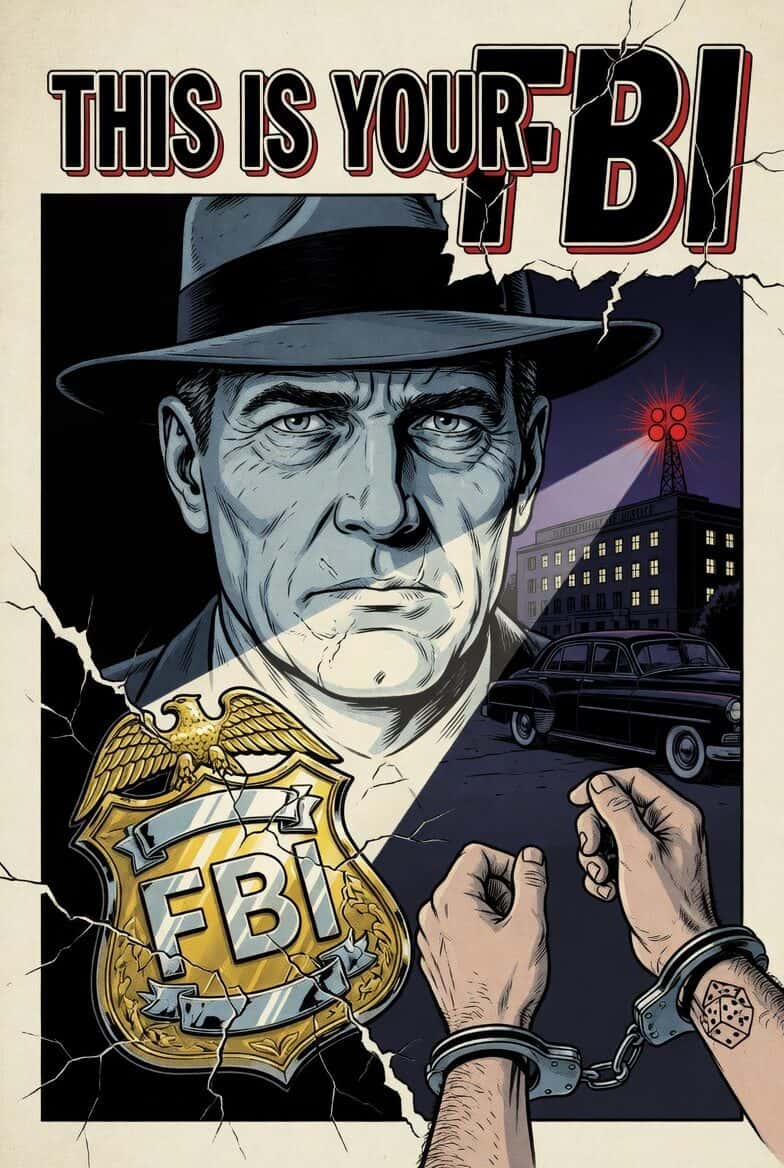
The Equitable Life Assurance Society presents, This is Your FBI. This is Your FBI. The official broadcast from the files of the Federal Bureau of Investigation, presented as a public service by the Equitable Life Assurance Society of the United States, and the Equitable Society's representative in your community. Tonight, right in your own home, the telephone may ring. Hello? Why, yes it is. This is your FBI. Do you know who sponsors that program? Why, of course I do. It's the Equitable Life Assurance Society. Just last week, I got my equitable representative to bring me that fact-facing chart for fathers they tell about on this program. And believe me, that chart is a real eye-opener. So naturally, I know that this is your FBI is sponsored by the Equitable Society. And in just 15 minutes, I'll give all fathers full information about the Equitable Society's fact-facing chart.
that this father found so valuable. Tonight's FBI file, The Baby Big Shot. Tonight's case from the files of your FBI is one involving juvenile delinquency, involving children who are criminals. Juvenile delinquency is a phrase that is misunderstood by many people. Misunderstood because they regard any case in that category as being the result of a childish prank. But they are wrong. For your juvenile criminal of today is not a boy or girl whose ambition is to steal a package of gum from the corner drugstore. Your juvenile criminal of today is capable of any crime committed by his elders. A few weeks ago, a store in New York was held up by an armed robber who shot it out with a New York detective. The detective was seriously wounded. The armed bandit was killed.
The armed bandit was age 16. Tonight's file opens in a town in one of our Midwestern states. At a street intersection in the midtown district of this community, two teenage boys exchange greetings. Hi there, Pete. Oh, hello, Frankie. I ain't seen you around the candy store lately. I don't hang out there anymore. Why not? It's strictly for kids. Oh. You hitching rides? Uh-huh. That truck there looks okay. Yeah, we're just gonna grab onto it. Mind if I come along, Pete? Come ahead. Hey, the traffic light's changing. Yeah, I know. Grab hold. Quick, right. Yeah? You're hanging out with Lefty Davenport now, huh? That's right. Hey, how'd you get in with him? He heard about me. He asked me and... That's a real big gang he's got, huh? Biggest in town. How's chances? For what? For me.
Oh, are you kidding? What's so funny? I'm as smart as you are. What? What about when we used to go to the stores together? I stole more than you did every time. You're crazy. Pete, why can't you send me in to Lefty? Because in the first place, you're too young. I'm 14. Lefty's got a rule. You gotta be 16 or over, you can't join. Ah, that's stupid. Tell him that. Maybe I will. There's a traffic light. Stay back. If I drive, I don't see you. Get off the back of that truck. Uh-oh, the driver's seen us. What's the matter? You hot to hear him? Shut up, you jerk. Why, you... Come on, let's... Okay, that's good enough. Pete, Lefty's gang hangs out in that old barge down on the river, don't they? That's right. Why? I'm going down there tomorrow to see him. Can I see what is Lefty? Yeah, go ahead. Hiya, Pete. Oh, hello, Frankie. Lefty around? Well, he's, uh...
Busy now. Why don't you come? How is it, Pete? Ah, just a kid. I need to meet Pete. Wait a minute. Hiya, Lefty. Who are you? Frankie Moore. Look, punk, get out of here. Not till I talk to Lefty. I said get out. Hold it, Pete. See what he wants. Now, what is it, kid? I want to join up with you. Pete, do you know him? Yeah. I told him yesterday he didn't have a chance. Price Lacey's only 14. So what? You gotta be 16. Is that so, Lefty? Yeah. And all I can say is you don't know how to run a mob. Huh? What difference does it make how old a guy is? What he thinks, what he does, that's what counts. And I can outthink and outdo any guy you got. Let me throw him out. Leave him alone. You mean I'm in? Just done a pass. I don't get it. I'm giving you a chance to go out and do a job. If it's smart enough and big enough, then we'll talk about your joining the organization. At the local FBI field office.
Special Agent Jim Taylor is just greeting a visitor. Hello there, Tom. Hiya, Jim. Good to see you again. Why don't you sit down? Thanks. Now, what can I do for you? Well, first of all, I want you to know I'm not here because of any trouble. Good. I've come to ask a favor. Oh, what's that, Tom? I'd like you to come over to the high school and talk to the students. You mean make a speech? Well, yes. Ah, Tom, look, you know... I know how busy you are, but let me tell you what I have in mind. Okay, go ahead. You see, Jim, as principal of the school, I can talk all year to the students on their responsibility to the community, but these days I'm afraid that isn't enough. Well, it's true enough. For some of the youngsters, good citizenship isn't as glamorous as crime and criminals. That's why I want you to talk to me. Well, what about, Tom? Your job of law enforcement. I think it has more glamour than any dozen criminal adventures. What do you say? Would you do it? Well, personally, I'd be glad to, Tom, but I'd have to get permission from my agent in charge. I see.
He's out of town today. I'll tell you what I'll do. I'll talk to him about it first thing in the morning and then get in touch with him. Who's that? Me, Pete. Where you been? I saw them bags we clipped the other day. How much you get? Forty bucks. Here. Thanks. That kid, Frankie, come here? He the one that was here the other day? Yeah. I didn't see him. I seen him this morning at school. Said he was coming over to see you. Said he was doing a big job. Yeah? What kind of a job? Didn't tell me. What's the story on him? Well, he lives with his mother. He's got a little doll. Is he smart? Feels pretty good. And he thinks he's a big shot, though. You know what he said to me this morning? What? He says if you don't take him in, you'll form his own gang. Is that a fact? Well, that sounds like him now. Let him in. All right. Hiya, Pete. Lefty here? Yeah, come on in. Hiya, Lefty, old boy. What do you want, Junior? I want to talk to you. What about?
The other day, you told me to go out and do something big, right? Uh-huh. Well, I done it. I got the biggest deal... Wait a minute. What's this talk you were throwing at Pete this morning? What do you mean? You told me that if Lefty don't take you in, you'll form your own mob. That's right. Look, Junior, for your information, we've got this town all cut up. Everybody has his own territory. Anyone moves in, we put them out of business. Fast. Lefty, just listen to my deal first, will you? Okay. What is it? It's snatched. Kidnapping? That's right. Wait a minute. You can't do nothing like that. Too late, Pete. I already done it. You snatched somebody? Sure. Sent out the ransom note, too. I asked for two grand. What is it? A rib or something? No. You told me to do something big, didn't you? Who did you send the letter to? My mother. Huh? Who'd you kidnap? Me. Oh, my poor friend. Mrs. Morton. Yes? I realize how upset you are, but...
Well, I'd appreciate it if you could answer a few questions for me. I'll try, Mr. Taylor. When did you find the ransom note? As soon as I came home here. What time was that? Late this afternoon. Have you told anyone about the note other than the police? No, I haven't. Now, when did you see your son last? Sometime yesterday, I think. Aren't you sure? It was yesterday. Yes, yesterday morning. And he hasn't been home since? Oh, he must have been here last night. His bed was slept in. Well, didn't you see? Well, I wasn't home last night. I was visiting friends. Oh, I see. The two of you live here alone, right? Yes, that's right. Mrs. Morton, tell me about your son's habits, what he does, who he sees. Well, he goes to school, high school. Yes. He does all the things that other children do. Who are his friends?
I'm afraid I don't know. Where does he spend his time when he isn't in school? Out playing, I guess. Well, Mrs. Morton, can't you tell me something specific? I'd like to, but... Well, I'm afraid I can't. Look, Mr. Taylor, all I care about is getting him back. What can we do? Can you raise the $2,000? Oh, yes. Well, the note states that if you're willing to pay the money, you should take an ad in the morning paper. I'll do that right away. Good. I'd like to take the note with me, if I may, to send to our laboratory in Washington. And, Mrs. Morton, I want to assure you of one thing. Yes? In all kidnapping cases, our first concern is the safe return of the victim. Our every effort will be directed toward your son coming home unharmed. How'd you sleep, Frankie? Oh, hiya, Lefty. When'd you come here? A little while ago. I just like sleeping on a barge. Oh, okay. I, uh, brought you some buns and some milk. Help yourself. Thanks. Hey, did you get a morning paper? Uh-huh. Did my mother take an ad? Yep. Wow. I'm not reading she'll pay off.
Looks that way. I finally figured a way to get some dough out of her. What a routine I've been going through. Any time I wanted it before, I had to clip it from her purse. Say, you want one of these buns? No, what's the next move, kid? Well, I said in the note that if she took out the ad, then she'd get a phone call telling her where to leave the dough. Hey, I just thought of something. Huh? What? That note you wrote. Won't your mother recognize your handwriting? No, I disguised it good. Besides, she's so busy going out all the time. I don't think she'd know what my regular handwriting looks like. She'd know what your voice sounds like, but you can't make that phone call. Yeah, that's right. Maybe we'll have Pete make it. Think you can trust him? What do you mean? Well, you've seen how he acted about this snatch. He was scared stiff. Better get over that. What if he don't? How's that? Hey, Pete. Still here, Frankie? Yeah. We're really gonna go through with it, huh? Why shouldn't we? That's awful big for us to handle. What did I tell you, Lefty? What do you mean by that?
Frankie, uh, thinks you're scared. I'm crazy. Yeah, that's what I told him. I said you'd go right along with it. In fact, I even told him you'd make the phone call. What phone call? To Frankie's mother. What about? Telling her where to leave the two grand. Wait a minute. I couldn't do that. Why not? Well, she'd recognize my voice. She don't even know you. Well, anyway, I ain't gonna do it. The kid was right. Too dangerous. We could go to prison for life. Are you backing out? You want to call it that? Yes. It ain't that easy, Pete. Huh? You know too much. Lefty, I don't want no part of this. You've got nothing to say about that now. I'm getting out of here. Oh, no, you're not. Frankie, you've got his territory now. We will return in just a moment to tonight's file, which shows how your FBI promotes security for the nation. Now, a word to fathers about security for the family.
Fathers, maybe you're planning to turn a deaf ear to this commercial. Okay, try and do it, for I give you fair warning that you're going to be asked a question that will have you sitting up straight in your chair. Ready? Here it is. If you should die, how would your family get through the critical years until the youngest child finished high school? How long would your wife and children continue to be well-fed, well-housed, and well-clothed? The more you love your family, the more serious thought you'll give to that question. The more determined you'll be to get an answer based on facts. To help you get them, the Equitable Life Assurance Society has prepared a special fact-facing chart for fathers, which has these three advantages. First, this equitable chart is simplicity itself. You can fill it out in five minutes flat. Second, you are guided every step of the way.
by easy-to-understand pictures which illustrate the unavoidable expenses your family will have to meet. Third, when you're finished with this equitable, fact-facing chart, you'll have a clear, accurate, and complete picture of just what income your family would need during the critical years. Say, that's something not one father in a hundred knows. Where do I get one of these fact-facing charts, and how much does it cost? Why, it doesn't cost a cent. The Equitable Society representative in your community will be glad to see that you get this fact-facing chart. Phone him tomorrow or send a postcard, care of this station, to the Equitable Society. That's E-Q-U-I-T-A-B-L-E. The Equitable Life Assurance Society of the United States. And now back to the FBI file, the baby big shot. The future of America lies in the hearts and minds of our children.
But the day will come sooner than you think, when they will have to provide the sinews and the brains for our nation. It is proper, therefore, to look at those in whom our future lies. The record is not a very attractive one to examine, for it shows that of all the crimes that were committed in the United States in the last year, almost half were committed by those who are not yet eligible to cast a vote. That makes the future of the country look dark indeed. But the picture has a brighter side. Because we can change that wave of juvenile crime. It will take work, hard work, and long, tedious hours. But we can make the use of this country tomorrow's good citizens instead of tomorrow's criminals. The choice is up to us. To all of us.
Tonight's file continues at the local FBI field office. Special Agent Jim Taylor is seated at his desk. Special Agent Taylor speaking. Hello, Mr. Taylor. This is Mrs. Morton. Oh, hello, Mrs. Morton. I was just going to call you. Have you received any phone calls? No, I haven't. Well, the paper's only been out for a few hours. I'm sure that when the kidnapper reads the ad, you'll get some word. I hope so. Oh, I've gotten a report back from the laboratory in Washington on the handwriting in the ransom note. Yes? It didn't correspond with the writing of any known kidnapper in our files. Oh, I see. But it's the laboratory's belief that the note was written by a juvenile. A youngster? Yes. So, you see, I think it's very important that we find out just who your son's friends were. One of them could be behind this. Well, I'll make every effort to find out, Mr. Taylor. Fine, Mrs. Morton. We'll do some checking ourselves. And if the kidnapper should call you, please get in touch with us at once. Oh, I will. Fine. Well, goodbye. Goodbye.
You busy, Jim? Oh, hello, Tom. No, come on in. Thanks. I made a special trip here to ask you one question. Oh? Can you make the speech? Yes. Good! I sort of wish, though, it were for a different audience. What do you mean? Tom, I'm working on a case right now that makes me feel that parents are in greater need of instruction in youth guidance than their children are. How would you like to tell a group of parents that? I'd love to. We're having a parent-teachers association meeting this afternoon. Care to drop over? Maybe I will. I was coming by the school anyway. I want to enlist your help. Huh? What for? Well, there's a youngster mixed up in this case I'm working on, Tom. And it's just possible that you could give me a hand in finding out who he is. Glad to. Can I count on your speaking this afternoon? Yes. Ladies and gentlemen, I think we can safely say that the problem of juvenile delinquency today is a problem involving delinquent parents. Every parent made a sincere effort to learn how their child was progressing at school.
where they were playing outside of school, and who their companions were, the problem would be less than material, and the parents would be making a real contribution toward a better tomorrow for America. Now, there are countless suggestions offered, but the best solution for the juvenile crime wave is juvenile crime prevention. And this prevention, like charity, must start at home. That was excellent, Jim. Excellent. Thanks, Jim. All right. Did I receive any phone calls? No, you didn't. Hmm. Oh, look, can you leave, Anna? Yeah. Well, perhaps we can go to your office, then, and start to work. Let's see if we can find out if the young star I'm looking for is a pupil here at your school. That you, Lefty? Yeah. Did you make the call? Uh-huh. Did you talk to my mother? Sure. What'd she say? She said she'd get up the dough. You told her where to leave it? Of course. She said she should make up a package, put it under the Lincoln statue in Memorial Park before 10 tonight. Swell. Where's Pete?
Ah, he started to come, too, so I tied him up. Where'd you put him? Down below. Was he beefing? Plenty. Hey, what are we gonna do about him, Rusty? You know, even after we collect the dough, he can still squeal on it. Yeah, I know. So what happens to him? After we collect the dough, I'll, uh, take care of him. You mean you're gonna... I said I'll take care of him. Now we gotta make plans for tonight. Come right into the living room, Mr. Taylor. Thank you, Mrs. Morgan. First of all, I'll tell you about the phone call. Please do. It came at exactly 4.30. I looked at my watch. Yes. As I told you on the phone, it was a man requesting that I leave the money under the Lincoln statue in Memorial Park. Oh, did it sound like a young man? A boy? No. No. He spoke very gruffly, as though he were attempting to disguise his voice. Well, then obviously you didn't recognize it. No, I didn't. What do I do now? Follow his instructions. And leave the money. That's right.
Nothing will go wrong. As I told you before, Mrs. Morton, we'll do nothing to interfere. We won't make a move of any kind until your son is safely home. I hope that'll be soon. This has been dreadful. Yes, I know. Mr. Taylor, I want you to know that this has made me realize what a failure I've been as a parent. Why, I couldn't even help by telling you who his friends were, what he did. If he's returned to me, Mr. Taylor, I swear I'll never neglect him again.
Okay, Frankie. As far as we go. What happens now? I go into the park and pick up the dough. Uh-huh. You wait here. If I get the dough okay, I'll come back, give you the word, and you head for home. Uh, when do we cut the dough up? You stay home for a couple of days till the heat's off, then meet me back at the barge. What about Pete? I told you I'd take care of him. Well, good luck, Lefty. Thanks, kid. See you later. Just a minute.
Hello, Mrs. Walton. Oh, Mr. Taylor, Frankie's home. I figured he would be. Won't you come in, please? Thank you. Oh, I'm so happy. Yes, I'm sure you are. And I want you to know how much I appreciate everything you've done. Thank you, Mrs. Walton. Oh, where is Frankie? Oh, he's right here in the living room. Please come in, won't you? I'd like so much to have you meet him. Yes, I want to. Frankie? Yeah, Mom? Frankie, dear, this is Mr. Taylor. He's the man from the FBI who did so much to bring you home. Oh. Hiya. Hello, Frankie. I'm going to put him right to bed. He's been through so much. I'm okay, Mom. Oh, Mrs. Morton. Yes? We've recovered your ransom money. Huh? What? The kidnappers? One of them, yes. You mean there was a gang? No. No, only two. I think I will go up to bed. Wait a minute, Frankie. I want you to hear this. Yeah, but I'm tired. I want you to hear who the other kidnapper was. Well? It was you, son. Mr. Taylor, what do you think?
I'm sorry to say, Mrs. Morton, that your son was behind this whole thing. He wrote the ransom note. That's a lie. Frankie, our laboratory checked over compositions written by every student at the high school. They compared the handwriting with the ransom note. And even though you attempted to disguise your writing, certain key letters gave you away. And in case you don't think that's proof enough, Frankie, your companion, Lefty, was picked up on the barge as he was about to dump a boy named Pete into the river. He confessed that you worked together. I'm getting out of here. Just a minute, son. Oh, Mr. Taylor, please. I'm sorry, Mrs. Morton. I wish this could have had a happy ending. But your son has to come with me to see the United States Attorney. Frankie Morton and Peter Scott were both sentenced to a reformatory until they reached the age of 21. Lefty Davenport was turned over to the local authorities and sentenced to serve a term in a penitentiary. And so another kidnapping file was closed by your FBI.
closed because of the invaluable aid given to a special agent in the field by the FBI laboratory in Washington. In this particular case, handwriting experts closely examined 700 essays, closely examined every word on every sheet of paper in their search for the truth. Their reward was the reward every member of your FBI has when a file is closed, the satisfaction that comes with a job well done. In just a moment, we will tell you about next week's exciting case from the files of your FBI. When the breadwinner of a family dies, what are the critical years for his wife and children? The critical years are the years before the youngest child finishes high school. Years in which the home must be kept together. To help you estimate just what income your family would need during those critical years...
The Equitable Life Assurance Society has prepared a special fact-facing chart for fathers. Your Equitable Society representative will be glad to bring you a copy of this fact-facing chart. Phone him tomorrow or send a postcard care of this station to the Equitable Life Assurance Society of the United States. Next week, we will bring you another colorful story from the files of the Federal Bureau of Investigation. Hijackers Incorporated.
The incidents used in tonight's Equitable Life Assurance Society broadcast are adapted...