
The written record
Read the transcript
Read along with the recording · About 22 min to read
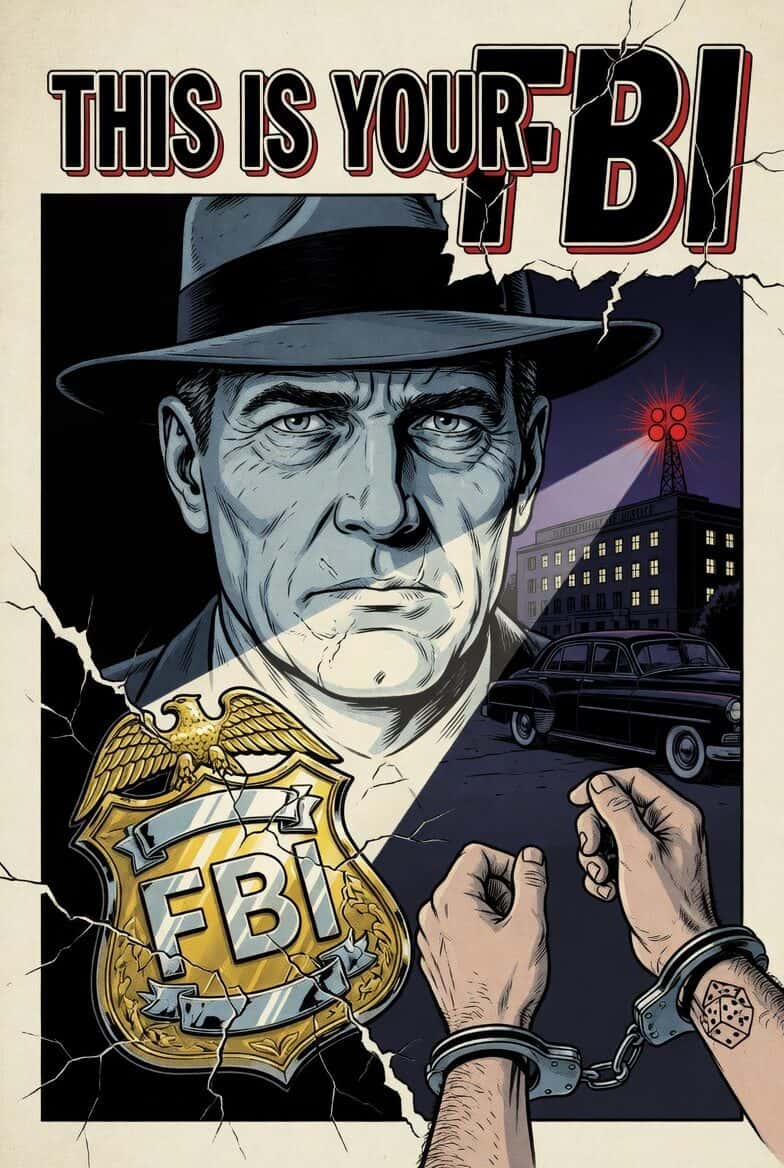
The Equitable Life Assurance Society presents This is Your FBI. This is Your FBI. The official broadcast from the files of the Federal Bureau of Investigation presented as a public service by the Equitable Life Assurance Society of the United States and the Equitable Society's representative in your community. If you're between the ages of 35 and 45, here's a question you've probably asked yourself more than once. Will I be alive in 1975? Well, statistics indicate that right now there are 10 million men and women in this country who are over 65 years old. By 1975, it is estimated that there may be twice as many. And we at the Equitable Life Assurance Society know that age group will consist of people who are in your age bracket right now. Yes, certainly the chances are good you will be alive in 75.
And in 15 minutes, we'll have a suggestion which will show you how life insurance with the Equitable Life Assurance Society can help you make the most of this long life that's ahead of you. Tonight, FBI file, Hijackers Incorporated. Shortly after the middle of January, stories came out of the state of Florida that Al Capone had suffered a stroke. From other sections of the country came countless stories about Capone. Stories that portrayed him as a man who had once known greatness and who lay on a lonely deathbed, deserted by the many he once ruled. On January 25th, Capone died. Ordinarily, death is something to be treated with quiet solemnity. But the counterfeit nostalgia that was aroused by the passing of a man who stood as a symbol of evil was a reflection on the taste of those who shed their tears.
Al Capone was a vicious criminal who lived on the blood of his fellow men. He terrorized entire cities with his mob of gangsters after World War I. It was a disgrace to America. But from his memory, let America learn a lesson and see to it that now, after World War II, we do not allow a new Capone to move in and take over.
The night file opens in a towering office building in New York's Lower Manhattan. In the executive office of one of the suites in this skyscraper, John Baldwin, president of Baldwin Enterprises, impatiently summons his secretary. Ruth! Ruth! I'm coming, Mr. Baldwin. What's happened to this organization? I've been buzzing for you for five minutes. I was on the phone. Well, where's Walter Davis? He hasn't come in yet. I told him to be here at 11 o'clock. You know he's never on time. Well, he'd better change that. I'm sick and tired of it. Yes? Have him come right in. Yes, sir. Ruth, where's our last statement? I have it right here. Good. Good evening, Mr. Baldwin. Oh, come in, Davis. Where have you been? I definitely asked you to be here at 11 o'clock. Giving your ulcer a little workout this morning. Skip the levity. I want to talk to you. Okay, go ahead. I've just been going over a statement of our quarterly earnings. Give me the figures, Ruth. They're 20% less than the previous period. Well, Davis, what do you think of that? I'm not surprised. Why?
The war is over now. Things are getting back to normal. Our expenses aren't. We still have 30 men on the payroll and at wartime prices. Want me to fire some? Of course not. Then that leaves it up to you. What do you mean? Mr. Baldwin, this is your business. I just work here. You know, we can't hijack trucks unless you locate them for us. I'd like to remind you that 10 of the trucks I located in the last two months flipped right through your fingers. You can't steal nothing when the law is standing right over it. We still made five successful pickups, and that ain't a bad average. You can still improve it. I have an assignment for you tonight. Okay, what's the setup? Truckload of imported olive oil. Oh, Ruth, what was that name I gave you? Al Franklin. Oh, yes. Walter, I want Al Franklin to do the job. Okay, I'll tell him. Now, I'd like to remind you that imported olive oil is a particularly valuable commodity. I can dispose of it for a substantial sum of money. So please, don't bungle this one. At you, Walter. Uh-huh.
You called here a while ago? Yeah, I didn't get an answer. I came in just as the phone stopped ringing. Well, anything doing? Yeah, Baldwin spotted a truckload of olive oil. He asked me to give you the job of knocking it off. What's the story? Somewhere near 10 o'clock tonight, the truck stopped at a diner just outside of Newark. One guy on the truck, he goes in to eat, you take over. I see. Do we have duplicate keys? No, he just crossed the ignition wires. Say, is olive oil weightless? Yes, a good score. Uh, what about us? Do we steal a little too? Yes, sir. Use the regular routine. Stop off here at our drop first, unload a few cases, then move on down to Baldwin's warehouse. Right. And don't get greedy. Don't take more than ten cases. Remember, Baldwin's paying us to steal for him, not from him. The following day, in the New York field office of the FBI...
Assistant to the agent in charge, Edward Garland, has just summoned Special Agent Jim Taylor to his desk. You wanted to see me, Mr. Garland? Yes, Jim. Sit down. Thank you, sir. I've just been talking to the New Jersey State Police. Yes? A truckload of olive oil was hijacked last night outside of Newark. Oh? The truck was found early this morning by the New York Police. It had been emptied and abandoned in the Brownsville section of Brooklyn. Any trace of the hijacker? No, they made a clean getaway. Any leads? Nothing as yet. That's the fourth hijacking over there in the past three weeks. Yes, I know it. I don't think there's any question, Jim, that we're dealing with an organized gang. The pattern has always been more or less the same. The truck movements were spotted, no violence. And in each case, the truck was found abandoned in Brooklyn. Right. Come in. Mr. Garland. Yes, Henry. Our Newark office just called. Yeah? They've located a witness who saw the hijacker drive the truck away last night. He believes he can identify him. Oh, Henry, why did he wait this long to turn in the information?
He didn't know if the truck was being stolen until he read about the theft in this morning's paper. Oh. Newark will get in touch with us as soon as this witness has gone through the files. Fine. Uh, Jim. Yes, sir? I want you to go over to Brooklyn and check that abandoned truck. Examine it carefully, then report back here to me. Good morning, sweetheart. Morning, Walter. Baldwin in? Yes, he's expecting you. How's his disposition? Terrible. That's right. Well, I guess I'd better go on in. Okay. How are you this morning, Mr. Baldwin? Hello, Walter. Well, everything worked like a charm last night. Franklin knocked off the olive oil, put it in your warehouse, drove the truck to Brooklyn, left it there. Yes, I know. Pretty good haul, too. Must be worth about 10 Gs. It could have been worth more than that. What do you mean? As you probably have gathered, I pay the informers who tip me off about the trucks we later hijack. Yeah? They generally let me know the approximate value of the load. Uh-huh. Lately, there have been several discrepancies between what I had been promised.
What actually turned up at the warehouse. You mean they gave you the wrong information? That was my first impression. But then I noticed that in each instance where these discrepancies occurred, the man who'd hijacked the truck was Al Franklin. Well? On last night's job, I obtained the exact number of cases of olive oil that were loaded in that truck before it started out. That's why I requested that Franklin do the job. Yeah? His delivery to the warehouse was 20 cases shy. 20? cases. Walter, I will not countenance thieves working in this organization. No, no, of course not. You're running a legitimate thrift here. Exactly. Well, look, what do you want me to do with the guy? I'll handle this. I intend to conduct a thorough investigation. Find out if anyone else is working with him. I can do that for you. I'd rather do it myself. Arrange to have him meet me at the warehouse tonight. Garland, may I come in? Yes, come ahead, Jim. Thank you, sir. Well, how'd you make out?
Well, I spent about two hours going over the abandoned truck. Any results? I picked up a number of sets of fingerprints, but I have a hunch that they belong to the men who legitimately worked around the truck. Yeah, that's probably true. There were no prints at all on the steering wheel or gear shift. They'd all been carefully wiped off. What did you do with the prints you did get? I sent them on to the identification division in Washington. Good. Oh, have you heard anything from Newark? Yes, they called about a half an hour ago. The witness identified a picture in their file. Oh, it seems certain it's the man he saw drive away in the truck. Who was it?
A small-time hoodlum named Al Franklin. Has a long record. Has he ever been mixed up with hijacking before? No, but he's always worked with an organized gang of some sort. Any idea where he can be picked up? I just checked on that. And? I got a report that he's living right here in New York City. Did you get an address? Yes. I want you to get right over there. All right, sir. Jim. Yes, sir? I'm certain that Franklin is only a small cog in this hijacking set, but he could tell us who the big fish are, so let's get him in here. Who is it? All right, come ahead. Okay. Why don't you use your key, Al? I forgot it. Hey, what's with the hurry call? I had to see you. Yeah? What for? You got trouble. What do you mean? First of all, I told you not to get greedy. I said take no more than 10 cases. Okay, okay. So I took a few more. Yeah, so you took a few. You took 20. That was too much. Why? Baldwin knows you clipped him. How? He told me today he's been suspecting you right along.
He found out how many cases the truck was carrying before he put you on the shelf. You mean it was a frame? That's right. He wants to see you tonight at the warehouse. Yeah? What about you? I'm clean. You mean that's what he thinks? Yep. Well, what do I do? I got that all figured out. Yeah? We can't keep the date at the warehouse. I don't want him to find out about this little drop we got there. Mm-hmm. What then? Well, like I told you, Al. I'm clean. I want to stay that way. So? So Baldwin don't talk to you. Ever. Sorry, Al. We will return in just a moment to tonight's file, which shows how your FBI helps provide security for your country. Now let's talk briefly about security for those who want to be independent as they grow older. Don't make me laugh, Mr. Cross. You know how taxes and the cost of living have gone up.
Well, the only man who can be independent as he grows older is the fellow who's already got a big bank account. Ah, that's where you're wrong. Thousands of men, many of them earning much less than you, are looking forward to complete independence in their 60s through an Equitable Life Assurance Society Independent 60s Plan. Well, I'm from Missouri, Mr. Cross. You've got to show me how this plan works. The Independent 60s Plan of the Equitable Life Assurance Society has these three features. First, it costs... considerably less than you probably think, especially if you're covered by Social Security. Second, you can create your retirement estate for the full amount the moment you sign the contract. You don't spend years wondering whether or not you're going to accumulate enough money to be independent in your 60s, guaranteed by the Equitable Life Assurance Society. Third, this equitable plan gives you a definite goal and provides you with a method for reaching that goal.
Yes, there's nothing finer than being independent in your 60s, being your own boss, able to do the things you've always wanted to do. Say, I'd like to know more about this. Then I suggest that you get in touch with an equitable life assurance society representative. He'll give you the facts on the independent 60s plan and let you make up your own mind. Look in your phone book for the Equitable Society. That's E-Q-U-I-T-A-B-L-E. Or send a postcard, care of this station, to the Equitable Life Assurance Society of the United States. And now back to tonight's file, Hijackers Incorporated. This case history from the files of your FBI contradicts the fallacy of longstanding that the ordinary citizen has believed and repeated.
That fallacy is that there is honor among thieves. The simple truth is that honor indicates a certain strength of character and the possession of an ordinary set of morals. But your average criminal does not have the strength of character to resist the temptation to break the law, and he is possessed of no moral stability. Loyalty, the devotion of one human being for another, is beyond the understanding of the criminal. for his very business is taking what does not belong to him. He has rewritten the ancient proverb, and his version says, it is much more blessed to receive. Tonight's file continues in the New York field office. Special Agent Jim Taylor is just reporting to the assistant to the agent in charge, Edward Garland. How did you make out, Jim? Well, as you can see, I didn't bring Franklin back with me. Yeah. Did he live at that address? Yes.
It's a rooming house, but he'd gone out about an hour before. Why didn't you wait for him? Well, Jennings came along with me, sir. I left him there. I wanted to follow up another lead. Oh, what was that? Well, the landlady let me into Franklin's room. I searched it, and lying on the dresser, I found an envelope marked storage. Yeah? It was open. I saw it contained a key. It was made by the Sheffield Key Company. They're right here in the city. An envelope marked storage? That's right. That made me think the key might possibly have something to do with the hijacker's loot. So I contacted the key company. Could they give you anything? Well, their records show that the lock the key fits was sold to the Phoenix Hardware Company. They're up on West 24th Street. You check with them? Henry's not doing that now, sir. I thought I should report back here to you. We'd better alert the local police in case Franklin decides not to come back to that rooming house. I've already done that. Oh, good. Yeah. Can I see you, Mr. Garland? Yes, come in. Oh, hi, Henry. How'd you make out? I've got a report on that lock. What is it? It was sold to a man named Walter Davis.
The hardware store installed it for him. Where? A small garage on West 56th Street. Did you get the number? Yes, sir. Here it is. Oh, Mr. Garland, we've had dealings with a man named Walter Davis before. I talked to him about, oh, three years ago on that Westside bank job. Oh, yes, I remember. We didn't get anything on him. He's a pretty clever operator. Henry, dig up a copy of Davis' record from the file. See if you can find out where he is and what he's doing. Yes, sir. Jim, we're going to get a search warrant and go over to that garage. The garage obviously isn't being used. Now, try that key in this door. Okay. Let's go on. Let's go in. Yes, sir. Got your flashlight? Mm-hmm. Thank you. Doesn't seem to be anyone around. No. Look, Jim. Huh? All those packing cases over there. Yes. Let's have a look at them. Right. Shine your flashlight on that label. Yes, sir. Well, you've come to the right place. Cases of Oliver. Yeah, the same trade name as that shipment that was hijacked.
There's less than two dozen cases here. This can't be the main drop. No. Say, look here. Cardons of Inuitu. Well, that pinch is that a truck that was hijacked two weeks ago carried tires and tubes. I'm going out to call the office. Oh, wait, Mr. Garland. There's a phone right over there. Oh, fine. Jim. Huh? Look here. A body? Yeah. Have a look at it. Shot through the head. Say, that's Franklin. Al Franklin? Yeah. Are you sure? Yes. When that man in Newark identified him, I got his picture out of our files. Jim, would you get the office on the phone? Yes, sir. I want to find out what Henry's got on Walter Davis. He could be an important man in this case now. Yeah. Hello. Mr. Garland wants to talk to Henry Marsh. Just one moment. Hey, Oscar. Thank you. Hello, Henry. This is Mr. Garland. Yes, sir. What did you find out about Walter Davis? I got his record from the files on your desk here in New York City. Did you get an address? Yes. You want me to pick him up?
No, but arranged to have him put under 24 hours surveillance. Ruth? What is it, Mr. Baldwin? Well, where were you this time? I didn't know you were back from lunch. That's no excuse. Did I get any calls? Yes, Walter Davis phoned about half an hour ago. Where is he? I've been trying to locate him all morning. He's at the warehouse. Did he say anything about Al Franklin? Just that he'd been looking for him and couldn't find him. I wonder why Franklin didn't show up at the warehouse last night. Maybe he found out why you wanted to talk to him. Who could have tipped him off? Mr. Davis. What makes you think that?
Female, huh? You could be right. Get Davis on the phone. Are you going to accuse him? No, not until I have proof. I want to talk to him about another job tonight. Have you got a truck spotted? Yes, so get him for me. I want to give him the details. Garland. Yes, Jim. I have a full report on Walter Davis' activities. Good, let's hear it. Well, first of all, we've definitely linked him with Al Franklin. How? Well, they've been seen together around town. Well, that doesn't say he committed the murder. No. Well, anyway, when he left his hotel today... Davis went to a large warehouse down on West 18th Street. He stayed there most of the afternoon. Did you check on the warehouse? Yes, it's owned by a man named John Baldwin. Baldwin's being investigated now. Our preliminary report on him is that he's a legitimate businessman. Ah, I see. Baldwin has leased the warehouse to a corporation we're looking him up to. Where did Davis go after he left the warehouse? Well, then he had dinner at a Midtown restaurant. I left him there in Jennings, Dakota. Mr. Garland? Yes, Henry? A report just came in from the New Jersey State Police.
A truckload of sugar was hijacked near Elizabeth less than an hour ago. Oh, Henry, has Jennings checked in recently? Yes, he called ten minutes ago. Davis is still in the restaurant. Well, that eliminates him having hijacked the truck. Well, after reading over Davis' record, I don't think he'd be doing the actual work. But it still could have been done by one of his gangs. Well, if that's true, the stolen truck could be heading for the warehouse that we trailed into. That's just what I was thinking. Jim, I want to set up a cordon around that warehouse. If that truck should move in there, I think we could clean up this whole case.
Mr. Garland, I've got the car in a parking lot right up to the warehouse. Any action yet? No, sir. Everything's quiet. Where's Marshall? Oh, wait a minute. There's a cab pulling up to the warehouse. It's David. He's going inside. No. No, he's alone. But there are other people in there. I've seen them through a window moving around. Hold it, Jim. Yes, sir. Did Marshall pick it up? He's staying well behind. Wait. There's a truck coming down the street now. It's slowing down. Swing up in front of the warehouse. Swiper just blew his horn. It's evidently a signal. The doors are opening. Going inside. That's all we need. I'll notify all cars. We're moving in. Good evening, Walter. What are you doing here, Mr. Baldwin? Waiting for you. Close the door. Okay. Thought you didn't like to be around the warehouse when we moved stuff in. I don't. I made an exception tonight. How come? I want to talk to you about Al Franklin. Well?
According to the afternoon papers, his body was found yesterday in a small garage on West 56th Street. Hey, no wonder he didn't show. Papers also stated that the authorities found numerous articles there that had been recently digested. Well, then you were right about him. Partly. I finally realized he wasn't smart enough to have been doing this alone, so I checked up on that garage. I found it had been leaked to you. What is this? It's quite obvious, don't you think? Franklin was merely the scuse. By killing him, you hope to clear yourself with me. That's a lie. Walter, you know my attitude towards thieves. I'm afraid I'm going to have to deal with you just as you dealt with him. I'm going to have to. What's that? I don't know. Hey, what's going on? Where are you at, Davis? Huh? What's the trouble here? I don't know this guy, Mr. Baldwin. I'm a special agent of the FBI. We're taking over your business, Mr. Davis. I must say, finding Mr. Baldwin here makes the evening a complete success.
Walter Davis was turned over to local authorities who tried and convicted him of first-degree murder. The ringleader of the gang, John Baldwin, was sentenced to serve 15 years in a federal prison. Other members of his organization were also sentenced to long terms in the penitentiary. And now we have a statement about tonight's case from the files of your FBI by Mr. J. Edgar Hoover, director of the Federal Bureau of Investigation. Mr. Hoover said, and I quote, One of the serious problems concerning the law enforcement agencies in the United States today is the prevalence of hijacking. It has cost Americans in the past year millions of dollars. We of the Federal Bureau of Investigation are straining our every effort to break up the rings of hijackers. For just as your FBI is responsible within the limits of federal laws for maintaining your freedom of speech and your freedom of religion and your other freedoms granted under the Constitution, So, too, are we charged with maintaining your freedom of the highway. We intend to make it plainer than ever before to those with criminal tendencies that we will operate in 1947 on the same policy as in the past, the policy that crime must not be allowed to pay. In just a moment, we will tell you about next week's exciting case from the files of your FBI.
A little while ago, I gave you a few brief facts about the independent 60s plan of the Equitable Life Assurance Society. To get full information, you'll want to ask your Equitable Society representative questions like these. Exactly how much will the plan cost me? The Equitable Man has the answer. How will it dovetail with my Social Security? He's got the answer to that, too. What income will it give me in my 60s? Your Equitable Society representative... We'll give you the exact figure. Ask him to drop around tomorrow for a friendly visit. Find him in the phone book or send a postcard care of this station to the Equitable Life Assurance Society of the United States. Next week, we will bring you another colorful story from the files of the Federal Bureau of Investigation. Death in the desert. The incidents used in tonight's Equitable Life Assurance Society's broadcast.
are adapted from the files of the Federal Bureau of Investigation. However, all names used are fictitious, and any similarity thereof to the names of persons living or dead is accidental. Tonight, the music was composed and conducted by Frederick Steiner.