
The written record
Read the transcript
Read along with the recording · About 23 min to read
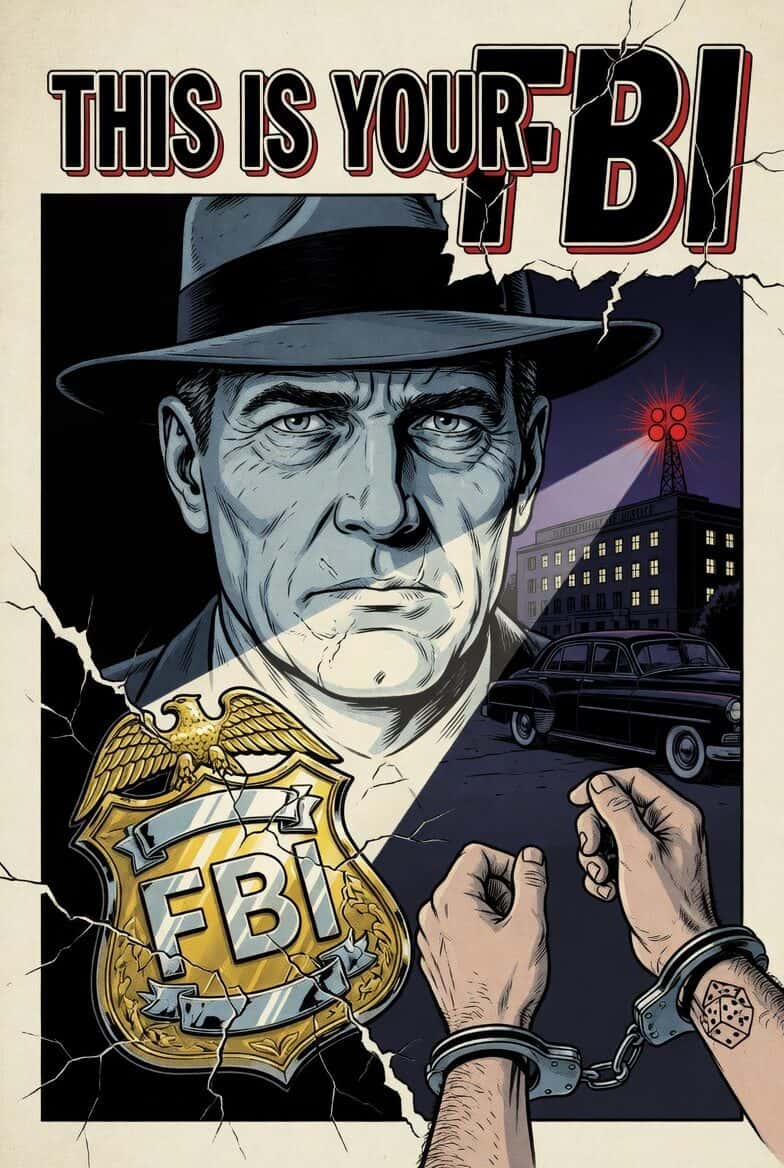
The Equitable Life Assurance Society presents, This is Your FBI. This is Your FBI. The official broadcast from the files of the Federal Bureau of Investigation. Presented as a public service by the Equitable Life Assurance Society of the United States and the Equitable Society's representative in your community. It can happen to you tonight, right in your own home. Suddenly the telephone bell will ring. Yes?
Why, yes, it is. What is? It's This Is Your FBI, just starting. Do you sponsor that program? Sure I do. It's the Equitable Life Assurance Society. I listened last week and heard about the Equitable Society's fact-finding chart for fathers and mothers. My Equitable Society representative brought me a copy. So naturally I know that This Is Your FBI is sponsored by the Equitable Society. In about 15 minutes, I'll be back with full information about the Equitable Society's... Fact-finding chart for fathers and mothers. Tonight's FBI file, The Out-of-Date Killer. The citizens of America like to think that because there is no daily story of the exploits of a gun-crazy criminal like John Dillinger on the front pages of their morning newspapers, that the era of the gang has passed. Nothing could be further from the truth. And not only are gangs of criminals operating in almost every section of the United States today, but in many instances they are composed of the same gangsters who were operating during the Prohibition era. There is one difference between the gangster of the late 1920s and the top criminals of today. The current version is no fast-talking thug with a broken nose and a cauliflower ear. Somewhere in the years between then and now, he has acquired an almost genteel quality. In spite of his monogrammed shirts and his manicured nails, however, He still remains a menace to you, the decent citizen. If through your law enforcement agencies, both local and federal, you do not wipe him out, then you in turn will be wiped out by him. For the war against crime is a war of survival. Tonight's file opens in a large Midwestern city. It is late afternoon as two men walk toward a room located in the rear of a bowling alley. Both men are middle-aged, but one is well-dressed and dapper.
The other is ill-kept, and as they walk, he says... You own the bowling alley, too, Frank. I own the whole building, George. Pretty good. Well, wait till you see this horse room. A man can lose his money here in real comfort. Go ahead, George. Thanks. Hey, this is quite a joint, Frank. You remember Joe Essex? No, I don't think so. Well, maybe he came around after you left. He runs this place for me. Oh, Joe. Oh, hi, Frank. Looks like a pretty good day for us. Yeah. Joe, I'd like you to meet George Mundy. Hiya, George. You've probably heard me speak of George. Yeah. He just got out of Hotel Leavenworth. He did 18 down there. I want you to give George a job. At doing what? I used to be pretty good at collecting. Well, George, we don't use that kind of muscle anymore. I'll find something for him, Frank. Leave it to me. All right, you're in, George. And once you get to know how we operate these days, you'll be just as big a man as you were before you went away. Well... Well, I've got to be going now, fellas.
I'll see you both later. Don't you want to stick around and watch the action, Frank? Oh, no, no. I've got to run, Joe. I've got a date in 15 minutes with the mayor. The following afternoon at the local FBI field office, Special Agent Jim Taylor is just entering the office of Agent in Charge Davis. Sent for me, sir? Yes. I'd like you to meet Lieutenant Jenkins, Mr. Special Agent Taylor. Now, how are you, Lieutenant? Lieutenant Jenkins is a graduate of the FBI Academy. Oh, why? Lieutenant, why don't you tell Taylor what you've been telling me? All right. Mr. Taylor. How much do you know about a man named Frank Adams? A lot of things I can't prove. And we're both in the same boat. I don't think there's any question about the fact that you can't make a bet on a horse in this town without having it go through a handbook that's either owned or controlled by Adams. Right. And my big gripe is, if one of my men raids a horse room without a search warrant, the evidence is not allowed in court. If he goes and gets a warrant first, the horse room is closed by the time he gets there.
Well, Lieutenant, you and I both know that an organization like Adams can't operate without political protection. Sure, but if we work on this thing together, I think maybe we can do something about it. Oh, I'd like to work on it with you very much. Jim, I've already explained to the Lieutenant that we can't do anything officially unless there's been a violation of a federal statute over which we have jurisdiction. However, I want you to give the Lieutenant all the unofficial help you can. I'll be happy to, sir. Fine. I've got to check in down at headquarters now, but I'll be back to see you first thing in the morning.
Hi, Frank. Huh? Oh, hello, Joe. Your secretary said it was okay for me to poke my head in. I'm glad she did. Come in, come in. Okay. A little slow at the horse room? No, but something's come up. I thought I should come over and spill it to you. Oh, what is it? You kind of handed me a hot potato when you gave me that guy George Mundy. How? Two new buildings just went up over on 10th Street. I sent George over to see if he could handle the horse business. Well, how did he make out? Made out fine. He got the horse business. Well, then what's your complaint? He slammed the elevator starter in one building and the old guy runs the newsstand in the other. I told him not to use any muscle. Yeah, he's got the cops on him, too. Huh? For what? I don't know. That Lieutenant Jenkins came around this afternoon. Lucky I got word he was coming. Had the room all closed by the time he got there. What did he want? He asked me if George Mundy was working for me. You told him no? Sure.
Then he said, when you see Frank Adams, tell him I think it's my turn now. Oh, I figure he's got something. Yes. You better get Mundy, bring him here to my office tonight. And don't worry about that cop, Jenkins. I've got something in mind for him, okay? You busy, Taylor? Oh, hello, Lieutenant. I think I've got something on Frank Adams. Hey, that's great. What is it? An old man came to see me this afternoon down at headquarters. He runs the newsstand in that new building down at 10th and Olive. Oh. He'd just come from seeing his doctor. Seems that he was badly beaten up the other night. By Frank Adams? No, not by Adams directly. A hoodlum came in and ordered the old man to put in a handbook and handle the horse business for the tenants in the building. I see. I took the old man over to the rogues' gallery, and he went through the files and picked out this picture. I don't recognize him. Who is he? Name is George Mundy.
He just got back into town after serving 18 years. Used to be a good friend of Frank Adams back in the Prohibition days. Oh, well. I've got a warrant for Monday's arrest, and I'm going out to pick him up now. I wish I could go with you. Monday does talk. I think maybe this time we'll be able to keep going and get an airtight case against Adams. Now, this is Frank's office here. Frank? At you, Joe? Yeah. I'm back here in the conference room. Come on, George. George with you? Yeah. Oh, come in, boys. Come in. Sit down. Sit down. Okay, thanks. Cigar, George? No. You want one, Joe? Help yourself. Right. What's all this about, Frank? This meeting? Yeah. Well, I asked Joe to bring you up here so I could straighten out a couple of things for you. Yeah, like what? Well, the other day when you first came back, I tried to explain this whole operation to you. I understood that. No. No, I don't think you did, George.
You're under the impression that we still work like we did in the old days. Look, why, all the time knocking the old days, we did pretty good then, didn't we? We do better now. We're all part of a team, George. No more muscle men, no more rugged individuals. If anybody in the organization needs a gun, he tells me what he wants it for. I give him one from that ball fair. He checks it out like a book in the library. You see, George, We operate altogether different today. Now, take Frank, for instance. Instead of kipping up in a broken-down hotel room, he lives in a 20-acre house in the country. Like an estate. Look at his wardrobe. You saw him on the street, you'd figure him for a banker or a businessman. Well, what are you trying to prove? George, remember Fred Bristol? Sure, he used to run policy slips. That was 18 years ago. He's not running policy slips now.
He owns a brewery on the north side. And last year, he threw a $15,000 party when his daughter got married. The best people in town were there, George. You remember Charlie Snyder? Yeah, a trigger man. He worked for me. He's not a trigger man anymore. Charlie controls every jukebox in town, and he lives on a big estate out near mine. Why, the place must have cost him better than $100,000. So everybody's doing good but me. Is that what you're trying to say? No, no, no, George. I'm trying to tell you that we're all doing good because we run our affairs in a business-like way. We've got the best lawyers in town, the best tax experts, the best politicians. And they're all on our side. And you know why, George? We pay them off. In the old days, we used to sell protection. Now, we buy it. See? I see. But I don't go along with it.
Look, George, we can't have you using muscle. I'll operate any way I want to. Not for us. Who needs you? 20 years ago, you worked for me. George, the meeting's over. Yeah, you're right, it is. Let me tell you one thing, Frank. Before I quit, you'll be working for me again. Working the old-fashioned way. My way. Joe? Yeah? George is in favor of using the old-fashioned way, so I think we ought to oblige him. What do you mean? Get a gun out of the vault and follow him. We will return in just a moment to tonight's exciting case from the files of your FBI. Now, listen. Hear that clock? By the time its second hand has traveled a full circle, in hundreds of homes, husbands will turn to their wives and say, That fact-finding chart for fathers and mothers the Equitable Society is offering sounds like a mighty good thing. Remind me to phone an Equitable Society representative and ask him to bring us a copy.
Yes, for six weeks, the Equitable Society has been offering this fact-finding chart for fathers and mothers. And every week, the number of requests for free copies has been enormous. Here's why. I like the idea of getting an accurate figure on the monthly income my family would need if I should die unexpectedly. I can only guess at that figure now. But once I know what it is, I can take steps to make sure that my wife and children will continue to live in comfort and security. no matter what happens to me. With the Equitable Society's fact-finding chart for fathers and mothers, you'll have that figure in no time at all. This chart is simplicity itself. You're guided every step of the way by easy-to-understand pictures. In five minutes, you'll know exactly how much money your family would need during the critical years until your youngest child finishes high school. So phone your Equitable Society representative and ask him to bring you a free copy of the fact-finding chart for fathers and mothers.
Or send a postcard care of this ABC station to the Equitable Life Assurance Society. Your request will be forwarded to the nearest Equitable representative. Yes, if you truly love your children, you will not let another day tick away on the clock without sending for the fact-finding chart for fathers and mothers prepared for you by the Equitable Life Assurance Society of the United States. And now back to the FBI file, the out-of-date killer.
There are very few large American cities in which you cannot with comparative ease make a bet on a horse or buy a policy slip. That is a grave situation, and the crimes which spring from it are legion. That such a situation does exist is beyond question, and it exists because you allow it to. It is a truism in law enforcement circles that organized bookmaking and the organized sale of policy slips cannot exist anywhere without political protection. on the local government level. Possibly you're asking how you contribute to that state of affairs. If you check the voting records of your community, you will probably find that the situation there is the same as it is throughout the country. The number of votes cast in purely local elections is approximately 50% of the number cast during presidential election years. That means that you, the voters, are exercising your all-important right to cast a ballot.
approximately once every four years. That is not enough. If you are sincerely interested in seeing to it that your local police go unfettered by political ties, then investigate the background of every local candidate at the next election. And after that investigation, go to the polls and vote. For only in that way can decency triumph in a democracy. Tonight's file continues the following morning at the local FBI field office. Mr. Davis, Lieutenant Jenkins was up to see me last night. He seems to be making some real progress. Oh, that's fine. He's going to arrest a man named George Mundy who was mixed up in Adams' bookmaking operations. Oh, I remember Mundy. I was a special agent in this office when he was arrested. Oh? Well, this Mundy beat up an old man who runs the newsstand in the building at 10th and Olive. The old man has identified Mundy and is willing to testify against him. Yes, that's the most difficult part of the job, getting a decent citizen to go to court and testify. Pardon me. Certainly.
Agent of Charge Davis speaking. Yes, Captain. I see. Yes. Mm-hmm. Yes, that does come under our jurisdiction. What's that? Why? I see. Oh. Yes, thanks for calling. Bye. Jim, that was police headquarters. There was a body found. It was riddled with bullets. They've just made the identification. Who was it, sir? George Monday. He was in a stolen car that was parked on the inside boundaries in the National Park, and that makes it a federal crime. Well, it's a tough break for Lieutenant Jenkins. Now he's got to start all over again. I'm afraid he won't get the chance. Lieutenant Jenkins has been suspended from the force. Why? When the police went through George Monday's pockets, they found an envelope that had been torn open. On the face of it was typewritten, Lieutenant Robert Jenkins, $3,000. He wouldn't take money from anybody.
Well, I'd have said the same thing ten minutes ago, but across the face of the envelope was Lieutenant Jenkins' signature. Lieutenant Jenkins is down here on the right-hand side, Mr. Taylor. Thanks. I'll open it up and then leave you two alone. Thanks very much. Uh, just don't say anything at the outside desk about it. Okay. Hello, Lieutenant. Oh, hello, Taylor. I got down here as soon as I could. I appreciate that. Oh, Lieutenant, do you think the handwriting experts will be able to prove that it really isn't your signature on that envelope? No, they won't. It is my signature. It's what? You mean you actually signed that envelope? Yes, but there wasn't anything on it when I signed it. What made you do it? I came out of headquarters yesterday. An old lady came up to me and asked me to sign a petition to increase the pension for the widows of policemen and firemen killed in line of duty. I took a quick look at the petition and signed it. What happened? She must have pulled the old gag on me. Had me sign the envelope when I thought I was signing the bottom of the petition.
Lieutenant, how many con men have you arrested for using that old trick to get somebody's signature? Probably 50. Well, then how could you fall for the same thing yourself? Taylor, I don't know. Well, Lieutenant, I believe you. But I'm afraid it's going to be awfully tough to get a jury to believe you. Yeah. Well, I'm going down to the morgue now and look at George Mundy's effects. Then I'm going out and take a look at the car he was found in. If I can get a lead on who killed George Mundy, maybe I can untangle your case at the same time.
Sorry I'm late, sir. I've been up in the file room. Jim, I've just gotten a report back from Washington. Our friends at the paper wire-photoed pictures of those shells you found near George Monday's body to the lab. I see. They checked through the unidentified ammunition file and found tentatively that the bullets which killed George Monday were fired from the same gun that killed a policeman two years ago. Oh? Where was that, sir? Well, there was a raid in a gambling house called the Club Dover. By the time the police arrived, the place was closed. Lieutenant Jenkins, who conducted that raid, sent one man around to check the back door.
He's the one who was killed. Who owned this club, Dover? Why, it was owned by a corporation. Allegedly, it was Frank Adams' place, but the police could never prove that. Ah, I see. Lieutenant Jenkins told me that story the other day when he was up here by way of explaining why he was so anxious to get Adams. And now, instead of getting Adams, it looks as if Adams has gotten him. I was down to see him yesterday morning before I went out and found those cartridge cases. I see. He told me that an old lady got him to sign the envelope by making him think he was really signing a petition. You know, if we could locate that old lady, sir, we might be able to corroborate that story. Pardon me. Agent in charge Davis speaking. Yes, he's here just a minute. It's for you, Jim. Thank you, sir. Hello. Hey, you did? That's fine. I'll be right up. Yeah, thanks very much. Goodbye. We don't have to find that old lady now, sir. The lab just proved that Lieutenant Jenkins was telling the truth. Did you want to see me, Joe?
Oh, yeah, Frank. I must have left 20 messages around town for you. Well, what's all the excitement about? We might be in big trouble. What kind of trouble? I got word a couple hours ago. Jenkins got out of jail. How could he do that? You know the envelope we planted on him? Yes. Well, the guys from the FBI proved that the carbon in the pencil markings was underneath the ink from the typewriter ribbon. So what? So they proved that the typing was done after the signature was placed on the envelope and not before. Oh. That's trouble, Frank. Those guys from the FBI can't be fixed. What do we do? I think maybe we ought to take a little vacation. Someplace out of town. That's a good idea. I've got some things to clean up at my office before I can get away. Meet me there in an hour. Well, Lieutenant, how does it feel to be a free man again? Taylor, I'll never be able to tell you how much I appreciate this. Don't tell me. Tell the technicians in the laboratory. They're the ones who did all the work. Wish they could help me get something on Adams. Maybe they have. What do you mean?
The men at the lab in Washington found that the bullets that killed George Mundy were fired from the same gun that killed that policeman on the raid on the Club Dover two years ago. That only tells us what we already know, that Adams was behind both murders. What it doesn't tell us is how we can prove it. One way is to find that gun. I've been trying for two years to do that. We may be getting closer now to where it is. We've got a crew of men out trying to piece together George Mundy's movements on the night of his murder. I see. Say, did you get to talk to Adams at all yesterday? Oh, yes. All right, his alibi is airtight. That would be. He was in his office at 9 o'clock that night. He didn't leave the building until well after midnight. Three cleaning women and two elevator men saw him. Now, that building is owned and operated by the security bank, so we've got to assume that those cleaning women and the elevator men are telling the truth. Yeah, I'm sure they are. And from the coroner's report, Lieutenant, we know that George Mundy died at approximately 11 o'clock that night. I never thought that Adams committed the murder himself, but if we could prove... Now, pardon me. Special Agent Taylor speaking.
Yes, Keith. Hey, you have? What time? Hmm? Thanks very much, Keith. See you later. That's one of the men who's been checking on George Mundy's movements the night he was killed. What did he find? He found that Mundy went to the security bank building at 9.30 that night. Come on, let's go over there. Is that you, Joe? No, Mr. Adams, it's not. Huh? Oh, hello there. Remember me? Yes, yes, you're from the FBI. Come in, come in, sit down. Have a cigar or a drink? No, thanks, Mr. Adams. This isn't a social call. Oh, I've got a warrant here for your arrest. But there must be some mistake. Well, here's the warrant. Would you like to read it? What's the charge? Murder. Oh, now I know it's a mistake. You don't have to make any statement if you don't want to, Mr. Adams, but I should tell you that anything you do say will be used against you. I know that. Exactly who am I accused of killing? Two people.
The first is a policeman at the Club Dover two years ago. Now, that's ridiculous. Oh, why do you say that? If you were able to prove that I killed a policeman two years ago, you wouldn't have waited this long to arrest me. Nobody was able to prove it then. And they can't prove it now. Who else am I supposed to have killed? George Mundy. That's even sillier than the other charge. I found out about his death in the morning papers. You can tell all that to the United States Attorney, Mr. Adams. I will. I'm a legitimate businessman now. And I won't stand for any interference from some cop who's trying to make a reputation. I'll admit that during Prohibition, I was mixed up in a lot of things that weren't quite legal. But the statute of limitations has run out on them. Taylor, I've got Joe Essex here. Good work, Lieutenant. Come on, Essex. Found him just entering the outer office. Anything on him? Yes, this gun. And unless I miss my guess, this is the .38 caliber Colt we've been looking for. It ain't mine. Shut up. They can't prove anything. Oh, I don't think we need any confessions, Mr. Adams.
I'm pretty sure we've got enough now to get convictions against both of you on charges of first-degree murder. Frank Adams and Joe Essex were found guilty of murder on a government reservation and sentenced to be executed. Upon returning to the building in which Frank Adams had his office, Special Agent Taylor examined the book which all people entering or leaving the building after business hours must sign. He found that on the night of the murder, George Monday had visited the office of Mr. Adams and had left a half hour later accompanied by Joe Essex. A later entry on that same page showed that Joe Essex signed into the building again at 11.55 p.m., which gave him time to commit the murder and then return. As Lieutenant Jenkins guessed, the gun found on Joe Essex at the time of his apprehension proved to be the weapon used in the killing of the policeman at the Club Dover and also of George Monday, thus implicating Essex in both murders. When an examination of the typewriter in Frank Adams' office revealed that it was the same machine that had been used to type the words, Lieutenant Robert Jenkins, $3,000 on the envelope found in George Mundy's body. It proved that Adams was implicated, too. And thus, your FBI, through the use of its laboratory and the tireless investigation of its special agents, was able not only to solve two vicious murders, but was also able to perform the most worthwhile function of any law enforcement agency, to help clear an innocent man. In just a moment...
We will tell you about next week's case from the files of your FBI. But now, listen. The ticking of that clock may remind you that you do not have all the time in the world. So don't delay. Get the equitable fact-finding chart for fathers and mothers. Then you make sure that your wife and children, whom you love so well, will still be cherished and protected even if you should be taken from them. Phone your Equitable Society representative soon. Or send a postcard to the Equitable Society. care of this ABC station. Your request will be forwarded to the nearest representative of the Equitable Life Assurance Society of the United States.