
The written record
Read the transcript
Read along with the recording · About 22 min to read
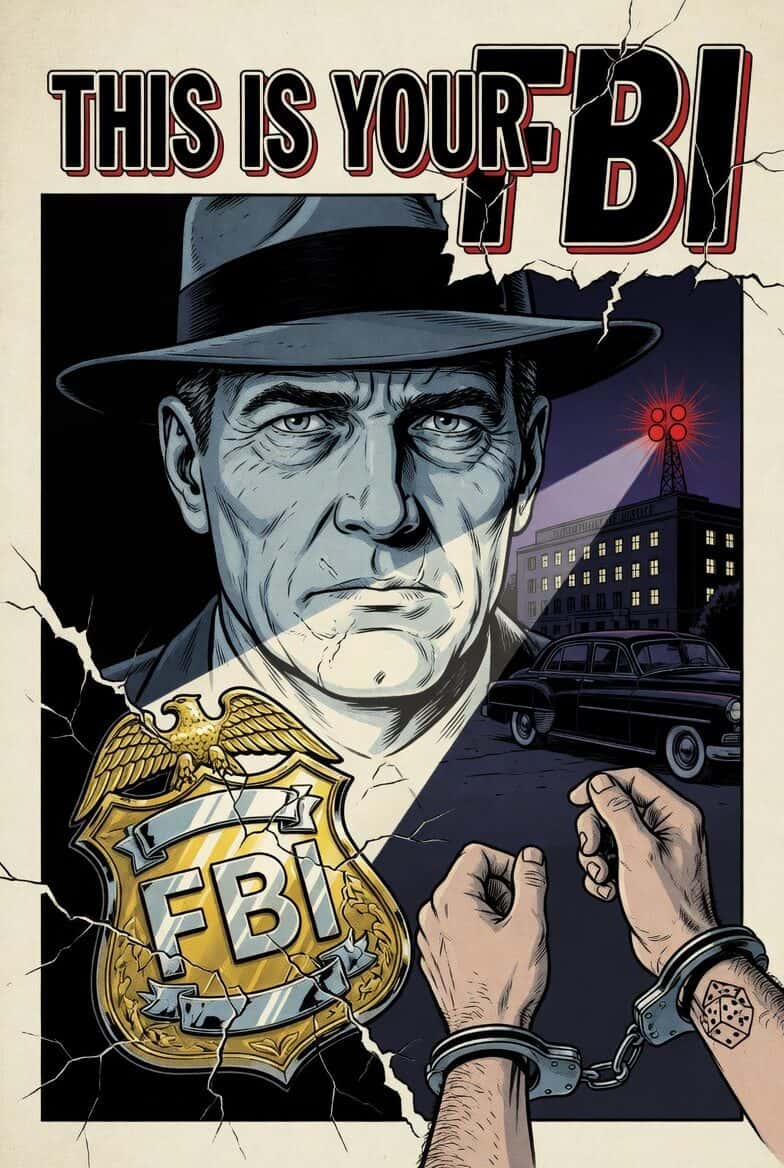
The Equitable Life Assurance Society presents, This is Your FBI. This is Your FBI. The official broadcast from the files of the Federal Bureau of Investigation. Presented as a public service by the Equitable Life Assurance Society of the United States and the Equitable Society's representative in your community. All through the coming week, representatives of the Equitable Life Assurance Society will be busy answering their telephones.
Say, Mr. Wakefield, I heard about that fact-finding chart for fathers and mothers that the Equitable Society is offering on This Is Your FBI. Sounds like a great idea. Could you bring me one? That's what's been happening every week since we started offering this fact-finding chart for fathers and mothers. Listen carefully in about 14 minutes, and you'll learn more about this famous chart created for you by the Equitable Life Assurance Society of the United States. Tonight's FBI file, The Skid Row Shakedown.
The face of America is freckled with cities of such beauty that they make you hold your breath when you first see them. New York on a spring night when the wind comes crawling through Central Park. San Francisco when the gentle fog wraps Knob Hill in a white blanket as a gift for the sightseer to take home. New Orleans when Canal Street lights up with the gaiety they call the Mardi Gras. Those are just a few of the things that make a trip through our big city so memorable. But there are other places in our urban centers, other places not so attractive, places like the Bowery in New York, Main Street in Los Angeles, West Madison Street in Chicago. Each has a different name, but they are all alike. They are the streets to which men go when hope dies, and when it makes very little difference to them whether they die too. Tonight's file is about such a street.
and about some of the people who breathe its foul air. Tonight's file opens in the lobby of a cheap flophouse located in the slum district of a large eastern city. A young man stands behind the desk as the front door opens, and the visitor enters. Good morning, good morning. Mr. Guilford about, please? Yeah. Well, I wonder if I might see you, please? Ma'am. Oh, are you Mr. Guilford's son? Yeah. Well, well. What is it? Oh, good morning, Mr. Guilford. Good morning. Oh. Hi, Mr. Fergus. This young man was just telling me that he's your son. Why, I had no idea that you had any offspring. Oh, he's been away. He just got back. Unbelievable. Unbelievable that someone as youthful as yourself should be the mother of a strapping boy this size. Cut the con, Mr. Fergus. What do you want? Well, I understand that one of your guests passed into the great beyond last night. That's right. A man called George Pettus. Have any of my con players been here yet?
No, you're the first. Splendid, splendid. What room did Mr. Pettis occupy? 31. Will I require a key? No, the door's open. Oh, thank you, buddy. Excuse me. What's that? A scavenger. Huh? There are a lot of them down here. They get the word when any of these bums die and they come round, go over whatever stuff they left. What for? Maybe the bum had some moo in a bank. Maybe he's an heir. They might even have left some stuff that the bum's family'd want. Oh. Yeah, sort that mail, will you? Okay. Once in a while, they score pretty good. What happens then? I get cut in. Once, Fergus got 300 bucks from a guy in Chicago. The bum who died was the guy's father. What did you get? Ten percent. Very much. Oh, it is when you don't have to work for it. Hey, Miss Gilbert. It appears that this was a rather fruitless visit. Uh-huh. There may be a few trinkets of sentimental value in Mr. Pettis' effects, but it may be a difficult pursuit.
Finding anyone to whom they possess such value. Well, do what you can. Oh, I shall, I shall. Good day, Miss Guilford. So long. Oh, and goodbye to you, Miss Guilford. It was a real pleasure to have made your acquaintance. Weird little guy, ain't he? Well, I think I'll take a walk. Mrs. Calloway? That's right. Well, how do you do? I'm John Fergus. Hello. I ask you to meet me here at the zoo because I thought we... we'd be able to talk freely in front of the animals. You said on the phone that you had something important to speak to me about. That's right, Miss Galloway, I have. What is it? Let's sit down on this bench here. Very well. There we are. I have my wares in this briefcase. Your wares? Yes, yes. Let me see. Oh, yes. Do you recognize the handwriting on this envelope, Mrs. Galloway? Ah, splendid, splendid.
Where did you get that letter? George Pettis, the man to whom you indiscreetly wrote so many letters, died last night in a waterfront clubhouse. Oh. He left nothing of value except your correspondence. You see this return address on the envelope? That's how I was able to find you. Who are you? How did you get them? I am a friend of the weary and the dispossessed. I am likewise a messenger who links the past with the present. I frequent the cheap hotels here in town and... When I discover a deceased derelict, I try to let someone who cares know that he has gone to his reward. Oh. They have great pride, these ragged hulks. And because of that pride, they frequently destroy any evidence that might help to lead me to their loved ones. And you called me just so that you could give me this letter that I wrote 15 years ago? This and the other nine letters that the late Mr. Pettis left among his effects. Oh, that's wonderfully kind of you. Thank you, Miss Galloway. Do you have the other letters with you? Yes.
May I have them, please? I'm not quite ready to turn them over just yet. Why? I've made you a gift of the one you hold in your hand. However, the other nine are the wares I have to sell. But they're only letters from me to George. They wouldn't be of any value to anyone else. Not even to your husband? Mrs. Calway, I... I admit that I'd rather not be forced to do business with your husband, but... If you refuse to buy the letters, I'd have no alternative. How much do you want for them? I can't quite put a price on them yet. Why not? There are factors to be weighed. When will you know how much you want? Maybe today, maybe tomorrow. I'll drop you a line as soon as I've determined what the current market price is on Callaway Originals. Meanwhile, at the local FBI field office.
Special Agent Jim Taylor is just being greeted by a visitor, Police Sergeant Blaine. Jim, it looks like we get to work together again. That's fine with me, Dick. I was just in to see your agent in charge and he asked me to check with you. Oh, what's the story? Did you read about a Mr. Clinton Lowell committing suicide yesterday? No, I just saw the headlines. He was being victimized. How do you know that? In going over the files at his office, we found a series of notes from an extortioner that threatened him with physical violence unless he paid. Which gives the FBI its jurisdiction. Right. We didn't discover what the extortioner knew about Lowell, but he referred to some letters that Lowell had written. Letters that he wanted to sell back to Lowell? Yes. Apparently, the extortioner found them among the effects of someone who died. Someone whose first name was Justin. I don't suppose there was any signature on any of the extortion notes? No. When I found them, I...
Put them all in this cellophane envelope. Here. Thanks, Dick. I thought maybe your laboratory might be able to analyze the type and see if they can give us any help. Well, I'll be glad to send them through for you. Thanks. Any dates on these notes, Dick? Oh, yes. That first one is dated about six months ago. Oh, yeah. Well, then I think we can assume that this Justin something or other died right around that time, huh? That's logical. Well, if he died here in the city, the local board of health would have some kind of a report on him. Yeah, they would. Well, I'll check that angle for you. Okay. In the meantime, why don't you go back and see if you can find anything else in the files at Clinton Lowell's office. Let's meet back here tomorrow afternoon. What is it, then? You've heard of that guy, Fergus? Yeah. Came by this morning. Gave me ten bucks. For what? Pettis. Guy who died in room 31. He had an old pocket watch. Fergus found some relatives and sold it to them for a hundred bucks. He clipped you. What do you mean?
Remember I walked out of here right after him yesterday morning? Yeah. I followed him. We went to the zoo to meet some dame. Well? Remember the briefcase she had? Uh-huh. We opened it up and got a letter. And the dame got a look at the letter and threw her for a loop. We talked for a couple of minutes and then they both left. I tried to follow the dame, but she got in the cab and I lost her. What are you trying to prove? Said he wasn't trying to sell no pocket watch. Where's Fergus hanging out? Well, he's got an office in the Miller building, room 629. You know his phone number? Uh-huh. Call him. Ask him to meet me here tonight. Dick, I don't know how much good it'll do us, but I did find something. What, Jim? In checking the death records for the week previous to the date on that first extortion note, I found an old man named Justin Gentry died in a flop house over on the west side. Oh, did you go over there? Yeah.
Dick, do you know anything about any of those scavengers who get a man's effects after he dies in one of those places? Yes. Well, one of them got Gentry's effects. Apparently, he found some letters which incriminated Clinton Lowell. Oh. Well, I didn't find anything else in Lowell's private files. Oh. Well, this clerk down at the flop house I went to said he couldn't tell me which of the scavengers had gotten Gentry's effects. Was he on duty at the time? No. A clerk named Thompson had the desk that day, and he won't be back at the flop house until tomorrow morning. And they didn't know where to reach him, huh? No.
But I'm going to stop by there on my way to the office tomorrow morning and see if this Thompson can remember who got his effects. If he does, Dick, we're in business. Good evening, Miss G. Good evening. Hi. I'm sorry I couldn't get here any sooner. That's all right, Miss Fergus. Has another of your guests crossed the Great Divide? No, my son wanted to see you. Your son? Mm-hmm. About what? He'll tell you himself. Come in the office. Oh, very well. It's right through here. You first, Miss Gilbert. You first. Arthur? Here's Mr. Fergus. Okay. Your charming mother just told me that you had something to discuss with me, young man. That's right. Well, what is it? Mom, he gave you ten bucks for the stuff he got out of that pedestal guy's room, didn't he? Yeah. You got short-handed. No, see here, Mr. Goodwin. I resent your inference. Mr. Fergus, I followed you when you left here yesterday. You made a phone call, and then you went to the zoo and met a dame. You showed her a letter that you got out of Mr. Fergus.
Pettis' room. That's correct. Mr. Pettis had several letters in his room when he passed away. I thought they might be of value, but they weren't. Then why did you keep them in a safe at your office? What? I went to your office this afternoon. Couldn't find nothing in your desk, so I opened the safe. Mrs. Gilbert, this is outrageous. I don't go along with you. Mr. Fergus, them letters ain't worth nothing. You won't mind me keeping them, will you? I got them right here. Let me have them. They're no good to you. The only person to whom they have any value is the woman who wrote them. What's her name? If you knew that, you'd be as smart as I am. And quite obviously, you're not. Well, it looks like you guys are stuck. Fergus, you know who wrote the letters, but you ain't got them. Arthur's got them, but he don't know who wrote them. I want them!
Arthur, you shouldn't have hit him so hard. Why? Get up. Hit his head against the leg of that table. Come on. Get up, I said. Why? What? He ain't breathing. Huh? Mom, I think he's dead. We will return in just a moment to tonight's exciting case from the files of your FBI. But now, listen. While the clock ticks away the next 60 seconds... We're going to ask you to give one minute of your time to considering something that may make a world of difference in the future happiness and security of your children. That's worth a lot more than one minute of my time, Mr. Keating. Then you'll certainly be interested in the Equitable Society's famous fact-finding chart for fathers and mothers. Certainly sounds interesting. What's it all about? Frank, it's a chart that every father who really loves his family should have. A chart which shows him how to figure out just what income his family would need if he should die unexpectedly.
The minimum amount of money his wife and children would require to maintain a comfortable standard of living. Do you know how much that would be for your family? No, I guess I don't really have even a foggy idea. Well, in five minutes flat, this equitable fact-finding chart for fathers and mothers will give you the answer. Now here, see how simple and uncomplicated it is. You're guided every step of the way by easy-to-understand pictures. In no time at all, you'll know just what income your family will need to keep going and to keep together. during the critical years until your youngest child finishes high school. I'd certainly like to have one of those charts, Mr. Keating. How much do they cost? Not one cent, Frank. They're free. Phone your Equitable Society representative and ask him to bring you a fact-finding chart for fathers and mothers. Or send a postcard, care of this ABC station, to the Equitable Life Assurance Society. Your request will be forwarded to the nearest Equitable representative. Yes, if you truly love your children, you will not let another day tick away on the clock.
without sending for the fact-finding chart for fathers and mothers prepared for you by the Equitable Life Assurance Society of the United States. And now back to the FBI file, The Skid Row Shakedown. The loss of John Fergus from the community is not, as you can imagine, a devastating one. Nor would the loss of any extortioner constitute one to be mourned. They are the parasites of our civilization and not worthy even of our contempt. However... The death of John Fergus does serve to prove the truth of an axiom which has been repeated time and again in an attempt to bring it home forcibly to you listeners on this series of official broadcasts from the files of the Federal Bureau of Investigation. That axiom is that crime begets crime. Neither you nor anyone else can engage in the commission of a single illegal act and then decide to stop. That first misstep is often the beginning of a criminal career.
The reason your FBI repeats that fact is that it knows that crime has often been portrayed as a glamorous occupation, and that many first offenders took that wrong step because they were tempted by that false glamour. It is an odd fact that, from the moment of a criminal's first illegal act, his best chance for survival rests with the strongest possible law enforcement agency. Or, as in tonight's case... If he succeeds in committing one crime without being apprehended, he will continue to commit others until finally he commits the number one crime, murder. Tonight's file continues at the local FBI field office. I think I found another piece of the puzzle. I stopped by that flop house this morning where Justin Gentry died. Uh-huh. I spoke to the clerk who was on duty when one of those ghoulish characters came in for Gentry's effects. Did he remember which one it was? Yes, it was a man named John Fergus.
Did the clerk have any idea where Fergus could be located? No, he said he knew that he had an office, but he didn't know where. I checked with the phone company. They have no telephone listed under that name. How often does Fergus come around? Oh, every couple of days. Oh, I've had an alarm sent out on him. Good. Oh, pardon me. Sure. Special Agent Taylor speaking. Lieutenant Frederick's down at headquarters, Jim. Well, hello, Lieutenant. It's been a long time. Yes, it has. Say, I got word you're looking for a man named John Fergus. Yeah, that's right. What do you know about him? He's just been found.
What is it, son? I took up where Fergus lived. Good boy. How did you do it? Remember the gas bill he had in his pocket? Huh? One made out in the name of Jackson. Oh. That was for his apartment. St. Kendall Street. You went there? Yeah. Find anything? Yeah. John was full of carbon copies of letters he wrote to the suckers he was clipping. He's the one we're looking for. Name is Mrs. Calloway. Let's see it. Dear Mrs. Calloway, with reference to the antiques belonging to the dear departed George Pettis, my current market quotation is $9,000. You see? Why, that little crook. And he was going to brush me off with a sawbuck. Well, I'm going to make me some food. I'll figure out what we want to do with the nine grand we're going to get from that Mrs. Calloway.
I think I went to John Fergus's office. It had been rifled, cleaned out. There was nothing there. I wish we could come up with where he lived. Oh, I already have. How, Jim? Well, I went to the morgue and looked at his effects. They consisted of some movie stubs, some matches from a restaurant on the west side, and a key. Uh-huh. It was a new key, so I decided to go up to the neighborhood where the movie house and the restaurant were and see if any locksmith could recognize it. That didn't work. So, on a hunch, I tried the doors of a brand-new apartment house about a block from the movie. And that did work? Yeah, it paid off. A key opened the front door of one of the apartments. It was listed under the name of Leo Jackson. Once I got inside, with the cooperation of the building superintendent, I knew I was in the right place. How? The apartment had been rifled, too. You know, we may be able to find out who it is if we get lucky. At both the office and Fergus' apartment, this morning's mail had been opened and read.
I, then, is trying now to get prints off the mail. Ah. According to the files I found up in the apartment, Fergus has been in the extortion business for quite some little time. Did you find anything on Clinton Lowell? Ah, Fergus was the one who was shaking him down. I also found out the name of his latest victim. Who's that? A woman named Calloway. I found a sheet of carbon paper and held it up to a mirror. He had written to Mrs. Calloway with an obvious reference to some letters that belonged to a George Pettus. Did you find those letters? No, no, Dick, I didn't. Well, I think I'd better check and see if I can find anything on where this George Pettis died and who he is. All right, Dick. While you're doing that, I'll go up and see Mrs. Calloway. Yes? Who is this? Arthur who? If you don't tell me your name, I'm going to hang up. Oh, I see. No. I'll have to have more time. Fergus said no start. Well, I have to go to the bank first. Be here in an hour. Just a moment. Mrs. Calloway?
That's right. Are you Arthur? No, ma'am. I'm a special agent of the FBI. Here are my credentials. I see. Do you mind if I ask you some questions, Mrs. Calloway? Why, no. Please come in. Thank you. Mrs. Calloway, in going over the effects of a man named John Fergus, we found evidence that he might be extorting money from you. I don't know anyone named John Fergus. Who is he? He's a man who was found dead down on the waterfront. Murdered. In checking on another case, we learned that Fergus was an extortioner and that he had written you a recent note. I've never received a note from him. Are you quite positive? Yes. Well, it had to do with some letters that you had written. He had come into possession of them. If those letters exist, Mrs. Calloway, and if you haven't yet paid on them, it's perfectly possible that someone else has come into possession of them now and will try to extort you. Well, I'm sorry I can't be of more help than this, but I don't know anything about it. Let's leave it this way. If anyone gets in touch with me...
I'll get in touch with you. Thank you, Mrs. Calloway. Coming. Mrs. Calloway? That's right. Come on. Come in. Thanks. You know why I'm here? Yes. For some money. Where's Mr. Fergus? He's busy. That's why I sent me. You're lying. What do you mean? A man from the FBI was just here. Hmm? He told me that Mr. Fergus was murdered. That... sort of changes things, doesn't it? No. Oh, I think the police would be interested in knowing that you now have those letters. Who would tell them? I would. It wouldn't save your neck. Before the cops get the letters, I'll have them printed all over town. Don't you want that? No. Then where's the money? In that police on the table. That bag you mean? Yes. Is there 9,000 here? Yes. Now let me have my letters. Sure. Here.
Now get out. Get out, I said. Hello, Guilford. Who are you? I'm a special agent of the FBI. Now turn around and step back inside. Although charged in federal court for extortion, Arthur Guilford and his mother were turned over to local authorities for prosecution of the more serious charge of murder. Arthur Guilford was found guilty and sentenced to be executed. His mother was convicted as an accessory and sentenced to a 20-year term in prison.
The reason Special Agent Taylor returned to see Mrs. Calloway is that a check at the neighborhood bank revealed not only that she had her account there, but that she had withdrawn $9,000 in cash that morning, the exact amount mentioned in the extortion letter John Fergus had written. Special Agent Taylor learned from the identification section that the fingerprints on the mail which had been opened in John Fergus' office the morning after Fergus' death belonged to Arthur Gilbert. When an examination of the carpet in the office of Mrs. Guilford revealed a fresh bloodstain and several hairs which the laboratory identified as having come from the head of John Fergus, both Mrs. Guilford and her son confessed. And thus, because of the swift cooperation of a local police department and the untiring investigation of a special agent, your FBI was able to close another file and to close it successfully. In just a moment...
We will tell you about next week's case from the files of your FBI. But now, listen. With every tick of the clock, time, as they say, is marching on. So don't put off that important decision you made a few minutes ago. Be sure to get the equitable fact-finding chart for fathers and mothers. It's the first step towards making certain that your wife and children will continue to live in comfort and security, even if you should be taken from them. Phone your equitable society representative soon. Or... Send a postcard to the Equitable Society, care of this ABC station. Your request will be forwarded to the nearest representative of the Equitable Life Assurance Society of the United States. Next week, we will dramatize another case from the files of the Federal Bureau of Investigation. A dramatic account of the Bureau's effort to clear an innocent man. Its subject, armed robbery. Its title, the slapstick holdup.
The incidents used in tonight's Equitable Life Assurance Society's broadcast are adapted from the files of the Federal Bureau of Investigation. However, all names used are fictitious, and any similarity thereof to the names of persons living or dead is accidental. Tonight, the music was composed and conducted by Frederick Stein. The author was Jerry D. Lewis. Your narrator was William Woodson, and Special Agent Taylor was played by Stacey Harris. This is your FBI.