
The written record
Read the transcript
Read along with the recording · About 22 min to read
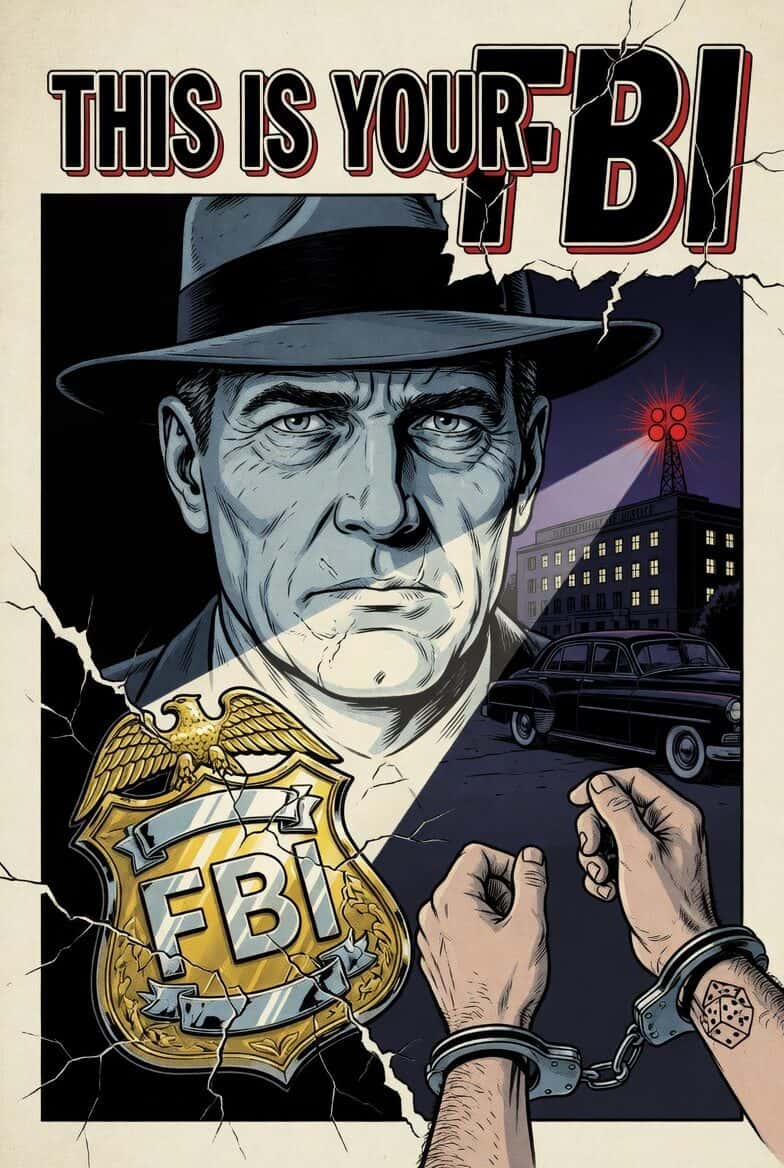
The Equitable Life Assurance Society presents, This is Your FBI. This is Your FBI, the official broadcast from the files of the Federal Bureau of Investigation. Presented as a public service by the Equitable Life Assurance Society of the United States and the Equitable Society's representative in your community. Now for a moment, we're going to hear from a representative of our sponsor, the Equitable Life Assurance Society of the United States. Last week. I saw my daughter off to our state university. She's going on an equitable education fund I started the year she was born. And on the same train were five other youngsters of her age leaving for college, thanks to the equitable education funds I planned for their dad. Do you wonder I'm proud to be a representative of the Equitable Life Assurance Society? In approximately 14 minutes, I'll be back to give the whole story of the Equitable Education Fund, an important contribution to American education.
made by the Equitable Life Assurance Society of the United States. Tonight's FBI file, Dead Man's Tale. This morning, a graduation ceremony was held in Washington, D.C. A graduation ceremony at the FBI National Academy, a school operated by the Federal Bureau of Investigation for the dissemination of knowledge to members of local police organizations throughout the country. If it seems strange to you that these local police officers, the men who form your first line of defense against crime, are going to school to learn the latest methods of waging that war, then you are guilty of old-fashioned thinking. Yesterday's blue-uniformed minion of the law who took his tribute in fruit from the corner stands has been replaced by the modern police officer, a younger man who in every respect is better equipped to do his job, is better equipped to safeguard your precious freedoms.
Each day, as more of these well-trained young men take their places as members of your local police, law enforcement becomes even more established as a recognized and honorable profession. This FBI Academy is a young school, 14 years old, but already its graduates are in every state in the Union. Soon we hope they will be in every city, for when that time comes, the war against crime will not automatically have been won. But a tremendous stride will have been taken in the right direction, in the direction of victory for the people over the common enemy, the American criminal. Tonight's file opens late at night in a large frame dwelling located on the bank of a river running between two Midwestern states. A man stands alone in the front room of this establishment, idly throwing dice on the table. A second man enters. Money's all counted, Sam. How'd we do tonight? Win $3,600. That's not bad.
What's with those guys? Trying to win a mind bet? Yeah, watch them. They're loaded. Oh, crap. You gonna use them in a joint? You ever seen me use a gimmick, George? No. Then I ain't gonna start now. Tell that to the guys that try to sell me these things. If I run the games honest here, I get from three to 16% running for me every time a bet's made. So instead of eight Gs a night, I make 3,600. Give a little, take a little. That's it. Look at the guy in the gray suit tonight. He walked out a $200 winner. Tomorrow, he'll tell everybody that he beat the joint for $2,000. Everyone he tells is a new customer. Answer that, George. Yeah. Say we're closed for the night, all right? Hello? Yeah, Frankie. He is? This late? Uh-huh. Yeah, yeah. We're closed tight. They're just having me. Yeah. You sure? Okay, Frankie, thanks. Hello. Where's Frankie? Down at the hall. What'd he want? A cup.
and giving us trouble on his way out here. Scott? Mm-hmm. Just get a warrant. But not to slow the joint. He's gonna try and put the collar on you. What for? That Hamilton guy signed a statement for him saying that you'd threaten his life if he didn't clean up his tab out here. What'll we do? We'll see him. What? We'll make him one more offer to come over. And if he turns you down? We'll fix it so he don't bother us again.
A few days later, at local police headquarters, FBI Special Agent Jim Taylor is greeting an old friend. Hey, it's good to see you. Same here. What are you doing in this neck of the woods? Oh, I came down to investigate a stolen car ring. Oh? Oh, you're not working on the case, eh? No, I'm still on traffic control. Hey, is Carl Scott around? No, Jim. I heard he got an appointment at the academy. I wanted to congratulate him. He won't be using it. Oh, what do you mean? Carl said you. What? Come on in the locker room. I'll tell you the whole story. Go ahead, Jim. Thanks. I gotta get in a uniform. Dave, what happened to Carl? They fished his body out of the river early this morning. They what? Yeah. Carl's preliminary report says drowning was no sign of any physical injury. I'd be willing to bet that he was murdered. By whom? A man named Tom Caldwell. Oh, who's he? Local Capone. Told gambling and just about everything else. Oh.
He's been arrested about 30 times on various charges. But no one's been able to make any of them stick. Oh, why not? Political protection. Hand me that chute for you over there, will you? Yeah. Thanks. What makes you think he killed Scott? A car dropped by my desk late Monday night. Said he was going to arrest Caldwell and this time it would stick. You know what he meant? Yeah. He told me that a customer named Johnny Hamilton owed Caldwell a lot of money. Caldwell had given him credit at the gambling house, and when Hamilton didn't pay, his life was threatened. By Caldwell? Yeah. Hamilton had given Scott a signed statement. Who is this Hamilton? Son of a wealthy local family. Have you spoken to him? Yeah. He denies that he ever gave any statement to Carl Scott or that he owes Caldwell any money. Sounds like Caldwell got to him first. Probably. Him? Caldwell's got two big ambitions. One was to go to the FBI Academy, and the other was to put Caldwell out of business.
I've asked to be transferred from traffic control so I can work on the Corvo file. I think the chief will approve. If he does, I'm not only going to prove murder, I'm going to solve it. Tom. Yeah. You seen the paper? No. What's in it? The coroner's office this afternoon declared after a complete examination of the body of policeman Carly Scott that the cause of death was accidental drowning. Oh. You already heard, huh? Mm-hmm. Oh, I've just been to see Johnny Hamilton. Did you collect? No. Why not? He wouldn't pay. Did you tell him about the cop? Yeah. What'd he say? He just laughed. So I said to him, what's so funny? The same thing could happen to you. And? He kept laughing. Do you want me to get some muscle to collect for us? No. We'll collect. I think I know just how to do it. Dave! Oh, Dave! Hi, Jim.
It brings you up to this end of the state. I'm on my way to Washington. Oh? Remember that call Scott was supposed to go to the session of the academy starting next week? Yeah. The chief was sending me instead. Why, that's great. Good luck, Jay. Thanks. I'll sure need it. I haven't done any concentrated studying since I was in school. Keep a good notebook. Study a lot and you'll make it. You taking the plane? No, on the bus. That's a long jump. I know, but it's cheaper and every buck has to go a long way. I borrowed on my car to finance this venture. Well, it'll be worth it. Oh, I know that, Jim. The only regret I have is stopping on that Caldwell file. There'll be plenty of time for Caldwell when you get back, if we don't catch up to him first. You working on him, too? Well, I don't know, Dave. We got a complaint from the chief of police across the river from you about some slot machines being in candy stores next to schoolhouses. That sounds like Caldwell, all right. That's what this chief of police thought. And if we can prove that he transported them across in a state line in a stolen car that the police found.
We may be able to give the U.S. Attorney enough to prosecute him. I surely hope so. Hey, time for my bus. Look, I'm going to be at Mother McCartwright's in Washington, Jim, and the address is... I know it. Well, good. If you get anything on call, well, let me know. I will, Dave. I hope when you get back, you can visit him in a cell. Nine is the point. Get your bets down. You can't accumulate unless you speculate. Here we go. Tom. Yeah, George. Oh, look. Johnny Hamilton just walked in this morning. Is he gambling? No. What'd he come for? See you. He's waiting outside now. Bring him in. All right. Hey, Mr. Hamilton. Come on in. How are you, Mr. Caldwell? Okay. You're doing good business tonight. We'll break even. Want me to stick around, sir? Yeah, might as well. You come to pay up, Hamilton?
No. Look, if you want to settle for less, then you're on the rim. I don't want to settle. What are you bothering him for? He's a busy man. I'll handle it, George. Why'd you come here? I came to collect 5,000. Why? You owe us 5,000. I know. I want you to call that square and give me a bonus. Are you Daffy? No. I figure it's worth 5,000 to you to avoid being tried on the charge of murder. What are you talking about? Remember the night that cop came out here to see you? The night I gave him the statement about you threatening me? Uh-huh. I drove out here with him. I was at the window when you killed him. I see. That's worth 5,000 to you and your friend here, isn't it? Well, it's worth something. Like what? Like this. Thanks, George. That pays you, Mark. We will return to tonight's exciting FBI file in just a moment. Now for another type of thrill.
One that you may experience tomorrow afternoon as you watch your favorite college football team battle it out with some traditional rival. Here's the play. Jones takes the pass from center. He's fading back. It looks like a forward pass. A long one way down the field. Looks like, yes, it's completed for a touchdown. Football fields aren't the only places where college men score touchdowns. Surveys show that after graduation, they're still on the ball, still playing to win. It's a fact that a college graduate is nearly 15 times as likely to reach a salary of $10,000 a year as a non-college man. And the same principle holds good in every salary bracket, from $10,000 to $100,000. Yes, a college education is not only an endless source of personal satisfaction, it pays off in dollars and cents. Realizing this many years ago, the Equitable Life Assurance Society created its famous Equitable Education Fund. As its name suggests...
This is a plan for far-sighted parents who want to make certain that their children get the higher education that means so much to their future success. First and foremost, an equitable education fund is sure. S-U-R-E. Right. This fund combines planned regular savings with life insurance. So if the father dies or becomes permanently disabled, this plan makes it certain. that his children will still be able to get the education he was ambitious for them to have. Second advantage, an equitable education fund is easy. You'll be amazed how quickly a comparatively small monthly payment builds up into a sum that is ample to see a boy or girl through college. Remember, higher education and higher salaries go hand in hand. So the more truly you love your children, the more determined you will be to give them a head start toward future success and happiness with an equitable education fund. Get in touch with your Equitable Society representative soon, or send a postcard care of this station to the Equitable Society. That's E-Q-U-I-T-A-B-L-E, the Equitable Life Assurance Society of the United States. And now back to the FBI file, Dead Man's Tale.
The situation described in tonight's case from the files of your FBI, the situation of a local police force anxious to do its job but being prevented because of political shackles, is not an isolated instance. There are, for example, few jurisdictions where gambling is legal, and yet only the blind can truthfully say that they see no gambling in virtually every community in the country. In a few such instances, the laws are inadequate or antiquated. and should be rewritten to fit present-day conditions. In the overwhelming majority of cases, however, the laws are sufficient, but law enforcement officers are, to put it bluntly, restrained from functioning. Only one thing can free them to do their appointed jobs, and that is an aroused public. The Federal Bureau of Investigation does not imagine that any single individual can remedy the situation alone, but it does believe that something can be done.
It's a big job, but it must be undertaken. And you, as an individual, can help start it. And help see it through. Can help clean up your city and make it the kind of place in which you're proud to live. You can help do it by cooperative effort. By working with other individuals who, by themselves, could accomplish little. But who, by a mass effort, can achieve your aim. Your aim of seeing democracy at work. of seeing your local police function so that they can repay and build your trust. Tonight's file continues at the FBI Academy at Quantico, Virginia. Policeman Dave Mitchell and his class are just finishing at the pistol range when Special Agent Jim Taylor approaches. Nice shooting, Dave. Hey, Jim, what are you doing here? I'm in service. Once every 18 months, every Special Agent comes back to Washington for a refresher course. The same things I'm studying at the Academy? That's right.
We learn what new scientific advances have been made by the lab. We exchange ideas with agents from other offices, and we get a series of lectures. I see. Well, say, did you get anything on your investigation of Caldwell? No, Dave. No one was willing to testify against him. And so far as you're concerned, Caldwell is untouchable. I wouldn't say that. We haven't given up entirely yet. Uh, Dave, didn't you tell me that a man named John Hamilton was Carl Scott's informant? That's what Carl told me the night he was killed. Why? Well, Hamilton's disappeared. How do you know? Well, his parents reported his disappearance over two months ago. They were hysterical. They wanted immediate action. Yeah? Well, since we felt it might give us the key to a federal violation, we went to work on the case. We traced Hamilton's movements on the night of his disappearance. It led to Tom Caldwell's. Did you arrest Caldwell? No, just about that time, Hamilton's parents withdrew their support and asked that everything be called off. But why? I don't know, Dave. He didn't turn up.
I said they were satisfied that he'd just run away, come back when he was ready. Well, that'll be something else for me to work on. Yeah. Well, when do you graduate, Dave? This week. And then I'm going home. And I'm going to keep working till Tom Caldwell goes to the camp of Carl's murder. You want me, Tom? Yeah. Go down to the hall and see Frankie. Okay. Find out if he knows anything about a guy named Dave Mitchell. Who's he? The cop. He was just here. I think he'd like to make some trouble for us. Why? Yeah, that other cop was his pal. Oh. I think he suspects we killed him. Yeah, but he can't prove nothing. He might be able to prove something on Hamilton. Why? He's in the river, ain't he? His body ain't turned up yet, has it? Well, they ask a lot of questions about Hamilton. Have we seen him? Where was he? You want me to see Frankie about? Have him check, see if they have anything on this guy. If they have, we'll get him bounced off the floors. What if he's clean? Then we'll bounce him ourselves into the river.
Got a few minutes, Jim? Oh, hello, Dave. I was just going to call you. Oh, about what? I just got back from Washington this morning. The SAC put me on a case that's down in your section. What kind of a case? I lived in several hijackings recently on the highway outside of Hawthorne. I'm going down to see if I can spot anything. Oh, tell me, how are you doing with Caldwell? I think he's responsible for Hamilton's disappearance, Jim. Oh? Any proof? Well, I went over the microfilm at our local bank to see what checks Tom Caldwell deposited the day after Carl Scott disappeared. And? Well, you see, lots of the people who gamble at Caldwell's and lose pay by check. I thought those checks could tell me who had been at the gambling house that night. Good idea. That's an investigative angle I learned at the academy. And it paid off? Yes, sir. I interviewed the writers of every check, and finally I came up with one that was stalled in the parking lot after the place closed. He saw a policeman knock on the door and someone let him in. That would be Scott. Yes. And also he saw a man that night who answers the description of Hamilton. Now where? Driving the car that brought Scott out to Caldwell.
He says the man stayed in the car and waited. It was exactly 3 o'clock. The coroner's report says that Scott drowned at 3.15. Well, that's a real solid fact today. Yeah. Oh, this is what I came up for. Jim, will you send this sheet of paper to your lab and see if they can read it? Sure, sure. What is it? It was found on Carl Scott's body. It didn't mean anything to any of us on the force then, but the knowledge I gained in document examination at the academy made me take it to an X-ray lab in Hawthorne. And? They put it under black light. Fluorescent showed up all over it. The water washed away most of the ink, but the pigment remained. Enough to read any of it? No, but I'm hoping they'll be able to read it by using infrared photography at the lab. Okay, Dave. I'll airmail it right away. Thanks, Jim. And as soon as I get it off, we can leave and go back to Hawthorne together. Jim, I...
Just finished talking to your office. They gave me a report from the lab. Did they find enough to read on that paper? Yes, the infrared did the trick. Hey, great. It said, I'm giving this statement to policeman Carl Scott voluntarily and of my own free will. I do hereby swear that within the past ten days, one Tom Caldwell, the owner of a gambling establishment, threatened, and that's all there was on that sheet of paper. Obviously, there was a second sheet that wasn't found on Scott. There's no signature at all on that page, huh? No, but from what Scott told me the night he disappeared, Hamilton had to have been the writer.
Well, there's only one way to learn what was on that second page, Dave. Find young Hamilton alive. Hello. Hello, Jim. I set up surveillance on Hamilton's father. Any luck, Dave? Yeah. He went to Western Union. I followed Washington through the window. I saw him take a pad of money order blanks, write out an order, and give it to the clerk. Did you find out who he sent the money to? No, I couldn't, but I've got the pad. See you back at headquarters. Yeah, man. Making progress? What happened? I used a parallel beam on the Western Union money order blanks. Did you read the intended writing? Yes. Mr. Hamilton sent the money to someone named Mr. Harvey W. Morton. Now, who's he? I don't know, but I'm going back to the bank and examining Mr. Hamilton's canceled checks. That might give me a lead. Have there been any calls from me, Jim? No, there. I was hoping I'd hear from the police at Fultonville. That's where the money order was sent. Aren't you going over Hamilton's checks? Yes. Several of them were cashed by this Harvey W. Morton. Excuse me. Hello? What's that?
Fine. Yes, hold him. Well, looks like our luck is turning, Jim. Oh, why? That was the Fultonville police. They've located Harvey W. Morton and they're holding him for us. And Jim. Yeah? Morton is really John Hamilton. Come in. Hello, Mr. Caldwell. Hamilton. That's right. And I'm alive. Well, come in. You don't mind if I come along, do you, Caldwell? What's this cop doing here? He came with me. You know what I came for. No, I don't. Hamilton told me his story. What story? I told him about the night you killed that cop. I don't know what you're talking about. We have a witness who saw Hamilton drive Carl Scott out here that night. Who's your witness? You can find that out later. Right now, I've got a warrant here for your arrest on the charge of murder. I've got one for your friend George Walker, too. Where is he? Right here. Keep your hands above your head, copper. This gun goes off. Nice work, George. What do you want me to do with him?
Finish the job on Hamilton and give the cop the same treatment. Cheers. Sign where you are. Grab his gun and take him. Right. Who are you? Special agent of the FBI. I've got a federal warrant here charging you with theft from interstate shipment. What? I think we'll turn you over to Officer Mitchell here and let you face the charge of murder. All members of the Caldwell gang were turned over to state authorities, prosecuted for murder, convicted and executed. In the dramatization of tonight's case from the files of your FBI... you have seen the solid values received by those local policemen who go to the FBI National Academy. Values in training which enable them to solve a tremendous number of cases through the increased knowledge of science and through their own sharpened natural talent. And now, This Is Your FBI brings you a message from Washington, D.C. from the office of the Director of the Federal Bureau of Investigation, Mr. J. Edgar Hoover. Mr. Hoover's message is, and I quote, Tonight, this official radio program of our organization has given you an insight into part of the job done by the FBI National Academy. For you have seen a local policeman use his newfound knowledge to improve his efficiency. The rest of the job is done by the local law enforcement officer when he passes along the benefits of his training to his fellow officers. As of this date, the knowledge gained by the graduates of the academy has been made available to more than 100,000 other officers.
in every state in the Union, and as each succeeding class is graduated, that knowledge is spread even further. The Federal Bureau of Investigation conducts this school because it believes that brain, science, and hard work are the most effective weapons against criminals, and because it teaches every special agent to use those weapons. It is now our hope that ultimately, through the FBI National Academy, every local policeman will learn to use those weapons too. and so will be better equipped to perform the job of every law enforcement officer, to protect you, the American people. In just a moment, we will tell you about next week's exciting case from the files of your FBI. But first, let's hear briefly from an Equitable Society representative on the subject of an equitable education fund. I'd like to leave this one thought with our audience, Mr. Keating.
The sooner a father starts an equitable education fund after his youngster's birth, the lower the monthly payment will be. So don't delay. The man whose words you have just heard speaks for 6,000 Equitable Society representatives from coast to coast. We're always ready to give you friendly help and counsel. If you do not know the name of the equitable man in your community, send a postcard, care of this station, to the Equitable Life Assurance Society of the United States. Next week we...