
The written record
Read the transcript
Read along with the recording · About 19 min to read
<!-- kimi_cleaned -->
The rain descended, and the floods came, and the winds blew. And they beat upon that house, and it fell not, for it was founded upon a rock. There is such a house in our nation's capital, Washington, D.C. And this year, as every four years for more than a century and a half, men are contending for its occupancy, the highest honor that can be bestowed upon an American by his countrymen.
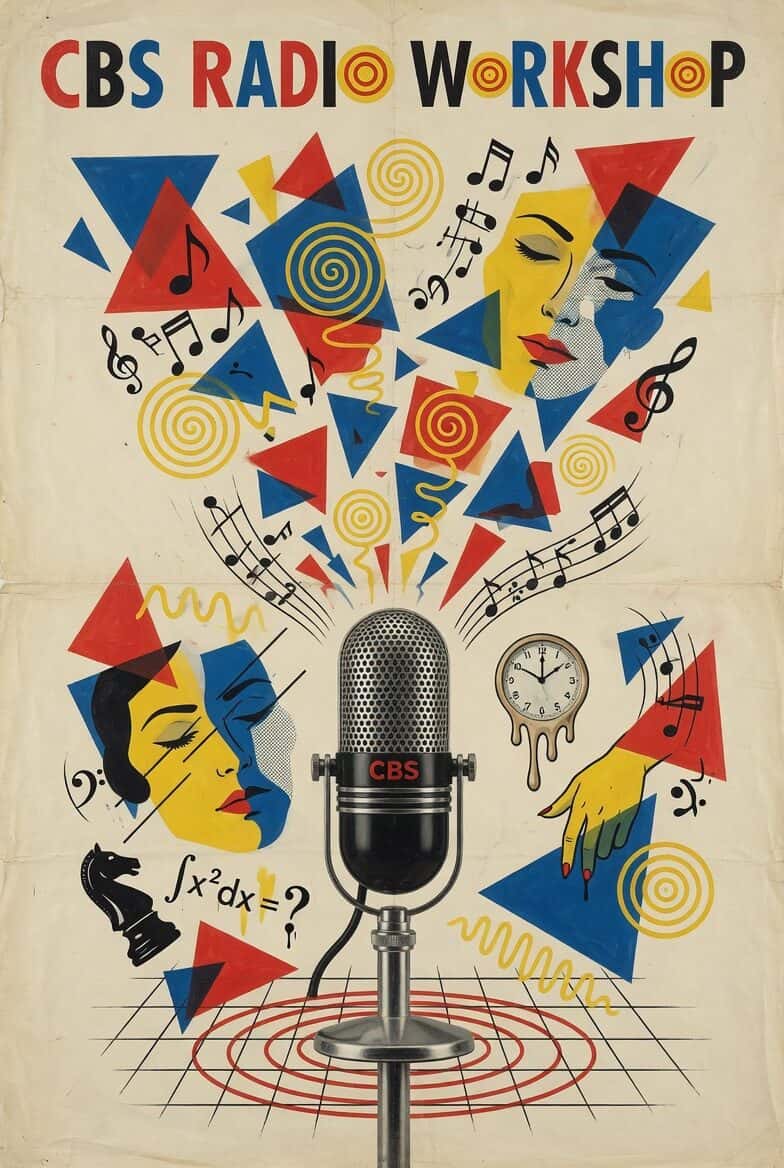
The CBS Radio Workshop, dedicated to man's imagination, the theater of the mind. Tonight, the biography of that graceful yet indestructible symbol of our nation, the White House, home of our presidents at 1600 Pennsylvania Avenue, Washington, D.C., narrated by CBS News correspondent Alan Jackson.
In the beginning, there was little more than a swamp by the river's edge, with a few hills rising here and there. But the country was new, and swamps did not scare it. Besides, it was an ideal location, just far enough in the so-called south to please the southern half of the new nation, and close enough to the north to satisfy that section as well. So, on one of the low hills bordering the Potomac and Anacostia rivers, our ancestors began to build a new capital. And on the next hill, not much more than a mile away, they built a house of lasting grace to serve as residence for their chief executives, the presidents of the new United States of America.
General Washington, the first president, personally picked the site for the house, in which he himself was destined never to live. The first occupant of the house was a stern man, whose New England ancestors had weathered many storms in war and in peace. He was the second president of our new nation, and he moved into the house late in his single four-year term. His name was John Adams. And when John Adams first passed through the entrance of the still unfinished building, he uttered a prayer, the sense of which he put down in a letter to his wife, Abigail. John Adams' prayer was ultimately carved over the fireplace in the state dining room by order of the one occupant of the house, who has perhaps caused more debate than any other, Franklin Delano Roosevelt. And so, it may be read today.
I pray heaven to bestow the best of blessings on this house, and on all that shall hereinafter inhabit it. May none but honest and wise men ever rule under this roof.
Executive Mansion, or the President's House, is what it became in the minds of the American people. And more than 100 years after John Adams became the first occupant, another president named Roosevelt, Theodore in this case, set a precedent by having his stationery engraved with the words, The White House. The name, at first unofficial, originated with one of the many misadventures which have befallen the house during the 150-odd years of its life. In August 1814, British soldiers set the structure afire, ruining the interior and blackening the sandstone outer walls. When the house was reconstructed, a coat of white paint was applied to the exterior to cover the damage caused by smoke and flame, giving rise to the name by which we know the building today, The White House.
The British attack took place during the presidency of James Madison, whose universally admired and attractive wife was the famed Dolly. The British troopers and marines came under Cockburn and Ross up from the river, closer and closer to the house, and to the president's wife, Dolly Madison.
I am Dolly Madison. There are stories about me. That I tucked the original copies of the Declaration of Independence and the Constitution into my bodice just before I ran from the burning house. That I hacked the portrait of General Washington out of its frame and carried it off with the British at my heels. And, not least of all, that my husband was a coward and had left me alone when the British came. They are not true. And they were not true. The documents were taken off safely by clerks from the Department of State. The painting of Washington that had been painted by Stuart was carried to safety by two gentlemen from New York, and James Madison was with his troops at Bladensburg, where he should have been, and was later joined by his wife.
And so the house was burned, later to be rebuilt and become what is probably one of the best-loved structures in the world. But what was it like in the beginning, when John Adams and his wife Abigail arrived? The city of Washington at that time had a population of just 3,210 and the nation of just 5 million. There were no bathrooms, of course, and...
Cold? It's so cold, John. And so damp, so terribly damp.
It's that miserable swamp that surrounds us. I ordered that all the wood we had been able to get should be burned in the fireplaces so as to dry out the plaster before you came. But the damp still oozes from this confounded, porous Virginia freestone in the walls.
But we'll need to keep all of 13 fires going, even with so few chambers finished or furnished.
There's no wood to be had, Abby.
Could we not use coals? We have a small supply, but I have not been able to get grates made for the fireplaces.
John, do you know that there is no place, no place at all to dry clothes?
You'll just have to make do somehow, Abby. This is a wild new country we've come to.
Oh, I'll manage. I'll just use the great audience chamber to hang our wash in. But it isn't these small inconveniences that worry me.
What is it, then?
It's you, John. Never have I seen you so disconsolate, so woebegone. And it's not the ague from the walls that makes you so.
No, it's not. I suffer from a... a dampness of the soul.
John, what a strange remark. I don't think I have ever known you to be sorry for yourself before.
Not out loud. I'm not sorry for myself. But I never asked for this thankless task. I never sought the presidency.
John!
Oh, yes, yes, yes. I've been ambitious in my mind, but not in my heart. With all my heart and soul at this moment, I wish we were back in Milton, or in Brattle Street, or on the Braintree Farm. Let Mr. Jefferson have this... this cave of the winds.
Mr. Jefferson, Thomas Jefferson of Virginia, did become the next occupant of the house, bad heating and all. Jefferson, however, collaborated in plans for various additions to the house, most importantly for columned porticoes, softening the somewhat severe aspects of the building from the north and the south. And his official dinners were renowned for their good food and wines and the good conversation that went with them. The insatiably curious president, in fact, not only sparked some memorable intellectual exchanges himself, but he also substituted round or oval dining tables for the customary rectangles, so that all his guests could more easily observe each other, thus encouraging the freest exchanges of intimate opinions, thereby eliminating those delicate points of diplomatic precedence, which he believed were out of place in a democracy.
I still say that if the British were to support us...
It seems that trifles do become giants in the mouths of Americans.
There can be no more piracy, sir. The United States will not stand for it.
Well, sir, as to slavery, we know that certain European countries do...
Purchasing Louisiana, in my opinion, is a mean and degrading mode of acquiring territory.
Mr. Ambassador, you won't believe this, but when I left Virginia to take up my post in France, I had two bushels of ripe pears sold in bags. And when I returned six years later, they were in perfect condition. They'd candied themselves.
Mr. President, you will excuse us. Will the ladies please join me? The gentlemen will follow later.
That was Dolly Madison, wife of James Madison, who at that time was a member of Jefferson's cabinet. Dolly was a borrowed hostess for the Jefferson's formal dinners, for when Jefferson moved into the White House, he was a widower. After Jefferson served two terms, James Madison, his distinguished secretary of state, succeeded him, and Dolly Madison became first lady of the land.
Following Madison, James Monroe occupied the house, Monroe to whom we owe the Monroe Doctrine, which has become a keystone of our foreign policy. Of his wife, Elizabeth Kortright Monroe, it was said that she was often frail and had to keep herself secluded in one of the bed or drawing rooms on the second floor, among which were the Rose Room, the Northeast Corner Bedroom, the Northwest Corner Bedroom, the Southwest Corner Drawing Room, and the bedroom west of the Book Storage Room. None of this, however, kept Mrs. Monroe from being one of the liveliest hostesses the house was ever to know.
John Quincy Adams came next. He was the son of the John Adams who had been the original occupant of the house. John Quincy soon became known as the Learned Yankee. He is said to have treated his guests at the house with a very special interest. He would make inquisitions on poetry, music, painting, and sculpture, all, as the old books say, of rare excellence and untiring interest.
Then a new kind of storm arose, a storm of votes and of voters, mostly out of what was then called the West, that is, the territory beyond the Appalachians. This was a part of the country which the cultured, Eastern and Southern states still considered savage. But from it there came a tempest of political power, and a Tennessean on horseback rode to the house in Washington in its wake. He was Andrew Jackson, and the house was destined to shake to a new rhythm, as old Hickory and his friends heard behind.
Perfectly, it reminds me of the days of the French Revolution.
I say, do you notice that woman, that huge monstrosity? Why, she's actually wiping her hands on the window drapes.
What was that?
A chair, I fancy. The chairs are much too small for these bears to sit in.
President, I said, have you seen General Jackson?
Only on his horse, out on the avenue. He looked like a ghost. They say he has never recovered from the death of his wife.
Good heavens, they've broken that beautiful French sofa.
Well, the breaking of that sofa does seem to have quietened the mob a bit.
Gap, this sort of thing would never do with us, never.
I don't suppose it would do in your country, gentlemen, but I find it a rather pleasing spectacle.
Oh, really?
Why, yes. This is the people's house, after all. Let them enjoy it for a day.
And who might you be, sir, might I ask?
My name is Andrew Jackson.
The General!
Yes. Yes, I'm the one all this fuss is for. But I am very tired, gentlemen. It is a lonely life.
The house was officially declared finished and furnished in 1829, the first year of General Jackson's administration. Still, even five years later, a member of Congress from Massachusetts observed, "The receiving room contains nothing but a dilapidated sofa and a battered pine table. The two pieces together are not worth five dollars. There is not even a mirror." The fabled East Room was often used for public receptions, but there also, the tables were still of pine and much of the other furniture was unfinished. Jackson, though, bought 20 shining brass spittoons for it. Water for the needs of the household was still caught in cedar wood troughs. It was only in Jackson's fifth year in the house that a pipe was finally laid to bring running water into the residence of the President of the United States.
Jackson's successor was Martin Van Buren of New York. Van Buren, we are told, bought a gold dinner service for the house. And was defeated in his bid for re-election, at least partly because it was noised around that he was in the habit of tasting French sauces from golden ladles.
After Van Buren came Tippecanoe, General William Henry Harrison. He died after only 31 days in the house, too soon to leave an impress upon its character. And after Harrison came John Tyler, and after John Tyler came James Knox Polk. It was in Polk's time that gas lighting was installed in the house. And then, Zachary Taylor, Millard Fillmore, Franklin Pierce, James Buchanan. And then, a new man and a new party arisen from beyond the mountains, from the newly settled, harsh and hard-living prairie states, the area that we now call our Middle West, came Abraham Lincoln.
With Lincoln, there came to the house much of the hurly-burly of family life, both joyous and tragic, which has almost always been a characteristic of this structure. So much abused, so often reconstructed, but still one of the world's most beautiful homes. Lincoln's occupancy was dominated at all times by that most critical event, the war between the states. It began almost before he had had a chance to hang his best broadcloth coat in a White House closet. And ended only a few days before his own life did, terminated by an assassin's bullet in a Washington theatre, not much more than a mile from the house.
An awareness of the tragic war that was ravaging the country, north and south, was, of course, forever present in the house during Lincoln's time. It penetrated even to the children's quarters. The two young Lincoln boys, Tad and Willie, often played with two other children, whose home was in Cincinnati, Ohio, and whose last name was Taft. One of these children, in fact, the one called William Howard, himself became President of the United States about 50 years later.
There was a day when the four children made a doll out of some rags and old clothes and named it Jack.
I think he should be shot at sunrise.
What for?
Sleeping on sentry duty.
But you can't... A soldier remiss in his duty must be punished.
But Jack didn't do it. Not really.
Let's ask the gardener here.
I tell you, this is a pretty serious business. I don't believe anybody except the President could figure that one out.
The President? But my father... I mean, the President, well, he's busy with the war.
Well, it seems to me that this here difference of opinion, you might say, it's got plenty to do with the war. Now, I got to see the President anyhow, so I reckon I'll ask him.
The gardener did go to the President and returned with the following message.
I seen the President, boys, and here's what he says. Now, look here, I'll read it to you. The doll Jack is pardoned by order of the President, A. Lincoln.
It was not long after this incident that young Willie went out riding on his horse, riding on his pony in a chilly rain. A few hours later, he fell sick of the fever, as Washington wives and mothers then called it. They blamed Washington's swampy origins for it, and the deadly miasmas which were supposed to arise from the marshy shores of the Potomac and Anacostia Creek, or sometimes they blamed the abundant insect life of the capital. We now know that the main cause of Washington's dreaded fevers was its unpurified water supply, a ready-made carrier for typhoid.
Willie's illness occurred when he was only 11. It came during a particularly critical time in the war. Mrs. Elizabeth Keckley, a Negro housekeeper in the Lincoln household, worked day and night to save the boy. His parents did all they could.
Easy. His forehead feels hotter, sir.
My boy.
Mr. President.
Mrs. Keckley.
It's the Secretary of War, Mr. Stanton, sir. He asks you to join him at the telegraph office at once, a dispatch from General McClellan.
Tell Mr. Stanton to... Tell Mr. Stanton I shall join him within the hour. You see, Mrs. Keckley, my young son has just died. I must see him first.
But even tragedies do end sometime. On April 2nd, 1865, President Lincoln drafted this memorandum. Lieutenant General Ulysses Grant at Appomattox. Allow me to tender you and all with you the nation's grateful thanks. At your kind suggestion, I think I will visit you tomorrow. A. Lincoln.
It was Mrs. Eleanor Roosevelt who once said that if the White House was really haunted, it must be haunted by the shade of Abraham Lincoln. But there have been many other men who have paced the floors and carpetings of the house at 1600 Pennsylvania Avenue, paced the floor in the executive offices, which were originally located on the second floor of the house itself, but later moved to a specially built wing attached to the west facade. Or between the executive office and the library, or the map room, or at night, walking up and down the second floor corridor, past the doors to the family bedrooms, thinking, planning, and making decisions.
Andrew Johnson, who bought Alaska for the nation. General Ulysses S. Grant, the man who had won the war. Rutherford Hayes of Ohio, who labored hard to strengthen the federal civil service. James Garfield, who was shot less than four months after taking office in 1881, the same year that the first elevator was installed in the house. Chester Arthur, an attorney, interested in civil rights, and the man who ordered a silver ceiling for the east room of the house, designed by Tiffany of New York. And Grover Cleveland, the only man ever to occupy the house for two non-continuous four-year periods. The first president ever to be married.
Grover Cleveland, take this woman, Clara Folsom, to be your lawful wedded wife, to keep and to cherish.
My dears, I wish you could see the bridal gown. It's of heavy, oh, very heavy ivory satin, with a high plain corsage, elbow sleeves, and a very long train. It could stand alone, I believe.
These are the footsteps of men of terrible responsibility, men who gave themselves to their country, men who in passing have left their imprint in the house of the presidents. Benjamin Harrison, during whose tenancy electric lighting was installed. William McKinley, who on September 6th, 1901, was fatally wounded by an assassin's bullet. Theodore Roosevelt, the hero of San Juan, who attended to his house by fireproofing the first floor and building a new roof for the third. William Howard Taft, who had played with Lincoln's boys nearly 50 years before.
Those are the footsteps that could be heard as President Wilson walked in the so-called Lincoln study on an evening in the spring of 1917.
Good evening, Colonel House.
Good evening, Mr. President.
Sir, I've heard that you've made up your mind, sir.
I have, Colonel. I will ask Congress tomorrow to recognize that a state of war exists with Germany, my friend. Let me read to you a part of the message I shall deliver to Congress tomorrow. It is a fearful thing to lead this great peaceful people into war. But the right is more precious than peace. And we shall fight for the things we have always carried nearest our hearts and fortunes. With the pride of those who know that the day has come when America is privileged to spend her blood and might for the principles that gave her birth and happiness and the peace which she has treasured. God helping her, she can do no other.
There have been six occupants of the house at 1600 Pennsylvania Avenue since Woodrow Wilson. These are still too close to us for words without partisanship, whether that of pride or that of anger. Warren Harding, Calvin Coolidge, Herbert Hoover, Franklin Delano Roosevelt, and Harry S. Truman were five of these. And during their time, the house was faltering in all its joints, slipping sidewise and bottomwise into the old district swamp. Plaster crumbled, ceilings cracked, and a piano belonging to President Truman's daughter, Margaret, once threatened to fall through the second floor. In 1948, a long overdue reconstruction was undertaken at a cost of nearly six million dollars and was completed in 1952. And in January of 1953, D. Eisenhower, the 34th president, entered the house. The house that, according to experts, is now secure for the foreseeable future.
On Tuesday, the people will decide who is to live in the house for the next four years, who is to make the difficult decisions to lead our country during the fateful years ahead. I pray heaven to bestow the best of blessings on this house and on all who shall hereinafter inhabit it. May none but honest, honest and wise men ever rule under this roof. And may it be so forever. And may no one ever betray the trust.
This is Alan Jackson. A big job awaits the man who will reside at 1600 Pennsylvania Avenue during the four years just ahead. On Tuesday next, be sure to vote for the candidate of your choice. And remember, as soon as you have cast your ballot, those of us who make up CBS Radio's team of CBS News correspondents aided by the mathematical wizardry of the famous UNIVAC machine will be on the job reporting the election story just as quickly as it develops.
You have been listening to the CBS Radio Workshop and 1600 Pennsylvania Avenue, the story of the White House, written by George H. Faulkner, with music arranged and conducted by Charles Paul, narrated by CBS News correspondent Alan Jackson, and produced and directed in New York by Paul Roberts.
This is Bob Hite reminding you that from now on the CBS Radio Workshop will be heard on a new day and at a new time over most of these same stations. For the highly imaginative productions of the CBS Radio Workshop, tune in every Sunday afternoon here at the Star's Address. America listens most to the CBS Radio Network.