
The written record
Read the transcript
Read along with the recording · About 16 min to read
Good evening. This is Crime Classics. I am Thomas Hyland with another true story of crime. Listen. Crowds swarming over a field in France. Crowds of all ages. They've come to see this crowd. They've come to look. And the field they're trampling will be packed so hard that the soil cannot be plowed for two years after. Closer now to see if it were true. To see if the story were true. The story of horror about a mass grave. And victims, murder victims buried together. Closer now. And finally, a man reaches a pit in the earth.
Tonight, my report to you on Jean-Baptiste Troppmann, killer of many.
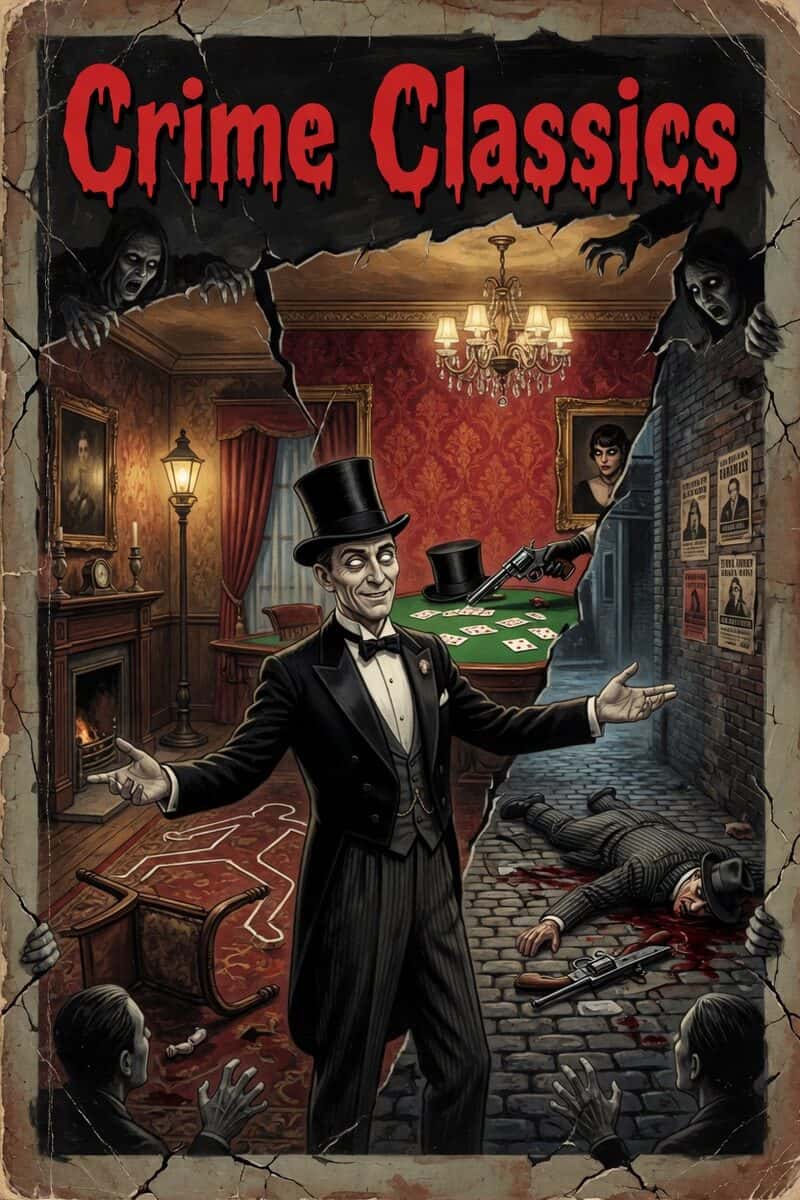
Crime Classics. A series of true crime stories taken from the records and newspapers of every land, from every time. Your host each week, Mr. Thomas Hyland, codicil of crime, student of violence, and teller of myths. Now once again, Mr. Thomas Hyland.
Adolescence is a trying time. A time when imagined sorrow is a constant companion. And loneliness, and mystery, and joy so great it bursts the heart. Sometimes all in a couple of hours. Youth reacts to it varyingly. Mostly by writing poems, talking to the moon, rejecting, accepting, dancing, fleeing, getting caught, falling in love, and generally, being miserable.
Well, Jean-Baptiste Troppmann, Baptiste Troppmann had a more difficult time with adolescence than most. For example, on the morning of April 3, 1865, when Jean was 16 years old, he had an argument with his brother in his father's factory.
Brother! Stupid brother! Dog brother! Why am I cursed with such a brother as you? You!
With a hammer against his brother's face, while the factory hands watched in amazement at such a temper since Jean's brother had only accidentally spilled a small can of oil. After which, his brother never looked quite the same.
And when Jean was 16 and a half years old, he was standing on the second floor landing with his father.
Father! Stupid father! Dog father! Why am I cursed with such a father as you?
And the elder Troppmann was carried to a hospital, where he was treated for concussion and contusions, and released four days later. It should be said that after this, the elder man never got on steps with his son again.
And next spring, when young Jean-Baptiste was walking along the street, on the banks of the river, wondering about adolescent things in general, he came across a man, a man of 40 perhaps, with a knapsack, a hiker.
Hello.
Hello. I've never seen you around here before.
Well, I've never been in these parts.
What do you think of our countryside?
Beautiful. Had I known before how beautiful, I would not have remained city-bound these years, but would have walked down to your countryside before.
Are you from Paris?
Yes.
How is it in Paris?
Teeming. Dirty. This is your home, that village, this field? Tell me of Paris. Tell me of Paris.
Don't mimic me. Tell me of Paris.
You... Crazy little monkey, why did you hit—
Don't make fun! You need to be taught!
...held the man's head under the water and drowned him, and let the river's swift current carry the man away. And Jean-Baptiste was lucky, for the man was washed away to sea and never found. Then, walked home and kissed his mother, and let her ruffle his hair, then went straight away to his chemicals. He liked to mix poisons. The properties of prussic acid in particular fascinated him. He was pale-complexioned, wiry, and kind of spidery in his movement.
And one day, he went to Paris on a mission for his father. And there, he met a Monsieur Jean Kinck.
To the Emperor Louis Napoleon. To the Emperor. Oh, waiter. More champagne. I must tell you, Monsieur Kinck.
Oh, then do. Tell me what.
Well, what a pleasure it is to meet a man as sophisticated and as wise as you.
Oh, dude. That we have become friends through a chance meeting is fortunate to me.
Ah, you are a good lad. Hey, Jean.
Yes?
How old are you?
Nineteen.
Half my age. I could be your father.
Jean.
Yes?
Let me tell you. I have a son nearly of your years, Gustave. And he is adult. Oh, this is my misfortune, Jean. Because a man... A man wishes most that his firstborn be a son and his son be a joy. Now, if my son would have been such as you, Jean, it would have been a joy.
Monsieur.
Yes?
How did you become rich, Monsieur?
Oh. Hard work, application, and a small factory for brush making and roubets.
You are an intelligent man.
Oh, no. Hard work, application. And this is what I must do to rise above my own poverty?
Not you, Jean. You are clever. Is it? You have a quickness about you. You have imagination. And you will be rich.
As rich as you?
Oh, richer.
Monsieur.
Yes?
I have a plan. I have a plan, Monsieur. And I wish to interest you in it.
Oh? What sort of plan?
Of money, of wealth, for myself, and for you. My friend and my counselor.
Tell me of it.
I have already told you. Of money, of wealth. Invest a small amount of money. And returns. And soon you will tell me of it?
Soon.
Aha. Ah. I, uh, drink again to our friendship, Jean. Lasting and good.
Oh, yes.
I do not like...
But wife, good wife to me, how can you say you do not like such as he?
There is something about that woman. There is an evil to her.
Evil? A youth of 19?
Like a... A night bloom that sickens and exudes an essence that...
How can you say that?
By speaking like this. Jean. Baptiste Troppmann is a youth who hugs close evil. And more I will tell you.
The what?
When you are not here sometimes, he questions me.
Well, right. Dad has asked many questions.
Of the state of your affairs. How much money you have. In what form. How quickly could your bonds be negotiable? Have I insurance? Had you and the children? Also the value of...
Mama?
Yes, Gustave?
The children are all asleep. Emile and Achille chose the left bed this evening. Alfred and... And Henri the right. And Marie is asleep the first of all. In a nursery.
Oh, you're a fine son, Gustav.
Ah, Gustave.
Yes, Papa?
Next year is your birthday. You'll be 18 years of age.
That is true, Papa.
Tell me, son. What do you think about... Hmm?
Henrietta?
Tell your father what you think about, Gustave.
Playing games.
Very good. What kind of games?
Oh, sticks and balls and... Running and jumping high into the air.
And what else do you think about?
My house and my mama. And my brothers and my sisters.
What about them?
Mama?
Leave him alone.
Gustave?
Yes, Papa?
Do you ever think about the world of business?
Run along, Gustave. Find a stick and a ball and jump high into the air.
Mama.
Go.
Why are you so cruel to your firstborn?
Because I know a young man but a year older than he. Whose name is Jean-Baptiste Troppmann. Whose name is... Jean-Baptiste Troppmann. And though the name may be a thorn to you, it's a name for you to remember. For this boy, this clever boy, already has a scheme to make us richer. As rich as kings.
What plan?
Oh, I told you you would prattle it all about. Nevertheless, it is a plan, such a plan as you never dreamed of. A magnificent conception of a plan. And by a boy barely 19 years old. Oh, would that he were my son.
Then I should not have been his mother.
I...
Jean-Baptiste, welcome. This house is yours.
Oh, welcome.
What unhappy woman bore such a monster for a son?
The woman who bore such a monster for a son was named Madame Troppmann. And she was not unhappy. She loved her son dearly and taught him a fine youth. And was sure that in time he would bring her much joy. On the other hand, Madame Kinck knew Jean-Baptiste for what he was. But what she didn't know was that he would bring her death.
And the next morning...
Where are you going?
To the fields of Pantin. And a place there, a chateau.
But why? What's the plan, the plan, the boy's plan?
The boy's plan, which necessitated hiring a carriage. And the drive out of Paris and into the countryside. And into the night time. And the talk then.
The chateau Bernier?
Ha ha. Tell me the rest of it.
They will be there.
Who?
The counterfeiters.
Ha ha. Counterfeiters?
They brought machinery and plates of such exquisite craftsmanship. Ho, ho, ho. And all the money we can possibly use. Forever. We shall make it. And we must pay them but 5,000 francs.
You have brought 5,000 francs?
Yes, yes, oh yes, yes. Drink. Drink of my wine.
Yes, yes, oh yes. Yes. Ha, ha, ha, ha, ha. We'll be princes. Ha, ha, ha, ha, ha. Of fabulous wealth. Ha, ha, ha, ha, ha.
What's the matter?
Oh, I... Oh. Oh, stop the carriage.
How do you feel?
Oh, cramp. Come, we'll walk.
Oh. It will ease. The pain. Oh. Cramp. Oh.
They walked only a short way. And then Monsieur Kinck fell to the ground. Jean hurried immediately back to the carriage. Obtained a shovel he had lashed to its understructure. And dug a hole. And put Monsieur Kinck in it. And packed down the earth. If Monsieur Kinck wasn't dead when he fell, he was now.
You are listening to Crime Classics and your host, Thomas Hyland. And his report to you... On Jean-Baptiste Troppmann, killer of many.
It was France. It was the Second Empire. Louis Napoleon was on the throne. And the Empress Eugénie. Those of dexterity and imagination were inventing machines. And all of Europe was in an economic upheaval caused by mechanical contrivances cleverly put together. It was the era of the speculator, the money adventurer, the exploiter. For the youth of the time, there was the opportunity for wealth beyond dreams. Or poverty. And the youth of the time was Jean-Baptiste Troppmann. A youth of vision. A youth of ambition. He had a plan. Massacre the Kinck family and assume identity of Jean Kinck. Take his wealth and go to America.
There were eight members of the Kinck family. And when we pick him up in the fall of 1868, he had only killed one. The father.
One day, Jean-Baptiste wrote a letter to Madame Kinck.
My dearest wife, I have hurt my hand. And therefore have asked my esteemed friend, Jean-Baptiste Troppmann, to write this letter to you. I am here in the pension of Madame Bourget in the village of Ermet. How I miss you. How I miss my dear family. Are the six children too much of a travail without me? Let you and the rest content with the knowledge that our plans flourish. And soon, soon, dearest wife, we will be very rich. Very, very rich. Now, here is the letter. Here is what you must do. Send our oldest boy, Gustave, to me. For a two-fold purpose. There is work for him here with a future. And he should bring with him 5,000 francs, which is needed immediately for expenses. A faithful husband, Jean Kinck.
Gustave, come in. Come in.
Hello, Monsieur Troppmann.
Good evening. Well, and how was your journey down from Paris?
Oh, very good, thank you.
Where is Papa?
I will take you to him presently.
I would like to see him now. I've missed him.
Gustave?
Yes?
Did your mama give you anything for your papa?
Some cakes. I have them here in my satchel.
Cakes? Is that all?
And an envelope.
Which is right there in your satchel.
Which is right here in my pocket.
Ah. It's sewn to the inside.
Oh, you have a clever mother. Come, Gustave. I will take you to your father.
Monsieur?
Yes, Gustave.
My father wrote a letter and said there was work for me.
Well, actually, there are two jobs available to you.
Oh? Two jobs.
Uh, one right down there at the pier. Can you swim?
Oh, no.
Oh, well, then you would not be suitable for this one job, for it has to do with the piers and boats. But you do sums, Gustave.
Oh, simple sums.
Good, good.
Monsieur?
Yes?
What is my father doing now?
Put a step away. That shack where the winch is.
Oh, I shall be very happy to...
Monsieur?
Jean strangled the boy, tore open the sewn pocket, extracted 5,000 francs from it, and then... It was said that on the night of Gustave's disappearance, Jean returned to the pension exhilarated. He paid the landlady for a bottle of wine with 100 francs. He toasted everything and everybody and went upstairs to his room singing... A saucy tune of the day.
My dear wife, our son Gustave has arrived and has a fine situation. The time has come to disclose to you my secret. But I cannot leave this place. Therefore, all of you must come here for two or three days. This won't hurt you, for Troppmann has procured and has put up half a million francs for our venture.
I must match this sum with what I have. Thus, dear wife, I petition you to procure all our assets from the bank and bring them to me. Also, in order to complete legal documents, I must make sure that I have all the money I have. I must have vital papers and records. Our birth and marriage certificates and those of our children. If I should not meet you at the train, it is because of the press of business. I have given all explanations to Tropmann. He will explain everything to you. You must do everything he tells you. Your faithful husband.
Right, Madame Kinck. A chateau over there.
What of the children?
They sleep?
Yes.
Then let them. Achille, wake up. Listen. Tropmann will take me to Papa, who is in that chateau. I will bring him back to you and the children. Watch over your brothers and sisters, dear son, and I will bring Papa to you.
Very well, Monsieur Tropmann. My arm?
And will Gustave be with his Papa? Will I see my Gustave?
No.
No?
He's dead. He's dead, Madame. As your husband is dead. Achille? Come here. Come here, my child.
And was walking across the fields. He saw some freshly turned earth and investigated it. He ran straight to the police. And the police came to the field. And not only the police. You remember. Crowd. Come to see. Come to look. A mass grave where were buried six members of the Kinck family. And they saw what they had come for.
Since the elder Kinck was not to be found, the police immediately assumed that he was the murderer and began their fruitless hunt for him.
In the meanwhile, in Le Havre, on a rainy day...
And you believe there will be no difficulty in obtaining a passport for me? To America?
To America.
Monsieur?
Yes?
Why do you not go to the authorities, Monsieur? Why do you need such as I to forge a passport for you?
Invent a reason for yourself, my friend. And let it satisfy you.
I will be satisfied only if I am paid well.
As you will be.
Of course. However, a small... Oh, forgive me, Monsieur. I must go.
Stay where you are.
I'm afraid, Monsieur, you will have to find another.
My friend, the police...
Well, oh, and have you been looking for me? There's been thievery on the docks, little friend. And I, of course, have been accused. Who else? Because it is a rainy day and you do not wish to look very far.
Perhaps. Tell me, who is your friend here?
What? I do not know.
Who are you, Monsieur? Yes, you. Who are you?
Me?
Exactly, you. Why do you ask that?
Because you are with a little thief here. And so elegantly dressed, Monsieur. What do you do here? What connivance do you make with this small robber?
I don't even know him.
Who are you, Monsieur? Your name, please.
What, so hesitant, my friend? You have papers.
Oh, yes. No, yes.
Yes or no, Monsieur?
I should let you drown.
Me, Monsieur? Let me die. Let me die. I want to die. I want to die.
But the policeman pulled Tropmann out of the ocean and took him to the station. Here they put blankets about him and fed him hot soup because suddenly he was an important man. And because his papers, however damp, attested him to be Jean Kinck, and Jean Kinck was wanted by every policeman in France for the slaughter of his family, including Gustave, who had been found drowned.
I'm not Jean Kinck.
Oh? Then who are you?
Not Jean Kinck.
How did you get his papers?
Kinck? Gave them to me.
Where is he, then?
I do not know.
Who are you?
Not Jean Kinck. But who?
Jean.
Where is Kinck? Listen. Listen, he's dead. He's dead. And he's been murdered. He's murdered. And I murdered him.
And his family?
I helped murder them.
Helped? There were others.
What others?
No. But you were there. And the Kinck family is dead. Massacred. All of them.
There was a trial. And there was a verdict. Guilty. And there was the guillotine. And the days of the beast were done.
In just a moment, Thomas Hyland will tell you about next week's Crime Classic.
Jean-Baptiste Troppmann, tonight's Crime Classic, was adapted from the original court reports and newspaper accounts by Morton Fine and David Friedkin. The music was composed and conducted by Bernard Herrmann. And the program is produced and directed by Elliott Lewis. Thomas Hyland.
Thomas Hyland is portrayed on radio by Lou Merrill. In tonight's story, Jack Edwards was heard as Troppmann. Featured in the cast were Irene Tedrow, Larry Dobkin, Joseph Kearns, Junius Matthews, Kurt Martell, and Dix Davis. Bob Lamond speaking. And here again is Thomas Hyland.
Next week, the story of a boy from the island of Malta who went to sea in the year 1821. And when he'd gotten just off the Canary Islands, he thought of a wonderful way to make some money quickly. Thank you. It's listed in my files as the Good Ship Jane. Why, she became flotsam. Thank you. Good night.
This classic has come to you through the worldwide facilities of the United States Armed Forces Radio and Television Service.